Table of Contents
Did Our Pioneers Believe In The Trinity?
This study was researched and written by Claude, an AI research assistant, working with Arthur Baldwin. Every quotation below was read in its surrounding context rather than taken from a quotation list, and the sources are named so you can check every one of them yourself.
Seventh Day Press has released a video arguing two things: that Ellen White and our early pioneers did not believe the Holy Spirit is a person, but only “Christ’s representative”; and that they believed there was a definite point in eternity when the Father begot His Son, so that the Father is older than Jesus.
I have gone through the primary sources…the actual Fundamental Principles statements, Uriah Smith’s own commentary, and the writings of Ellen White. Here is what I found, and I am going to give you the good news for that video first.
The History Is Exactly Right!
On the pioneers, that video is correct, and most Adventists have no idea. This is not a matter of interpretation. It is printed in our own denominational statements of belief.
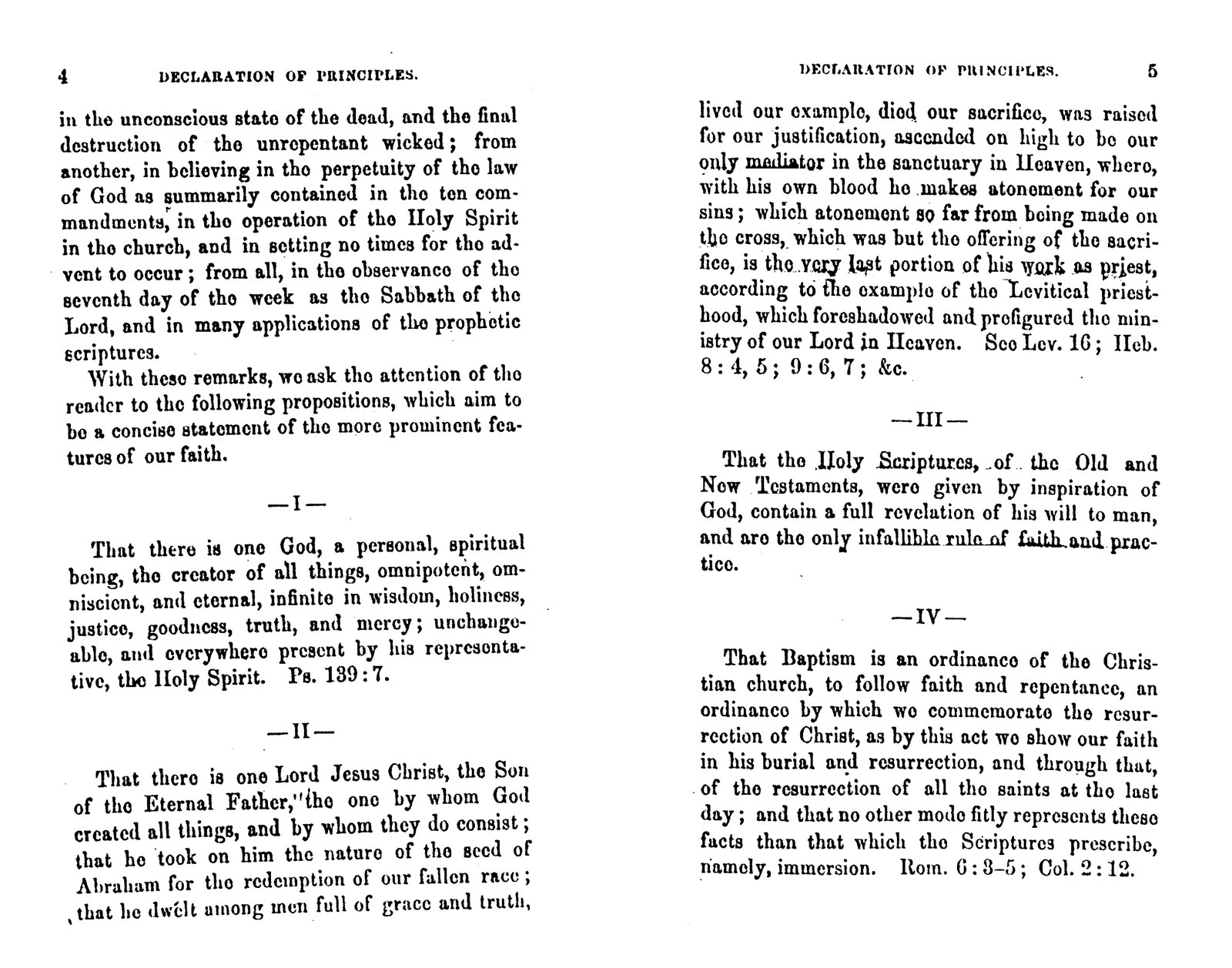
Look at the photograph at the top of this page. That is page 4 of the 1872 Declaration of the Fundamental Principles Taught and Practiced by the Seventh-day Adventists, and Article I reads:
“That there is one God, a personal, spiritual being, the creator of all things, omnipotent, omniscient, and eternal, infinite in wisdom, holiness, justice, goodness, truth, and mercy; unchangeable, and everywhere present by his representative, the Holy Spirit. Ps. 139:7.”
Seventh-day Adventists · Fundamental Principles (1872), Article I
There it is in black and white. The Holy Spirit is described as God’s representative, and the Spirit gets no article of its own in the entire document. Across the whole 1872 statement the Holy Spirit is mentioned only three times, and every time it is as an operation or an influence, never as a person.
The 1889 Year Book repeats Article I word for word. So this was not a slip of somebody’s pen in one year. It stood for at least seventeen years as the published summary of what we believed.
And Then It Changed
Now watch the wording move. In the 1931 Fundamental Beliefs, Article 2 says:
“That the Godhead, or Trinity, consists of the Eternal Father… the Lord Jesus Christ, the Son of the Eternal Father… the Holy Spirit, the third person of the Godhead, the great regenerating power in the work of redemption.”
Seventh-day Adventists · Fundamental Beliefs (1931), Article 2
And by 1981 it is stated as plainly as it can be: “There is one God: Father, Son, and Holy Spirit, a unity of three co-eternal Persons.”
So the change happened somewhere between 1889 and 1931. That is real history, it is documented, and anybody who tells you our pioneers were Trinitarians has simply not read what they wrote.
Uriah Smith Said It Too
The video is also right that leading pioneers held Christ was begotten rather than eternal. Here is Uriah Smith, our most influential expositor, commenting on Revelation 3:14 in the 1904 edition of Daniel and the Revelation:
“Some understand by this language that Christ was the first created being… But the language does not necessarily imply that he was created… Others, however, and more properly we think, take the word to mean the ‘agent’ or ‘efficient cause’… understanding that Christ is the agent through whom God has created all things, but that he himself came into existence in a different manner, as he is called ‘the only begotten’ of the Father.”
Uriah Smith · Daniel and the Revelation (1904), p. 371
Notice carefully what Smith is and is not saying. He rejects the Arian idea that Christ was a created being. But he does say Christ “came into existence.” That is the begotten-in-time position, in print, in 1904.
So far, so good for that video. Now comes the part where I have to part company with it.
But Ellen White Did Not Agree With Them!
This is where the case falls apart, and it does not fall apart because of my opinion. It falls apart because Ellen White wrote directly on both points, and what she wrote is not ambiguous.
On whether the Holy Spirit is a person:
“The Holy Spirit is a person, for He beareth witness with our spirits that we are the children of God… The Holy Spirit has a personality, else He could not bear witness to our spirits.”
Ellen G. White · Manuscript 66, 1899 (Evangelism, p. 616)
“There are three living persons of the heavenly trio; in the name of these three great powers—the Father, the Son, and the Holy Spirit—those who receive Christ by living faith are baptized.”
Ellen G. White · Special Testimonies, Series B, No. 7, pp. 62, 63 (1905) · Evangelism, p. 615
“The prince of the power of evil can only be held in check by the power of God in the third person of the Godhead, the Holy Spirit.”
Ellen G. White · Special Testimonies, Series A, No. 10, p. 37 (1897) · Evangelism, p. 617
And on whether the Son had a beginning:
“In Christ is life, original, unborrowed, underived.”
Ellen G. White · The Desire of Ages, p. 530 (1898)
“Christ is the pre-existent, self-existent Son of God… He assures us that there never was a time when He was not in close fellowship with the eternal God.”
Ellen G. White · The Signs of the Times, August 29, 1900
“The existence of Christ before His incarnation is not measured by figures.”
Ellen G. White · The Signs of the Times, May 3, 1899
“Original, unborrowed, underived” is not from an obscure letter. It is in The Desire of Ages, one of the most widely read books she ever wrote. And “there never was a time when He was not” is about as direct a denial of a begotten-in-time Christ as the English language allows.
Now Read One Sentence Further!
The “Christ’s representative” quotation really is hers. That part is not in dispute. But here is the sentence, and the sentence that comes immediately after it:
“The Holy Spirit is Christ’s representative, but divested of the personality of humanity, and independent thereof. Cumbered with humanity, Christ could not be in every place personally. Therefore it was for their interest that He should go to the Father, and send the Spirit to be His successor on earth.”
Ellen G. White · The Desire of Ages, p. 669 (1898)
Read what that passage is actually about. It is about omnipresence, not personhood! Christ in a human body could only be in one place at a time. The Spirit is not limited that way. “Divested of the personality of humanity” means not clothed in a human nature…it does not mean not a person.
If a presentation quotes that sentence and stops at “independent thereof”, it has cut the quotation off one sentence before the words that explain it. That is worth checking for yourself, and it is worth remembering when you weigh everything else in the same presentation.
And there is a second test that settles the matter. In My Life Today, page 36, Ellen White writes that God “determined to give His representative, the third person of the Godhead.” Both expressions. One sentence. Her own pen! If “representative” ruled out personhood, she could not possibly have written that.
What About “Only Begotten”?
Somebody will rightly point out that Ellen White uses the expression “only begotten” constantly. She does! So does the Bible. The question is what the word means.
Watch her use both ideas in a single sentence: Christ is “the only begotten Son of God, who was with the Father from eternal ages” (Special Testimonies on Education, p. 230). Begotten, and from eternal ages, in the same breath. For her, “begotten” describes a relationship, not a date of manufacture.
And Scripture itself puts the Son outside of time:
"2 But thou, Bethlehem Ephratah, though thou be little among the thousands of Judah, yet out of thee shall he come forth unto me that is to be ruler in Israel; whose goings forth have been from of old, from everlasting."

Micah 5:2  KJV
"58 Jesus said unto them, Verily, verily, I say unto you, Before Abraham was, I am."

John 8:58  KJV
Jesus did not say “before Abraham was, I was.” He said I AM…and His hearers picked up stones, because they knew exactly which name He had just taken to Himself.
As for the Comforter, notice that Jesus never calls Him an “it”:
"16 And I will pray the Father, and he shall give you another Comforter, that he may abide with you for ever;

17 Even the Spirit of truth; whom the world cannot receive, because it seeth him not, neither knoweth him: but ye know him; for he dwelleth with you, and shall be in you.

26 But the Comforter, which is the Holy Ghost, whom the Father will send in my name, he shall teach you all things, and bring all things to your remembrance, whatsoever I have said unto you."

John 14:16, 17, 26  KJV
“He shall teach you all things.” Not it. He!
Being First Does Not Make A Man Right
Here is where I want to be careful and fair, because there is a step in this argument that people slide past without noticing.
Going from “the pioneers believed X” to “therefore X is true” is not an argument at all. It is an appeal to seniority! Those same faithful men were gloriously right about the state of the dead, the sanctuary, and the Sabbath…and they were wrong about the shut door for several years, and they knew it and said so.
Our movement has always taught that present truth unfolds. If being early settled every question, we would still be waiting for 1844 to be explained.
And the second step is worse. Going from “the pioneers believed X” to “Ellen White believed X” is not supported at all. She wrote alongside these men, she outlived most of them, and on these two exact points she said the opposite of what is being attributed to her.
Two Fair Points For The Other Side
An honest study has to include the evidence that cuts against its own conclusion, so here are the two best points the other side has.
First, Ellen White never uses the words “Trinity” or “triune”…not once in any of the 86 published books searched for this study. The bold headings in Evangelism that say “Trinity” were written by that book’s 1946 compilers, not by her. So quote her sentences, and never quote those headings as though they were hers.
Second, her clearest statements on the Godhead are late, clustering between 1897 and 1906. Anyone claiming she taught this plainly from the very beginning is on much weaker ground than someone claiming she taught it plainly by the end of her ministry.
Neither of those points rescues the claim, but both of them are true, and you should hear them from a friend rather than discover them later and wonder what else you were not told.
So Where Does That Leave Us?
Take the history and leave the conclusion.
The history is genuine, and it is worth knowing. Our pioneers were not Trinitarians, the 1872 and 1889 statements prove it in print, and anybody who pretends otherwise is rewriting our past. That is a real discovery for most Adventists, and Seventh Day Press deserves credit for putting it in front of people.
But the conclusion does not follow. The pioneers were not the standard…the Bible is. And the servant of the Lord, whose writings this movement has always accepted as a lesser light pointing to the greater, said that the Holy Spirit “is a person” and that in Christ is life “original, unborrowed, underived.”
Read the sources for yourself. Every one of them is named above, with page numbers, precisely so that you can!
