Jeremiah is told to stand in the gate of the temple and tell the worshippers going in that the building will not save them. He names a ruined sanctuary they had all forgotten, and ends with the saddest sentence in the book.
A study in Jeremiah 7-8 · Arthur Baldwin · StandUp4Jesus.Org · 14 min read
Said Three Times At The Gate
“Amend your ways and your doings, and I will cause you to dwell in this place. Trust ye not in lying words, saying, The temple of the LORD, The temple of the LORD, The temple of the LORD, are these.”
Jeremiah 7:3, 4
Consider where Jeremiah is standing. He is in the temple gate, and the people he is addressing are on their way in to worship. They are not skipping church. They are arriving.
And the phrase he quotes back at them is repeated three times, because that is how they said it. The temple of the LORD, the temple of the LORD, the temple of the LORD. It has the rhythm of something chanted rather than argued — a thing you say when you are not expecting to be questioned.
What they were trusting was true, and that is what makes this passage difficult. It was the temple of the LORD. God’s name really was on that building. The furniture inside it was made to His specification, the priesthood was the one He appointed, and the sacrifices were the ones He commanded.
God calls it lying words anyway.
Not because the sentence was false, but because of the work it was being made to do. A true statement about God’s presence had been converted into a guarantee about their safety, and the second thing does not follow from the first. That is the whole sermon, and it is aimed at religious people exclusively. Nobody outside the covenant would ever have said this sentence.
A Den Of Robbers
“Will ye steal, murder, and commit adultery, and swear falsely, and burn incense unto Baal, and walk after other gods whom ye know not; And come and stand before me in this house, which is called by my name, and say, We are delivered to do all these abominations?”
Jeremiah 7:9, 10
The list is not random. Steal, murder, commit adultery, swear falsely, and go after other gods — that is the second table of the ten commandments and then the first, itemized by a God quoting His own law back to the people who kept it in a box in that building.
Then verse 10 supplies the logic they were actually using, and it is put in their own mouths: we are delivered to do all these abominations. The temple visit was not repentance. It was the thing that made the rest survivable. Come, stand, be delivered, go back out.
“Is this house, which is called by my name, become a den of robbers in your eyes? Behold, even I have seen it, saith the LORD.”
Jeremiah 7:11
A den is not where thieves rob. It is where they go afterwards — the safe place, the cave you retire to with what you took. God is not accusing them of stealing in the temple. He is accusing them of using it as cover.
Six centuries later a Man overturned tables in the courts of a rebuilt version of that same building and quoted this verse while He did it: “My house shall be called the house of prayer; but ye have made it a den of thieves” (Matthew 21:13). He was not inventing the charge. He was reading it out.
And note the last clause here, which is easy to hurry past: even I have seen it. The arrangement worked on everybody except the one it was designed to fool.
Go Ye Now Unto My Place Which Was In Shiloh
“But go ye now unto my place which was in Shiloh, where I set my name at the first, and see what I did to it for the wickedness of my people Israel.”
Jeremiah 7:12
This is the argument that should have ended the discussion, and it is made by giving them an address.
Shiloh was where the tabernacle stood for generations after Joshua — the place Hannah prayed, where Samuel slept beside the ark and heard his name called in the night. It was the sanctuary before Jerusalem had one. Where I set my name at the first.
And by Jeremiah’s day it was ruins you could walk to. God had already abandoned one sanctuary that carried His name, within their own history, for exactly the reason now under discussion. The precedent was not theoretical and it was not far away. It was a day’s journey north.
Which exposes what the chant at the gate really was. It was not faith in God. It was confidence in a building — and there was a field full of rubble twenty miles away proving that God does not need any particular building, and will not be held hostage by one that bears His name.
I Spake Not Concerning Burnt Offerings
“For I spake not unto your fathers, nor commanded them in the day that I brought them out of the land of Egypt, concerning burnt offerings or sacrifices: But this thing commanded I them, saying, Obey my voice, and I will be your God, and ye shall be my people.”
Jeremiah 7:22, 23
This verse has to be handled carefully, because read flatly it appears to say something that is not true. God did give Israel detailed instructions about burnt offerings. Leviticus is largely those instructions.
Two things resolve it. The first is the timing God specifies: in the day that I brought them out of the land of Egypt. On that day the requirement was obedience — the sacrificial system came afterwards, at Sinai, as part of a covenant they had already agreed to. Obedience was the foundation; the offerings were built on it. The order is the argument.
The second is the way Hebrew commonly states a comparison. Where we would say this more than that, Scripture often says not this, but that — the same construction as “I desired mercy, and not sacrifice; and the knowledge of God more than burnt offerings” (Hosea 6:6) — where the second half says plainly that the first half is a comparison. Jesus quoted that verse twice, as “I will have mercy, and not sacrifice” (Matthew 9:13; 12:7), to men who were keeping the ritual scrupulously.
So the point is not that the offerings were a mistake. It is that they were never the thing itself. A sacrifice offered by someone who will not obey is not a partial payment; it is the wrong currency altogether, and God is saying so in the courtyard where the offerings were being made.
Neither Came It Into My Heart
“And they have built the high places of Tophet, which is in the valley of the son of Hinnom, to burn their sons and their daughters in the fire; which I commanded them not, neither came it into my heart.”
Jeremiah 7:31
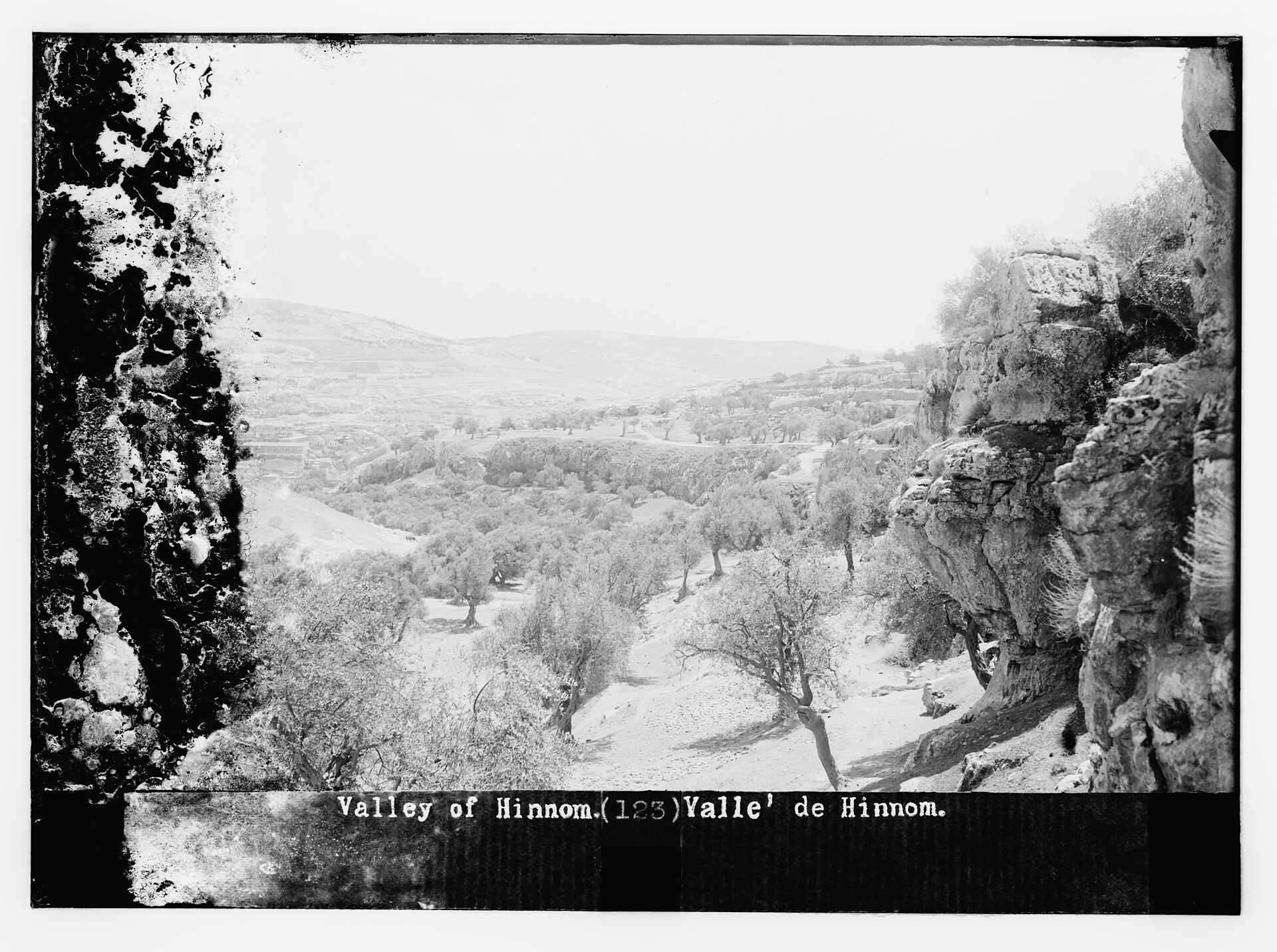
The valley of the son of Hinnom lies just outside the walls of Jerusalem. Its name in Hebrew is ge-hinnom, which comes into the New Testament as Gehenna — the word translated hell in the Gospels. When Jesus warned about it, He was naming a real place, and this is what happened there.
The people burning their children in that valley were the same people chanting at the temple gate. Both activities were within walking distance of each other and both were current.
And then God says something about Himself that is worth stopping on: “which I commanded them not, neither came it into my heart.”
He goes past denying that He required it. He says the thought never entered His mind. Given what is being described, that is a mercy to know. Whatever else was confused in Judah’s religion, nobody could claim this had come from Him — and God evidently thought it important that the record say so in as absolute a form as language allows.
The Stork Knoweth Her Appointed Times
“Yea, the stork in the heaven knoweth her appointed times; and the turtle and the crane and the swallow observe the time of their coming; but my people know not the judgment of the LORD.”
Jeremiah 8:7
Four birds, named individually, and the comparison is deliberately humbling.
A migrating bird has no calendar, no instruction and no capacity to reason about any of it. It simply knows when to go, and goes, and arrives. Judah had the law in writing, a temple, a priesthood and a living prophet standing in the gate — and could not read the season she was in.
The word appointed is doing quiet work here. The bird’s times were set by Someone, and it keeps them without being told. So the failure is not lack of information. Everything else in creation is already obeying a timetable it never had to be taught.
The Harvest Is Past
“The harvest is past, the summer is ended, and we are not saved.”
Jeremiah 8:20
Eleven words, and they are spoken by the people rather than by God — which is what makes them so bleak. This is Judah’s own voice, arriving at an accurate conclusion far too late.
The picture is agricultural and every farmer would have felt it. There is a window for gathering grain. It is generous while it lasts and absolute when it closes. Nothing about the field changes on the day the season ends — the sun still shines, the ground is still there — but the year’s food is now whatever is already in the barn.
Notice that there is no complaint in the sentence. They do not say the harvest was unfair or the summer too short. They state the case correctly, and the correctness is the tragedy. They understood the situation perfectly, and understanding it was no longer any use.
It should be said plainly that this is not God shutting a door on people who wanted in. Seven chapters of pleading stand in front of this verse, and chapter 6 has already recorded the answer they gave: we will not walk therein. The season did not close early. It ran its full length, and was declined for the whole of it.
Is There No Balm In Gilead?
“For the hurt of the daughter of my people am I hurt; I am black; astonishment hath taken hold on me. Is there no balm in Gilead; is there no physician there? why then is not the health of the daughter of my people recovered?”
Jeremiah 8:21, 22
Before the famous question comes verse 21, and it should not be skipped: for the hurt of the daughter of my people am I hurt. The prophet who has spent eight chapters announcing the disaster is not standing clear of it. He is wounded by the wound he predicted.
Then the three questions. And the first two have obvious answers, which is the point of asking them.
Gilead was famous for balm. It was the region’s export — the caravan that carried Joseph down to Egypt was loaded with it. Asking whether there is balm in Gilead is like asking whether there is water in the sea. Yes. Obviously yes. And yes, there are physicians there too.
So the third question is the real one, and it lands with nowhere to go: why then is not the health of the daughter of my people recovered?
The remedy exists. The physician is available. The medicine is not in short supply and never was. The sickness continues anyway — not for want of a cure, but because the patient will not go.
Which is the exact shape of the whole book, and the reason these two chapters belong together. The temple was real. The law was real. The balm was real. Every provision God made was genuinely there and genuinely sufficient, and none of it was used. The tragedy of Judah is never that God withheld something. It is that everything necessary was within reach the entire time.
Next in this study: Let Him Glory In This — Jeremiah 9 and 10, the only boast God permits, and a tree cut out of the forest, nailed upright so it will not move.
