Everything in this Gospel has been building toward a single afternoon. The Word who was with God and was God, who made all things, who fed five thousand and raised a man four days dead, now hangs on a Roman execution device between two criminals, and the whole weight of the book comes down to five words spoken with His last breath. This is the chapter every other chapter in John has been pointing to.
A study in John 19 · Arthur Baldwin · StandUp4Jesus.Org · 32 min read
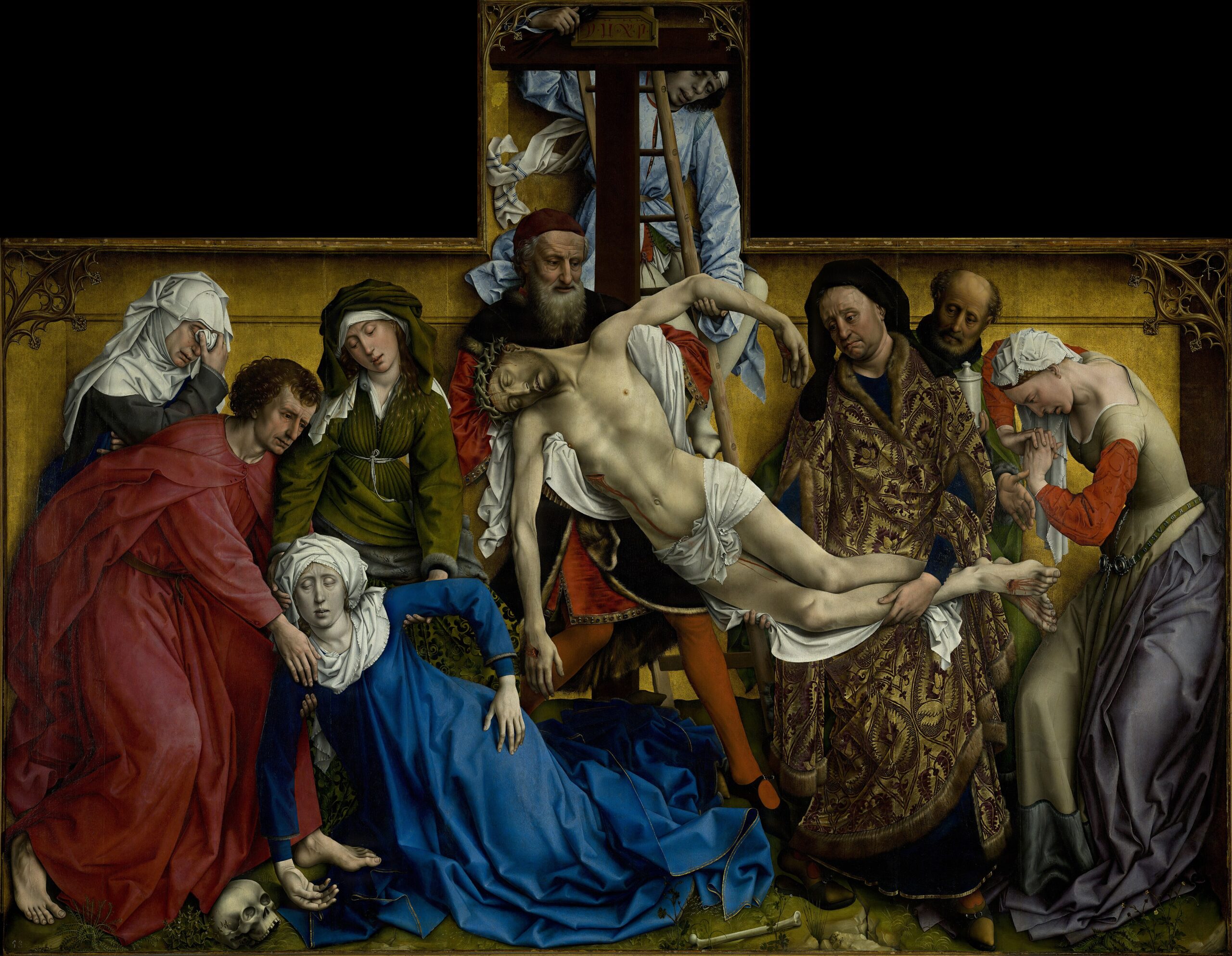
Behold The Man
“Then Pilate therefore took Jesus, and scourged him. And the soldiers platted a crown of thorns, and put it on his head, and they put on him a purple robe, And said, Hail, King of the Jews! and they smote him with their hands.”
John 19:1-3
“Jesus was taken, faint with weariness and covered with wounds, and scourged in the sight of the multitude. ‘And the soldiers led Him away into the hall, called Praetorium, and they call together the whole band. And they clothed Him with purple, and platted a crown of thorns, and put it about His head, and began to salute Him, Hail, King of the Jews! And they … did spit upon Him, and bowing their knees worshiped Him.’ Occasionally some wicked hand snatched the reed that had been placed in His hand, and struck the crown upon His brow, forcing the thorns into His temples, and sending the blood trickling down His face and beard.”
Ellen G. White · The Desire of Ages, p. 734
John compresses into two verses a scene that took real time and real violence to carry out. Rome’s scourge was not a symbolic gesture; men died under it before ever reaching a cross. Jesus is whipped, mocked with a soldier’s parody of royal dress, and struck — all before the actual sentence of crucifixion has even been pronounced.
“Christ’s enemies had demanded a miracle as evidence of His divinity. They had evidence far greater than any they had sought. As their cruelty degraded His torturers below humanity into the likeness of Satan, so did His meekness and patience exalt Jesus above humanity, and prove His kinship to God.”
Ellen G. White · The Desire of Ages, p. 734
“Pilate therefore went forth again, and saith unto them, Behold, I bring him forth to you, that ye may know that I find no fault in him. Then came Jesus forth, wearing the crown of thorns, and the purple robe. And Pilate saith unto them, Behold the man!”
John 19:4-5
“Pilate now sent for Barabbas to be brought into the court. He then presented the two prisoners side by side, and pointing to the Saviour he said in a voice of solemn entreaty, ‘Behold the Man!’ ‘I bring Him forth to you, that ye may know that I find no fault in Him.’”
Ellen G. White · The Desire of Ages, p. 735
Two words in Latin — ecce homo — have echoed through two thousand years of art and preaching, and Pilate almost certainly meant them as nothing more than a plea for pity: look how thoroughly this man has already been punished, isn’t that enough? He has no idea he is stating, with total accuracy, exactly who is standing beside him.
“When the chief priests therefore and officers saw him, they cried out, saying, Crucify him, crucify him. Pilate saith unto them, Take ye him, and crucify him: for I find no fault in him. The Jews answered him, We have a law, and by our law he ought to die, because he made himself the Son of God.”
John 19:6-7
“The Roman governor, though familiar with cruel scenes, was moved with sympathy for the suffering prisoner, who, condemned and scourged, with bleeding brow and lacerated back, still had the bearing of a king upon his throne. But the priests declared, ‘We have a law, and by our law He ought to die, because He made Himself the Son of God.’”
Ellen G. White · The Desire of Ages, p. 736
For the first time in this whole proceeding, the real charge is spoken out loud. Not sedition. Not tax resistance. Blasphemy — the same claim to deity Caiaphas tore his robe over back in chapter 18, now handed to Pilate as the actual reason this Man must die.
What I Have Written I Have Written
“When Pilate therefore heard that saying, he was the more afraid; And went again into the judgment hall, and saith unto Jesus, Whence art thou? But Jesus gave him no answer.”
John 19:8-9
“The Son of God” is exactly the wrong phrase to say to a superstitious Roman governor who already suspects, from his wife’s dream and his own uneasy conscience, that he may be looking at something more than a man. Fear, not conviction, is what finally sends him back inside for one more question.
“Then saith Pilate unto him, Speakest thou not unto me? knowest thou not that I have power to crucify thee, and have power to release thee? Jesus answered, Thou couldest have no power at all against me, except it were given thee from above: therefore he that delivered me unto thee hath the greater sin.”
John 19:10-11
“By this Christ meant Caiaphas, who, as high priest, represented the Jewish nation. … The greatest guilt and heaviest responsibility belonged to those who stood in the highest places in the nation, the depositaries of sacred trusts that they were basely betraying.”
Ellen G. White · The Desire of Ages, p. 737
Even bound and bleeding, Jesus is still the one correcting the terms of the conversation. Pilate’s authority is real, but it is borrowed, delegated, temporary — and the guilt of the men who handed Him over is heavier than the guilt of the pagan governor merely carrying out their sentence.
“And from thenceforth Pilate sought to release him: but the Jews cried out, saying, If thou let this man go, thou art not Cæsar’s friend: whosoever maketh himself a king speaketh against Cæsar.”
John 19:12
“‘But the Jews cried out, saying, If thou let this man go, thou art not Caesar’s friend.’ … ‘Whosoever maketh himself a king,’ they continued, ‘speaketh against Caesar.’ This was touching Pilate in a weak point.”
Ellen G. White · The Desire of Ages, p. 737
It takes one sentence to undo every conviction Pilate has formed over the last hour. Not a legal argument — a threat to his career. That is the entire weight it takes to move a man who has three times already declared this prisoner innocent.
“When Pilate therefore heard that saying, he brought Jesus forth, and sat down in the judgment seat in a place that is called the Pavement, but in the Hebrew, Gabbatha. And it was the preparation of the passover, and about the sixth hour: and he saith unto the Jews, Behold your King!”
John 19:13-14
“But they cried out, Away with him, away with him, crucify him. Pilate saith unto them, Shall I crucify your King? The chief priests answered, We have no king but Cæsar.”
John 19:15
“Pilate then took his place on the judgment seat, and again presented Jesus to the people, saying, ‘Behold your King!’ Again the mad cry was heard, ‘Away with Him, crucify Him.’ … ‘We have no king but Caesar.’ Thus by choosing a heathen ruler, the Jewish nation had withdrawn from the theocracy. They had rejected God as their king.”
Ellen G. White · The Desire of Ages, p. 737
It is the priesthood itself — the office founded to guard Israel’s covenant loyalty to God alone — that finally says the words. Chapter 18 opened with a garden and a King who told Pilate His kingdom was not of this world. It closes here, with the very men who should have known Him best formally trading that kingdom away for Caesar’s.
“Then delivered he him therefore unto them to be crucified. And they took Jesus, and led him away. And he bearing his cross went forth into a place called the place of a skull, which is called in the Hebrew Golgotha: Where they crucified him, and two other with him, on either side one, and Jesus in the midst.”
John 19:16-18
“‘And when they were come to the place, which is called Calvary, there they crucified Him.’ ‘That He might sanctify the people with His own blood,’ Christ ‘suffered without the gate.’ … He died outside the gate, where felons and murderers were executed.”
Ellen G. White · The Desire of Ages, p. 741
“As soon as Jesus was nailed to the cross, it was lifted by strong men, and with great violence thrust into the place prepared for it. This caused the most intense agony to the Son of God. Pilate then wrote an inscription in Hebrew, Greek, and Latin, and placed it upon the cross, above the head of Jesus. It read, ‘Jesus of Nazareth the King of the Jews.’”
Ellen G. White · The Desire of Ages, p. 745
“And Pilate wrote a title, and put it on the cross. And the writing was, JESUS OF NAZARETH THE KING OF THE JEWS. This title then read many of the Jews: for the place where Jesus was crucified was nigh to the city: and it was written in Hebrew, and Greek, and Latin.”
John 19:19-20
“Then said the chief priests of the Jews to Pilate, Write not, The King of the Jews; but that he said, I am King of the Jews. Pilate answered, What I have written I have written.”
John 19:21-22
“The priests saw what they had done, and asked Pilate to change the inscription. They said, ‘Write not, The King of the Jews; but that He said, I am King of the Jews.’ But Pilate was angry with himself because of his former weakness, and he thoroughly despised the jealous and artful priests and rulers. He replied coldly, ‘What I have written I have written.’”
Ellen G. White · The Desire of Ages, p. 745
“A higher power than Pilate or the Jews had directed the placing of that inscription above the head of Jesus. In the providence of God it was to awaken thought, and investigation of the Scriptures.”
Ellen G. White · The Desire of Ages, p. 745
Pilate refuses to edit the sign, and in that single flash of wounded pride an unbelieving Roman governor becomes, for one afternoon, an unwitting evangelist — nailing the truest thing anyone says about Jesus in this whole chapter above His own dying head, in three languages, for every passer-by in Jerusalem to read.
They Parted My Raiment Among Them
“Then the soldiers, when they had crucified Jesus, took his garments, and made four parts, to every soldier a part; and also his coat: now the coat was without seam, woven from the top throughout. They said therefore among themselves, Let us not rend it, but cast lots for it, whose it shall be: that the scripture might be fulfilled, which saith, They parted my raiment among them, and for my vesture they did cast lots. These things therefore the soldiers did.”
John 19:23-24
“In the sufferings of Christ upon the cross prophecy was fulfilled. Centuries before the crucifixion, the Saviour had foretold the treatment He was to receive. He said, ‘Dogs have compassed Me: the assembly of the wicked have enclosed Me: they pierced My hands and My feet. … They part My garments among them, and cast lots upon My vesture.’ Psalm 22:16-18. The prophecy concerning His garments was carried out without counsel or interference from the friends or the enemies of the Crucified One.”
Ellen G. White · The Desire of Ages, p. 746
Psalm 22 was written roughly a thousand years before Roman crucifixion existed as a method of execution at all, yet it names the pierced hands and feet and the gambled-for garments with uncomfortable precision. Soldiers who never opened a scroll of Psalms in their lives fulfill it anyway, purely by doing what soldiers do at every execution: dividing up whatever the condemned man was wearing.
“To the soldiers who had placed Him upon the cross, His clothing was given. Christ heard the men’s contention as they parted the garments among them. His tunic was woven throughout without seam, and they said, ‘Let us not rend it, but cast lots for it, whose it shall be.’”
Ellen G. White · The Desire of Ages, p. 746
He is close enough, still conscious enough, to hear men haggling over His clothes while He hangs above them dying.
“Now there stood by the cross of Jesus his mother, and his mother’s sister, Mary the wife of Cleophas, and Mary Magdalene. When Jesus therefore saw his mother, and the disciple standing by, whom he loved, he saith unto his mother, Woman, behold thy son! Then saith he to the disciple, Behold thy mother! And from that hour that disciple took her unto his own home.”
John 19:25-27
“As the eyes of Jesus wandered over the multitude about Him, one figure arrested His attention. At the foot of the cross stood His mother, supported by the disciple John. … Looking into her grief-stricken face and then upon John, He said to her, ‘Woman, behold thy son!’ then to John, ‘Behold thy mother!’ John understood Christ’s words, and accepted the trust. He at once took Mary to his home, and from that hour cared for her tenderly.”
Ellen G. White · The Desire of Ages, p. 752
“The disciple standing by, whom he loved” is how John refers to himself for the second time in this Gospel, still too modest to write his own name into the scene he is describing. It is worth pausing on: the same man arranging Peter’s entrance into the high priest’s courtyard back in chapter 18 is the man Jesus now entrusts with His own mother’s care, mid-crucifixion, with what little breath He has left to spend.
“The perfect example of Christ’s filial love shines forth with undimmed luster from the mist of ages. … And now, even in His last agony, He remembers to provide for His sorrowing, widowed mother.”
Ellen G. White · The Desire of Ages, p. 752
Of all the titles John could have chosen for the man he was writing about — Lord, Messiah, King, the Word made flesh — this Gospel’s own author lets the reader watch Him being, in this one verse, simply a son.
It Is Finished
“After this, Jesus knowing that all things were now accomplished, that the scripture might be fulfilled, saith, I thirst. Now there was set a vessel full of vinegar: and they filled a spunge with vinegar, and put it upon hyssop, and put it to his mouth.”
John 19:28-29
“One of the Roman soldiers, touched with pity as he looked at the parched lips, took a sponge on a stalk of hyssop, and dipping it in a vessel of vinegar, offered it to Jesus.”
Ellen G. White · The Desire of Ages, p. 754
John frames even this smallest, most human of details — a parched throat, an ordinary thirst — as something Jesus says deliberately, “that the scripture might be fulfilled.” Even the last few words He has strength for are spoken with full, conscious awareness of exactly what is being completed and how.
“When Jesus therefore had received the vinegar, he said, It is finished: and he bowed his head, and gave up the ghost.”
John 19:30
“Suddenly the gloom lifted from the cross, and in clear, trumpetlike tones, that seemed to resound throughout creation, Jesus cried, ‘It is finished.’ ‘Father, into Thy hands I commend My spirit.’ A light encircled the cross, and the face of the Saviour shone with a glory like the sun. He then bowed His head upon His breast, and died.”
Ellen G. White · The Desire of Ages, p. 756
One Greek word carries the whole of John 19:30’s declaration — tetelestai — a term stamped on a completed bill to mean “paid in full.” Not “I am finished,” worn down and defeated. Not “it is over,” a life simply ending. A word of completion, spoken by the only person in history entitled to speak it over the debt this book opened by saying He Himself came to pay.
“Christ did not yield up His life till He had accomplished the work which He came to do, and with His parting breath He exclaimed, ‘It is finished.’ John 19:30. The battle had been won. His right hand and His holy arm had gotten Him the victory. As a Conqueror He planted His banner on the eternal heights.”
Ellen G. White · The Desire of Ages, p. 758
Every Gospel writer records that Jesus dies. Only John lets Him announce, in His own final words, that He has won.
That Ye Might Believe
“The Jews therefore, because it was the preparation, that the bodies should not remain upon the cross on the sabbath day, (for that sabbath day was an high day,) besought Pilate that their legs might be broken, and that they might be taken away. Then came the soldiers, and brake the legs of the first, and of the other which was crucified with him. But when they came to Jesus, and saw that he was dead already, they brake not his legs.”
John 19:31-33
“His consent having been obtained, the legs of the two thieves were broken to hasten their death; but Jesus was found to be already dead. The rude soldiers had been softened by what they had heard and seen of Christ, and they were restrained from breaking His limbs. Thus in the offering of the Lamb of God was fulfilled the law of the Passover, ‘They shall leave none of it unto the morning, nor break any bone of it …’”
Ellen G. White · The Desire of Ages, p. 771
The Passover lambs slaughtered that same week, in accordance with a law given fifteen hundred years earlier, had to be roasted and eaten with not one of their bones broken. John opened this Gospel with the Baptist’s cry, “Behold the Lamb of God.” Chapter 19 closes the identification with a legal technicality carried out by soldiers who had no idea what regulation they were fulfilling.
“But one of the soldiers with a spear pierced his side, and forthwith came there out blood and water. And he that saw it bare record, and his record is true: and he knoweth that he saith true, that ye might believe.”
John 19:34-35
“The priests wished to make sure of the death of Jesus, and at their suggestion a soldier thrust a spear into the Saviour’s side. From the wound thus made, there flowed two copious and distinct streams, one of blood, the other of water. This was noted by all the beholders, and John states the occurrence very definitely.”
Ellen G. White · The Desire of Ages, p. 771
“John states the occurrence very definitely” is a small phrase worth sitting with on this site in particular: it is Ellen White herself noting that John writes as an eyewitness reporting an exact, physical, verifiable detail — not composing pious legend decades after the fact, but recording, with a physician’s precision he could not have known he had, two distinct fluids from a single wound.
“But it was not the spear thrust, it was not the pain of the cross, that caused the death of Jesus. … declared that He died of a broken heart. His heart was broken by mental anguish. He was slain by the sin of the world.”
Ellen G. White · The Desire of Ages, p. 772
“For these things were done, that the scripture should be fulfilled, A bone of him shall not be broken. And again another scripture saith, They shall look on him whom they pierced.”
John 19:36-37
John, writing decades later, still feels the need to insist on his own credibility — “his record is true,” “he knoweth that he saith true” — the plain, almost defensive language of a man who knows exactly how extraordinary his claims sound and wants the reader to know he is not exaggerating a single detail of it.
“And after this Joseph of Arimathaea, being a disciple of Jesus, but secretly for fear of the Jews, besought Pilate that he might take away the body of Jesus: and Pilate gave him leave. He came therefore, and took the body of Jesus. And there came also Nicodemus, which at the first came to Jesus by night, and brought a mixture of myrrh and aloes, about an hundred pound weight.”
John 19:38-39
“In this emergency, Joseph of Arimathaea and Nicodemus came to the help of the disciples. Both these men were members of the Sanhedrin, and were acquainted with Pilate. … They were determined that the body of Jesus should have an honorable burial. Joseph went boldly to Pilate, and begged from him the body of Jesus.”
Ellen G. White · The Desire of Ages, p. 773
Nicodemus has not appeared in this Gospel since a night visit back in chapter 3 and one lone objection raised in the council back in chapter 7. He reappears here, at the one moment it costs him the most to be seen helping Jesus at all, carrying a burial gift fit for a king.
“Then took they the body of Jesus, and wound it in linen clothes with the spices, as the manner of the Jews is to bury. Now in the place where he was crucified there was a garden; and in the garden a new sepulchre, wherein was never man yet laid. There laid they Jesus therefore because of the Jews’ preparation day; for the sepulchre was nigh at hand.”
John 19:40-42
“Gently and reverently they removed with their own hands the body of Jesus from the cross. … Joseph owned a new tomb, hewn in a rock. This he was reserving for himself; but it was near Calvary, and he now prepared it for Jesus. The body, together with the spices brought by Nicodemus, was carefully wrapped in a linen sheet, and the Redeemer was borne to the tomb. … Then they saw the heavy stone rolled against the entrance of the tomb, and the Saviour was left at rest.”
Ellen G. White · The Desire of Ages, p. 774
“Nicodemus, when he saw Jesus lifted up on the cross, remembered His words spoken by night in the Mount of Olives: ‘As Moses lifted up the serpent in the wilderness, even so must the Son of man be lifted up: that whosoever believeth in Him should not perish, but have eternal life.’ John 3:14, 15. … A clearer light now illuminated his mind, and the words which Jesus had spoken to him were no longer mysterious. He felt that he had lost much by not connecting himself with the Saviour during His life.”
Ellen G. White · The Desire of Ages, p. 775
The bronze serpent Jesus described to Nicodemus in a private night conversation, back near the start of this Gospel, has now been literally lifted up in front of him in broad daylight, and only now does the sentence finally make complete sense. A new, unused tomb receives a body its own owner will only need to borrow for three days. Everything is finished. Nothing, this Gospel is about to show, is actually over.
