Luke’s Gospel ended with an empty tomb and a risen Christ; this book, by the same author, to the same reader, opens with that same Christ standing on a hillside outside Jerusalem, about to leave His followers for good — and yet somehow, the eleven men watching Him go are not the ones this story is really about to be written for. Acts is what happens when a small, frightened, indoor group of disciples becomes an outdoor, unstoppable church.
A study in Acts 1 · Arthur Baldwin · StandUp4Jesus.Org · 21 min read
O Theophilus
“The former treatise have I made, O Theophilus, of all that Jesus began both to do and teach, Until the day in which he was taken up, after that he through the Holy Ghost had given commandments unto the apostles whom he had chosen: To whom also he shewed himself alive after his passion by many infallible proofs, being seen of them forty days, and speaking of the things pertaining to the kingdom of God.”
Acts 1:1-3
The “former treatise” is the Gospel of Luke, and the same hand that wrote it now picks the story back up exactly where it left off, addressed to the same “most excellent Theophilus.” Whoever Theophilus was — a Roman official, a wealthy patron, simply “one who loves God,” as the name itself means — two whole books of the New Testament exist because someone once wanted him to have an accurate, orderly account of what actually happened.
Forty days is a long time for a resurrected Man to keep appearing and disappearing among His own followers, teaching them “the things pertaining to the kingdom of God” a little at a time rather than all at once.
“And, being assembled together with them, commanded them that they should not depart from Jerusalem, but wait for the promise of the Father, which, saith he, ye have heard of me. For John truly baptized with water; but ye shall be baptized with the Holy Ghost not many days hence.”
Acts 1:4-5
“Christ’s visible presence was about to be withdrawn from the disciples, but a new endowment of power was to be theirs. The Holy Spirit was to be given them in its fullness, sealing them for their work. ‘Behold,’ the Saviour said, ‘I send the promise of My Father upon you: but tarry ye in the city of Jerusalem, until ye be endued with power from on high.’”
Ellen G. White · The Acts of the Apostles, p. 30
Eleven men who have just watched their Lord conquer death are told, in effect, to do nothing yet. Not to preach, not to organize, not even to leave the city — simply to wait, in the very place where He was crucified, for a promise they cannot yet fully understand.
Ye Shall Receive Power
“When they therefore were come together, they asked of him, saying, Lord, wilt thou at this time restore again the kingdom to Israel? And he said unto them, It is not for you to know the times or the seasons, which the Father hath put in his own power.”
Acts 1:6-7
“Just before leaving His disciples, Christ once more plainly stated the nature of His kingdom. He recalled to their remembrance things He had previously told them regarding it. He declared that it was not His purpose to establish in this world a temporal kingdom. He was not appointed to reign as an earthly monarch on David’s throne.”
Ellen G. White · The Acts of the Apostles, p. 30
Even after forty days of resurrection appearances and kingdom teaching, this is still the question uppermost in their minds — the same misunderstanding that shadowed Christ’s whole earthly ministry, a political throne rather than a spiritual mission. His answer redirects them without ever fully answering the question they actually asked.
“But ye shall receive power, after that the Holy Ghost is come upon you: and ye shall be witnesses unto me both in Jerusalem, and in all Judæa, and in Samaria, and unto the uttermost part of the earth.”
Acts 1:8
This single verse is the whole book of Acts laid out in advance, like a table of contents in miniature: power from the Spirit first, then Jerusalem (chapters 1-7), then Judea and Samaria (chapters 8-12), then the uttermost part of the earth (chapters 13-28). Everything that follows in this twenty-eight chapter book is simply this one sentence unfolding, one journey at a time.
“The Saviour knew that no argument, however logical, would melt hard hearts or break through the crust of worldliness and selfishness. He knew that His disciples must receive the heavenly endowment; that the gospel would be effective only as it was proclaimed by hearts made warm and lips made eloquent by a living knowledge of Him who is the way, the truth, and the life.”
Ellen G. White · The Acts of the Apostles, p. 31
Eleven men who spent three years being personally taught by the way, the truth, and the life are still told they are not ready. Knowledge about Christ, even firsthand knowledge, is not the same thing as the power this book is about to describe.
“Christ told His disciples that they were to begin their work at Jerusalem. That city had been the scene of His amazing sacrifice for the human race. … And it was while all Jerusalem was stirred by the thrilling events of the past few weeks, that the preaching of the disciples would make the deepest impression.”
Ellen G. White · The Acts of the Apostles, p. 31
The strategy is almost counterintuitive: begin the hardest sell in the very city that just finished crucifying their Leader, while the wound is still fresh, rather than somewhere safer and friendlier. The disciples are sent first to the people most likely to remember exactly what happened seven weeks earlier.
This Same Jesus
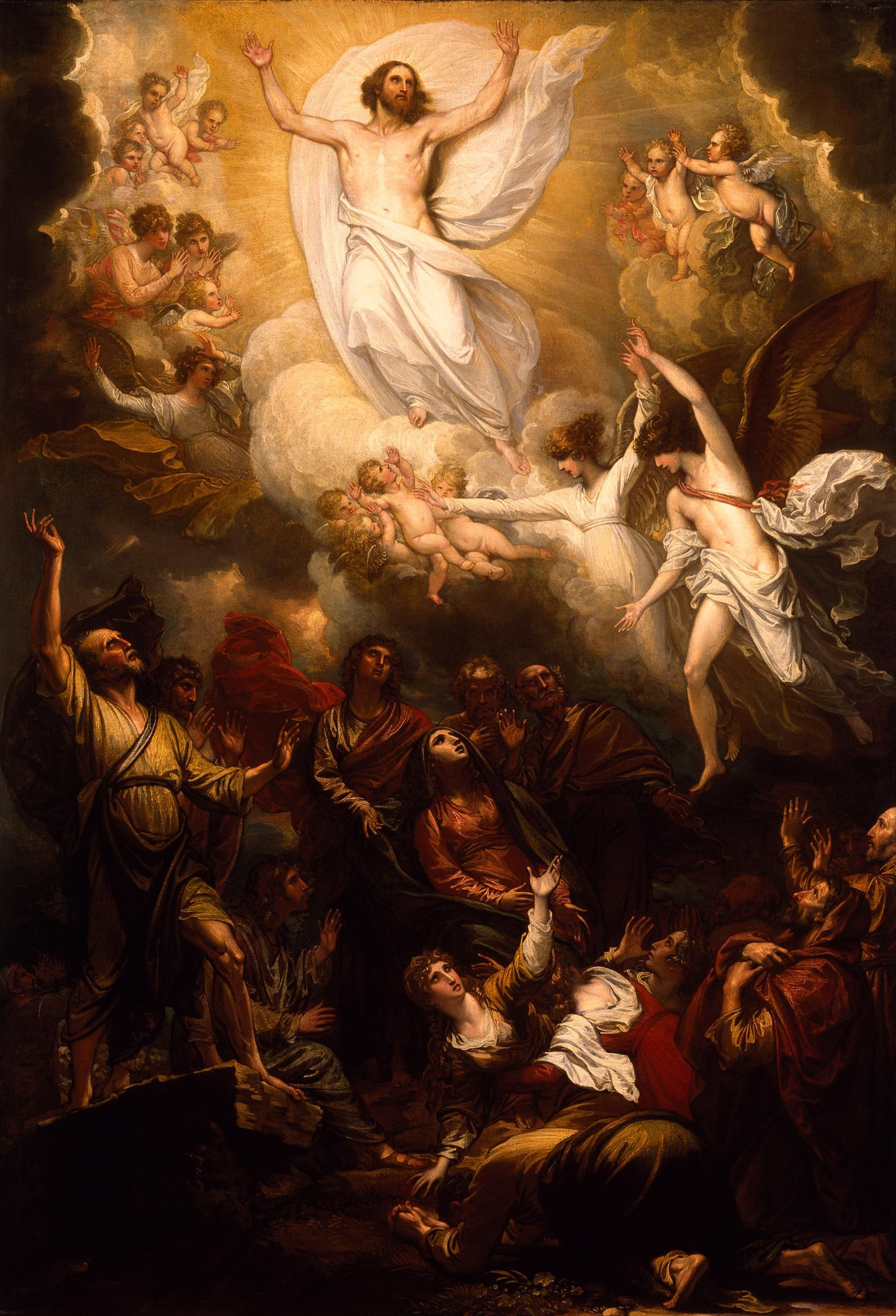
“And when he had spoken these things, while they beheld, he was taken up; and a cloud received him out of their sight.”
Acts 1:9
“When the time came for Christ to ascend to His Father, He led the disciples out as far as Bethany. Here He paused, and they gathered about Him. With hands outstretched in blessing, as if in assurance of His protecting care, He slowly ascended from among them.”
Ellen G. White · The Acts of the Apostles, p. 32
The last posture the disciples see Him in is not triumph or judgment, but blessing — hands still outstretched over them, even as the distance between heaven and earth begins closing behind Him.
“While the disciples were gazing upward to catch the last glimpse of their ascending Lord, He was received into the rejoicing ranks of heavenly angels.”
Ellen G. White · The Acts of the Apostles, p. 32
Two very different scenes are happening at once, separated only by a thin layer of cloud: eleven men straining their eyes at an empty patch of sky, and an entire heavenly host bursting into celebration on the other side of it.
“And while they looked stedfastly toward heaven as he went up, behold, two men stood by them in white apparel; Which also said, Ye men of Galilee, why stand ye gazing up into heaven? this same Jesus, which is taken up from you into heaven, shall so come in like manner as ye have seen him go into heaven.”
Acts 1:10-11
“The promise of Christ’s second coming was ever to be kept fresh in the minds of His disciples. The same Jesus whom they had seen ascending into heaven, would come again, to take to Himself those who here below give themselves to His service. The same voice that had said to them, ‘Lo, I am with you alway, even unto the end,’ would bid them welcome to His presence in the heavenly kingdom.”
Ellen G. White · The Acts of the Apostles, p. 33
“This same Jesus” is a small, deliberate phrase carrying enormous weight. Not a different, more terrifying Christ returning as cosmic judge with no memory of Galilee, but the identical Person the disciples had eaten breakfast with on a beach only days before — departing in a cloud, and one day returning “in like manner,” the same way He left.
With One Accord
“Then returned they unto Jerusalem from the mount called Olivet, which is from Jerusalem a sabbath day’s journey. And when they were come in, they went up into an upper room, where abode both Peter, and James, and John, and Andrew, Philip, and Thomas, Bartholomew, and Matthew, James the son of Alphaeus, and Simon Zelotes, and Judas the brother of James.”
Acts 1:12-13
“As the disciples returned from Olivet to Jerusalem, the people looked on them, expecting to see on their faces expressions of sorrow, confusion, and defeat; but they saw there gladness and triumph. The disciples did not now mourn over disappointed hopes. They had seen the risen Saviour, and the words of His parting promise echoed constantly in their ears.”
Ellen G. White · The Acts of the Apostles, p. 35
Everyone watching would have expected a defeated, leaderless group walking back into a city that had just executed their Teacher. Instead they see something the crowd cannot explain: joy, in men who by every visible measure ought to have none left.
“These all continued with one accord in prayer and supplication, with the women, and Mary the mother of Jesus, and with his brethren.”
Acts 1:14
“In obedience to Christ’s command, they waited in Jerusalem for the promise of the Father—the outpouring of the Spirit. They did not wait in idleness. The record says that they were ‘continually in the temple, praising and blessing God.’”
Ellen G. White · The Acts of the Apostles, p. 35
Waiting, in this chapter, is never passive. The same men who once argued over which of them was greatest are now found praising God together in the temple courts, no longer competing for rank.
“As the disciples waited for the fulfillment of the promise, they humbled their hearts in true repentance and confessed their unbelief. As they called to remembrance the words that Christ had spoken to them before His death they understood more fully their meaning. Truths which had passed from their memory were again brought to their minds, and these they repeated to one another.”
Ellen G. White · The Acts of the Apostles, p. 36
Ten days of waiting turn out to be ten days of unlearning — every misunderstanding, every moment of doubt or ambition from the last three years, quietly examined and repented of before a single sermon of this new church is ever preached.
“The disciples prayed with intense earnestness for a fitness to meet men and in their daily intercourse to speak words that would lead sinners to Christ. Putting away all differences, all desire for the supremacy, they came close together in Christian fellowship.”
Ellen G. White · The Acts of the Apostles, p. 37
“These days of preparation were days of deep heart searching. The disciples felt their spiritual need and cried to the Lord for the holy unction that was to fit them for the work of soul saving.”
Ellen G. White · The Acts of the Apostles, p. 37
“With one accord” is a phrase this book will repeat again and again in its early chapters, and it starts here — not as a slogan, but as the direct, practical result of eleven proud men choosing humility before God ever sends the power they are praying for.
The Lot Fell Upon Matthias
“And in those days Peter stood up in the midst of the disciples, and said, (the number of names together were about an hundred and twenty,) Men and brethren, this scripture must needs have been fulfilled, which the Holy Ghost by the mouth of David spake before concerning Judas, which was guide to them that took Jesus.”
Acts 1:15-16
One hundred twenty believers are gathered by now — a small but real congregation waiting in that upper room, far more than the eleven apostles alone. Peter, restored since the beach at Galilee, is already stepping into the leadership role he will carry through this book’s opening chapters.
“For he was numbered with us, and had obtained part of this ministry. Now this man purchased a field with the reward of iniquity; and falling headlong, he burst asunder in the midst, and all his bowels gushed out. And it was known unto all the dwellers at Jerusalem; insomuch as that field is called in their proper tongue, Aceldama, that is to say, The field of blood.”
Acts 1:17-19
Peter does not soften Judas’s story or pass over it in silence. A traitor who had genuinely “obtained part of this ministry” — not an outsider, but one of their own twelve — and whose end was violent and public enough to leave the very ground he died on with a permanent, ugly name.
“For it is written in the book of Psalms, Let his habitation be desolate, and let no man dwell therein: and his bishoprick let another take. Wherefore of these men which have companied with us all the time that the Lord Jesus went in and out among us, Beginning from the baptism of John, unto that same day that he was taken up from us, must one be ordained to be a witness with us of his resurrection.”
Acts 1:20-22
The qualification Peter sets is strict and narrow: not merely a believer, not merely an enthusiastic new convert, but someone who had personally walked with Jesus from His baptism all the way to His ascension — a living eyewitness, able to testify to the resurrection from firsthand memory rather than secondhand report.
“And they appointed two, Joseph called Barsabas, who was surnamed Justus, and Matthias. And they prayed, and said, Thou, Lord, which knowest the hearts of all men, shew whether of these two thou hast chosen, That he may take part of this ministry and apostleship, from which Judas by transgression fell, that he might go to his own place.”
Acts 1:23-25
Two qualified men are put forward, and the decision is handed entirely to prayer rather than to argument, campaigning, or a show of hands. Nobody in that room claims to know which of the two God has actually chosen; they simply ask the One who does.
“And they gave forth their lots; and the lot fell upon Matthias; and he was numbered with the eleven apostles.”
Acts 1:26
Casting lots feels, to modern eyes, like leaving something important to chance. Scripture never treats it that way — “the lot is cast into the lap; but the whole disposing thereof is of the Lord” (Proverbs 16:33) — and this is the very last time the book of Acts records the church using it. From the next chapter forward, decisions are made a different way entirely, guided directly by a Spirit not yet given when Matthias was chosen. The number twelve, broken at Gethsemane, is quietly restored just before the number that actually matters — the number waiting to be added at Pentecost — begins to grow far beyond it.
