Ten days of prayer in an upper room end, without warning, in a sound like a rushing wind, fire that does not burn, and a hundred and twenty ordinary people suddenly speaking languages they never learned. What happens next in a single morning in Jerusalem is the actual birth of the Christian church — and every single person who joins it that day joins because of one sermon, preached by the same man who three months earlier denied he even knew Jesus.
A study in Acts 2 · Arthur Baldwin · StandUp4Jesus.Org · 24 min read
With One Accord In One Place
“And when the day of Pentecost was fully come, they were all with one accord in one place. And suddenly there came a sound from heaven as of a rushing mighty wind, and it filled all the house where they were sitting.”
Acts 2:1-2
Pentecost was already, for every Jew in that room, one of the three great pilgrim feasts — fifty days after Passover, a harvest festival that had brought devout Jews to Jerusalem from every direction. Nobody chose this date for what was about to happen; it was already circled on the calendar of the whole Jewish world.
“And there appeared unto them cloven tongues like as of fire, and it sat upon each of them. And they were all filled with the Holy Ghost, and began to speak with other tongues, as the Spirit gave them utterance.”
Acts 2:3-4
“The Holy Spirit, assuming the form of tongues of fire, rested upon those assembled. This was an emblem of the gift then bestowed on the disciples, which enabled them to speak with fluency languages with which they had heretofore been unacquainted. The appearance of fire signified the fervent zeal with which the apostles would labor and the power that would attend their work.”
Ellen G. White · The Acts of the Apostles, p. 39
The wind and the fire are not the point; the languages are. This is not merely an impressive spiritual experience for the hundred and twenty themselves — it is, from the very first second, aimed outward, at a crowd of strangers who are about to be able to understand it.
“The Spirit came upon the waiting, praying disciples with a fullness that reached every heart. The Infinite One revealed Himself in power to His church. … And under the influence of the Spirit, words of penitence and confession mingled with songs of praise for sins forgiven. Words of thanksgiving and of prophecy were heard.”
Ellen G. White · The Acts of the Apostles, p. 38
Ten days of “with one accord” prayer in an upper room, described back in chapter 1, are what this room was doing when the promise finally arrived. The Spirit was not poured out on strangers to prayer, but on people who had already spent a week and a half asking for exactly this.
Every Man Heard Them Speak In His Own Language
“And there were dwelling at Jerusalem Jews, devout men, out of every nation under heaven. Now when this was noised abroad, the multitude came together, and were confounded, because that every man heard them speak in his own language.”
Acts 2:5-6
“During the dispersion the Jews had been scattered to almost every part of the inhabited world, and in their exile they had learned to speak various languages. Many of these Jews were on this occasion in Jerusalem, attending the religious festivals then in progress. Every known tongue was represented by those assembled.”
Ellen G. White · The Acts of the Apostles, p. 39
Centuries of scattering and exile — a history of loss, mostly — turn out to be exactly what makes this particular morning possible. The very dispersion that broke up the nation of Israel is what gathers, by accident of festival timing, a representative of nearly the whole known world into one place to hear the gospel at once.
“And they were all amazed and marvelled, saying one to another, Behold, are not all these which speak Galilæans? And how hear we every man in our own tongue, wherein we were born? Parthians, and Medes, and Elamites, and the dwellers in Mesopotamia, and in Judæa, and Cappadocia, in Pontus, and Asia, Phrygia, and Pamphylia, in Egypt, and in the parts of Libya about Cyrene, and strangers of Rome, Jews and proselytes, Cretes and Arabians, we do hear them speak in our tongues the wonderful works of God.”
Acts 2:7-11
Fifteen different peoples and regions are named in three verses — Luke, ever the careful historian, taking the trouble to record the exact geographic spread of that first crowd, a detail that reads almost like a manifest for everywhere the gospel is about to travel in the chapters ahead.
“And they were all amazed, and were in doubt, saying one to another, What meaneth this? Others mocking said, These men are full of new wine.”
Acts 2:12-13
“The priests, determined to account for the miraculous power of the disciples in some natural way, declared that they were drunken from partaking largely of the new wine prepared for the feast. Some of the most ignorant of the people present seized upon this suggestion as the truth, but the more intelligent knew it to be false; and those who understood the different languages testified to the accuracy with which these languages were used by the disciples.”
Ellen G. White · The Acts of the Apostles, p. 40
It is a remarkably weak accusation, and the priests know it even as they make it — wine does not teach a Galilean fisherman fluent Parthian. The very people in the crowd best qualified to judge, the ones who actually spoke those languages natively, are the ones who can testify the loudest that nothing about this was faked.
This Jesus Hath God Raised Up
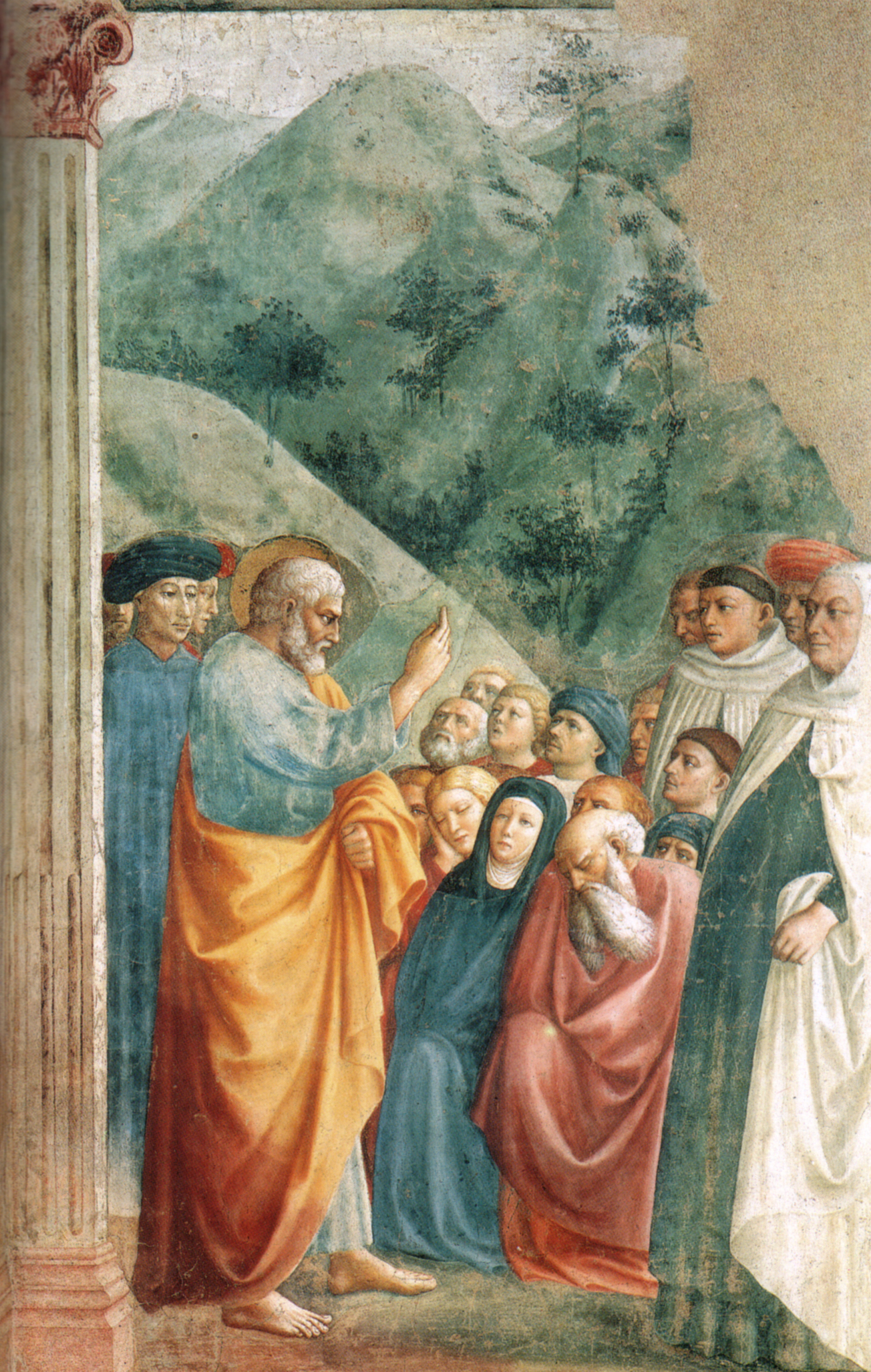
“But Peter, standing up with the eleven, lifted up his voice, and said unto them, Ye men of Judæa, and all ye that dwell at Jerusalem, be this known unto you, and hearken to my words: For these are not drunken, as ye suppose, seeing it is but the third hour of the day.”
Acts 2:14-15
Nine o’clock in the morning is Peter’s own dry rebuttal to the drunkenness charge — hardly the hour anyone in Jerusalem would already be staggering from new wine. It is the same Peter who once denied Christ three times to a servant girl, now standing to correct a whole crowd without a trace of fear.
“But this is that which was spoken by the prophet Joel; And it shall come to pass in the last days, saith God, I will pour out of my Spirit upon all flesh: and your sons and your daughters shall prophesy, and your young men shall see visions, and your old men shall dream dreams: And on my servants and on my handmaidens I will pour out in those days of my Spirit; and they shall prophesy.”
Acts 2:16-18
“In answer to the accusation of the priests Peter showed that this demonstration was in direct fulfillment of the prophecy of Joel, wherein he foretold that such power would come upon men to fit them for a special work.”
Ellen G. White · The Acts of the Apostles, p. 41
Peter’s very first move as a Christian preacher is to open a scroll of prophecy centuries old and show his listeners that what just happened to them was not spontaneous, not accidental, and not unprecedented — it was written down and waiting for this exact morning.
“Ye men of Israel, hear these words; Jesus of Nazareth, a man approved of God among you by miracles and wonders and signs, which God did by him in the midst of you, as ye yourselves also know: Him, being delivered by the determinate counsel and foreknowledge of God, ye have taken, and by wicked hands have crucified and slain: Whom God hath raised up, having loosed the pains of death: because it was not possible that he should be holden of it.”
Acts 2:22-24
“With clearness and power Peter bore witness of the death and resurrection of Christ: ‘Ye men of Israel, hear these words: Jesus of Nazareth, a man approved of God among you by miracles and wonders and signs, which God did by Him in the midst of you, as ye yourselves also know: Him … ye have taken, and by wicked hands have crucified and slain: whom God hath raised up, having loosed the pains of death: because it was not possible that He should be holden of it.’”
Ellen G. White · The Acts of the Apostles, p. 41
Peter says this to a crowd that very likely includes people who were standing in that same city seven weeks earlier shouting for Christ’s blood. He does not soften the accusation to spare their feelings or improve his odds of a friendly hearing; he names the crime plainly, “by wicked hands,” and trusts the truth to do its own work.
“Priests and rulers are there, the dark scowl of malignity still on their faces, their hearts still filled with abiding hatred against Christ, their hands uncleansed from the blood shed when they crucified the world’s Redeemer. They had thought to find the apostles cowed with fear under the strong hand of oppression and murder, but they find them lifted above all fear and filled with the Spirit, proclaiming with power the divinity of Jesus of Nazareth.”
Ellen G. White · The Acts of the Apostles, p. 42
The very men who thought a crucifixion would be the end of this movement are standing in the crowd watching it begin in earnest, their own silence the loudest evidence that the fear which once scattered every disciple in Gethsemane is entirely gone.
Both Lord And Christ
“For David speaketh concerning him, I foresaw the Lord always before my face, for he is on my right hand, that I should not be moved: Therefore did my heart rejoice, and my tongue was glad; moreover also my flesh shall rest in hope: Because thou wilt not leave my soul in hell, neither wilt thou suffer thine Holy One to see corruption.”
Acts 2:25-27
“Peter did not refer to the teachings of Christ to prove his position, because he knew that the prejudice of his hearers was so great that his words on this subject would be of no effect. Instead, he spoke to them of David, who was regarded by the Jews as one of the patriarchs of their nation.”
Ellen G. White · The Acts of the Apostles, p. 41
Peter builds his whole argument on ground his hearers cannot dismiss — not Christ’s own disputed words, but David’s, a name every Jew in that crowd already revered without question.
“Men and brethren, let me freely speak unto you of the patriarch David, that he is both dead and buried, and his sepulchre is with us unto this day. … He seeing this before spake of the resurrection of Christ, that his soul was not left in hell, neither his flesh did see corruption. This Jesus hath God raised up, whereof we all are witnesses.”
Acts 2:29, 31-32
“‘Men and brethren, let me freely speak unto you of the patriarch David, that he is both dead and buried, and his sepulcher is with us unto this day.’ ‘He … spake of the resurrection of Christ, that His soul was not left in hell, neither His flesh did see corruption. This Jesus hath God raised up, whereof we all are witnesses.’”
Ellen G. White · The Acts of the Apostles, p. 42
David’s own tomb, still standing and still occupied in Jerusalem at that very moment, is Peter’s proof text. Whatever David meant when he wrote “Thou wilt not suffer thine Holy One to see corruption,” he could not have meant himself — his body had long since seen exactly that. He was, Peter argues, a prophet describing someone else’s empty grave centuries in advance.
“Therefore being by the right hand of God exalted, and having received of the Father the promise of the Holy Ghost, he hath shed forth this, which ye now see and hear. … Therefore let all the house of Israel know assuredly, that God hath made that same Jesus, whom ye have crucified, both Lord and Christ.”
Acts 2:33, 36
The sermon’s whole argument lands on one sentence, and it is not gentle: the very Man this crowd helped crucify is the same Man God has now made both Lord and Christ. Every strange thing they have just witnessed — the wind, the fire, the languages — is offered as living proof of that one claim, not as a spectacle to be marveled at for its own sake.
They Continued Stedfastly
“Now when they heard this, they were pricked in their heart, and said unto Peter and to the rest of the apostles, Men and brethren, what shall we do?”
Acts 2:37
“Now they heard the disciples declaring that it was the Son of God who had been crucified. Priests and rulers trembled. Conviction and anguish seized the people.”
Ellen G. White · The Acts of the Apostles, p. 43
A crowd that arrived amused or suspicious, wondering whether these Galileans were drunk, leaves this sermon “pricked in their heart” — the same crowd, in the space of a single speech, moving from mockery to genuine terror at what they have done.
“Then Peter said unto them, Repent, and be baptized every one of you in the name of Jesus Christ for the remission of sins, and ye shall receive the gift of the Holy Ghost. For the promise is unto you, and to your children, and to all that are afar off, even as many as the Lord our God shall call.”
Acts 2:38-39
“Peter urged home upon the convicted people the fact that they had rejected Christ because they had been deceived by priests and rulers; and that if they continued to look to these men for counsel, and waited for them to acknowledge Christ before they dared to do so, they would never accept Him.”
Ellen G. White · The Acts of the Apostles, p. 43
Peter’s counsel is urgent precisely because waiting for permission from the same authorities who orchestrated the crucifixion would mean waiting forever. Every person in that crowd has to decide for themselves, on the spot, rather than deferring the decision to men with every reason to keep them from deciding at all.
“Then they that gladly received his word were baptized: and the same day there were added unto them about three thousand souls. And they continued stedfastly in the apostles’ doctrine and fellowship, and in breaking of bread, and in prayers.”
Acts 2:41-42
“The disciples were astonished and overjoyed at the greatness of the harvest of souls. They did not regard this wonderful ingathering as the result of their own efforts; they realized that they were entering into other men’s labors. … The conversions that took place on the Day of Pentecost were the result of this sowing, the harvest of Christ’s work, revealing the power of His teaching.”
Ellen G. White · The Acts of the Apostles, p. 44
Three thousand baptisms in a single afternoon is more converts than Christ’s own three-year earthly ministry is recorded as gathering into any one place at any one time — not, the apostles themselves recognized, because they had suddenly become better preachers, but because every seed Christ had ever sown in three years of teaching and one act of dying was now, all at once, coming up.
“And all that believed were together, and had all things common; And sold their possessions and goods, and parted them to all men, as every man had need. And they, continuing daily with one accord in the temple, and breaking bread from house to house, did eat their meat with gladness and singleness of heart, Praising God, and having favour with all the people. And the Lord added to the church daily such as should be saved.”
Acts 2:44-47
“No longer were they a collection of independent units or discordant, conflicting elements. No longer were their hopes set on worldly greatness. They were of ‘one accord,’ ‘of one heart and of one soul.’ … Christ filled their thoughts; the advancement of His kingdom was their aim.”
Ellen G. White · The Acts of the Apostles, p. 45
The same phrase that described eleven men praying together in an upper room back in chapter 1 now describes thousands of former strangers sharing meals, property, and worship together in the temple courts — “one accord” scaled up, almost overnight, from a small room to an entire new community. Later chapters of this book will return to this same community of goods in fuller detail, when it is tested by the very different example of two believers named Ananias and Sapphira; for now, Luke simply records it as it was at its best: joyful, generous, and growing daily by additions that were not the church’s own doing.
