Given one last chance to answer the charge against him, a deacon chosen originally to distribute food to widows delivers the longest single speech in the whole book of Acts — not a defense of himself at all, but a sweeping retelling of his own nation’s history, aimed at showing that Israel has been resisting God’s messengers since Abraham. It costs him his life within the hour, and the young man guarding the executioners’ coats will spend the rest of his own life unable to forget it.
A study in Acts 7 · Arthur Baldwin · StandUp4Jesus.Org · 24 min read
The God Of Glory Appeared
“Then said the high priest, Are these things so? And he said, Men, brethren, and fathers, hearken; The God of glory appeared unto our father Abraham, when he was in Mesopotamia, before he dwelt in Charran, And said unto him, Get thee out of thy country, and from thy kindred, and come into the land which I shall shew thee.”
Acts 7:1-3
“When Stephen was questioned as to the truth of the charges against him, he began his defense in a clear, thrilling voice, which rang through the council hall. In words that held the assembly spellbound, he proceeded to rehearse the history of the chosen people of God.”
Ellen G. White · The Acts of the Apostles, p. 99
Stephen’s very first sentence quietly undercuts the charge against him. He is accused of blasphemy against Moses and the temple, and he answers by pointing out that God’s own glory first appeared to Abraham in Mesopotamia — in a foreign land, centuries before Moses was born and a full millennium before a single stone of any temple was laid.
“And he gave him none inheritance in it, no, not so much as to set his foot on: yet he promised that he would give it to him for a possession, and to his seed after him, when as yet he had no child. … And he gave him the covenant of circumcision: and so Abraham begat Isaac, and circumcised him the eighth day; and Isaac begat Jacob; and Jacob begat the twelve patriarchs.”
Acts 7:5, 8
A promise of land is made to a man who will never own so much as a single square foot of it in his own lifetime — faith, in Stephen’s telling, has always meant trusting a promise whose fulfillment its recipient will not personally see.
“And the patriarchs, moved with envy, sold Joseph into Egypt: but God was with him, And delivered him out of all his afflictions, and gave him favour and wisdom in the sight of Pharaoh king of Egypt; and he made him governor over Egypt and all his house.”
Acts 7:9-10
The very first pattern of Stephen’s whole speech surfaces here, four verses in: Israel’s own patriarchs, moved by envy, reject the man God is preparing to save them, and God simply continues working through him anyway. Stephen’s listeners cannot yet hear how directly this will end up describing their own treatment of Jesus.
“Now there came a dearth over all the land of Egypt and Chanaan, and great affliction: and our fathers found no sustenance. But when Jacob heard that there was corn in Egypt, he sent out our fathers first. … So Jacob went down into Egypt, and died, he, and our fathers, And were carried over into Sychem, and laid in the sepulchre that Abraham bought for a sum of money of the sons of Emmor the father of Sychem.”
Acts 7:11-12, 15-16
Even the family’s burial plot is a small, deliberate detail in Stephen’s argument — a purchased grave, not an inherited temple or shrine, standing as evidence enough of where the patriarchs actually understood their true treasure to be.
I Am The God Of Thy Fathers
“Till another king arose, which knew not Joseph. The same dealt subtilly with our kindred, and evil entreated our fathers, so that they cast out their young children, to the end they might not live. In which time Moses was born, and was exceeding fair, and nourished up in his father’s house three months.”
Acts 7:18-20
Moses is introduced to this council exactly the way he was once introduced to the world — as a threatened infant, born under a death sentence, in a nation grown so hostile to Israel that mere survival past infancy was already an act of God’s protection.
“And Moses was learned in all the wisdom of the Egyptians, and was mighty in words and in deeds. And when he was full forty years old, it came into his heart to visit his brethren the children of Israel. And seeing one of them suffer wrong, he defended him, and avenged him that was oppressed, and smote the Egyptian: For he supposed his brethren would have understood how that God by his hand would deliver them: but they understood not.”
Acts 7:22-25
“They understood not” is the whole speech’s real thesis, quietly planted here for the second time. Moses arrives ready to deliver his own people forty years before they are ready to be delivered, and their misunderstanding costs him the next four decades of his life.
“But he that did his neighbour wrong thrust him away, saying, Who made thee a ruler and a judge over us? Wilt thou kill me, as thou diddest the Egyptian yesterday? Then fled Moses at this saying, and was a stranger in the land of Madian, where he begat two sons.”
Acts 7:27-29
“Who made thee a ruler and a judge over us” is thrown at Moses by his own countryman, the very people he is trying to rescue — the identical rejection, almost word for word, that this council has already leveled against Jesus and is about to level against Stephen himself.
“And when forty years were expired, there appeared to him in the wilderness of mount Sina an angel of the Lord in a flame of fire in a bush. … Saying, I am the God of thy fathers, the God of Abraham, and the God of Isaac, and the God of Jacob. Then Moses trembled, and durst not behold.”
Acts 7:30, 32
“Then said the Lord to him, Put off thy shoes from thy feet: for the place where thou standest is holy ground. I have seen, I have seen the affliction of my people which is in Egypt, and I have heard their groaning, and am come down to deliver them. And now come, I will send thee into Egypt.”
Acts 7:33-34
Holy ground, in this account, is a patch of empty desert beside a burning shrub — nowhere near Jerusalem, nowhere near any altar or temple ever built by human hands. Stephen’s audience, listening for an insult to sacred space, is instead being handed proof that sacred space has never been limited to the one building they are convinced houses it exclusively.
The Most High Dwelleth Not In Temples Made With Hands
“This Moses whom they refused, saying, Who made thee a ruler and a judge? the same did God send to be a ruler and a deliverer by the hand of the angel which appeared to him in the bush. He brought them out, after that he had shewed wonders and signs in the land of Egypt, and in the Red sea, and in the wilderness forty years.”
Acts 7:35-36
“This is that Moses, which said unto the children of Israel, A prophet shall the Lord your God raise up unto you of your brethren, like unto me; him shall ye hear.”
Acts 7:37
“He repeated the words of Moses that foretold of the Messiah: ‘A Prophet shall the Lord your God raise up unto you of your brethren, like unto me; Him shall ye hear.’ He made plain his own loyalty to God and to the Jewish faith, while he showed that the law in which the Jews trusted for salvation had not been able to save Israel from idolatry.”
Ellen G. White · The Acts of the Apostles, p. 99
The very same prophecy Peter had already quoted about Christ back in chapter 3, Stephen now quotes from Moses’s own mouth — a second witness this council cannot easily dismiss, since it comes from the one lawgiver they claim to revere above all others.
“To whom our fathers would not obey, but thrust him from them, and in their hearts turned back again into Egypt, Saying unto Aaron, Make us gods to go before us: for as for this Moses, which brought us out of the land of Egypt, we wot not what is become of him. And they made a calf in those days, and offered sacrifice unto the idol, and rejoiced in the works of their own hands.”
Acts 7:39-41
The nation now listening so proudly to Moses’s name once turned his own absence into an excuse for open idolatry, within sight of the very mountain where the law had just been given. Reverence for Moses, Stephen is quietly demonstrating, has never by itself guaranteed obedience to God.
“Our fathers had the tabernacle of witness in the wilderness, as he had appointed, speaking unto Moses, that he should make it according to the fashion that he had seen. … Who found favour before God, and desired to find a tabernacle for the God of Jacob. But Solomon built him an house.”
Acts 7:44, 46-47
“Howbeit the most High dwelleth not in temples made with hands; as saith the prophet, Heaven is my throne, and earth is my footstool: what house will ye build me? saith the Lord: or what is the place of my rest? Hath not my hand made all these things?”
Acts 7:48-50
“He referred to the building of the temple by Solomon, and to the words of both Solomon and Isaiah: ‘Howbeit the Most High dwelleth not in temples made with hands; as saith the prophet, Heaven is My throne, and earth is My footstool: what house will ye build Me? saith the Lord: or what is the place of My rest? Hath not My hand made all these things?’”
Ellen G. White · The Acts of the Apostles, p. 99
Forty-eight verses of patient historical argument finally arrive at their real destination. The whole recitation — Abraham without land, Joseph in a foreign palace, Moses at a burning bush in the desert, the tabernacle that moved from place to place before any temple existed — has been building toward exactly this conclusion, quoting Solomon’s own dedication prayer and Isaiah against the very stones this council reveres as God’s only address.
“When Stephen reached this point, there was a tumult among the people. When he connected Christ with the prophecies and spoke as he did of the temple, the priest, pretending to be horror-stricken, rent his robe. To Stephen this act was a signal that his voice would soon be silenced forever. He saw the resistance that met his words and knew that he was giving his last testimony.”
Ellen G. White · The Acts of the Apostles, p. 100
Stephen watches the exact moment his own death becomes certain, and does not stop talking. Whatever fear a normal man might feel at that signal, the record gives no hint that it slowed him down at all.
Ye Stiffnecked And Uncircumcised In Heart
“Although in the midst of his sermon, he abruptly concluded it. Suddenly breaking away from the train of history that he was following, and turning upon his infuriated judges, he cried…”
Ellen G. White · The Acts of the Apostles, p. 100
“Ye stiffnecked and uncircumcised in heart and ears, ye do always resist the Holy Ghost: as your fathers did, so do ye. Which of the prophets have not your fathers persecuted? and they have slain them which shewed before of the coming of the Just One; of whom ye have been now the betrayers and murderers.”
Acts 7:51-52
Fifty verses of careful, patient history end without a conclusion or a plea for mercy — just a direct verdict, spoken to the men who hold his life in their hands. Every patriarch and prophet Stephen has just walked through was rejected by the very people who claimed to be waiting for God’s deliverance; now he names the pattern outright and places this council squarely inside it.
“Who have received the law by the disposition of angels, and have not kept it.”
Acts 7:53
The charge against Stephen was blasphemy against the law. His actual closing argument reverses the accusation entirely: it is his judges, not he, who have failed to keep the very law they claim he has dishonored.
Lord Jesus, Receive My Spirit
“When they heard these things, they were cut to the heart, and they gnashed on him with their teeth.”
Acts 7:54
“At this, priests and rulers were beside themselves with anger. Acting more like beasts of prey than human beings, they rushed upon Stephen, gnashing their teeth. In the cruel faces about him the prisoner read his fate; but he did not waver.”
Ellen G. White · The Acts of the Apostles, p. 100
A council that could not out-argue Stephen when he first arrived before them is now reduced to raw physical rage — the same collapse from reasoned debate to violence this book has already shown happening to Stephen’s own accusers back in chapter 6.
“But he, being full of the Holy Ghost, looked up stedfastly into heaven, and saw the glory of God, and Jesus standing on the right hand of God, And said, Behold, I see the heavens opened, and the Son of man standing on the right hand of God.”
Acts 7:55-56
“For him the fear of death was gone. For him the enraged priests and the excited mob had no terror. The scene before him faded from his vision. To him the gates of heaven were ajar, and, looking in, he saw the glory of the courts of God, and Christ, as if just risen from His throne, standing ready to sustain His servant.”
Ellen G. White · The Acts of the Apostles, p. 100
Every other reference to Christ’s position in heaven describes Him seated — enthroned, at rest, His work of intercession settled. Here alone, in this one verse, Stephen sees Him standing, as if risen to His feet specifically to receive the first martyr of His own church.
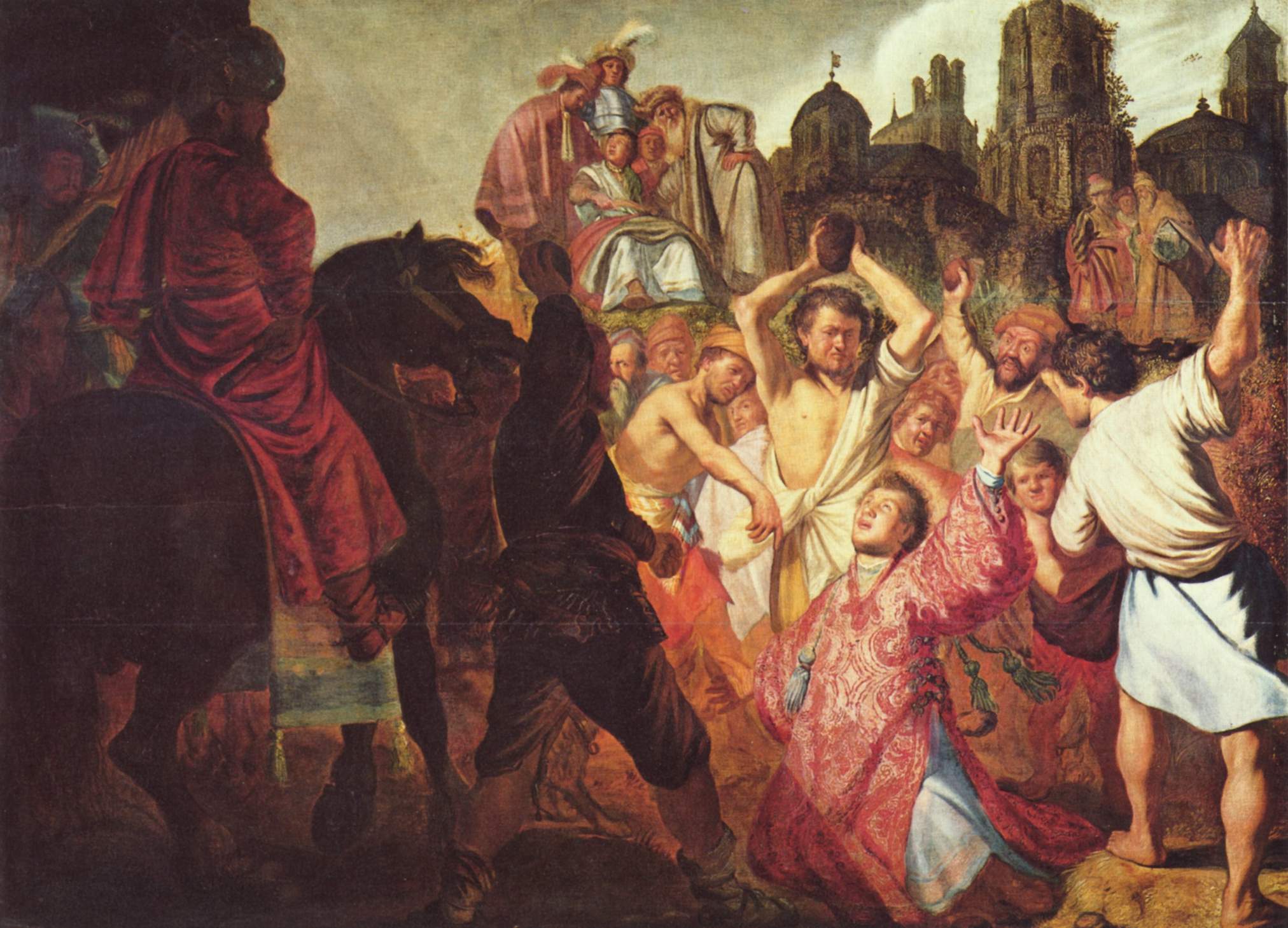
“Then they cried out with a loud voice, and stopped their ears, and ran upon him with one accord, And cast him out of the city, and stoned him: and the witnesses laid down their clothes at a young man’s feet, whose name was Saul.”
Acts 7:57-58
They stop their own ears rather than hear one more word of what he is seeing — the same council that once marveled at “the face of an angel” now refuses even to look at what that same face is reflecting. And Luke, with characteristic restraint, drops the name Saul into this scene without comment, a small detail that will turn out to matter more than anything else recorded in this chapter.
“And they stoned Stephen, calling upon God, and saying, Lord Jesus, receive my spirit. And he kneeled down, and cried with a loud voice, Lord, lay not this sin to their charge. And when he had said this, he fell asleep.”
Acts 7:59-60
“The martyrdom of Stephen made a deep impression upon all who witnessed it. The memory of the signet of God upon his face; his words, which touched the very souls of those who heard them, remained in the minds of the beholders, and testified to the truth of that which he had proclaimed. His death was a sore trial to the church, but it resulted in the conviction of Saul, who could not efface from his memory the faith and constancy of the martyr, and the glory that had rested on his countenance.”
Ellen G. White · The Acts of the Apostles, p. 101
Stephen’s last two sentences deliberately echo his own Lord’s last words from the cross — a prayer for his own spirit and a prayer of forgiveness for his killers, spoken in nearly the same breath. “He fell asleep” is Luke’s own quiet, almost tender word for death, the same word this whole young church has already learned to use because of what happened three days after another execution not long before.
“At the scene of Stephen’s trial and death, Saul had seemed to be imbued with a frenzied zeal. Afterward he was angered by his own secret conviction that Stephen had been honored by God at the very time when he was dishonored by men.”
Ellen G. White · The Acts of the Apostles, p. 101
The seed of Saul’s own conversion, still chapters away, is planted at the exact moment he thinks he has won. A face he cannot stop remembering, and a conviction he cannot quite silence, are already at work in him long before any voice speaks to him on the road to Damascus.
