A king with real political power decides it is finally time to move against the church directly — one apostle already executed, another in a cell between two soldiers, chained at both wrists, guarded around the clock, with public execution scheduled the moment the Passover crowds have gone home. The church has nothing left to do but pray. What happens that night, and what happens to the king himself only a few verses later, are two halves of the same story about exactly who is really in control.
A study in Acts 12 · Arthur Baldwin · StandUp4Jesus.Org · 20 min read
Herod Stretched Forth His Hands
“Now about that time Herod the king stretched forth his hands to vex certain of the church. And he killed James the brother of John with the sword.”
Acts 12:1-2
“He was professedly a proselyte to the Jewish faith, and apparently very zealous in carrying out the ceremonies of the Jewish law. Desirous of obtaining the favor of the Jews, hoping thus to make secure his offices and honors, he proceeded to carry out their desires by persecuting the church of Christ, spoiling the houses and goods of the believers, and imprisoning the leading members of the church.”
Ellen G. White · The Acts of the Apostles, p. 143
Herod’s persecution is not born of any deep personal conviction; it is a political calculation, entirely transactional. James’s death is simply the price he is willing to pay for popularity with the crowd that already hated the church.
“And because he saw it pleased the Jews, he proceeded further to take Peter also. (Then were the days of unleavened bread.) And when he had apprehended him, he put him in prison, and delivered him to four quaternions of soldiers to keep him; intending after Easter to bring him forth to the people.”
Acts 12:3-4
“It was during the Passover that these cruelties were practiced. While the Jews were celebrating their deliverance from Egypt and pretending great zeal for the law of God, they were at the same time transgressing every principle of that law by persecuting and murdering the believers in Christ.”
Ellen G. White · The Acts of the Apostles, p. 144
The contradiction sits in plain view and goes entirely unnoticed by everyone celebrating: a nation commemorating its own ancient deliverance from bondage, at the very same festival, delivering one of its own faithful sons to death.
“Peter therefore was kept in prison: but prayer was made without ceasing of the church unto God for him.”
Acts 12:5
“They prayed without ceasing for Peter, for they felt that he could not be spared from the cause. They realized that they had reached a place where, without the special help of God, the church of Christ would be destroyed.”
Ellen G. White · The Acts of the Apostles, p. 145
This is not a polite, occasional prayer request. “Without ceasing” describes a church that genuinely believes its own survival is at stake, with every legal and political avenue already closed off, leaving prayer as the only resource actually still available to them.
“Remembering the former escape of the apostles from prison, Herod on this occasion had taken double precautions. To prevent all possibility of release, Peter had been put under the charge of sixteen soldiers, who, in different watches, guarded him day and night. In his cell he was placed between two soldiers and was bound by two chains, each chain being fastened to the wrist of one of the soldiers.”
Ellen G. White · The Acts of the Apostles, p. 145
Herod remembers chapter 5’s earlier escape and takes no chances this time. Sixteen soldiers, rotating watches, two separate chains binding Peter directly to two guards — every conceivable human safeguard is in place, and every single one of them will prove equally useless.
Arise Up Quickly
“And when Herod would have brought him forth, the same night Peter was sleeping between two soldiers, bound with two chains: and the keepers before the door kept the prison.”
Acts 12:6
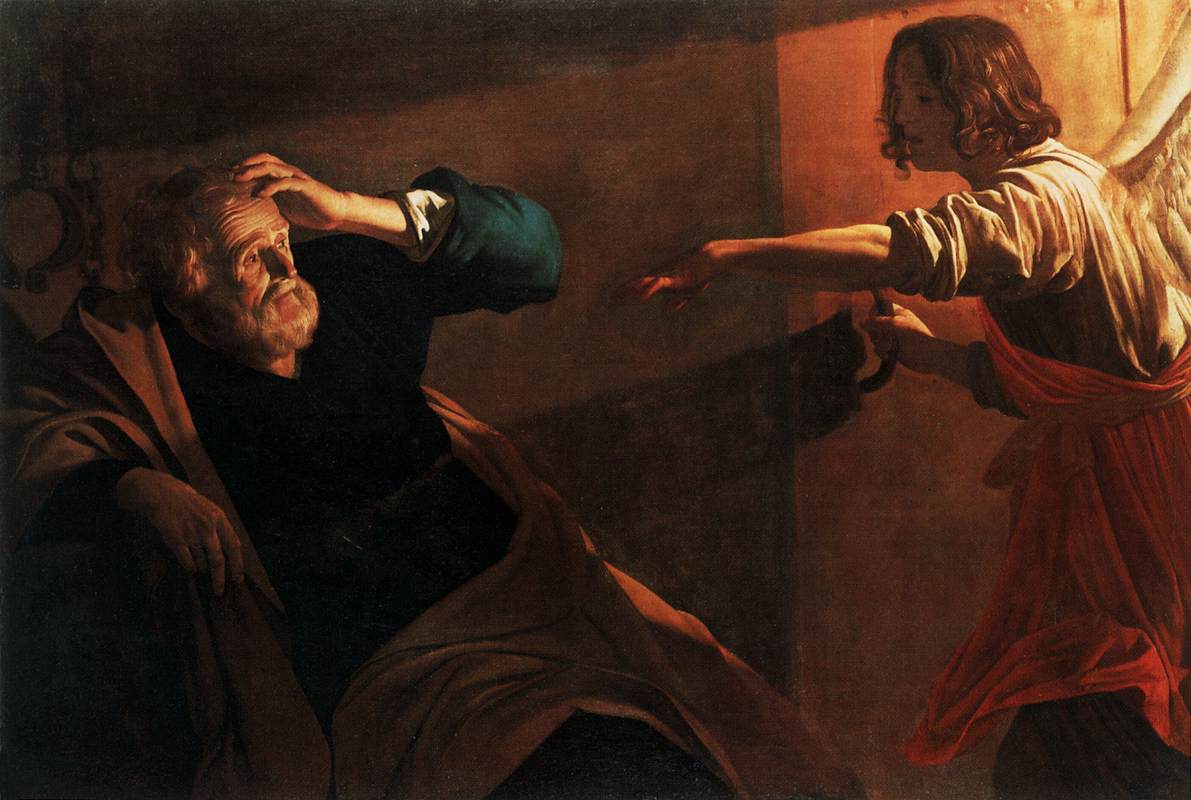
“It is the last night before the proposed execution. A mighty angel is sent from heaven to rescue Peter. The strong gates that shut in the saint of God open without the aid of human hands. … He enters the cell, and there lies Peter, sleeping the peaceful sleep of perfect trust.”
Ellen G. White · The Acts of the Apostles, p. 146
A man scheduled to die by morning is asleep. Not anxious, not pacing his cell rehearsing final words — genuinely, deeply asleep, the “peaceful sleep of perfect trust” on the very last night he has any earthly reason to expect.
“And, behold, the angel of the Lord came upon him, and a light shined in the prison: and he smote Peter on the side, and raised him up, saying, Arise up quickly. And his chains fell off from his hands.”
Acts 12:7
“The light that surrounds the angel fills the cell, but does not rouse the apostle. Not until he feels the touch of the angel’s hand and hears a voice saying, ‘Arise up quickly,’ does he awaken sufficiently to see his cell illuminated by the light of heaven, and an angel of great glory standing before him.”
Ellen G. White · The Acts of the Apostles, p. 146
A light bright enough to fill the whole cell does not wake him — only touch and voice together finally do. His sleep is deep enough that even a supernatural glow washing over his closed eyes cannot break it on its own.
“And the angel said unto him, Gird thyself, and bind on thy sandals. And so he did. And he saith unto him, Cast thy garment about thee, and follow me.”
Acts 12:8
“Again Peter mechanically obeys, keeping his wondering gaze riveted upon his visitor and believing himself to be dreaming or in a vision. … He moves toward the door, followed by the usually talkative Peter, now dumb from amazement.”
Ellen G. White · The Acts of the Apostles, p. 147
The same disciple who once talked his way through the transfiguration, who argued with Jesus about foot washing, who filled the silence at nearly every turn in these Gospels, is here reduced to complete, wide-eyed silence — an ordinary detail Luke includes almost gently, a small, human touch amid the miracle.
“And he went out, and followed him; and wist not that it was true which was done by the angel; but thought he saw a vision. When they were past the first and the second ward, they came unto the iron gate that leadeth unto the city; which opened to them of his own accord.”
Acts 12:9-10
“No word is spoken; there is no sound of footsteps. The angel glides on in front, encircled by a light of dazzling brightness, and Peter, bewildered, and still believing himself to be in a dream, follows his deliverer. Thus they pass on through one street, and then, the mission of the angel being accomplished, he suddenly disappears.”
Ellen G. White · The Acts of the Apostles, p. 147
Sixteen guards, two chains, three separate barred gates — and not one of them makes a single sound as Peter passes through. The whole escape happens in near-total silence, as if the physical world itself has been asked, briefly, to hold its breath.
“And when Peter was come to himself, he said, Now I know of a surety, that the Lord hath sent his angel, and hath delivered me out of the hand of Herod, and from all the expectation of the people of the Jews.”
Acts 12:11
“He examined his person and found himself fully dressed and girded. His wrists, swollen from wearing the cruel irons, were free from the manacles. He realized that his freedom was no delusion, no dream or vision, but a blessed reality.”
Ellen G. White · The Acts of the Apostles, p. 148
It takes standing alone in a cold, empty street, checking his own body for proof, before Peter can finally trust that what just happened was real. The swollen marks still on his wrists become, strangely, the very evidence that convinces him the miracle actually occurred.
It Is His Angel
“And when he had considered the thing, he came to the house of Mary the mother of John, whose surname was Mark; where many were gathered together praying.”
Acts 12:12
Peter walks, in the middle of the night, straight to the exact house where the prayers that God has just answered are, remarkably, still being prayed — the believers inside not yet aware their own petition has already succeeded.
“And as Peter knocked at the door of the gate, a damsel came to hearken, named Rhoda. And when she knew Peter’s voice, she opened not the gate for gladness, but ran in, and told how Peter stood before the gate.”
Acts 12:13-14
“And they said unto her, Thou art mad. But she constantly affirmed that it was even so. Then said they, It is his angel.”
Acts 12:15
There is a small, honest comedy tucked inside a scene of real miracle here that this book never bothers to smooth over: the very people who have been praying “without ceasing” for exactly this outcome refuse point-blank to believe it when a servant girl tells them it has happened, leaving Peter locked outside his own answered prayer.
“But Peter continued knocking: and when they had opened the door, and saw him, they were astonished.”
Acts 12:16
“But he, beckoning unto them with the hand to hold their peace, declared unto them how the Lord had brought him out of the prison. And he said, Go shew these things unto James, and to the brethren. And he departed, and went into another place.”
Acts 12:17
Even now, still standing free in a doorway, Peter cannot linger to celebrate. He gives quick instructions, asks that the news reach James, and disappears into hiding — a man who has just walked past sixteen soldiers and three sealed gates, still not yet safe from Herod’s own reach.
No Small Stir
“Now as soon as it was day, there was no small stir among the soldiers, what was become of Peter.”
Acts 12:18
“When the keepers before the door found that Peter had escaped, they were seized with terror. It had been expressly stated that their lives would be required for the life of their charge, and because of this they had been especially vigilant. When the officers came for Peter, the soldiers were still at the door of the prison, the bolts and bars were still fast, the chains were still secured to the wrists of the two soldiers; but the prisoner was gone.”
Ellen G. White · The Acts of the Apostles, p. 149
The detail is almost eerie in its precision: the chains are still fastened, still attached to the very wrists of the two soldiers who were supposed to be holding their prisoner between them. Whatever happened in that cell, it left the restraints themselves completely undisturbed — only the man inside them is gone.
“And when Herod had sought for him, and found him not, he examined the keepers, and commanded that they should be put to death. And he went down from Judæa to Cæsarea, and there abode.”
Acts 12:19
“Herod knew that no human power had rescued Peter, but he was determined not to acknowledge that a divine power had frustrated his design, and he set himself in bold defiance against God.”
Ellen G. White · The Acts of the Apostles, p. 149
Herod understands exactly what happened; he simply refuses to let that understanding change anything about how he acts. Innocent guards pay with their lives for a miracle they had no power to stop, and the king who ordered their deaths storms off to Caesarea still unwilling to bend.
Eaten Of Worms
“And Herod was highly displeased with them of Tyre and Sidon: but they came with one accord to him, and, having made Blastus the king’s chamberlain their friend, desired peace; because their country was nourished by the king’s country.”
Acts 12:20
“And upon a set day Herod, arrayed in royal apparel, sat upon his throne, and made an oration unto them. And the people gave a shout, saying, It is the voice of a god, and not of a man.”
Acts 12:21-22
“Clad in a robe sparkling with silver and gold, which caught the rays of the sun in its glittering folds and dazzled the eyes of the beholders, he was a gorgeous figure. … They further declared that while they had ever respected him as a ruler, henceforth they should worship him as a god.”
Ellen G. White · The Acts of the Apostles, p. 149
A flattering, star-struck crowd hands Herod exactly the kind of praise his pride has always craved — the same crowd, this study’s own prose cannot help but note, capable of once shouting “crucify Him” at the true King only a few years earlier and now offering worship to a man wearing nothing but expensive clothes.
“And immediately the angel of the Lord smote him, because he gave not God the glory: and he was eaten of worms, and gave up the ghost.”
Acts 12:23
“The same angel who had come from the royal courts to rescue Peter, had been the messenger of wrath and judgment to Herod. The angel smote Peter to arouse him from slumber; it was with a different stroke that he smote the wicked king, laying low his pride and bringing upon him the punishment of the Almighty.”
Ellen G. White · The Acts of the Apostles, p. 152
The same messenger, the very same angel, delivers two opposite verdicts within the space of one chapter — a gentle touch that wakes a sleeping apostle for rescue, and a fatal blow that ends a preening king mid-sentence. Mercy and judgment, this whole narrative quietly insists, can come from precisely the same hand.
“But the word of God grew and multiplied. And Barnabas and Saul returned from Jerusalem, when they had fulfilled their ministry, and took with them John, whose surname was Mark.”
Acts 12:24-25
A chapter that opened with an execution and a king’s cruelty closes on a single quiet sentence about the gospel’s own quiet growth — the true headline this whole book actually cares about, easily missed beneath the drama of angels and worm-eaten kings, but never once actually stopped by either.
