Every warning in this chapter points the same direction, and Paul walks toward Jerusalem anyway. A prophet binds his own hands and feet with Paul’s belt to act out exactly what is coming; friends in two different cities beg him not to go; and a well-meaning compromise inside the temple itself is what finally triggers the riot everyone saw coming.
A study in Acts 21 · Arthur Baldwin · StandUp4Jesus.Org · 19 min read
The Will Of The Lord Be Done
“And finding disciples, we tarried there seven days: who said to Paul through the Spirit, that he should not go up to Jerusalem. And when we had accomplished those days, we departed and went our way; and they all brought us on our way, with wives and children, till we were out of the city: and we kneeled down on the shore, and prayed.”
Acts 21:4-5
“At the close of the week spent in Tyre, all the brethren, with their wives and children, went with Paul to the ship, and before he stepped on board, they knelt upon the shore and prayed, he for them, and they for him.”
Ellen G. White · The Acts of the Apostles, p. 396
A whole congregation — not just its leaders, but wives and children too — walks a visiting apostle all the way to the water’s edge and kneels down together on an open beach. Whatever warning they have just given him about Jerusalem, it clearly has not diminished their affection for the man carrying on toward it anyway.
“And the next day we that were of Paul’s company departed, and came unto Cæsarea: and we entered into the house of Philip the evangelist, which was one of the seven; and abode with him. And the same man had four daughters, virgins, which did prophesy.”
Acts 21:8-9
“Here Paul spent a few peaceful, happy days—the last of perfect freedom that he was to enjoy for a long time.”
Ellen G. White · The Acts of the Apostles, p. 397
Philip has not appeared in this study since the Ethiopian eunuch’s own conversion back in chapter 8, more than a decade earlier in the book’s own timeline. He resurfaces here simply as a generous host, his household now including four daughters with the gift of prophecy — a detail Scripture records and then, characteristically, does not elaborate on at all.
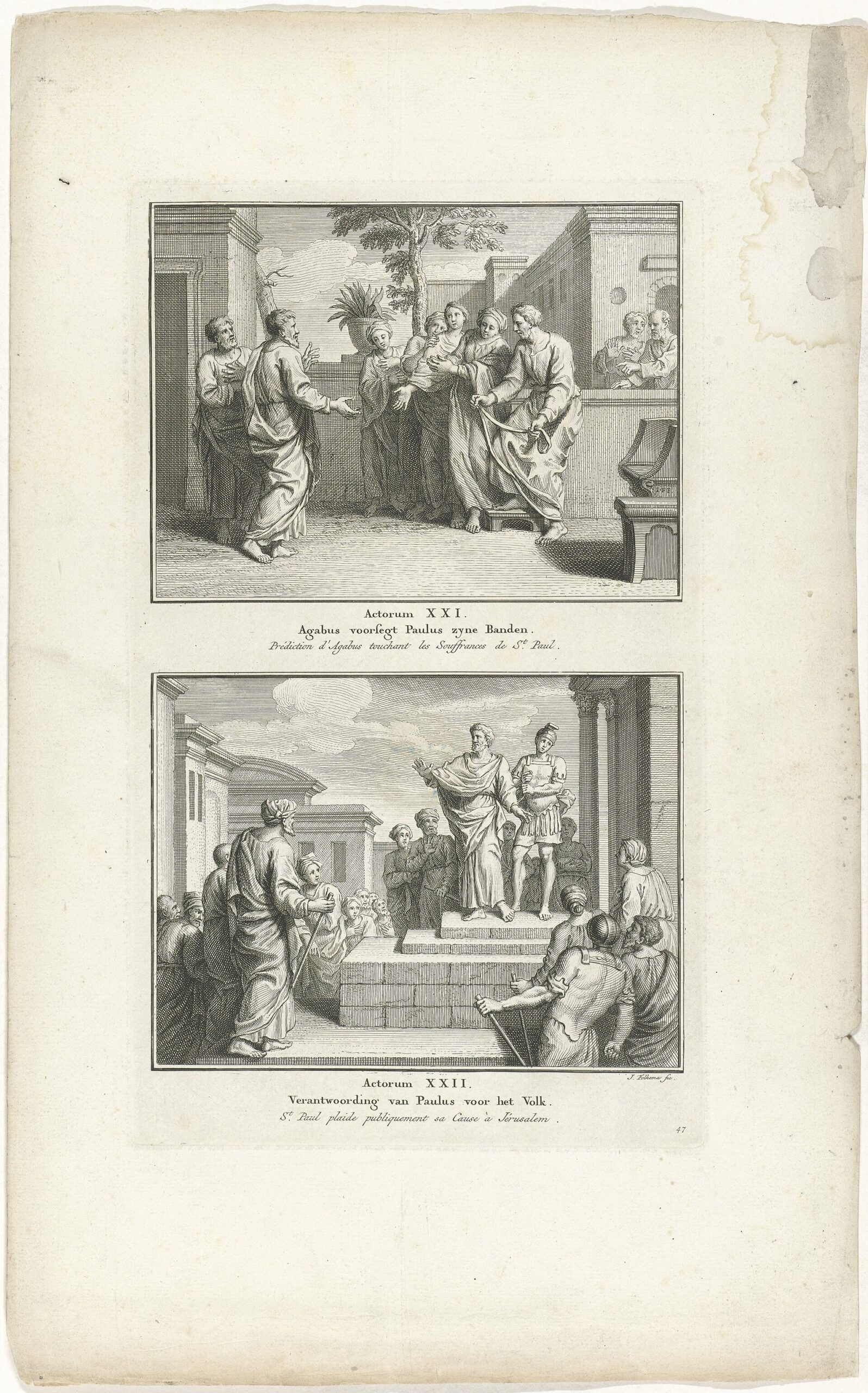
“And as we tarried there many days, there came down from Judæa a certain prophet, named Agabus. And when he was come unto us, he took Paul’s girdle, and bound his own hands and feet, and said, Thus saith the Holy Ghost, So shall the Jews at Jerusalem bind the man that owneth this girdle, and shall deliver him into the hands of the Gentiles.”
Acts 21:10-11
“He took Paul’s girdle, and bound his own hands and feet, and said, Thus saith the Holy Ghost, So shall the Jews at Jerusalem bind the man that owneth this girdle, and shall deliver him into the hands of the Gentiles.”
Ellen G. White · The Acts of the Apostles, p. 397
Agabus, already known from this study’s own eleventh chapter for his famine prophecy, works here in the ancient prophetic tradition of Isaiah, Jeremiah, and Ezekiel — not merely announcing coming events but physically acting them out, turning his own body into a living illustration Paul cannot easily misunderstand or forget.
“And when we heard these things, both we, and they of that place, besought him not to go up to Jerusalem. Then Paul answered, What mean ye to weep and to break mine heart? for I am ready not to be bound only, but also to die at Jerusalem for the name of the Lord Jesus.”
Acts 21:12-13
“But Paul would not swerve from the path of duty. He would follow Christ if need be to prison and to death. ‘What mean ye to weep and to break mine heart?’ he exclaimed; ‘for I am ready not to be bound only, but also to die at Jerusalem for the name of the Lord Jesus.’”
Ellen G. White · The Acts of the Apostles, p. 397
Notice what Paul says is actually breaking his heart — not the prospect of prison or death, which he has already made peace with, but the tears of people he loves trying to talk him out of an obedience he has no intention of abandoning.
“And when he would not be persuaded, we ceased, saying, The will of the Lord be done.”
Acts 21:14
This is a real tension worth sitting with rather than resolving too quickly: the Spirit warns through Agabus what will happen, and yet does not command Paul to avoid it. Prophecy here functions as honest preparation, not as a directive to flee — and the friends who love him most are the ones who finally recognize the difference and let him go.
Thou Seest, Brother, How Many Thousands
“And when we were come to Jerusalem, the brethren received us gladly. And the day following Paul went in with us unto James; and all the elders were present. And when he had saluted them, he declared particularly what things God had wrought among the Gentiles by his ministry.”
Acts 21:17-19
“On this occasion, Paul and his companions formally presented to the leaders of the work at Jerusalem the contributions forwarded by the Gentile churches for the support of the poor among their Jewish brethren. … The sum, which far exceeded the expectations of the elders at Jerusalem, represented many sacrifices and even severe privations on the part of the Gentile believers.”
Ellen G. White · The Acts of the Apostles, p. 399
The relief offering this study’s own twentieth chapter tracked across seven named traveling companions finally reaches its destination here — a tangible, costly proof of exactly the Gentile-Jewish unity Paul’s whole ministry has been arguing for since Antioch.
“And when they heard it, they glorified the Lord, and said unto him, Thou seest, brother, how many thousands of Jews there are which believe; and they are all zealous of the law: And they are informed of thee, that thou teachest all the Jews which are among the Gentiles to forsake Moses.”
Acts 21:20-21
“This was the golden opportunity for all the leading brethren to confess frankly that God had wrought through Paul, and that at times they had erred in permitting the reports of his enemies to arouse their jealousy and prejudice. But instead of uniting in an effort to do justice to the one who had been injured, they gave him counsel which showed that they still cherished a feeling that Paul should be held largely responsible for the existing prejudice.”
Ellen G. White · The Acts of the Apostles, p. 403
The elders never actually dispute a word of Paul’s own report; the problem, as they frame it, is entirely one of public relations — not whether his gospel is true, but whether the wrong rumor about him might cause trouble.
“Do therefore this that we say to thee: We have four men which have a vow on them; Them take, and purify thyself with them, and be at charges with them, that they may shave their heads: and all may know that those things, whereof they were informed concerning thee, are nothing.”
Acts 21:23-24
“The brethren hoped that Paul, by following the course suggested, might give a decisive contradiction to the false reports concerning him. … But the advice now given was not consistent with that decision. The Spirit of God did not prompt this instruction; it was the fruit of cowardice.”
Ellen G. White · The Acts of the Apostles, p. 404
This is a strikingly candid verdict on well-intentioned church leadership from this study’s own source — not malicious counsel, but frightened counsel, the kind that asks a faithful man to manage other people’s misunderstanding of him rather than simply trusting the truth to eventually stand on its own.
“Then Paul took the men, and the next day purifying himself with them entered into the temple, to signify the accomplishment of the days of purification, until that an offering should be offered for every one of them.”
Acts 21:26
“When we think of Paul’s great desire to be in harmony with his brethren, his tenderness toward the weak in the faith, his reverence for the apostles who had been with Christ… it is less surprising that he was constrained to deviate from the firm, decided course that he had hitherto followed. But instead of accomplishing the desired object, his efforts for conciliation only precipitated the crisis.”
Ellen G. White · The Acts of the Apostles, p. 405
Paul, who refused every doctrinal compromise at the Jerusalem council in chapter 15 and would not so much as let Titus be pressured into circumcision, agrees here to a purely ceremonial gesture meant to ease tension — and this study’s own source is unflinching about the outcome: the very effort made to prevent a riot is what puts him in the temple, at the exact moment, in the exact place, where the riot actually starts.
Men Of Israel, Help
“And when the seven days were almost ended, the Jews which were of Asia, when they saw him in the temple, stirred up all the people, and laid hands on him, Crying out, Men of Israel, help: This is the man, that teacheth all men every where against the people, and the law, and this place.”
Acts 21:27-28
“(For they had seen before with him in the city Trophimus an Ephesian, whom they supposed that Paul had brought into the temple.)”
Acts 21:29
“Paul had been seen in the city in company with Trophimus, an Ephesian, and it was conjectured that he had brought him into the temple. This he had not done; and being himself a Jew, his act in entering the temple was no violation of the law. But though the charge was wholly false, it served to arouse the popular prejudice.”
Ellen G. White · The Acts of the Apostles, p. 407
The one specific accusation that actually ignites the riot is, Luke is careful to note in a parenthetical aside, simply false — a guess about a man seen in Paul’s company in the city, mistaken for an act Paul never committed, in the one place where that particular mistake carries a death sentence.
“And all the city was moved, and the people ran together: and they took Paul, and drew him out of the temple: and forthwith the doors were shut. And as they went about to kill him, tidings came unto the chief captain of the band, that all Jerusalem was in an uproar.”
Acts 21:30-31
“Claudius Lysias well knew the turbulent elements with which he had to deal, and he ‘immediately took soldiers and centurions, and ran down unto them: and when they saw the chief captain and the soldiers, they left beating of Paul.’”
Ellen G. White · The Acts of the Apostles, p. 407
The doors of the temple are shut behind Paul, a small and chilling detail — the very building he entered specifically to demonstrate his own reverence for it is sealed against him the moment the mob decides he has defiled it, and a Roman military commander, not a single fellow believer, is the one who actually saves his life.
“Then the chief captain came near, and took him, and commanded him to be bound with two chains; and demanded who he was, and what he had done. And some cried one thing, some another, among the multitude: and when he could not know the certainty for the tumult, he commanded him to be carried into the castle.”
Acts 21:33-34
“And when he came upon the stairs, so it was, that he was borne of the soldiers for the violence of the people. For the multitude of the people followed after, crying, Away with him.”
Acts 21:35-36
“Away with him” is the exact cry once raised against Jesus outside this same city, in front of the same kind of crowd, a generation earlier — and the soldiers who now have to physically carry Paul off the ground to keep the mob from tearing him apart are, in a strange twist, the only thing standing between this echo and its full repetition.
May I Speak Unto Thee?
“And as Paul was to be led into the castle, he said unto the chief captain, May I speak unto thee? Who said, Canst thou speak Greek? Art not thou that Egyptian, which before these days madest an uproar, and leddest out into the wilderness four thousand men that were murderers?”
Acts 21:37-38
“Ignorant of the cause of the tumult, but seeing that the rage of the multitude was directed against Paul, the Roman captain concluded that he must be a certain Egyptian rebel of whom he had heard, who had thus far escaped capture.”
Ellen G. White · The Acts of the Apostles, p. 407
Claudius Lysias has, in a sense, arrested the wrong man twice over — first mistaking a Roman citizen for a common rioter, then mistaking him again for a specific fugitive terrorist. Paul’s own calm, fluent Greek is the first thing that visibly surprises him.
“But Paul said, I am a man which am a Jew of Tarsus, a city in Cilicia, a citizen of no mean city: and, I beseech thee, suffer me to speak unto the people. And when he had given him licence, Paul stood on the stairs, and beckoned with the hand unto the people.”
Acts 21:39-40
“In the midst of the tumult the apostle was calm and self-possessed. His mind was stayed upon God, and he knew that angels of heaven were about him. He felt unwilling to leave the temple without making an effort to set the truth before his countrymen.”
Ellen G. White · The Acts of the Apostles, p. 408
Chained, dragged, and nearly beaten to death only minutes earlier, Paul’s first instinct is not relief at his own rescue but a request — permission to address the very crowd that just tried to kill him. The chapter ends on the stairs of the Roman fortress, a bruised man beckoning for silence, with the speech itself still to come.
