Paul’s grief for his own people, opened in chapter 9, does not fade in this one — but the focus sharpens. Israel’s problem was never a lack of zeal; Paul says so plainly. It was zeal aimed at the wrong target, trying to build a righteousness of their own instead of simply reaching for one already offered, as near as their own mouth and heart.
A study in Romans 10 · Arthur Baldwin · StandUp4Jesus.Org · 14 min read
Not According To Knowledge
“Brethren, my heart’s desire and prayer to God for Israel is, that they might be saved. For I bear them record that they have a zeal of God, but not according to knowledge.”
Romans 10:1-2
Paul refuses to let his own hard doctrine in chapter 9 cool his affection here — “my heart’s desire and prayer” is not the language of someone who has written his own people off, and “I bear them record” grants real, generous credit to a sincerity Paul knows firsthand, from the inside, having once shared it himself.
“For they being ignorant of God’s righteousness, and going about to establish their own righteousness, have not submitted themselves unto the righteousness of God.”
Romans 10:3
“While the law is holy, the Jews could not attain righteousness by their own efforts to keep the law. … But the Pharisees rejected Christ; ‘being ignorant of God’s righteousness, and going about to establish their own righteousness,’ … they would not submit themselves unto the righteousness of God.”
Ellen G. White · Thoughts From the Mount of Blessing, p. 54
The verb “submitted” is worth pausing on — not a failure of effort but a failure of surrender. Israel’s own righteousness-building was, in its own way, exhausting hard work; what it was missing was the far simpler, far harder act of laying that effort down and receiving a righteousness already finished.
“For Christ is the end of the law for righteousness to every one that believeth.”
Romans 10:4
“The end of the law” carries a real double meaning worth holding onto rather than resolving too quickly — both termination, in the sense that the law can no longer be the path to righteousness once Christ has come, and goal, in the sense that the law was always pointing toward exactly this destination all along.
The Word Is Nigh Thee
“For Moses describeth the righteousness which is of the law, That the man which doeth those things shall live by them. But the righteousness which is of faith speaketh on this wise, Say not in thine heart, Who shall ascend into heaven? (that is, to bring Christ down from above.)”
Romans 10:5-6
Paul is quoting Moses against Moses here, in a sense — taking Deuteronomy’s own language about the law being near, not distant, and applying it to the very faith some assumed stood opposed to the law altogether.
“Or, Who shall descend into the deep? (that is, to bring up Christ again from the dead.) But what saith it? The word is nigh thee, even in thy mouth, and in thy heart: that is, the word of faith, which we preach.”
Romans 10:7-8
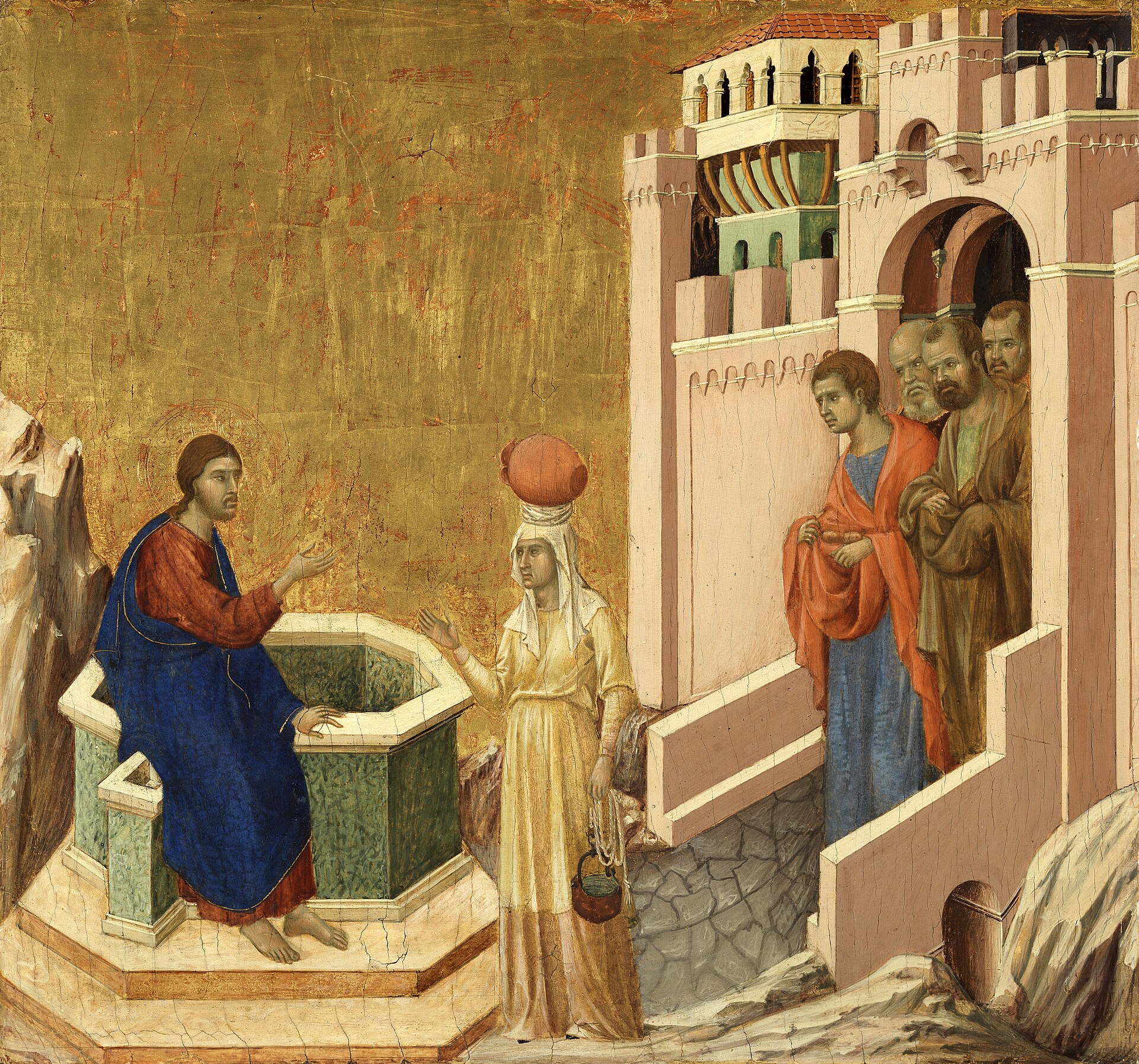
“She was looking backward to the fathers, forward to the Messiah’s coming, while the Hope of the fathers, the Messiah Himself, was beside her, and she knew Him not. How many thirsting souls are today close by the living fountain, yet looking far away for the wellsprings of life! ‘Say not in thine heart, Who shall ascend into heaven? … The word is nigh thee, even in thy mouth, and in thy heart: … if thou shalt confess with thy mouth the Lord Jesus, and shalt believe in thine heart that God hath raised Him from the dead, thou shalt be saved.’”
Ellen G. White · The Desire of Ages, p. 184
This study’s own source ties this exact passage to the Samaritan woman at Jacob’s well, standing next to the very fulfillment of everything she was still searching for — a striking, deliberate echo, since this study’s own ninth chapter has already used a well and a water source as its own governing image for how near, and how easily missed, this same gift can be.
Whosoever Shall Call Upon The Name Of The Lord
“That if thou shalt confess with thy mouth the Lord Jesus, and shalt believe in thine heart that God hath raised him from the dead, thou shalt be saved. For with the heart man believeth unto righteousness; and with the mouth confession is made unto salvation.”
Romans 10:9-10
Belief and confession are named here as two distinct, necessary acts rather than one collapsing into the other — an inward conviction that produces an outward declaration, private faith that does not stay entirely private.
“For the scripture saith, Whosoever believeth on him shall not be ashamed. For there is no difference between the Jew and the Greek: for the same Lord over all is rich unto all that call upon him.”
Romans 10:11-12
“No difference” repeats, almost word for word, chapter 3’s own conclusion after the universal guilt argument — the same phrase now doing identical work on the other side of the doctrine, since if all are equally guilty, all are equally invited to call on the same rich, sufficient Lord.
“For whosoever shall call upon the name of the Lord shall be saved.”
Romans 10:13
This verse, quoting the prophet Joel, is one of the most unqualified promises in the whole letter — no ethnic condition, no prior achievement, nothing but the single word “whosoever,” wide enough to include every reader of this study regardless of background.
How Shall They Hear Without A Preacher?
“How then shall they call on him in whom they have not believed? and how shall they believe in him of whom they have not heard? and how shall they hear without a preacher?”
Romans 10:14
“The greatest work, the noblest effort, in which men can engage, is to point sinners to the Lamb of God. True ministers are co-laborers with the Lord in the accomplishment of His purposes. … ‘How then shall they call on Him in whom they have not believed? and how shall they believe in Him of whom they have not heard? and how shall they hear without a preacher?’”
Ellen G. White · Gospel Workers, p. 18
Each question in this chain depends entirely on the one before it, working backward from the promise of verse 13 to its actual precondition — the promise “whosoever shall call” was never meant to stand alone; it requires an entire supply chain of belief, hearing, and someone willing to speak first.
“And how shall they preach, except they be sent? as it is written, How beautiful are the feet of them that preach the gospel of peace, and bring glad tidings of good things!”
Romans 10:15
“Beautiful feet” is a deliberately unexpected compliment, borrowed from Isaiah — not the messenger’s own eloquence or appearance praised, but simply the feet that carried the message, dusty and travel-worn as they might genuinely have been.
“But they have not all obeyed the gospel. For Esaias saith, Lord, who hath believed our report? So then faith cometh by hearing, and hearing by the word of God.”
Romans 10:16-17
“‘Faith cometh by hearing, and hearing by the word of God.’ … The Scriptures are the great agency in the transformation of character. … If studied and obeyed, the word of God works in the heart, subduing every unholy attribute.”
Ellen G. White · Christ’s Object Lessons, p. 100
This study’s own source names Scripture itself, not merely preaching in general, as the specific engine of this chain — the same word that must be preached to be heard is also the word that, once received, does the actual inward work of transformation.
A Disobedient And Gainsaying People
“But I say, Have they not heard? Yes verily, their sound went into all the earth, and their words unto the ends of the world.”
Romans 10:18
Paul closes off one possible excuse before it can even be raised — Israel’s own rejection cannot be blamed on a failure to hear, since the gospel’s reach, quoting the same psalm that once described creation’s own silent testimony, has by now genuinely gone out to the whole known world.
“But I say, Did not Israel know? First Moses saith, I will provoke you to jealousy by them that are no people, and by a foolish nation I will anger you.”
Romans 10:19
Even the jealousy Israel might feel watching Gentiles embrace what they themselves rejected was, Paul insists here, already foretold by Moses centuries earlier — not an unforeseen twist in the story, but part of its design from the very beginning.
“But Esaias is very bold, and saith, I was found of them that sought me not; I was made manifest unto them that asked not after me.”
Romans 10:20
“To Isaiah it was given to make very plain to Judah the truth that among the Israel of God were to be numbered many who were not descendants of Abraham after the flesh. … ‘Isaiah is very bold,’ Paul declares, ‘and saith, I was found of them that sought Me not; I was made manifest unto them that asked not after Me.’”
Ellen G. White · Prophets and Kings, p. 367
This study’s own source calls Isaiah’s own boldness exactly what it was — a genuinely uncomfortable message for its first audience, since it meant telling Judah that God’s own family would one day include people who had never once gone looking for Him.
“But to Israel he saith, All day long I have stretched forth my hands unto a disobedient and gainsaying people.”
Romans 10:21
“All day long He had stretched forth His hands unto a disobedient and gainsaying people; yet He would be found of them that sought Him not; among a people that had not called upon His name He would be manifest.”
Ellen G. White · The Desire of Ages, p. 458
The chapter’s own final image is not a slammed door but an open hand, held out “all day long” — a posture of continuous, patient invitation rather than sudden abandonment, closing this chapter’s own hard argument about Israel’s rejection with a picture of persistent love rather than finality. Whatever verdict this letter’s own next chapter has left to render on Israel’s future, it will not begin from a God who has stopped reaching.
