After fifteen chapters correcting divisions, discipline, marriage, meat, worship, gifts, and the resurrection itself, Paul closes this letter the way any real letter closes — with practical business and personal names. A collection for the suffering believers in Jerusalem, travel plans still uncertain, real people commended and greeted one by one. And in the middle of all that ordinary business sits one final, sweeping command, the same one that has quietly run underneath every argument since chapter 1: let all your things be done with charity.
A study in 1 Corinthians 16 · Arthur Baldwin · StandUp4Jesus.Org · 16 min read
Upon The First Day Of The Week
“Now concerning the collection for the saints, as I have given order to the churches of Galatia, even so do ye. Upon the first day of the week let every one of you lay by him in store, as God hath prospered him, that there be no gatherings when I come.”
1 Corinthians 16:1-2
“The plan of systematic benevolence does not press heavily upon any one man. ‘Now concerning the collection for the saints, as I have given order to the churches of Galatia, even so do ye. Upon the first day of the week let every one of you lay by him in store, as God hath prospered him, that there be no gatherings when I come.’ … The poor are not excluded from the privilege of giving. They, as well as the wealthy, may act a part in this work.”
Ellen G. White · Testimony Treasures, vol. 1, p. 378
This is not a spontaneous appeal for an emergency offering; it is a regular, weekly discipline, “as God hath prospered him” — proportional, not a fixed sum, and specifically timed so the whole amount would already be gathered before Paul’s own arrival made a hurried, pressured collection unnecessary. This study’s own source draws out the built-in fairness of the plan: giving in proportion to prosperity means no single believer, rich or poor, carries a weight the plan itself was not designed for them to bear.
“And when I come, whomsoever ye shall approve by your letters, them will I send to bring your liberality unto Jerusalem. And if it be meet that I go also, they shall go with me.”
1 Corinthians 16:3-4
Paul builds real accountability into the arrangement — not himself alone carrying a large sum of money, but messengers the Corinthian church itself has approved, carrying letters of introduction. Financial transparency, in the earliest days of the church, was already a deliberate practice rather than an afterthought.
A Great Door And Effectual
“Now I will come unto you, when I shall pass through Macedonia: for I do pass through Macedonia. And it may be that I will abide, yea, and winter with you, that ye may bring me on my journey whithersoever I go.”
1 Corinthians 16:5-6
Paul’s own plans are genuinely tentative — “it may be” is not the language of a rigid itinerary, but of a real traveler working within circumstances not entirely his own to control. Even an apostle writing inspired Scripture plans his travel one uncertain season at a time.
“For I will not see you now by the way; but I trust to tarry a while with you, if the Lord permit. But I will tarry at Ephesus until Pentecost.”
1 Corinthians 16:7-8
“If the Lord permit” is not a throwaway phrase; it is Paul’s own genuine posture toward his plans, the same submission James later commands explicitly — “if the Lord will, we shall live, and do this, or that.” Even his stated intention to stay in Ephesus is offered, not guaranteed.
“For a great door and effectual is opened unto me, and there are many adversaries.”
1 Corinthians 16:9
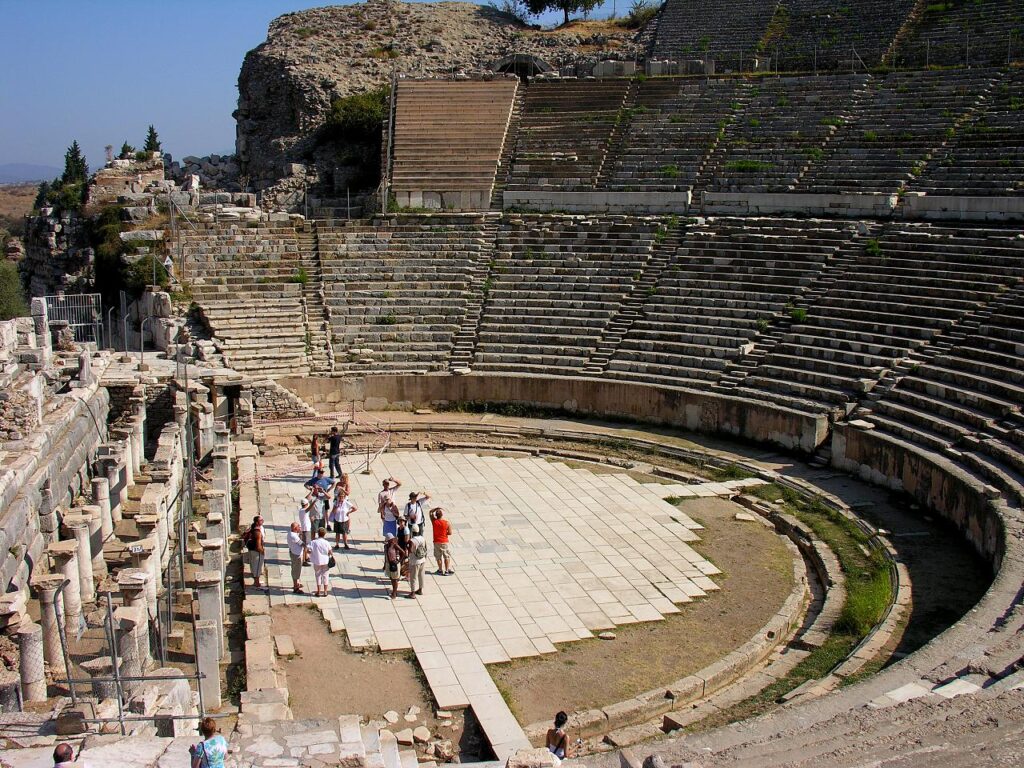
“Paul saw that ‘a great door and effectual’ was opening before him, although there were ‘many adversaries.’ … Ephesus was not only the most magnificent, but the most corrupt, of the cities of Asia. Superstition and sensual pleasure held sway over her teeming population.”
Ellen G. White · The Acts of the Apostles, p. 286
Paul’s single sentence links opportunity and opposition without treating them as contradictory. This study’s own source fills in exactly what those “many adversaries” actually looked like in the city Paul was writing this very letter from — a metropolis built around one of the ancient world’s most famous pagan temples, where magicians and superstition held real cultural power, and where God’s own miracles through Paul had only recently begun to publicly outmatch them.
“Now if Timotheus come, see that he may be with you without fear: for he worketh the work of the Lord, as I also do. Let no man therefore despise him: but conduct him forth in peace, that he may come unto me: for I look for him with the brethren.”
1 Corinthians 16:10-11
Paul’s protective instinct toward Timothy is worth noticing — still a relatively young worker, sent into a congregation that has shown, across this whole letter, a real capacity for tearing down its own leaders. “Let no man despise him” asks the Corinthians to extend to Timothy exactly the respect chapter 4 already said Paul himself had to forgo claiming for himself.
“As touching our brother Apollos, I greatly desired him to come unto you with the brethren: but his will was not at all to come at this time; but he will come when he shall have convenient time.”
1 Corinthians 16:12
Given how much of chapters 1 and 3 dealt with the “I am of Paul… I am of Apollos” rivalry, this small, almost administrative detail carries quiet weight. Paul genuinely wanted Apollos to visit, respected Apollos’s own independent judgment not to, and reports the whole exchange without a trace of the tension the Corinthians themselves had manufactured between the two men.
Let All Your Things Be Done With Charity
“Watch ye, stand fast in the faith, quit you like men, be strong. Let all your things be done with charity.”
1 Corinthians 16:13-14
Four short, urgent commands, and then this one closing sentence that reaches back to sum up the entire letter. Every specific correction since chapter 1 — factions, discipline, lawsuits, marriage, meat, worship, gifts, the resurrection itself — has, in the end, been an application of this single rule.
“I beseech you, brethren, (ye know the house of Stephanas, that it is the firstfruits of Achaia, and that they have addicted themselves to the ministry of the saints,) That ye submit yourselves unto such, and to every one that helpeth with us, and laboureth.”
1 Corinthians 16:15-16
“Firstfruits of Achaia” ties this one household directly back to chapter 15’s own resurrection imagery — the first converts in the whole province, a living guarantee, in miniature, of a much larger harvest still to come. Paul commends them not for rank or title, but for having “addicted themselves,” a striking phrase for wholehearted, self-chosen devotion to serving other believers.
“I am glad of the coming of Stephanas and Fortunatus and Achaicus: for that which was lacking on your part they have supplied. For they have refreshed my spirit and yours: therefore acknowledge ye them that are such.”
1 Corinthians 16:17-18
These three men, almost certainly the very messengers who carried the Corinthians’ own letter to Paul and brought back this one, are commended by name for a simple, tangible service — supplying what distance itself had made lacking, and refreshing Paul’s spirit in the process. Ordinary practical helpfulness, this brief note insists, deserves to be named and acknowledged, not taken for granted.
Maranatha
“The churches of Asia salute you. Aquila and Priscilla salute you much in the Lord, with the church that is in their house. All the brethren greet you. Greet ye one another with an holy kiss.”
1 Corinthians 16:19-20
Aquila and Priscilla, the tentmaking couple Paul first met in Corinth itself and who now host a congregation in their own Ephesian home, send greetings back to the very city where their friendship with Paul began. “The church that is in their house” is a quiet reminder of how the earliest Christian congregations actually met — not in dedicated buildings, but in the ordinary homes of ordinary believers.
“The salutation of me Paul with mine own hand.”
1 Corinthians 16:21
Paul typically dictated his letters to a scribe, adding a final greeting in his own handwriting as proof of authenticity, the ancient equivalent of a signature. This single sentence is a small, physical detail bridging the sixteen chapters of dictated argument and the real hand that guaranteed it.
“If any man love not the Lord Jesus Christ, let him be Anathema Maranatha.”
1 Corinthians 16:22
Two words, one Greek and one Aramaic, placed side by side in Paul’s own handwriting: “accursed” and “our Lord, come.” The juxtaposition is deliberate — the same coming that spells judgment for anyone who does not love Christ is, for everyone who does, the very hope chapter 15 just spent an entire chapter defending.
“The grace of our Lord Jesus Christ be with you. My love be with you all in Christ Jesus. Amen.”
1 Corinthians 16:23-24
The letter that opened with genuine thanksgiving for a divided, scandal-ridden, doctrinally confused church closes with genuine love for the very same people. Paul has spent sixteen chapters naming exactly what was wrong with the Corinthian church, sparing almost nothing, and still signs off calling every one of them “you all” — the same insistence on both truth and charity together that this entire letter, from its first correction to its last farewell, has never once let go of.
