Paul now defends his gospel with two pieces of evidence: first, that the acknowledged leaders of the Jerusalem church added nothing to his message and gave him their full fellowship; second, a much more startling proof — a public confrontation in which Paul openly rebuked Peter himself for compromising the very truth this letter defends. The chapter closes with what may be the most quoted single verse Paul ever wrote, a declaration of the gospel’s actual center: justification by faith, not by the works of the law.
A study in Galatians 2 · Arthur Baldwin · StandUp4Jesus.Org · 17 min read
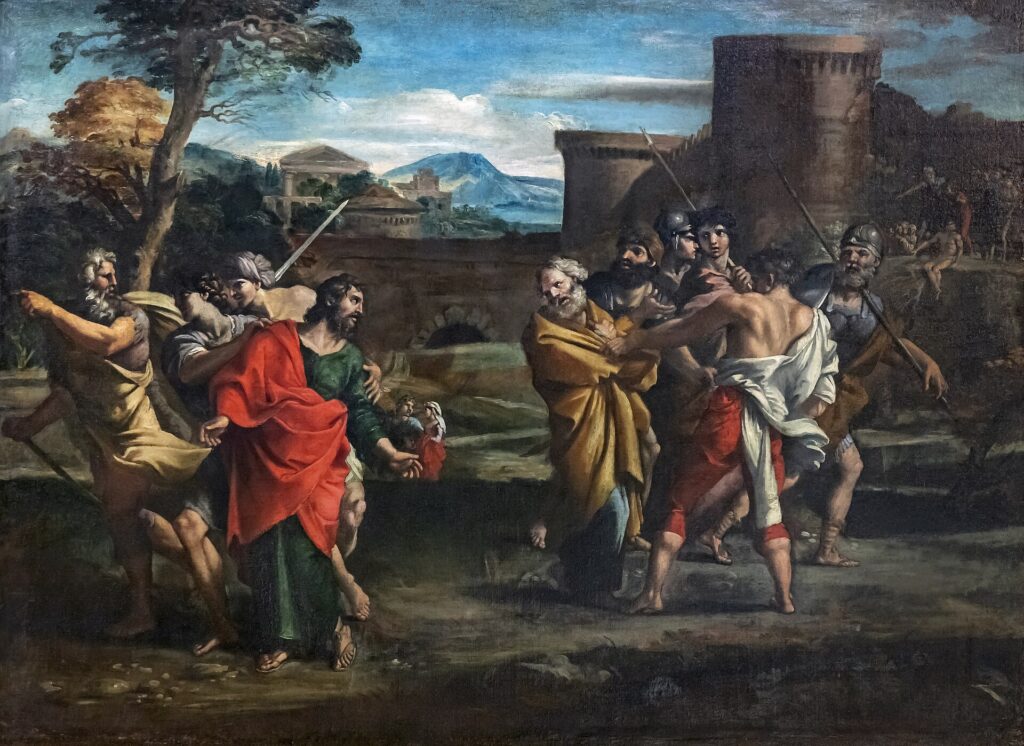
The Right Hands Of Fellowship
“Then fourteen years after I went up again to Jerusalem with Barnabas, and took Titus with me also. And I went up by revelation, and communicated unto them that gospel which I preach among the Gentiles, but privately to them which were of reputation, lest by any means I should run, or had run, in vain.”
Galatians 2:1-2
Fourteen more years pass before this second Jerusalem visit — Paul’s independence from that church’s oversight, already established in chapter 1, is only reinforced by how rarely and how deliberately he actually consulted them.
“But neither Titus, who was with me, being a Greek, was compelled to be circumcised: And that because of false brethren unawares brought in, who came in privily to spy out our liberty which we have in Christ Jesus, that they might bring us into bondage: To whom we gave place by subjection, no, not for an hour; that the truth of the gospel might continue with you.”
Galatians 2:3-5
Titus becomes a test case decided in Paul’s favor — a Greek convert whom no one, not even the Jerusalem church, required to be circumcised, settling in principle exactly the question the Galatian agitators were now trying to reopen.
“But of these who seemed to be somewhat, (whatsoever they were, it maketh no matter to me: God accepteth no man’s person:) for they who seemed to be somewhat in conference added nothing to me: But contrariwise, when they saw that the gospel of the uncircumcision was committed unto me, as the gospel of the circumcision was unto Peter.”
Galatians 2:6-7
“Added nothing to me” is Paul’s key phrase — the Jerusalem leaders did not correct, expand, or supplement his gospel, they simply recognized what was already complete.
“(For he that wrought effectually in Peter to the apostleship of the circumcision, the same was mighty in me toward the Gentiles:) And when James, Cephas, and John, who seemed to be pillars, perceived the grace that was given unto me, they gave to me and Barnabas the right hands of fellowship; that we should go unto the heathen, and they unto the circumcision. Only they would that we should remember the poor; the same which I also was forward to do.”
Galatians 2:8-10
The “right hands of fellowship” from James, Peter, and John make the coming confrontation all the more striking — Paul is not describing a rival apostle correcting an outsider, but one full equal calling another back to a gospel they had already publicly agreed on together.
I Withstood Him To The Face
“But when Peter was come to Antioch, I withstood him to the face, because he was to be blamed. For before that certain came from James, he did eat with the Gentiles: but when they were come, he withdrew and separated himself, fearing them which were of the circumcision. And the other Jews dissembled likewise with him; insomuch that Barnabas also was carried away with their dissimulation.”
Galatians 2:11-13
“When Peter, at a later date, visited Antioch, he won the confidence of many by his prudent conduct toward the Gentile converts. For a time he acted in accordance with the light given from heaven. He so far overcame his natural prejudice as to sit at table with the Gentile converts. But when certain Jews who were zealous for the ceremonial law, came from Jerusalem, Peter injudiciously changed his deportment toward the converts from paganism. A number of the Jews ‘dissembled likewise with him; insomuch that Barnabas also was carried away with their dissimulation.’ This revelation of weakness on the part of those who had been respected and loved as leaders, left a most painful impression on the minds of the Gentile believers. The church was threatened with division.”
Ellen G. White · The Acts of the Apostles, p. 197
This study’s own source fills in exactly what made Peter’s compromise so dangerous — not open false teaching, but a respected leader’s example silently reversing what he himself had once modeled, carrying even Barnabas along with it and threatening to split the church Paul and Barnabas had labored to build.
“But when I saw that they walked not uprightly according to the truth of the gospel, I said unto Peter before them all, If thou, being a Jew, livest after the manner of Gentiles, and not as do the Jews, why compellest thou the Gentiles to live as do the Jews?”
Galatians 2:14
“But Paul, who saw the subverting influence of the wrong done to the church through the double part acted by Peter, openly rebuked him for thus disguising his true sentiments. In the presence of the church, Paul inquired of Peter, ‘If thou, being a Jew, livest after the manner of Gentiles, and not as do the Jews, why compellest thou the Gentiles to live as do the Jews?’”
Ellen G. White · The Acts of the Apostles, p. 197
Notice the rebuke came publicly, “in the presence of the church” — Peter’s compromise had been public, and this study’s own source treats a public correction, not a private word alone, as the only remedy proportionate to a public wrong that was actively misleading others.
Not By The Works Of The Law
“We who are Jews by nature, and not sinners of the Gentiles, Knowing that a man is not justified by the works of the law, but by the faith of Jesus Christ, even we have believed in Jesus Christ, that we might be justified by the faith of Christ, and not by the works of the law: for by the works of the law shall no flesh be justified.”
Galatians 2:15-16
Paul turns the Antioch incident into a doctrinal statement that will govern the rest of the letter. “By the works of the law shall no flesh be justified” is not a new idea introduced here for convenience — it is the very truth Peter’s own withdrawal from the Gentiles had, in practice, contradicted, whatever he might still have affirmed in words.
“But if, while we seek to be justified by Christ, we ourselves also are found sinners, is therefore Christ the minister of sin? God forbid. For if I build again the things which I destroyed, I make myself a transgressor.”
Galatians 2:17-18
Paul anticipates the objection his critics were surely raising — does freedom from the law’s ceremonial demands make Christ responsible for lawlessness? His answer points the accusation back at them: it is rebuilding the old system of works, not abandoning it, that actually makes a person a transgressor of the gospel.
I Am Crucified With Christ
“For I through the law am dead to the law, that I might live unto God. I am crucified with Christ: nevertheless I live; yet not I, but Christ liveth in me: and the life which I now live in the flesh I live by the faith of the Son of God, who loved me, and gave himself for me.”
Galatians 2:19-20
“In His promises and warnings, Jesus means me. … The experiences related in God’s word are to be my experiences. Prayer and promise, precept and warning, are mine. ‘I am crucified with Christ: nevertheless I live; yet not I, but Christ liveth in me: and the life which I now live in the flesh I live by the faith of the Son of God, who loved me, and gave Himself for me.’”
Ellen G. White · The Desire of Ages, p. 390
Nearly a dozen of this study’s own sourcebooks return to this single verse, and this passage shows why — it is not simply a doctrinal claim about Paul’s own standing before God, but a template for how every believer is meant to personally read every promise Scripture contains. What Christ did for Paul, this study’s own source insists, he did for whoever reads these words in faith.
“I do not frustrate the grace of God: for if righteousness come by the law, then Christ is dead in vain.”
Galatians 2:21
The chapter’s final sentence states the stakes as plainly as they can be stated. If law-keeping alone could produce righteousness, the cross accomplished nothing that circumcision and Torah observance could not have accomplished on their own — a conclusion Paul refuses to let stand for even a moment, and the very question this whole letter, especially its next two chapters, exists to settle.
