Chapter 1 described the riches God has given His people in Christ. Chapter 2 shows how far down He had to reach to give them. It opens in a graveyard — “dead in trespasses and sins” — and ends in a temple, with Jew and Gentile built together into a dwelling place for God. Between those two points stands the most famous sentence Paul ever wrote on salvation, and a wall, a real one, that Christ tore down.
A study in Ephesians 2 · Arthur Baldwin · StandUp4Jesus.Org · 19 min read
Dead In Trespasses And Sins
“And you hath he quickened, who were dead in trespasses and sins; Wherein in time past ye walked according to the course of this world, according to the prince of the power of the air, the spirit that now worketh in the children of disobedience: Among whom also we all had our conversation in times past in the lusts of our flesh, fulfilling the desires of the flesh and of the mind; and were by nature the children of wrath, even as others.”
Ephesians 2:1-3
Paul’s diagnosis does not describe people who are sick and need help, but people who are dead and need life. And he names three forces that held them: “the course of this world,” the pull of the surrounding culture; “the prince of the power of the air,” Satan himself, still at work; and “the lusts of our flesh,” the enemy within. Notice the pronouns. Paul begins with “you” — the Gentile readers — but by verse 3 it is “we all.” The Jew is no better off than the pagan. Both were “children of wrath, even as others.”
“By nature we are alienated from God. The Holy Spirit describes our condition in such words as these: ‘Dead in trespasses and sins;’ ‘the whole head is sick, and the whole heart faint;’ ‘no soundness in it.’ We are held fast in the snare of Satan, ‘taken captive by him at his will.’ … God desires to heal us, to set us free. But since this requires an entire transformation, a renewing of our whole nature, we must yield ourselves wholly to Him.”
Ellen G. White · Steps to Christ, p. 43
But God, Who Is Rich In Mercy
“But God, who is rich in mercy, for his great love wherewith he loved us, Even when we were dead in sins, hath quickened us together with Christ, (by grace ye are saved;) And hath raised us up together, and made us sit together in heavenly places in Christ Jesus:”
Ephesians 2:4-6
“But God” may be the two most hopeful words in the letter. Everything before them is human ruin; everything after them is divine rescue. And the rescue follows exactly the path Christ Himself took in chapter 1. There, God raised Christ from the dead and set Him in the heavenly places (1:20); here, He has “quickened us together with Christ,” “raised us up together,” and “made us sit together in heavenly places.” Three times Paul uses the word “together.” What happened to Christ is counted as having happened to those who are in Him.
“That in the ages to come he might shew the exceeding riches of his grace in his kindness toward us through Christ Jesus.”
Ephesians 2:7
“The exaltation of the redeemed will be an eternal testimony to God’s mercy. … Through Christ’s redeeming work the government of God stands justified. The Omnipotent One is made known as the God of love. Satan’s charges are refuted, and his character unveiled. Rebellion can never again arise. Sin can never again enter the universe.”
Ellen G. White · The Desire of Ages, p. 26
Salvation is not only for the saved. The redeemed will stand for all eternity as living evidence of what God is really like — the final answer to every charge Satan ever made against Him. This study’s source sets verse 7 squarely inside the great controversy: every rescued sinner is part of God’s vindication before the universe.
By Grace Are Ye Saved Through Faith
“For by grace are ye saved through faith; and that not of yourselves: it is the gift of God: Not of works, lest any man should boast. For we are his workmanship, created in Christ Jesus unto good works, which God hath before ordained that we should walk in them.”
Ephesians 2:8-10
Every word is chosen to shut out human credit. Salvation comes “by grace” — God’s undeserved favor — “through faith,” the empty hand that receives it. “Not of yourselves.” “Not of works.” And the reason is stated: “lest any man should boast.” No one in heaven will be able to say they contributed to their own rescue.
Yet Paul does not stop at verse 9, and neither should we. Verse 10 says we are God’s “workmanship” — His handiwork, His masterpiece — “created in Christ Jesus unto good works.” Works are not the root of salvation, but they are its fruit. Good works cannot save anyone, but a saved person will walk in them, because that is what God re-created them for.
“We do not earn salvation by our obedience; for salvation is the free gift of God, to be received by faith. But obedience is the fruit of faith. … Righteousness is defined by the standard of God’s holy law, as expressed in the ten precepts given on Sinai. That so-called faith in Christ which professes to release men from the obligation of obedience to God, is not faith, but presumption. ‘By grace are ye saved through faith.’ But ‘faith, if it hath not works, is dead.’”
Ellen G. White · Steps to Christ, p. 61
This study’s source holds the two halves of Ephesians 2:8-10 together exactly as Paul does. Salvation is free and unearned; obedience is its fruit, measured by God’s own law. A faith that claims to release the believer from obedience has misunderstood the gift.
Made Nigh By The Blood Of Christ
“Wherefore remember, that ye being in time past Gentiles in the flesh, who are called Uncircumcision by that which is called the Circumcision in the flesh made by hands; That at that time ye were without Christ, being aliens from the commonwealth of Israel, and strangers from the covenants of promise, having no hope, and without God in the world: But now in Christ Jesus ye who sometimes were far off are made nigh by the blood of Christ.”
Ephesians 2:11-13
Paul asks the Gentile believers to “remember” — not to wallow in the past, but to measure the distance grace has carried them. Five losses describe their former state: without Christ, outside Israel, strangers to the covenants, without hope, without God. Then come two words that reverse all five: “But now.”
“No distinction on account of nationality, race, or caste, is recognized by God. He is the Maker of all mankind. All men are of one family by creation, and all are one through redemption. Christ came to demolish every wall of partition, to throw open every compartment of the temple, that every soul may have free access to God.”
Ellen G. White · Christ’s Object Lessons, p. 386
He Is Our Peace
“For he is our peace, who hath made both one, and hath broken down the middle wall of partition between us;”
Ephesians 2:14
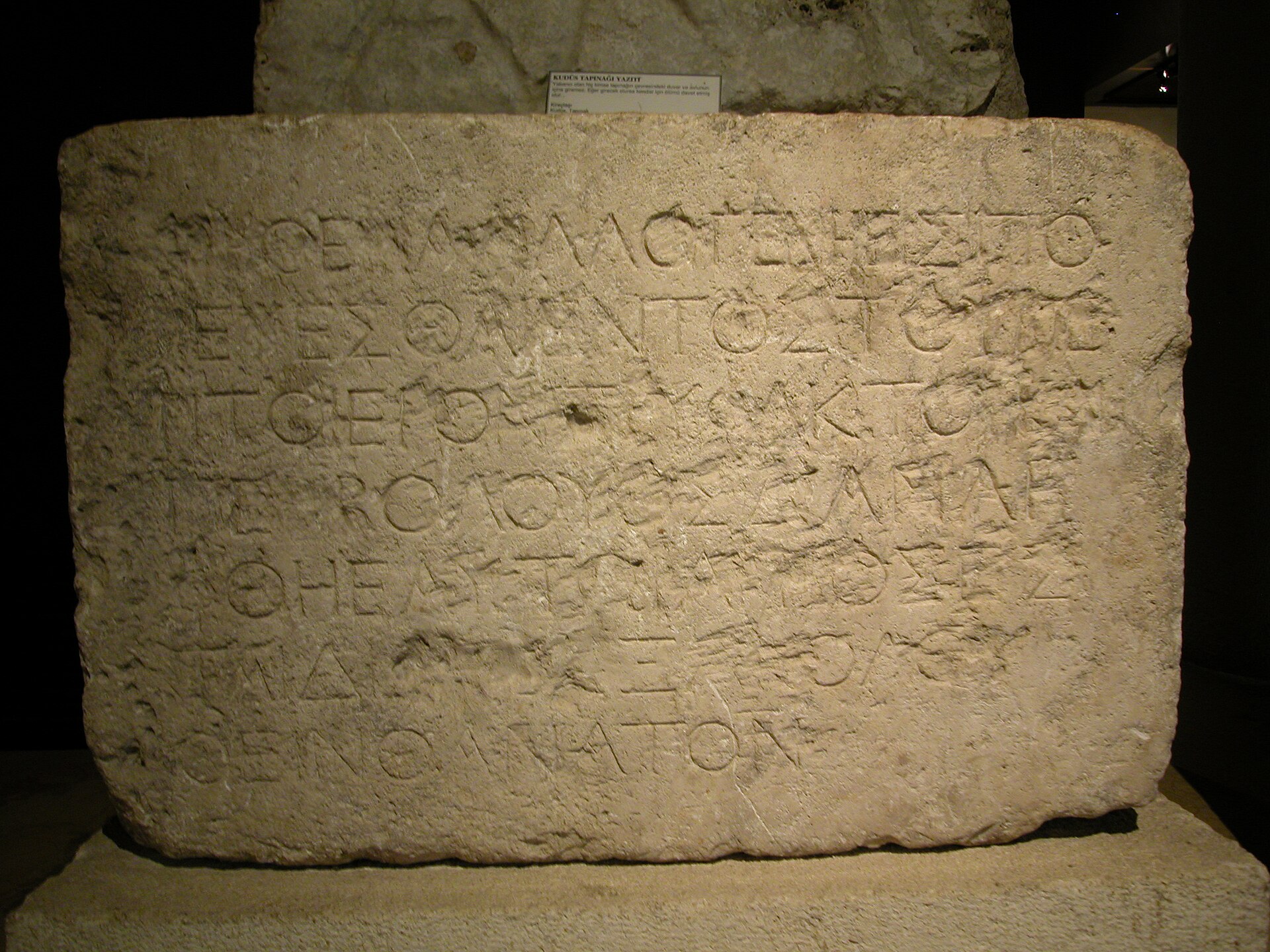
The “middle wall of partition” was not only a figure of speech. In Herod’s temple a low stone barrier separated the Court of the Gentiles from the inner courts, and warning stones set along it announced, in Greek and Latin, that any foreigner who passed it would have himself to blame for the death that followed. One of those stones, found in 1871, is pictured at the top of this study. Paul knew that barrier personally. He was seized in the temple and nearly killed by a mob because they supposed he had brought Trophimus, an Ephesian, past it (Acts 21:28-29) — and that arrest is the reason he is writing this very letter as a prisoner. The wall that nearly cost Paul his life is the wall he now tells the Ephesians Christ has broken down.
“During His earthly ministry Christ began to break down the partition wall between Jew and Gentile, and to preach salvation to all mankind. Though He was a Jew, He mingled freely with the Samaritans, setting at nought the Pharisaic customs of the Jews with regard to this despised people. He slept under their roofs, ate at their tables, and taught in their streets.”
Ellen G. White · The Acts of the Apostles, p. 19
“Having abolished in his flesh the enmity, even the law of commandments contained in ordinances; for to make in himself of twain one new man, so making peace; And that he might reconcile both unto God in one body by the cross, having slain the enmity thereby:”
Ephesians 2:15-16
What exactly did Christ abolish? Paul is specific: “the law of commandments contained in ordinances” — the same word he uses in Colossians 2:14 for “the handwriting of ordinances” nailed to the cross. It points to the ceremonial system of sacrifices, feasts, purity rules and circumcision that had served as a fence between Israel and the nations, and whose types all met their fulfillment at the cross. This site’s study of Galatians 3 traces that distinction between the ceremonial law and the moral law in detail.
Ephesians itself settles that Paul does not mean the Ten Commandments. Four chapters later he quotes the fifth commandment to Gentile children as still binding — “Honour thy father and mother; (which is the first commandment with promise;)” (6:2). What Christ removed was the wall of ordinances that divided people from each other. What remains is the law of love that unites them to God and to one another. And notice the result: not Gentiles turned into Jews, or Jews into Gentiles, but “one new man” — something that had never existed before.
“And came and preached peace to you which were afar off, and to them that were nigh. For through him we both have access by one Spirit unto the Father.”
Ephesians 2:17-18
Verse 18 names all three persons of the Godhead in a single line: access “through him” (the Son), “by one Spirit,” “unto the Father.” The Gentile who once could not pass a stone barrier in the temple courts now has direct access to the Father Himself.
An Holy Temple In The Lord
“Now therefore ye are no more strangers and foreigners, but fellowcitizens with the saints, and of the household of God; And are built upon the foundation of the apostles and prophets, Jesus Christ himself being the chief corner stone;”
Ephesians 2:19-20
“To those who believe, Christ is a sure foundation. Upon this living stone, Jews and Gentiles alike may build. It is broad enough for all and strong enough to sustain the weight and burden of the whole world.”
Ellen G. White · The Acts of the Apostles, p. 175
The Gentiles are not guests in God’s house on a visitor’s pass. They are citizens and family members. And the house has a single corner stone, the stone that sets the line for every other stone in the building. Everything Paul and the prophets taught is laid in line with Christ.
“In whom all the building fitly framed together groweth unto an holy temple in the Lord: In whom ye also are builded together for an habitation of God through the Spirit.”
Ephesians 2:21-22
“By His sacrifice and mediation Christ is both the foundation and the builder of the church of God.”
Ellen G. White · The Great Controversy, p. 416
The chapter ends with a stunning reversal. It began with a temple wall that kept Gentiles out on pain of death; it ends with Gentiles and Jews together becoming the temple — a living building, still growing, where God Himself dwells by His Spirit. The stone barrier in Jerusalem would fall with the temple in AD 70. The temple Christ is building will never fall.