A small church in the hills of Asia Minor, one Paul had never visited, was being offered something “more” than Christ — a deeper philosophy, a ladder of angelic powers, a set of rules for the truly spiritual. Paul’s answer in the first chapter of Colossians is not to argue with each idea. It is to show them how great Christ is: the image of the invisible God, the Creator of everything in heaven and earth, the One who holds the universe together, and the One who made peace through the blood of His cross.
A study in Colossians 1 · Arthur Baldwin · StandUp4Jesus.Org · 25 min read
The Saints And Faithful Brethren At Colosse
“Paul, an apostle of Jesus Christ by the will of God, and Timotheus our brother, To the saints and faithful brethren in Christ which are at Colosse: Grace be unto you, and peace, from God our Father and the Lord Jesus Christ.”
Colossians 1:1-2
Colossae was a fading market town in the Lycus valley, about a hundred miles inland from Ephesus, overshadowed by its larger neighbors Laodicea and Hierapolis (4:13). Paul had never been there; many in the church had never seen his face (2:1). The gospel reached them through Epaphras, a Colossian who probably heard Paul during his two years at Ephesus, when “all they which dwelt in Asia heard the word of the Lord Jesus” (Acts 19:10). Now Epaphras had traveled to Rome to see Paul in prison, bringing good news and a worry.
“We give thanks to God and the Father of our Lord Jesus Christ, praying always for you, Since we heard of your faith in Christ Jesus, and of the love which ye have to all the saints, For the hope which is laid up for you in heaven, whereof ye heard before in the word of the truth of the gospel; Which is come unto you, as it is in all the world; and bringeth forth fruit, as it doth also in you, since the day ye heard of it, and knew the grace of God in truth: As ye also learned of Epaphras our dear fellowservant, who is for you a faithful minister of Christ; Who also declared unto us your love in the Spirit.”
Colossians 1:3-8
Faith, love and hope — the three great Christian graces appear together in Paul’s thanksgiving, as they do in 1 Corinthians 13:13 and 1 Thessalonians 1:3. Their faith rests in Christ; their love reaches “all the saints”; and their hope is “laid up for you in heaven,” safe where no false teacher can touch it. And Paul makes a quiet but important point. The gospel the Colossians first heard from Epaphras was “the word of the truth.” It was not an introductory version waiting to be completed by something more advanced. It was the whole truth, and it was bearing fruit.
Translated Into The Kingdom Of His Dear Son
“For this cause we also, since the day we heard it, do not cease to pray for you, and to desire that ye might be filled with the knowledge of his will in all wisdom and spiritual understanding; That ye might walk worthy of the Lord unto all pleasing, being fruitful in every good work, and increasing in the knowledge of God; Strengthened with all might, according to his glorious power, unto all patience and longsuffering with joyfulness;”
Colossians 1:9-11
The false teachers at Colossae promised a special “knowledge” for the spiritually advanced. Paul prays that every believer will be “filled” with knowledge — not secret speculation, but “the knowledge of his will,” the kind that shows itself in a worthy walk and good works. True spiritual knowledge always ends in obedience and patience, not in pride.
“How high the ideal that these words hold before the follower of Christ! They show the wonderful possibilities of the Christian life and make it plain that there is no limit to the blessings that the children of God may receive. Constantly increasing in a knowledge of God, they may go on from strength to strength, from height to height in Christian experience, until by ‘His glorious power’ they are made ‘meet to be partakers of the inheritance of the saints in light.’”
Ellen G. White · The Acts of the Apostles, p. 471
“Giving thanks unto the Father, which hath made us meet to be partakers of the inheritance of the saints in light: Who hath delivered us from the power of darkness, and hath translated us into the kingdom of his dear Son: In whom we have redemption through his blood, even the forgiveness of sins:”
Colossians 1:12-14
“Translated” is the word used for moving a whole population from one country to another, as conquering kings did in the ancient world. Believers have been rescued out of one kingdom, the realm of darkness, and resettled in another, the kingdom of God’s beloved Son. We did not earn the move. God “made us meet” — made us fit — and “delivered us.”
“God ‘hath delivered us from the power of darkness, and hath translated us into the kingdom of His dear Son.’ Colossians 1:13. It is all offered us in His word. If we receive the word, we have the deliverance.”
Ellen G. White · The Desire of Ages, p. 320
The Image Of The Invisible God
“Who is the image of the invisible God, the firstborn of every creature: For by him were all things created, that are in heaven, and that are in earth, visible and invisible, whether they be thrones, or dominions, or principalities, or powers: all things were created by him, and for him: And he is before all things, and by him all things consist.”
Colossians 1:15-17
Here the letter rises to one of the highest passages about Christ in all of Scripture. Every phrase answers the false teaching at Colossae, which placed Christ somewhere on a ladder of spiritual beings between God and man.
“The image of the invisible God.” No one has seen God. But in Christ, the invisible God has been made visible. An image is not a rough likeness; it is an exact representation. “He that hath seen me hath seen the Father” (John 14:9).
“The firstborn of every creature.” Some have read this phrase as if Christ were the first being God created. The very next verse rules that out: “by him were all things created.” If all created things were made by Him, He cannot be one of them. In Scripture, “firstborn” is a title of rank, not only of birth order. God says of David, the youngest son of Jesse, “I will make him my firstborn, higher than the kings of the earth” (Psalm 89:27). Christ is “firstborn” over all creation because He is its Maker, its Heir and its Lord.
“Christ the Word, the Only Begotten of God, was one with the eternal Father,—one in nature, in character, and in purpose,—the only being in all the universe that could enter into all the counsels and purposes of God. By Christ the Father wrought in the creation of all heavenly beings. ‘By Him were all things created, that are in heaven, … whether they be thrones, or dominions, or principalities, or powers’ (Colossians 1:16); and to Christ, equally with the Father, all heaven gave allegiance.”
Ellen G. White · The Great Controversy, p. 493
Notice that Paul lists “thrones, or dominions, or principalities, or powers” — the very angelic ranks the Colossians were being taught to honor. Every one of them was made by Christ. The angels are His creatures and His servants; He is their Creator. To worship them, or to approach God through them, is to reverse the order of the universe. The site’s study of John 1 traces the same truth from “All things were made by him.”
Nor is Christ’s life borrowed from anyone. Commenting on His words at the tomb of Lazarus, “I am the resurrection, and the life,” Ellen White wrote:
“In Christ is life, original, unborrowed, underived. ‘He that hath the Son hath life.’ 1 John 5:12. The divinity of Christ is the believer’s assurance of eternal life.”
Ellen G. White · The Desire of Ages, p. 530
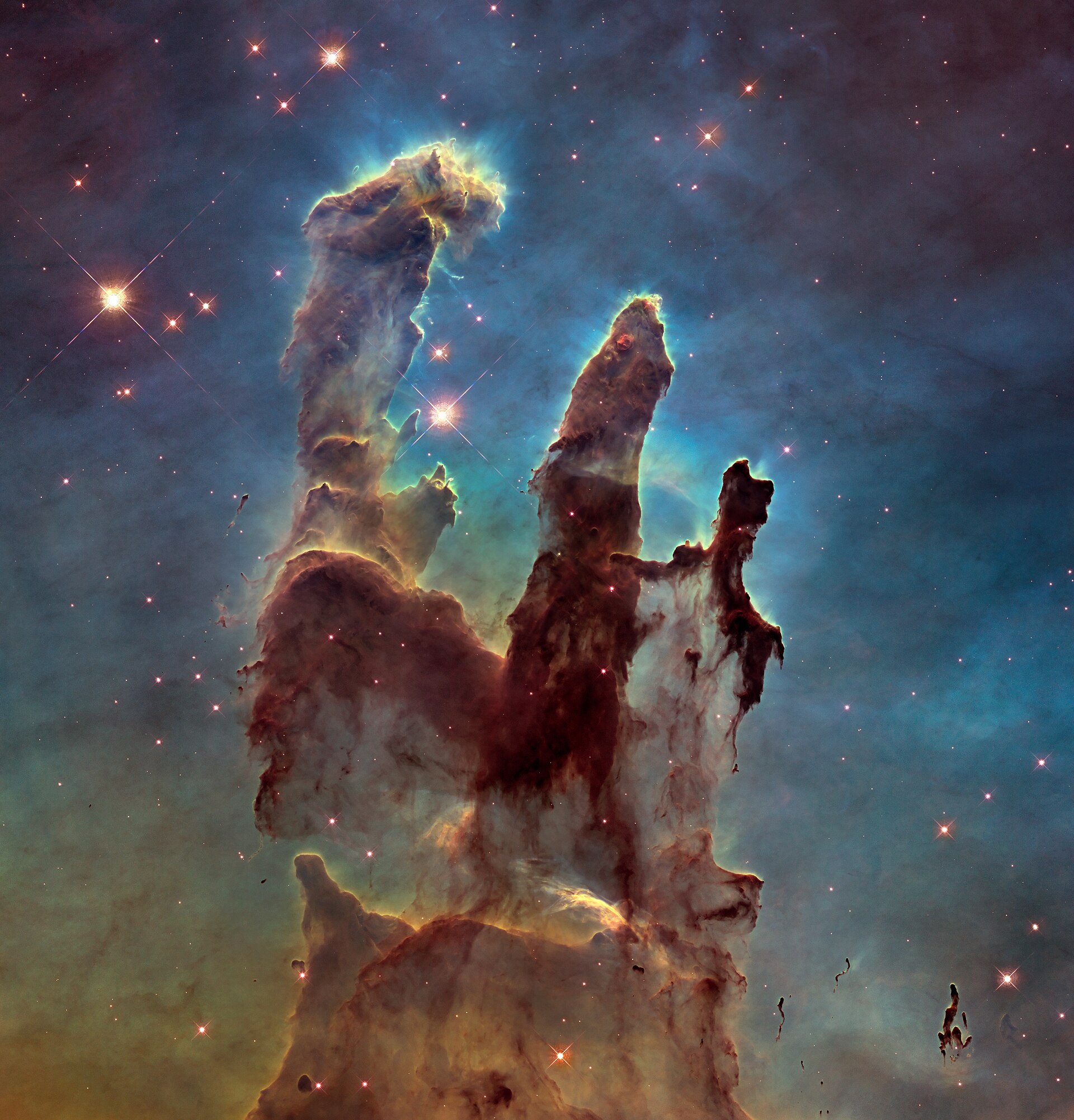
“By him all things consist.” The word means “hold together.” Christ did not merely create the universe and step back. He keeps it in being, every moment. The galaxies in the image above are held in their places by Him — and so is the next breath you take. The letter to the Hebrews says the same: He is the One “by whom also he made the worlds,” “upholding all things by the word of his power” (Hebrews 1:2-3).
“The apostle Paul, writing by the Holy Spirit, declares of Christ that ‘all things have been created through Him, and unto Him; and He is before all things, and in Him all things hold together.’ Colossians 1:16, 17, R.V., margin. The hand that sustains the worlds in space, the hand that holds in their orderly arrangement and tireless activity all things throughout the universe of God, is the hand that was nailed to the cross for us.”
Ellen G. White · Education, p. 132
Peace Through The Blood Of His Cross
“And he is the head of the body, the church: who is the beginning, the firstborn from the dead; that in all things he might have the preeminence. For it pleased the Father that in him should all fulness dwell; And, having made peace through the blood of his cross, by him to reconcile all things unto himself; by him, I say, whether they be things in earth, or things in heaven.”
Colossians 1:18-20
Christ is first in two creations. He is the Maker of the old creation, and He is “the firstborn from the dead,” the beginning of the new. Others had been raised before Him, but only to die again. He was the first to rise to a life that death can never touch, and His resurrection is the pledge of all His people’s. So “in all things” — in creation, in redemption, in the church — “he might have the preeminence.” There is no room above Him, and no need for anything beside Him.
“All fulness” was a favorite word of the teachers at Colossae, who spread God’s “fulness” out across a hierarchy of spiritual beings. Paul says it is not scattered at all. It pleased the Father that all of it should dwell in one Person. And that Person reconciled a universe torn by sin, not by philosophy or angelic intermediaries, but “through the blood of his cross.”
“The apostle exalted Christ before his brethren as the One by whom God had created all things and by whom He had wrought out their redemption. … The Son of God stooped to uplift the fallen. For this He left the sinless worlds on high, the ninety and nine that loved Him, and came to this earth to be ‘wounded for our transgressions’ and ‘bruised for our iniquities.’ Isaiah 53:5.”
Ellen G. White · The Acts of the Apostles, p. 471, 472
“And you, that were sometime alienated and enemies in your mind by wicked works, yet now hath he reconciled In the body of his flesh through death, to present you holy and unblameable and unreproveable in his sight: If ye continue in the faith grounded and settled, and be not moved away from the hope of the gospel, which ye have heard, and which was preached to every creature which is under heaven; whereof I Paul am made a minister;”
Colossians 1:21-23
From the whole universe Paul turns to the Colossians themselves. The enmity was on our side: “enemies in your mind.” God did not need to be persuaded to love us; we needed to be brought back. And He did it “in the body of his flesh through death” — a real body, a real death, against those who taught that the physical world was beneath God. The goal is breathtaking: to present us “holy and unblameable and unreproveable in his sight.”
Then comes a sober “if.” The promise belongs to those who “continue in the faith.” This is not a threat that salvation must be earned; it is a warning not to drift away from the gospel they already have toward something that only sounds deeper. The safety of the believer is in staying “grounded and settled” in Christ.
Christ In You, The Hope Of Glory
“Who now rejoice in my sufferings for you, and fill up that which is behind of the afflictions of Christ in my flesh for his body’s sake, which is the church:”
Colossians 1:24
This verse does not mean Christ’s sacrifice was incomplete. Paul has just said peace was made “through the blood of his cross”; nothing can be added to that. But the church is Christ’s body, and when His body suffers, He suffers with it (“Saul, Saul, why persecutest thou me?”). The sufferings that come to those who carry the gospel to the world are part of Christ’s ongoing mission, and Paul gladly takes his share.
“And Christ says, ‘As Thou hast sent Me into the world, even so have I also sent them into the world’ (John 17:18)—to ‘fill up that which is behind of the afflictions of Christ, … for His body’s sake, which is the church.’ Colossians 1:24. Every soul whom Christ has rescued is called to work in His name for the saving of the lost.”
Ellen G. White · Christ’s Object Lessons, p. 191
“Whereof I am made a minister, according to the dispensation of God which is given to me for you, to fulfil the word of God; Even the mystery which hath been hid from ages and from generations, but now is made manifest to his saints: To whom God would make known what is the riches of the glory of this mystery among the Gentiles; which is Christ in you, the hope of glory:”
Colossians 1:25-27
The false teachers dealt in “mysteries,” secrets reserved for the initiated. Paul uses their word and turns it inside out. The real mystery is not hidden from ordinary believers; it has been “made manifest to his saints.” And its content is astonishing: Christ Himself living in Gentile hearts. (The study of Ephesians 3 traces the same mystery.)
“Souls that have borne the likeness of Satan have been transformed into the image of God. This change is itself the miracle of miracles. A change wrought by the word, it is one of the deepest mysteries of the word. We cannot understand it; we can only believe, as declared by the Scriptures, it is ‘Christ in you, the hope of glory.’ Colossians 1:27.”
Ellen G. White · Education, p. 171
“Whom we preach, warning every man, and teaching every man in all wisdom; that we may present every man perfect in Christ Jesus: Whereunto I also labour, striving according to his working, which worketh in me mightily.”
Colossians 1:28-29
“Every man” three times over. The false teachers offered their “perfection” to a spiritual elite. Paul’s gospel is for everyone, and its goal is to present “every man perfect in Christ Jesus” — complete, mature, lacking nothing, because they are “in Christ.” And the energy for that labor is not Paul’s own. He strives “according to his working, which worketh in me mightily.”
“These words present before the worker for Christ a high attainment, yet this attainment all can reach who, putting themselves under the control of the Great Teacher, learn daily in the school of Christ. The power at God’s command is limitless.”
Ellen G. White · The Acts of the Apostles, p. 368
So the first chapter of Colossians sets the measure for everything that follows. The Colossians were being told they needed something more. Paul has shown them Who they already have: the image of the invisible God, the Creator of angels and galaxies, the One who holds all things together, the firstborn from the dead, the One in whom all fulness dwells, who made peace by His cross and now lives in them as the hope of glory. The next chapter draws the conclusion: in Him, they are complete.