Having shown the Colossians how great Christ is, Paul now draws the conclusion that answers the false teachers: in Him dwells all the fulness of the Godhead, and “ye are complete in him.” Nothing needs to be added — not philosophy, not the worship of angels, not the rituals and holy days of the ceremonial law, not the self-punishing rules of human religion. The shadows have met their substance. The cross has cancelled the record against us and defeated every power that held us.
A study in Colossians 2 · Arthur Baldwin · StandUp4Jesus.Org · 27 min read
All The Treasures Of Wisdom And Knowledge
“For I would that ye knew what great conflict I have for you, and for them at Laodicea, and for as many as have not seen my face in the flesh; That their hearts might be comforted, being knit together in love, and unto all riches of the full assurance of understanding, to the acknowledgement of the mystery of God, and of the Father, and of Christ; In whom are hid all the treasures of wisdom and knowledge. And this I say, lest any man should beguile you with enticing words.”
Colossians 2:1-4
Paul had never met most of these believers, yet he says he is in a “great conflict” for them — the word is agon, the root of our “agony,” the struggle of an athlete or a wrestler. He fights for them in prayer from a prison cell a thousand miles away.
Verse 3 answers the false teachers’ main selling point. They claimed to offer hidden wisdom for the advanced. Paul agrees that the treasures are hidden — but they are hidden “in” Christ, not beyond Him. Whoever has Christ has access to all of them. There is no higher knowledge above Him to climb to.
“Surrounded by the practices and influences of heathenism, the Colossian believers were in danger of being drawn away from the simplicity of the gospel, and Paul, in warning them against this, pointed them to Christ as the only safe guide.”
Ellen G. White · The Acts of the Apostles, p. 473
“For though I be absent in the flesh, yet am I with you in the spirit, joying and beholding your order, and the stedfastness of your faith in Christ. As ye have therefore received Christ Jesus the Lord, so walk ye in him: Rooted and built up in him, and stablished in the faith, as ye have been taught, abounding therein with thanksgiving.”
Colossians 2:5-7
How did you receive Christ? By faith, as a gift, with empty hands. Then that is how you go on. The Christian life does not begin by grace and continue by some other method. We are “rooted” like a tree and “built up” like a house, but always “in him.”
“As it is by giving yourself to God, and believing Him, that you become His child, so you are to live in Him. The apostle says, ‘As ye have therefore received Christ Jesus the Lord, so walk ye in Him.’ Colossians 2:6. Some seem to feel that they must be on probation, and must prove to the Lord that they are reformed, before they can claim His blessing. But they may claim the blessing of God even now.”
Ellen G. White · Steps to Christ, p. 52
Beware Lest Any Man Spoil You
“Beware lest any man spoil you through philosophy and vain deceit, after the tradition of men, after the rudiments of the world, and not after Christ. For in him dwelleth all the fulness of the Godhead bodily. And ye are complete in him, which is the head of all principality and power:”
Colossians 2:8-10
“Spoil” means to carry off as plunder, as a slave-raider carries off captives. The false teaching looked like an enrichment, but it would really rob them. Paul gives its three marks: it is human “tradition,” it is built on “the rudiments of the world” (the elementary principles of worldly religion), and it is “not after Christ.” Any teaching that leaves Christ smaller than it found Him fails the test.
“Christ was the standard by which they were to test the doctrines presented. All that was not in harmony with His teachings they were to reject. Christ crucified for sin, Christ risen from the dead, Christ ascended on high—this was the science of salvation that they were to learn and teach.”
Ellen G. White · The Acts of the Apostles, p. 473
“The warnings of the word of God regarding the perils surrounding the Christian church belong to us today. As in the days of the apostles men tried by tradition and philosophy to destroy faith in the Scriptures, so today, by the pleasing sentiments of higher criticism, evolution, spiritualism, theosophy, and pantheism, the enemy of righteousness is seeking to lead souls into forbidden paths.”
Ellen G. White · The Acts of the Apostles, p. 474
Then comes one of the plainest statements of Christ’s deity in the New Testament. Not a portion, not a reflection, but “all the fulness of the Godhead” dwells in Him — and dwells “bodily,” in a real human body. The One who walked the roads of Galilee was God in the flesh. And the believer who has Him is “complete.” The same Greek root lies behind “fulness” and “complete”: in Him the fulness dwells, and in Him you are filled full.
“Through faith in Christ, every deficiency of character may be supplied, every defilement cleansed, every fault corrected, every excellence developed. ‘Ye are complete in Him.’ Colossians 2:10.”
Ellen G. White · Education, p. 257
Buried With Him In Baptism
“In whom also ye are circumcised with the circumcision made without hands, in putting off the body of the sins of the flesh by the circumcision of Christ: Buried with him in baptism, wherein also ye are risen with him through the faith of the operation of God, who hath raised him from the dead.”
Colossians 2:11-12
The false teachers apparently urged circumcision as a step toward completeness. Paul answers that believers have already received the real thing: a circumcision “made without hands,” the cutting away of the old sinful life, performed by Christ Himself. The outward sign of that inner change in the new covenant is baptism.
Notice the picture Paul uses: “buried with him in baptism,” “risen with him.” Baptism is a burial and a resurrection. That is why the New Testament church baptized by immersion — going down under the water like a body laid in the grave, and coming up like Christ from the tomb. Paul draws the same picture in Romans 6:4: “we are buried with him by baptism into death: that like as Christ was raised up from the dead by the glory of the Father, even so we also should walk in newness of life.” (See the study of Romans 6.) And it is not the water that saves; we rise “through the faith of the operation of God.”
Nailing It To His Cross
“And you, being dead in your sins and the uncircumcision of your flesh, hath he quickened together with him, having forgiven you all trespasses; Blotting out the handwriting of ordinances that was against us, which was contrary to us, and took it out of the way, nailing it to his cross; And having spoiled principalities and powers, he made a shew of them openly, triumphing over them in it.”
Colossians 2:13-15
This is a passage that has often been used to argue that God’s law, and especially the seventh-day Sabbath, was abolished at the cross. So it is worth reading slowly, word by word.
“The handwriting of ordinances.” “Ordinances” translates dogmata, the same word Paul uses in Ephesians 2:15 for “the law of commandments contained in ordinances,” the ceremonial system that stood as “the middle wall of partition” between Jew and Gentile. (The study of Ephesians 2 looks at that wall.) The Ten Commandments were not written by a human hand; they were “written with the finger of God” on stone (Exodus 31:18). The ceremonial law of sacrifices, feasts and rituals was written by Moses “in a book” (Deuteronomy 31:24-26) and placed beside the ark, not inside it.
“There are many who try to blend these two systems, using the texts that speak of the ceremonial law to prove that the moral law has been abolished; but this is a perversion of the Scriptures. The distinction between the two systems is broad and clear. The ceremonial system was made up of symbols pointing to Christ, to His sacrifice and His priesthood. This ritual law, with its sacrifices and ordinances, was to be performed by the Hebrews until type met antitype in the death of Christ, the Lamb of God that taketh away the sin of the world. Then all the sacrificial offerings were to cease. It is this law that Christ ‘took … out of the way, nailing it to His cross.’ Colossians 2:14.”
Ellen G. White · Patriarchs and Prophets, p. 365
“That was against us, which was contrary to us.” A “handwriting” (cheirographon) was a handwritten certificate of debt, an IOU signed by the debtor. The ceremonial system, with its daily sacrifices, stood as a constant written reminder of sin and guilt: every lamb that died said that a debt was owed. At the cross the debt was paid, and the record of it could be cancelled. The notice of a crucified man’s crime was nailed above his head; here the record of our debt is nailed to the cross and declared settled.
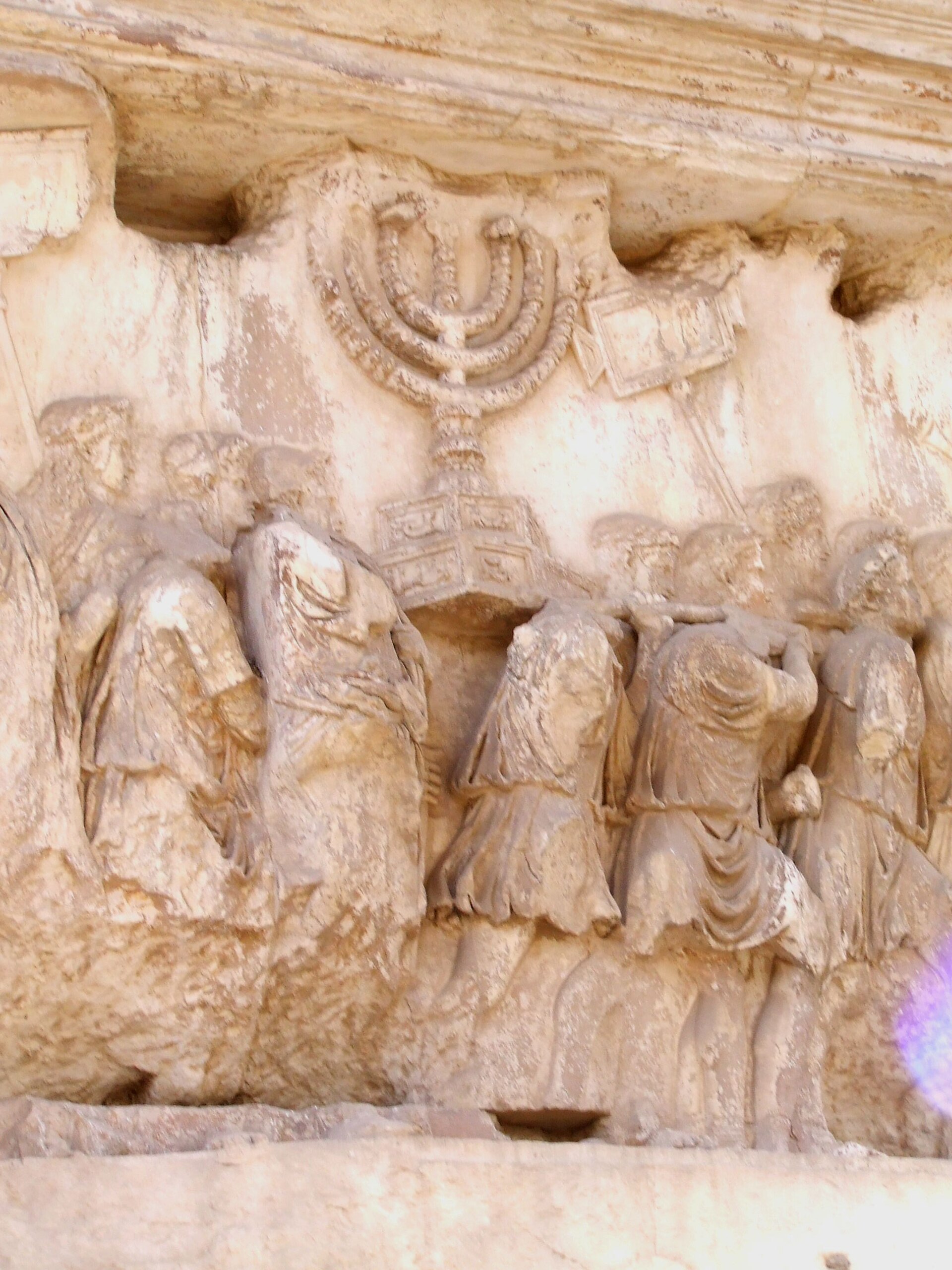
“Triumphing over them.” A Roman triumph was a victory parade through the capital, in which a conquering general displayed his captives and spoils to the whole city — like the procession carved on the arch in the image above. Paul says the cross was Christ’s triumph. What looked like His defeat was the public defeat of every power of darkness.
“In the Saviour’s death the powers of darkness seemed to prevail, and they exulted in their victory. But from the rent sepulcher of Joseph, Jesus came forth a conqueror. ‘Having spoiled principalities and powers, He made a show of them openly, triumphing over them.’ Colossians 2:15.”
Ellen G. White · The Desire of Ages, p. 165
A Shadow Of Things To Come
“Let no man therefore judge you in meat, or in drink, or in respect of an holyday, or of the new moon, or of the sabbath days: Which are a shadow of things to come; but the body is of Christ.”
Colossians 2:16-17
The “therefore” ties this verse to what came before: because the ceremonial ordinances were nailed to the cross, no one should now “judge” believers by them. Paul’s list is not random. It is a set phrase from the Old Testament that always describes the sacrificial calendar of Israel. Here is how Ezekiel describes the duties of the prince in the temple:
“And it shall be the prince’s part to give burnt offerings, and meat offerings, and drink offerings, in the feasts, and in the new moons, and in the sabbaths, in all solemnities of the house of Israel: he shall prepare the sin offering, and the meat offering, and the burnt offering, and the peace offerings, to make reconciliation for the house of Israel.”
Ezekiel 45:17
Meat offerings, drink offerings, feasts, new moons, sabbaths — nearly the whole of Colossians 2:16, in the same order, all describing the offerings of the ceremonial system. (The same yearly-monthly-sabbath series appears in 1 Chronicles 23:31, 2 Chronicles 31:3 and Nehemiah 10:33.) The “sabbath days” in this list are the ceremonial sabbaths: the annual feast days, such as the Day of Atonement and the first and last days of Tabernacles, which Leviticus 23 calls sabbaths and which fell on fixed dates of the year. Leviticus itself distinguishes them from the weekly Sabbath:
“These are the feasts of the LORD, which ye shall proclaim to be holy convocations, to offer an offering made by fire unto the LORD, a burnt offering, and a meat offering, a sacrifice, and drink offerings, every thing upon his day: Beside the sabbaths of the LORD, and beside your gifts, and beside all your vows, and beside all your freewill offerings, which ye give unto the LORD.”
Leviticus 23:37-38
And Paul tells us what kind of things he means: they “are a shadow of things to come.” Every feast pointed forward to something Christ would do — Passover to His death, the wave sheaf to His resurrection, Pentecost to the outpouring of the Spirit. A shadow is useful until the body that casts it arrives. The weekly Sabbath is a different kind of institution. It was not given at Sinai as part of the sacrificial system; it was made at creation, before sin, before there was anything to foreshadow a Saviour. It does not point forward to the cross; it points back to a finished creation: “For in six days the LORD made heaven and earth, the sea, and all that in them is, and rested the seventh day: wherefore the LORD blessed the sabbath day, and hallowed it” (Exodus 20:11). It stands in the Ten Commandments, written by God’s own finger, not in the handwriting of ordinances. (The study of Leviticus 23 traces this distinction feast by feast.)
Jesus Himself confirmed that His death would not end the Sabbath. Speaking of the destruction of Jerusalem, which would come nearly forty years after the cross, He told His disciples to pray that their flight would not be “on the sabbath day” (Matthew 24:20).
“He who made the Sabbath did not abolish it, nailing it to His cross. The Sabbath was not rendered null and void by His death. Forty years after His crucifixion it was still to be held sacred.”
Ellen G. White · The Desire of Ages, p. 630
What about “meat, or in drink”? In the context of the ceremonial calendar, these most naturally refer to the meat (grain) offerings and drink offerings of the festivals, and the ritual food rules that went with them. Nothing in this passage concerns the distinction between clean and unclean animals, which is older than Moses — Noah already knew it when he entered the ark (Genesis 7:2).
And notice what Paul actually forbids: “Let no man therefore judge you.” He is protecting Gentile believers from being condemned for not keeping Jewish feast days. The spirit of the verse applies both ways. It is no more right to make these ceremonial observances a test of fellowship today than it was then.
Not Holding The Head
“Let no man beguile you of your reward in a voluntary humility and worshipping of angels, intruding into those things which he hath not seen, vainly puffed up by his fleshly mind, And not holding the Head, from which all the body by joints and bands having nourishment ministered, and knit together, increaseth with the increase of God.”
Colossians 2:18-19
The false teachers practiced a showy humility: too humble, they said, to approach God directly, so they approached Him through angels. They claimed visions (“intruding into those things which he hath not seen”) and were proud of their spiritual experiences. Paul sees through it. That kind of humility is really pride, and it cuts the believer off from the only true source of life. A body that lets go of its head does not grow; it dies. And the angels they honored had been created by Christ (1:16). Scripture’s angels themselves refuse worship: “See thou do it not: I am thy fellowservant” (Revelation 22:9).
“Wherefore if ye be dead with Christ from the rudiments of the world, why, as though living in the world, are ye subject to ordinances, (Touch not; taste not; handle not; Which all are to perish with the using;) after the commandments and doctrines of men? Which things have indeed a shew of wisdom in will worship, and humility, and neglecting of the body; not in any honour to the satisfying of the flesh.”
Colossians 2:20-23
Finally Paul turns to the ascetic side of the false teaching: a growing list of prohibitions — don’t touch this, don’t even taste that — along with harsh treatment of the body. Paul identifies where these rules come from: they are “after the commandments and doctrines of men.” The phrase echoes Jesus’ words about the Pharisees’ traditions: “in vain do they worship me, teaching for doctrines the commandments of men” (Mark 7:7). These were not God’s laws but human inventions. And they fail at the one thing they claim to do. Self-made rules and self-punishment look impressive, but they have no power to restrain “the satisfying of the flesh.” Only a new life in Christ can do that — which is exactly where the next chapter begins.
So the answer to every “more” the false teachers offered is the same: Christ. In Him all the treasures of wisdom are hidden. In Him all the fulness of the Godhead dwells. In Him the believer is complete. His cross cancelled the debt, ended the shadows, and triumphed over every power. Whoever holds the Head has everything.