Table of Contents
The First Test!
(Based on Daniel Chapter One)
Daniel’s first test was on appetite, just like Adam and Eve had to face in the Garden of Eden! An excellent diet is the most essential foundation for good brain function!
Another Resource: Daniel Chapter 1 by Mark Finley

"1 In the third year of the reign of Jehoiakim king of Judah came Nebuchadnezzar king of Babylon unto Jerusalem, and besieged it.

2 And the Lord gave Jehoiakim king of Judah into his hand, with part of the vessels of the house of God: which he carried into the land of Shinar to the house of his god; and he brought the vessels into the treasure house of his god.

3 And the king spake unto Ashpenaz the master of his eunuchs, that he should bring certain of the children of Israel, and of the king's seed, and of the princes;

4 Children in whom was no blemish, but well favoured, and skilful in all wisdom, and cunning in knowledge, and understanding science, and such as had ability in them to stand in the king's palace, and whom they might teach the learning and the tongue of the Chaldeans.

5 And the king appointed them a daily provision of the king's meat, and of the wine which he drank: so nourishing them three years, that at the end thereof they might stand before the king.

6 Now among these were of the children of Judah, Daniel, Hananiah, Mishael, and Azariah:

7 Unto whom the prince of the eunuchs gave names: for he gave unto Daniel the name of Belteshazzar; and to Hananiah, of Shadrach; and to Mishael, of Meshach; and to Azariah, of Abednego.

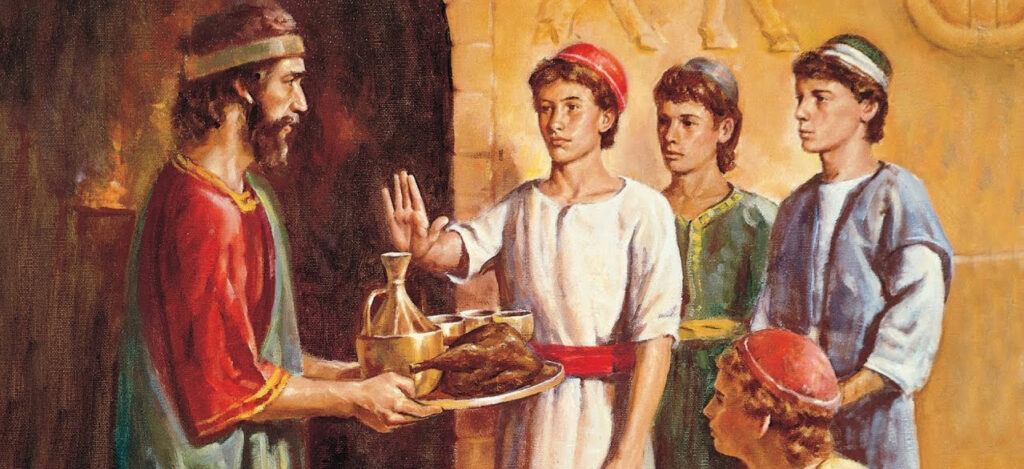
8 But Daniel purposed in his heart that he would not defile himself with the portion of the king's meat, nor with the wine which he drank: therefore he requested of the prince of the eunuchs that he might not defile himself.

9 Now God had brought Daniel into favour and tender love with the prince of the eunuchs.

10 And the prince of the eunuchs said unto Daniel, I fear my lord the king, who hath appointed your meat and your drink: for why should he see your faces worse liking than the children which are of your sort? then shall ye make me endanger my head to the king.

11 Then said Daniel to Melzar, whom the prince of the eunuchs had set over Daniel, Hananiah, Mishael, and Azariah,

12 Prove thy servants, I beseech thee, ten days; and let them give us pulse to eat, and water to drink.

13 Then let our countenances be looked upon before thee, and the countenance of the children that eat of the portion of the king's meat: and as thou seest, deal with thy servants.

14 So he consented to them in this matter, and proved them ten days.

15 And at the end of ten days their countenances appeared fairer and fatter in flesh than all the children which did eat the portion of the king's meat.

16 Thus Melzar took away the portion of their meat, and the wine that they should drink; and gave them pulse.

17 As for these four children, God gave them knowledge and skill in all learning and wisdom: and Daniel had understanding in all visions and dreams.

18 Now at the end of the days that the king had said he should bring them in, then the prince of the eunuchs brought them in before Nebuchadnezzar.

19 And the king communed with them; and among them all was found none like Daniel, Hananiah, Mishael, and Azariah: therefore stood they before the king.

20 And in all matters of wisdom and understanding, that the king enquired of them, he found them ten times better than all the magicians and astrologers that were in all his realm.

21 And Daniel continued even unto the first year of king Cyrus."

Daniel 1:1-21  KJV
Nebuchadnezzar’s Plan
In verses 1 to 5, we see King Nebuchadnezzar has a plan.
And it is a far shrewder plan than it first appears. Nebuchadnezzar does not threaten these boys. He does not torture them, imprison them, or order them to renounce anything. He offers them the best of everything he has — the finest school in the world, three years of it, the language of power, and a place at the king’s own table.
“The king did not compel the Hebrew youth to renounce their faith in favor of idolatry, but he hoped to bring this about gradually. By giving them names significant of idolatry, by bringing them daily into close association with idolatrous customs, and under the influence of the seductive rites of heathen worship, he hoped to induce them to renounce the religion of their nation and to unite with the worship of the Babylonians.”
Ellen G. White · Prophets and Kings, p. 481
That is the whole method in one sentence: not compulsion, but gradual assimilation. Persecution creates martyrs and hardens resistance. Kindness, prestige and a good dinner do the work quietly, and the captive does not notice he has changed until he already has.
The program had four parts, and each one takes a piece of a young man’s identity:
- A new place. Removed from Jerusalem, the temple, the prophets, and every familiar restraint.
- A new language. Three years in “the learning and the tongue of the Chaldeans” — including its astrology and its divination.
- A new name. Handed over on arrival, and this one is worth pausing on.
- A new diet. The king’s own provision, daily, for three years.
What The New Names Meant
Every one of their Hebrew names carried the name of their God, and every replacement carried the name of a Babylonian one.
- Daniel — God is my judge — became Belteshazzar, invoking Bel.
- Hananiah — the LORD is gracious — became Shadrach.
- Mishael — who is like God? — became Meshach.
- Azariah — the LORD has helped — became Abednego, servant of Nebo.
Four boys who could not be addressed, all day, every day, for the rest of their lives, without someone speaking the name of a false god over them. It was a re-education program conducted one greeting at a time.
A Great Battle Appears!
In verses 6 to 8, we see that a battle is now taking shape between God and Satan, and Daniel and his three friends are right in the middle of it!
And here is the thing most readers pass over. They accepted the names. They refused the food.
There is no protest recorded about Belteshazzar. Daniel carried that name to the end of his life and the book itself uses it. They learned the Chaldean language, including material they must have found repugnant. They did not fight every battle available to them — and a young man in a hostile court could have found a battle every hour.
What they would not do was participate. A name imposed on you is something done to you; eating food consecrated to an idol is something you do. Ellen White puts her finger exactly there:
“But a portion having been offered to idols, the food from the king’s table was consecrated to idolatry; and one partaking of it would be regarded as offering homage to the gods of Babylon.”
Ellen G. White · Prophets and Kings, p. 481
That is discernment, and it is rarer than courage. Knowing which hill to die on is most of wisdom, and these were teenagers.
Purposed In His Heart
Verse 8 is the hinge of the chapter, and the verb matters: Daniel purposed in his heart. Not decided when asked. Not worked out under pressure. The matter was settled inwardly before the tray arrived.
“But Daniel did not hesitate. The approval of God was dearer to him than the favor of the most powerful earthly potentate—dearer than life itself. He determined to stand firm in his integrity, let the result be what it might.”
Ellen G. White · Prophets and Kings, p. 483
And the reason he did not hesitate is not that he was made of different material. It is that the work had been done years earlier, in a home:
“Daniel and his associates had been trained by their parents to habits of strict temperance. … No power, no influence, could sway them from the principles they had learned in early life by a study of the word and works of God.”
Ellen G. White · Prophets and Kings, pp. 482
Somewhere in Jerusalem there were parents who never saw any of this. They taught four boys the word of God and habits of self-control, and then watched them marched off to a pagan empire, and as far as we know died not knowing it had held.
And the stakes of a single compromise are stated more sharply than we usually put them:
“Should they compromise with wrong in this instance by yielding to the pressure of circumstances, their departure from principle would weaken their sense of right and their abhorrence of wrong.”
Ellen G. White · Prophets and Kings, p. 483
The danger was never the meal. It was what the next refusal would cost after this one had been surrendered — the conscience worn down one reasonable exception at a time, until nothing is left that can say no.
How He Asked
Notice the manner, because it is as instructive as the stand.
Daniel does not denounce the king’s table, stage a hunger strike, or lecture anyone about idolatry. He requests. When the steward explains his genuine fear — his own head is on the line if these boys look worse than the others — Daniel does not dismiss the concern. He proposes something that answers it: prove thy servants ten days, and judge by the result.
He gives the man a way to say yes without risking his neck. Convictions held that way tend to be heard; the same conviction delivered as a rebuke would have ended the conversation and probably the four careers.
And behind the courtesy, verse 9 quietly records who was actually at work: God had brought Daniel into favour and tender love with the prince of the eunuchs. Daniel asked well. God had gone ahead of the asking.
Ten Times Better
Three years later the whole class was examined by the king himself, and the result is recorded without modesty:
“At the court of Babylon were gathered representatives from all lands, men of the highest talent, men the most richly endowed with natural gifts, and possessed of the broadest culture that the world could bestow; yet among them all, the Hebrew youth were without a peer.”
Ellen G. White · Prophets and Kings, p. 485
Your point about diet and brain function is exactly what she draws out — that the outward evidence of temperance was visible on them, “the erect form, the firm, elastic step, the fair countenance, the undimmed senses, the untainted breath—all… so many certificates of good habits.”
But the chapter is careful, and we should be too. Verse 17 does not say their diet made them clever. It says God gave them knowledge and skill in all learning and wisdom. Ellen White says the same in the next breath — “their learning did not come by chance” (p. 486); they worked, and God blessed the working.
So this is not a promise that a careful diet produces genius. It is something better and less tidy: a body kept clear enough to be used, a mind not dulled by what dulls it, diligence in the actual study — and God adding what no discipline can manufacture. Take any one of those away and there is no Daniel.
Why Appetite, And Why First
Your opening line puts it where it belongs. The first test in Eden was over food, and so is this one — and so was the first temptation in the wilderness, where the second Adam was told to command that stones be made bread.
Three decisive contests, all at the same point, and the reason is not that eating is uniquely wicked. It is that appetite is the plainest, most daily place where a man either governs himself or is governed. It arrives three times a day, it never argues, and it never stops asking. Whoever holds that ground holds a great deal else.
Eve lost there. Daniel held there. Christ held there for us — which is the only reason any of us can.
And the last line of the chapter is a quiet monument to the whole thing: Daniel continued even unto the first year of king Cyrus. He outlasted the empire that captured him. The boy who would not take the king’s wine was still standing when the kingdom that offered it had fallen — which is a story told in chapter 5.
The Greatest Want Of The World
Ellen White tells this chapter’s story in Education, and having told it she stops and says what it is for. The sentence has been quoted a great many times, and it is worth remembering that it was written about four teenagers refusing a dinner:
“The greatest want of the world is the want of men—men who will not be bought or sold, men who in their inmost souls are true and honest, men who do not fear to call sin by its right name, men whose conscience is as true to duty as the needle to the pole, men who will stand for the right though the heavens fall.”
Ellen G. White · Education, p. 57
Men who will not be bought or sold. Nebuchadnezzar was not trying to break Daniel. He was trying to buy him, and he offered a fair price — the best education on earth, a career at the centre of the world, and food from the king’s own table. That is how most people are actually lost: not overpowered, but purchased, at a price they were pleased to accept.
And the compass image is exact. A needle is not brave. It has no opinion about north and takes no credit for pointing there — it simply answers to something outside itself, steadily, whether the ship is calm or rolling. That is what Daniel’s parents had built into him before Babylon ever saw him, and it is why verse 8 needed no deliberation.
The chapter does not end by telling us to be remarkable. It shows us where such men come from — a home, a habit, a settled purpose formed long before the test — and then it leaves the question with whoever is reading.
