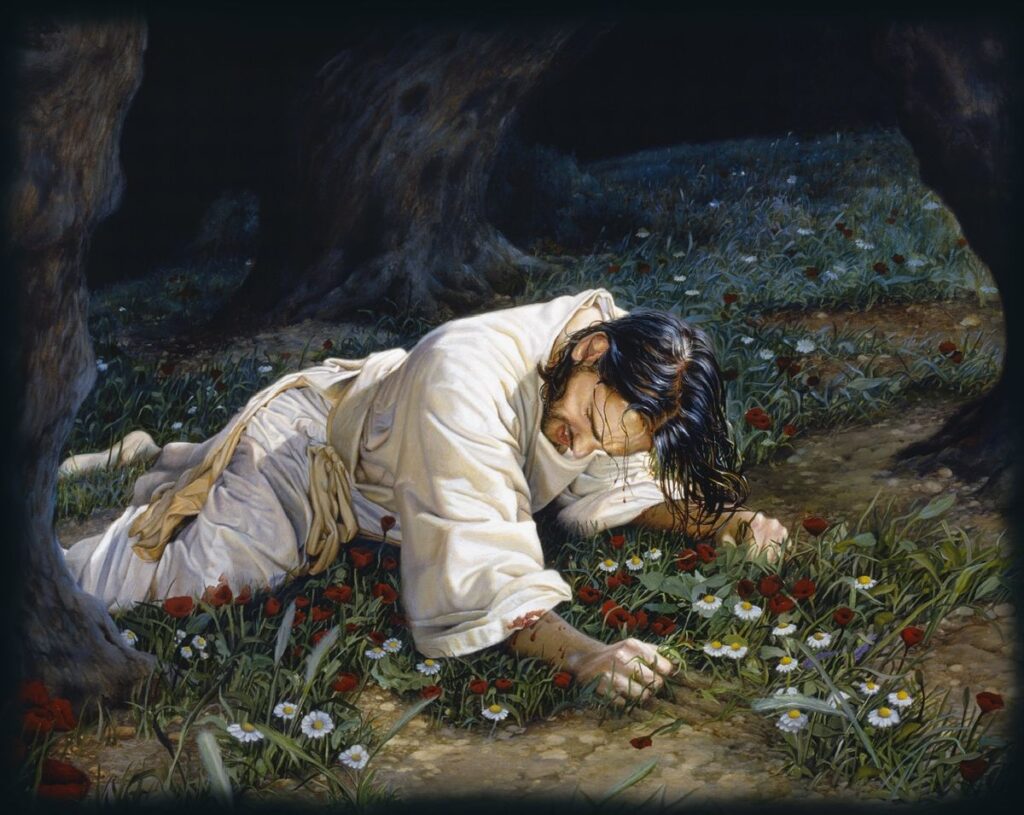
Everyone knows what the cross cost the Son. This study is about what it cost the Father — the One who could have stopped it at any second, and did not.
A study on the sacrifice of God · Arthur Baldwin · StandUp4Jesus.Org · 13 min read
Table of Contents
There is a sentence in the Bible that almost everybody can finish, and almost nobody hears all the way through. We have heard it on placards at ball games and on the back of pens. Familiarity is not the same as understanding, and a verse can be memorized into silence.
“For God so loved the world, that he gave his only begotten Son, that whosoever believeth in him should not perish, but have everlasting life.”
John 3:16
The agony of Gethsemane and the six hours on the cross are told in full elsewhere on this site, in The Ultimate Sacrifice. That study stands where most of us stand, looking at the Son. This one stands a step to the side and asks a question the Bible answers more quietly, and never at length: what did it cost the Father?
The Word In John 3:16 That Gets Skipped
Read the verse again and watch where the weight naturally lands. Most of us put it on so loved — and no wonder, because that is the warm part. But so loved is a measurement without a unit. It tells you there was a great deal of love; it does not tell you how much. The unit is in the next clause, and it is a verb: He gave.
Love that costs the lover nothing is a feeling. Love that costs everything is a fact, and it can be measured, because you can look at what was handed over. John does not write God so loved the world that He felt deeply about it. He writes that God gave, and then names what He gave: not an angel, not a prophet, not a rescue plan — His only begotten Son.
Notice one more thing about the grammar. The giving is finished — it is in the past tense, done, not offered on approval. The perishing is in the present. The gift was completed at a moment in history whether or not a single person ever accepted it, and that is a strange way to give anything. No one hands over what they love most against a maybe.
So the subject of this study is not the crucifixion, exactly. It is the Giver.
The One Story Told From The Father’s Side
Scripture almost never describes God’s feelings about Calvary directly. What it does instead is stage the whole thing once, in miniature, using a human father — and then let us watch that man’s face.
“And he said, Take now thy son, thine only son Isaac, whom thou lovest, and get thee into the land of Moriah; and offer him there for a burnt offering upon one of the mountains which I will tell thee of.”
Genesis 22:2
Count the words the command does not need. Thy son would have been enough to identify him. Thine only son is added. Isaac is added. Whom thou lovest is added. Four times over, God makes sure Abraham cannot hold the request at arm’s length by thinking of the boy as a category instead of a person. Every one of those four phrases is a hand pressed on a bruise — and every one of them is also true of Someone else.
Then comes the walk. Three days of it, which is the cruelest detail in the chapter. A man who is asked to do a terrible thing in one instant may do it before he can think; a man given seventy-two hours has time to imagine it, refuse it, agree to it and imagine it again, over and over, with the boy walking beside him asking ordinary questions. And on the third day, one of those questions:
“And Isaac spake unto Abraham his father, and said, My father: and he said, Here am I, my son. And he said, Behold the fire and the wood: but where is the lamb for a burnt offering? And Abraham said, My son, God will provide himself a lamb for a burnt offering: so they went both of them together.”
Genesis 22:7, 8
“So they went both of them together.” The sentence is repeated twice in the chapter, and the second time it comes after Isaac knows. This is not an ambush; it is two people walking up a hill in agreement, which is a much heavier thing to read.
And at the last possible instant — knife up, boy bound, the whole horror one second from happening — the story is stopped:
“And he said, Lay not thine hand upon the lad, neither do thou any thing unto him: for now I know that thou fearest God, seeing thou hast not withheld thy son, thine only son from me.”
Genesis 22:12
Now, why put a man through that? Not to find out something God did not already know, and not for the sake of cruelty. Ellen White reads the purpose off the text itself, and her explanation is the reason this chapter belongs in a study about the Father:
“The agony which he endured during the dark days of that fearful trial was permitted that he might understand from his own experience something of the greatness of the sacrifice made by the infinite God for man’s redemption.”
Ellen G. White · Patriarchs and Prophets, p. 154
Moriah was a rehearsal, staged at enormous expense for one man, so that one man could feel a fraction of what God feels. Which means every reader who has ever winced at Genesis 22 has been told, quite deliberately, that wince is the point — now multiply it.
And then there is the difference between the rehearsal and the real thing, which is the whole subject of this study in one line:
“The angels who witnessed the humiliation and soul anguish of the Son of God were not permitted to interpose, as in the case of Isaac. There was no voice to cry, ‘It is enough.’”
Ellen G. White · Patriarchs and Prophets, p. 154
Abraham’s hand was caught in mid-air. Nobody caught God’s. There was a voice available — there was always a voice available, and twelve legions of angels waiting on it — and it never came. The Father listened to His Son ask why He had been forsaken, and answered nothing.
One more detail, easy to miss. Centuries later, Solomon built the temple “in mount Moriah” (2 Chronicles 3:1) — the same ridge. The place where a father was stopped became the place where the whole sacrificial system was housed, morning and evening, for a thousand years, until the Lamb God promised to provide for Himself arrived and was not stopped.
It Did Not Buy God’s Love. It Proved It.
Here is where a great deal of well-meant preaching goes wrong, and where it matters most to get it right — because what is at stake is not a fine point of doctrine but the character of God, which is the actual subject of the whole controversy this world is caught in.
The picture many people carry, sometimes without ever putting it into words, runs roughly like this: God the Father is angry and holds a grudge; Jesus is kind and steps between; the Son’s blood changes the Father’s mind. It is a moving story. It is also exactly backwards, and Scripture will not have it.
“But this great sacrifice was not made in order to create in the Father’s heart a love for man, not to make Him willing to save. No, no! ‘God so loved the world, that He gave His only-begotten Son.’ John 3:16. The Father loves us, not because of the great propitiation, but He provided the propitiation because He loves us.”
Ellen G. White · Steps to Christ, p. 13
Read that middle sentence twice. The love came first. The cross is not the cause of the Father’s affection for you; it is the evidence of it. Paul says the same thing without a spare word: “God was in Christ, reconciling the world unto himself” (2 Corinthians 5:19). Not reconciling Himself to the world. The party that needed reconciling was us.
And then the sentence that gives this article its subject, four words long:
“God suffered with His Son. In the agony of Gethsemane, the death of Calvary, the heart of Infinite Love paid the price of our redemption.”
Ellen G. White · Steps to Christ, p. 13
God suffered with His Son. Not watched. Not permitted. Suffered with. Whatever else is mysterious about the Godhead, this much is stated plainly: there was no unaffected spectator in heaven that afternoon. The Father was not somewhere else, comfortable, receiving a payment. He was paying it.
If you have ever loved somebody who was in pain you know a little of the arithmetic here. The one who watches often suffers more than the one who is hurt, because the watcher can do nothing and cannot even trade places. Now imagine you could trade places, could end it with a word, and love was the exact reason you would not. That is what the Bible is asking us to look at.
What Was Given, And For How Long
There is a quiet assumption in most of our thinking about the incarnation: that it was a visit. Jesus came down, did what needed doing, went home, and things went back to how they were. That assumption is wrong, and correcting it raises the price of the gift considerably.
When Jesus rose, He did not step out of humanity the way a man steps out of a coat. He kept the body. He invited His disciples to check:
“Behold my hands and my feet, that it is I myself: handle me, and see; for a spirit hath not flesh and bones, as ye see me have.”
Luke 24:39
And when John is shown the throne room of heaven, long after the ascension, the central figure is not restored to how He looked before. He is marked:
“And I beheld, and, lo, in the midst of the throne and of the four beasts, and in the midst of the elders, stood a Lamb as it had been slain.”
Revelation 5:6
The scars did not heal over. In the middle of heaven, where nothing is broken, there is one thing that still bears the marks of this planet — and it is the Son of God. Hebrews says He “is not ashamed to call them brethren” (Hebrews 2:11), which is a startling sentence when you consider who the brethren are.
“He who was one with God has linked Himself with the children of men by ties that are never to be broken. Jesus is ‘not ashamed to call them brethren’ (Hebrews 2:11); He is our Sacrifice, our Advocate, our Brother, bearing our human form before the Father’s throne, and through eternal ages one with the race He has redeemed—the Son of man.”
Ellen G. White · Steps to Christ, p. 14
Through eternal ages. The Father did not lend His Son to the human race for thirty-three years and get Him back unchanged. He gave Him to us, permanently, and the arrangement holds after the last sinner is saved and the last star is made new. Whatever the Son laid aside, He laid aside for good.
Nobody who has given a child away in any sense — to a marriage, to a country’s army, to a mission field on the other side of the world — needs this explained further. The gift that costs is the one you do not get back.
The Darkness Was A Curtain
Around noon on the day of the crucifixion something happened to the sky that the Gospel writers report without explaining:
“Now from the sixth hour there was darkness over all the land unto the ninth hour. And about the ninth hour Jesus cried with a loud voice, saying, Eli, Eli, lama sabachthani? that is to say, My God, my God, why hast thou forsaken me?”
Matthew 27:45, 46
Three hours of darkness in the middle of the day, and out of it the loneliest sentence ever spoken. It is usually read as proof that the Father turned away. Ellen White’s account says something more careful, and more terrible:
“God and His holy angels were beside the cross. The Father was with His Son. Yet His presence was not revealed. Had His glory flashed forth from the cloud, every human beholder would have been destroyed. And in that dreadful hour Christ was not to be comforted with the Father’s presence.”
Ellen G. White · The Desire of Ages, p. 754
He was there the whole time. He simply could not be seen — and would not be felt, because the sin His Son was carrying stood between them, and because unveiled glory at that range would have killed every person on the hill, including the ones who put Him there. So the Father did the only thing love could still do: He drew a curtain over His Son’s last hour, so the mockery would at least happen in the dark.
Consider what that means for the One who drew it. The most natural act of a father is to come near and be recognized — to say I am here. That is precisely the one thing He could not do. He was close enough to touch His Son and had to withhold the touch, because to reveal Himself was to end the plan and lose the world.
Silence is not always absence. Sometimes it is the most expensive form of presence there is.
Why It Had To Be A Sacrifice At All
A fair question sits underneath all of this, and honest people ask it: if God is God, why not simply forgive? Why the blood at all? Could He not have waived the penalty and spared Himself the entire business?
The answer turns on something this site teaches everywhere it can: God’s law is a description of God’s character. The Ten Commandments are not a policy He adopted and could therefore repeal; they are what love looks like when you write it down. To amend the law would be to amend Himself — and the sentence attached to breaking it is not an arbitrary fine but a statement of fact about what separation from the Source of life does to a creature.
“Behold, all souls are mine; as the soul of the father, so also the soul of the son is mine: the soul that sinneth, it shall die.”
Ezekiel 18:4
So there were exactly two roads open. Let the race have what it had chosen, and watch it die. Or find a substitute of infinite value, willing and sinless, whose death could stand in for all of them — and there was only one candidate in the universe, and He was not a stranger.
“When man was doomed to death by transgression of the law of God, the Father, looking upon His Son, said to the sinner, ‘Live: I have found a ransom.’”
Ellen G. White · Patriarchs and Prophets, p. 154
Looking upon His Son — that is where the price tag was read. And Paul names the exact problem the cross solves, which is not God’s reluctance to forgive but God’s determination to remain just while doing it:
“To declare, I say, at this time his righteousness: that he might be just, and the justifier of him which believeth in Jesus.”
Romans 3:26
Just and the justifier. A judge who lets the guilty off is not merciful, he is corrupt, and a universe run that way would never be safe again. God refused both easy exits. He would not lower the standard, and He would not lose the race — so He paid the difference Himself, in the only currency He had that was worth that much.
Decided Before There Was Anyone To Thank Him
One more fact, and it is the one that settles the question of whether God was surprised into generosity.
“But with the precious blood of Christ, as of a lamb without blemish and without spot: who verily was foreordained before the foundation of the world, but was manifest in these last times for you.”
1 Peter 1:19, 20
John says it in four words that ought to stop a reader cold — “the Lamb slain from the foundation of the world” (Revelation 13:8). Before Eden. Before Adam drew breath. Before there was one human being in existence to be grateful, the price had been named and agreed.
Which means the creation of this world was not a cheerful project that went wrong. God made a race of free beings knowing exactly what freedom would cost Him, priced it in advance in the blood of His own Son, and went ahead and made them anyway. He was never gambling. He knew the bill before He signed for it.
That single fact answers the oldest accusation in the universe — that God is severe, self-serving, a keeper of rules for His own benefit. You do not answer a charge like that with an argument. You answer it with evidence, in public, where the angels and the unfallen worlds can see it, and the evidence has a name and hands with holes in them.
What A Gift Like That Asks
Paul draws the practical conclusion, and his logic runs from the greater thing to the lesser:
“He that spared not his own Son, but delivered him up for us all, how shall he not with him also freely give us all things?”
Romans 8:32
The argument is airtight and it is meant for the anxious. If the Father has already parted with the most valuable thing in existence for your sake, the smaller mercies you are afraid to ask for are not in doubt. Nobody sells the house and then quibbles over the doorknob. When you next find yourself wondering whether God is really inclined toward you, the answer is already lying on a hill outside Jerusalem, and it is not ambiguous.
And there is one response the New Testament asks for, phrased in the language of the altar on purpose:
“I beseech you therefore, brethren, by the mercies of God, that ye present your bodies a living sacrifice, holy, acceptable unto God, which is your reasonable service.”
Romans 12:1
A living sacrifice — the one kind of offering that can climb down off the altar, and the reason Paul has to say “I beseech you.” He does not command it, and he does not argue for it on the grounds that God deserves it, though He does. He asks for it by the mercies of God. In other words: look at what it cost Him, and then decide.
That is the whole appeal of this study. Not guilt, which never held anybody for long. Just a clear sight of a Father who watched His only Son die in the dark rather than lose you — and who has never once, since the foundation of the world, called it too high a price.
