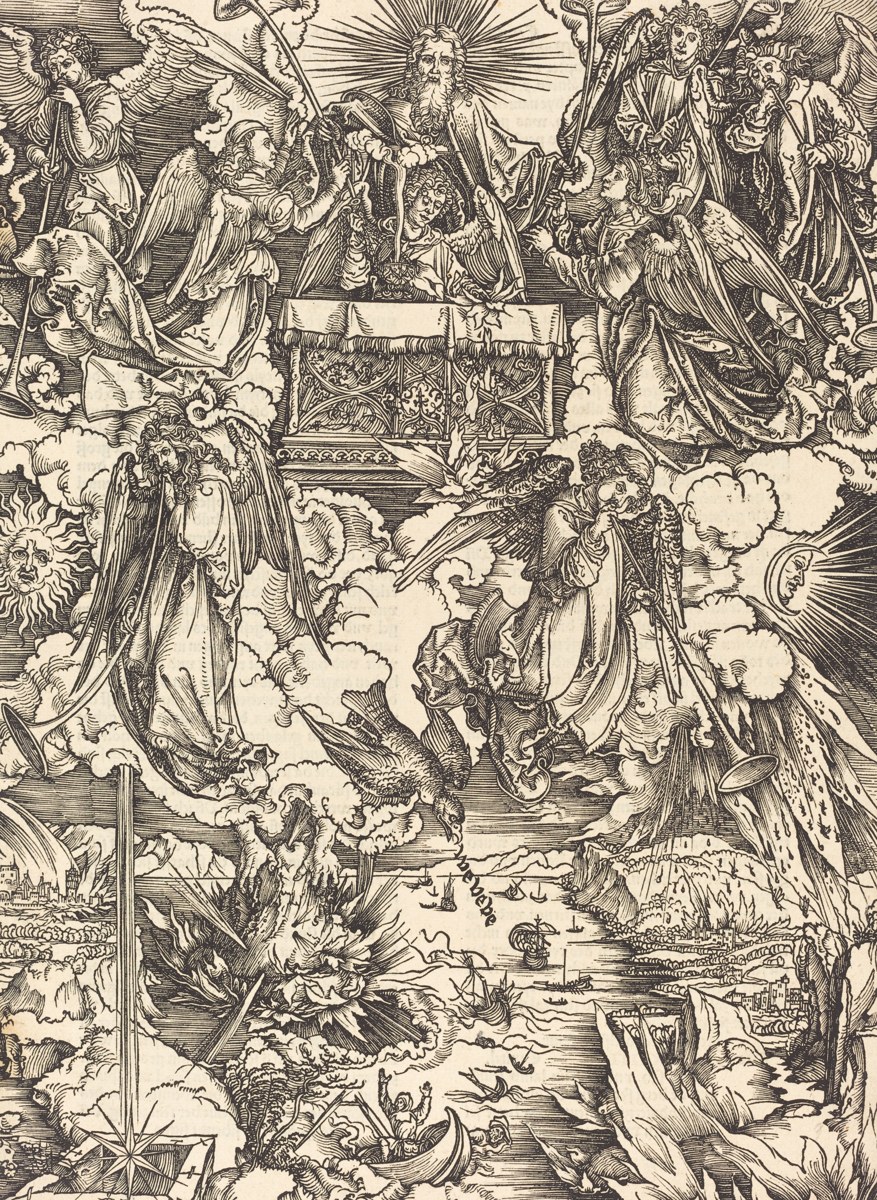
The seventh seal comes off and nothing happens. No thunder, no rider, no voice — half an hour of silence in the noisiest room in Scripture. Then seven angels pick up seven trumpets.
A Bible study on Revelation 8 · Arthur Baldwin · StandUp4Jesus.Org · 13 min read
Table of Contents
Six seals produced horses, martyrs, an earthquake and a sky rolled up like a scroll. A reader who has come this far expects the seventh to be the loudest of the lot. It is the quietest verse in the book.
Silence In Heaven
“And when he had opened the seventh seal, there was silence in heaven about the space of half an hour.”
Revelation 8:1
To feel the weight of that, remember what heaven has sounded like for the last four chapters. Four living creatures who “rest not day and night” saying Holy, holy, holy. Twenty-four elders falling down and singing. A hundred million angels shouting Worthy is the Lamb. A multitude nobody can count crying Salvation to our God.
And then, nothing. Not a lull, not a pause between songs — silence in heaven, and long enough to be measured.
Silence is a strange thing to write down. A vision is made of sights and sounds, and John has spent seven chapters reporting both; here he reports the absence of one, and takes the trouble to say how long it lasted. He thought the quiet was information.
Something has to account for that, and the simplest explanation is the one this study follows: heaven is quiet because heaven is empty. Jesus said He would come with all the holy angels with Him. If the throne room falls silent, it is because the singers have gone somewhere — and there is only one errand in Scripture that would take the entire population of heaven out of the room at once.
“When the Son of man shall come in his glory, and all the holy angels with him, then shall he sit upon the throne of his glory:”
Matthew 25:31
All the holy angels. If that is where they are, the throne room is empty, and an empty throne room is a silent one. On this reading the seventh seal has no content to describe because its content is an absence — and the absence is the best news in the book.
It is worth adding what the silence is not. It is not God going quiet on the world; the world is about to hear seven trumpets. It is not a gap in the record, as though John dozed. It is a measured stretch of time in which the most crowded place in existence has nobody left in it, because everybody went to a funeral that turned into a homecoming.
How Long Is Half An Hour?
Prophetic time in Scripture runs on a stated principle, given twice:
“I have appointed thee each day for a year.”
Ezekiel 4:6
A prophetic day is a year. A prophetic year is 360 days, and a day has twenty-four hours — so a single prophetic hour works out at fifteen literal days, and half of one at seven and a half.
But the verse does not say half an hour. It says about the space of half an hour, and the word about is doing real work. John is describing a duration he did not time with a clock, and the text declines to be exact where a reader would most like it to be.
Which is where a second witness becomes interesting. In her earliest published vision, Ellen White described the journey of the redeemed after Christ comes for them:
“We all entered the cloud together, and were seven days ascending to the sea of glass, when Jesus brought the crowns, and with His own right hand placed them on our heads.”
Early Writings, p. 16
Seven days. Not seven and a half — seven, which is what about half an hour leaves room for, and which is the number this site takes as the length of the silence. It is worth being clear that this is a reading rather than a demonstration: the text gives an approximation, the vision gives a number, and putting the two together is an inference. But it is a tidy one, and it has a consequence worth noticing.
A journey of exactly seven days begins and ends on the same day of the week. Seven and a half would not. If the trip home takes a week to the day, then the arrival falls on the same weekday as the departure — and God, who rested on the seventh day at creation and wrote it into His law, would be honouring His own Sabbath at the end of the journey home.
That also puts the halfway mark at around three and a half days: the point where the descent has finished and the ascent has begun, with the whole company of the redeemed gathered and the earth behind them.
None of which should be pressed harder than the text allows. The verse says about, and a study that turns an approximation into a timetable has stopped reading and started calculating. What the half hour establishes is that the silence has a length at all — that it is an event with a beginning and an end, and not a permanent state.
The Angel With The Golden Censer
“And another angel came and stood at the altar, having a golden censer; and there was given unto him much incense, that he should offer it with the prayers of all saints upon the golden altar which was before the throne.”
Revelation 8:3
The prayers are back. In chapter 5 they were held in golden vials by the elders; here they are offered on the altar, and they do not go up alone. Much incense is given to the angel to offer with them.
That is not decoration. Prayers of ordinary people do not arrive at the throne in the state they left in. Something is added to them, from a supply that is given rather than earned, and what ascends is the mixture: “And the smoke of the incense, which came with the prayers of the saints, ascended up before God out of the angel’s hand” (Revelation 8:4).
The service being described is the daily one. Aaron was to burn sweet incense on the golden altar “every morning: when he dresseth the lamps” (Exodus 30:7) — every day, without fail, for as long as the sanctuary stood. What Revelation shows at the golden altar is that same unbroken ministry, still running, with a Person at the altar and a supply of incense that is given to Him for the purpose.
Then the same censer is used for something else entirely:
“And the angel took the censer, and filled it with fire of the altar, and cast it into the earth: and there were voices, and thunderings, and lightnings, and an earthquake.”
Revelation 8:5
The vessel that carried prayers up is filled with fire and thrown down. Whatever else that pictures, it marks the end of something — the censer is no longer being used for incense. And the four words that follow, voices, thunderings, lightnings, earthquake, are the same weather that came out of the throne in chapter 4, arriving now on the ground.
That gesture has a name in this site’s reading of prophecy: the close of probation. There comes a point at which intercession finishes, not because God tires of it but because everyone has decided. Revelation says it plainly a few chapters later, when the temple fills with smoke and “no man was able to enter into the temple, till the seven plagues of the seven angels were fulfilled” (Revelation 15:8). The censer thrown down in chapter 8 is that moment in miniature — and the trumpets sound afterwards, which is the order worth remembering. The subject is followed further in The Last Days.
Seven Trumpets
Trumpets in Israel were not orchestral instruments. Moses was given silver trumpets for a short list of national purposes — calling the assembly, striking camp, marking a feast, and this:
“And if ye go to war in your land against the enemy that oppresseth you, then ye shall blow an alarm with the trumpets; and ye shall be remembered before the LORD your God, and ye shall be saved from your enemies.”
Numbers 10:9
An alarm, so that a people would be remembered. That is the register these seven trumpets sound in. They are not the plagues — those come later, and they fall on a world that has finished deciding. A trumpet is a warning blown while there is still something to be warned about, and every one of these strikes a third part and leaves two thirds standing.
The contrast with the plagues is exact and it is worth setting down. The trumpets take a third; the plagues in chapter 16 take everything they touch. The trumpets are announced in advance by an angel flying through heaven; the plagues fall after the temple has filled with smoke and nobody can go in. The trumpets are aimed at a world that can still hear them. That is the whole difference between a warning and a verdict.
The First Four
The first four come in a rush, each shorter than the last, and each strikes a different part of the created world: the land, the sea, the rivers, and the lights in the sky.
“The first angel sounded, and there followed hail and fire mingled with blood, and they were cast upon the earth: and the third part of trees was burnt up, and all green grass was burnt up.”
Revelation 8:7
Then a burning mountain thrown into the sea, turning a third of it to blood and destroying a third of the ships. Then a star called Wormwood falling on the rivers and the fountains of waters, making them bitter. Then a third of the sun, moon and stars struck, so that “the day shone not for a third part of it, and the night likewise” (Revelation 8:12).
Read in the historicist tradition this site follows, these four sound over the long collapse of the empire that had crucified Christ and hunted His church — invasion by land, then by sea, then the poisoning of what a civilisation drinks from, then the going out of its lights. Trees and grass, ships and sea, rivers and fountains, sun and moon: the picture moves from what is burned, to what is drowned, to what is embittered, to what simply stops giving light.
Commentators have matched those four to particular invasions and particular dates, and this study is content to leave the matching where it found it. What the text itself insists on is the proportion. Not the earth — a third of it. Not the sea — a third. Not the sun — a third. Judgment that stops short, four times running, is not judgment at the end of patience. It is an alarm.
One name in the list is worth a sentence of its own. Wormwood is a bitter herb, and in the prophets it is what God gives a people who have exchanged truth for something else — bitterness in the water is bitterness in what they are taking their teaching from. A star falling from heaven and embittering the fountains is a picture with a long history in Scripture, and it is about doctrine before it is about rivers.
“Therefore thus saith the LORD of hosts, the God of Israel; Behold, I will feed them, even this people, with wormwood, and give them water of gall to drink.”
Jeremiah 9:15
Jeremiah was speaking to a nation that had teachers it preferred to the truth. The bitterness was not arbitrary punishment; it was what happens when a people drink long enough from a poisoned spring. A third of the fountains, in Revelation 8, is a third of what a civilisation believes.
Woe, Woe, Woe
“And I beheld, and heard an angel flying through the midst of heaven, saying with a loud voice, Woe, woe, woe, to the inhabiters of the earth by reason of the other voices of the trumpet of the three angels, which are yet to sound!”
Revelation 8:13
The chapter closes with a warning about the chapter after it. Three trumpets are still to come, and they are given a name the first four did not get: woes. Whatever difference there is between a trumpet and a woe, the angel thinks it is worth flying across heaven to announce in advance.
Notice, though, that the announcement is itself a mercy. Nobody is ambushed in this book. The winds were held before they blew, the sealing came before the trouble, and now the last three trumpets are announced before they sound.
That pattern is now firmly established, and it is one of the kindest things about Revelation. The letters told each church what was wrong before anything happened to it. The seals were opened one at a time by a Lamb. The winds were held until the sealing was done. And here an angel crosses the sky to say that the next three trumpets are worse than the last four. A reader is never further than one page from a warning.
What This Asks Of Us
Two things in this chapter are worth carrying away, and they sit at opposite ends of it.
The first is the silence. Whatever its exact length, heaven falls quiet because everyone in it has gone to collect somebody. The most extravagant thing God has ever done with the population of heaven is spend all of it on a journey to fetch people home.
Which is worth setting against the way people usually picture the end of the world. The common picture is abandonment — a God who finally gives up on a bad planet. Revelation 8 opens with the opposite: heaven emptied, not shut; every angel deployed on a rescue; and the room where the singing never stopped standing silent because everyone who lives there is out on the errand.
The second is the incense. Between the silence and the trumpets stands an angel at an altar with much incense given to him, mixing it with the prayers of ordinary people so that what reaches the throne is acceptable. Nobody prays well enough. That was never the arrangement.
And notice the timing of that too. The incense is offered after the silence and before the trumpets — which is to say, the last thing that happens before the alarms start is somebody making sure the prayers of ordinary people have been heard properly.
And the trumpets themselves are not the end. They take a third and leave two thirds, four times over, and then an angel flies across the sky to warn about the rest. This is a chapter about how long God will keep making noise before He stops.
Next in this series: The Key Of The Bottomless Pit — the fifth and sixth trumpets, and the two woes that come up out of the smoke.
