Two witnesses prophesy in sackcloth for twelve hundred and sixty days, are killed by a beast out of the pit, and lie unburied in a street while the world sends each other presents. Three and a half days later they stand up. All of it happened, and the dates are in the record.
A Bible study on Revelation 11 · Arthur Baldwin · StandUp4Jesus.Org · 15 min read
Table of Contents
This is the chapter where Revelation stops being general. The seals covered centuries in a sentence each; the trumpets sounded over the fall of empires. Chapter 11 gives a period, a place, a death, a resurrection and a length of time — and the events it describes can be looked up in the minutes of a national assembly.
A Reed Like Unto A Rod
“And there was given me a reed like unto a rod: and the angel stood, saying, Rise, and measure the temple of God, and the altar, and them that worship therein.”
Revelation 11:1
Measuring, in the prophets, is assessment. Ezekiel was shown a man with a measuring reed going over a temple in detail; Amos saw a plumbline set in the middle of Israel. You measure a thing to find out whether it is true to the standard.
And notice what is measured here: the temple, the altar, and them that worship therein. Not the building alone. The worshippers are included in the survey.
That is not a threat so much as a definition. A temple can be magnificent and empty; worshippers can be numerous and unmeasured. What God is interested in, when He takes out a rod, is whether the people inside match the pattern of the place they are standing in.
The outer court is left out, “for it is given unto the Gentiles: and the holy city shall they tread under foot forty and two months” (Revelation 11:2). Forty-two months is three and a half years — and on the day-year principle, twelve hundred and sixty years. It is the same period as the sackcloth of the next verse, counted a different way, and Daniel gives it a third time as a time, times and half a time. Revelation is circling one stretch of history from several directions.
It is worth pausing on that. The same period turns up as forty-two months, as twelve hundred and sixty days, and in Daniel as a time and times and the dividing of time — three different ways of saying three and a half years, used by two prophets six centuries apart. A period given that many times, in that many forms, is a period the Bible expects somebody to count.
Two Witnesses In Sackcloth
“And I will give power unto my two witnesses, and they shall prophesy a thousand two hundred and threescore days, clothed in sackcloth.”
Revelation 11:3
Two, because that is what a testimony requires. The law of Moses would not convict a man on one voice; everything had to stand in the mouth of two or three witnesses. Whatever these two are, they are a legal minimum, deliberately met.
“These are the two olive trees, and the two candlesticks standing before the God of the earth.”
Revelation 11:4
Zechariah saw a golden lampstand fed by two olive trees, and asked what they were. A candlestick in Revelation has already been defined as something that holds light up where it can be seen; olive trees supply the oil that keeps it burning. Two things that both carry light and feed it.
“The two witnesses represent the Scriptures of the Old and the New Testament.”
The Great Controversy, p. 267
That reading makes the rest of the chapter work. The weapon in verse 5 is fire proceeding out of their mouth — a book’s only weapon is what it says. The powers in verse 6, shutting heaven so it does not rain and turning waters to blood, are the miracles of Elijah and Moses, the two men who between them stand for the prophets and the law.
And sackcloth is the clothing of mourning. For twelve hundred and sixty years the two witnesses go on testifying, and they do it dressed for a funeral.
Twelve Hundred And Sixty Years
The period this study takes for those years runs from 538 to 1798 — from the point at which the Bible’s public voice was effectively subordinated to another authority, to the year that authority was broken.
“The period when the two witnesses were to prophesy clothed in sackcloth, ended in 1798.”
The Great Controversy, p. 268
It matters what those centuries were actually like for a Bible. Copies were rare, expensive and mostly in a language ordinary people could not read. Translating it into the common tongue could cost a man his life, and did. Owning portions of it in English was, for a period, a criminal offence.
The names attached to that sentence are worth remembering. Wycliffe translated it and his bones were dug up and burned forty-four years after he died. Tyndale printed it in English and was strangled and burned at Vilvoorde, praying that God would open the king of England’s eyes. Neither of them was executed for immorality or sedition. They were executed for putting the two witnesses into a language the neighbours could read.
But the witnesses were never silent, and Ellen White is careful to say so:
“In the darkest times there were faithful men who loved God’s word and were jealous for His honor.”
The Great Controversy, p. 267
Sackcloth is not a gag. The testimony continued for the whole twelve hundred and sixty years — in obscurity, at cost, and without interruption.
The Street Of The Great City
“And when they shall have finished their testimony, the beast that ascendeth out of the bottomless pit shall make war against them, and shall overcome them, and kill them.”
Revelation 11:7
A new power, and it comes from the same pit that opened in chapter 9. This is not the authority that kept the Bible obscure for centuries; that one clothed the witnesses in sackcloth. This one kills them outright, and it appears as their long testimony is finishing.
The distinction matters, and this study keeps it deliberately. Two different powers do two different things to the same witnesses. One buried them in obscurity for centuries while professing to honour them; the other stood up in a parliament and denied that they were true. Suppression and denial are not the same enemy, and the Bible has now survived both.
“And their dead bodies shall lie in the street of the great city, which spiritually is called Sodom and Egypt, where also our Lord was crucified.”
Revelation 11:8
The verse gives three names and warns us to take them spiritually. Sodom is the city whose name became a byword for corruption. Egypt is the nation whose king asked, Who is the LORD, that I should obey his voice? — the Bible’s one great example of official atheism. And the place where our Lord was crucified is where religion itself put God to death.
“And in the land where the testimony of God’s two witnesses should thus be silenced, there would be manifest the atheism of the Pharaoh and the licentiousness of Sodom.”
The Great Controversy, p. 269
France, 1793
Here is where the chapter stops being a picture.
In the autumn of 1793 the French Revolution turned on religion itself. This was not a quarrel between churches, and not a reform. It was a national decision to be done with God — argued in a legislature, voted on, and written into law.
“It was in 1793 that the decrees which abolished the Christian religion and set aside the Bible passed the French Assembly.”
The Great Controversy, p. 287
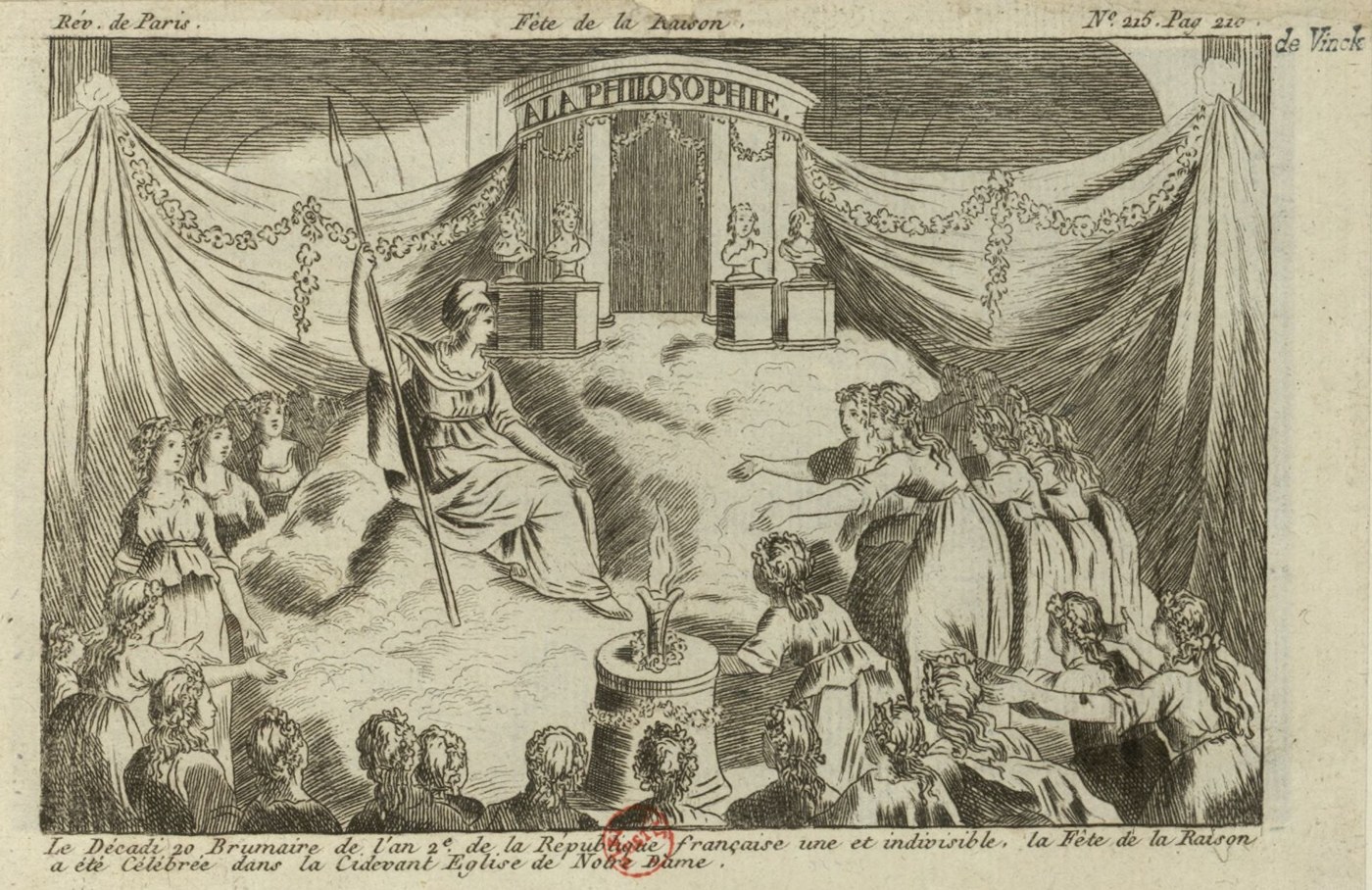
What followed is documented and almost unbelievable. The calendar itself was rewritten to abolish the week and with it the day of rest — ten-day cycles, months renamed, the years counted from the Revolution instead of from Christ. Churches were closed or repurposed. In Paris, a woman was carried into Notre Dame and enthroned as the Goddess of Reason, and the assembly bowed to her. Bibles were gathered up and burned in the streets. Death was officially declared to be an eternal sleep.
And the church’s own officers were paraded to renounce their faith. The constitutional bishop of Paris was brought before the Convention to declare that the religion he had taught for years was priestcraft with no foundation in history or truth; he laid his episcopal decorations on the table and was embraced by the president of the assembly.
“With blasphemous boldness almost beyond belief, one of the priests of the new order said: “God, if You exist, avenge Your injured name.”
The Great Controversy, p. 274
That is the street in verse 8, and this is what lying dead in it looked like:
“The word of truth lay dead in her streets, and those who hated the restrictions and requirements of God’s law were jubilant.”
The Great Controversy, p. 274
Verse 10 says the world would rejoice over them, and make merry, and shall send gifts one to another. Read the accounts of that winter in Paris — the festivals of Reason, the processions, the mockery staged in churches — and the verse stops sounding like symbolism.
What that winter actually produced is the other half of the record. The same movement that abolished the Bible ran the Terror: the guillotine in permanent session, tens of thousands executed, the prisons full, and a country that had declared reason its goddess killing its own citizens faster than any king had managed. It did not take long for the connection to be noticed.
“The world stood aghast at the enormity of guilt which had resulted from a rejection of the Sacred Oracles, and men recognized the necessity of faith in God and His word as the foundation of virtue and morality.”
The Great Controversy, p. 287
And They Stood Upon Their Feet
The bodies lie in the street three days and an half. On the same principle that turns twelve hundred and sixty days into years, that is three and a half years.
“Three years and a half later a resolution rescinding these decrees, thus granting toleration to the Scriptures, was adopted by the same body.”
The Great Controversy, p. 287
The same assembly that had abolished the Scriptures voted to permit them again, three and a half years later. Nobody planning that reversal was thinking about Revelation 11.
“And after three days and an half the Spirit of life from God entered into them, and they stood upon their feet; and great fear fell upon them which saw them.”
Revelation 11:11
And then the part that is easy to miss, because it happened slowly and in a different country. The witnesses did not merely revive. They were exalted.
“Since France made war upon God’s two witnesses, they have been honored as never before.”
The Great Controversy, p. 287
Consider the timing. “For the fifty years preceding 1792, little attention was given to the work of foreign missions” (The Great Controversy, p. 287). Within a generation of the burning of Bibles in Paris, Bible societies were founded in Britain and across Europe, and the printing and distribution of Scripture became one of the largest voluntary enterprises in the world.
“When the British Society was formed, the Bible had been printed and circulated in fifty tongues.”
The Great Controversy, p. 287
“It has since been translated into many hundreds of languages and dialects.”
The Great Controversy, p. 287
Fifty languages when the society began. Many hundreds by the time she wrote. Thousands now, and the work still going on — including in places where owning one is still dangerous, which is why this ministry supports The Urdu Bible Project.
A nation set out to kill the Bible and the result was the largest translation effort in human history. That is the resurrection in the street.
“Men became dissatisfied with the results of rationalism and realized the necessity of divine revelation and experimental religion.”
The Great Controversy, p. 287
And there is one more phrase in verse 12 worth holding: “Come up hither.” It is the same call that opened the door in chapter 4 and brought John into the throne room. The witnesses are not merely tolerated again. They are summoned upward, in the sight of the people who killed them.
The Seventh Trumpet
“And the seventh angel sounded; and there were great voices in heaven, saying, The kingdoms of this world are become the kingdoms of our Lord, and of his Christ; and he shall reign for ever and ever.”
Revelation 11:15
The trumpet the angel warned about in chapter 8 finally sounds, and what comes out of it is not a woe. It is an announcement of transfer. The kingdoms of this world are become — past tense, already done, said in heaven while the world below still thinks it is running itself.
Verse 14 has already told us how to place it: “The second woe is past; and, behold, the third woe cometh quickly.” So this trumpet is the third woe — and it is a woe only for those who wanted the kingdoms to stay as they were. The same event is announced in heaven with great voices and received on earth as a catastrophe, and both reactions are recorded in the same paragraph.
The elders’ song names what that involves, and it is not all comfortable: the nations were angry, God’s wrath is come, the dead are judged, the servants and prophets and saints are rewarded — and God will “destroy them which destroy the earth” (Revelation 11:18).
Then the last verse of the chapter opens a door:
“And the temple of God was opened in heaven, and there was seen in his temple the ark of his testament: and there were lightnings, and voices, and thunderings, and an earthquake, and great hail.”
Revelation 11:19
The ark of the testament is the box that held the ten commandments, under the mercy seat, in the most holy place. In a chapter about a book that men tried to kill, the vision ends with the law of God in plain view in heaven — and the last thing said about the two witnesses on earth is that their enemies had hated “the restrictions and requirements of God’s law.”
What This Asks Of Us
Two things, and the first is about evidence.
A prophecy written on Patmos said that the Scriptures would be killed in a nation that would behave like Egypt and Sodom, lie dead in public for three and a half of something, and rise. Seventeen hundred years later a legislature abolished the Bible, and the same legislature restored it three and a half years afterwards. That is not a vague fulfilment. Anyone can check the dates.
The second is about what happens to a book when people try to bury it. France did the most thorough job any nation has ever attempted, and the century that followed put the Bible into more languages than the eighteen centuries before it. Whatever you think of the arithmetic in this chapter, that outcome is a matter of public record.
Next in this series: War In Heaven — a woman clothed with the sun, a dragon waiting to devour her child, and where the whole conflict started.
