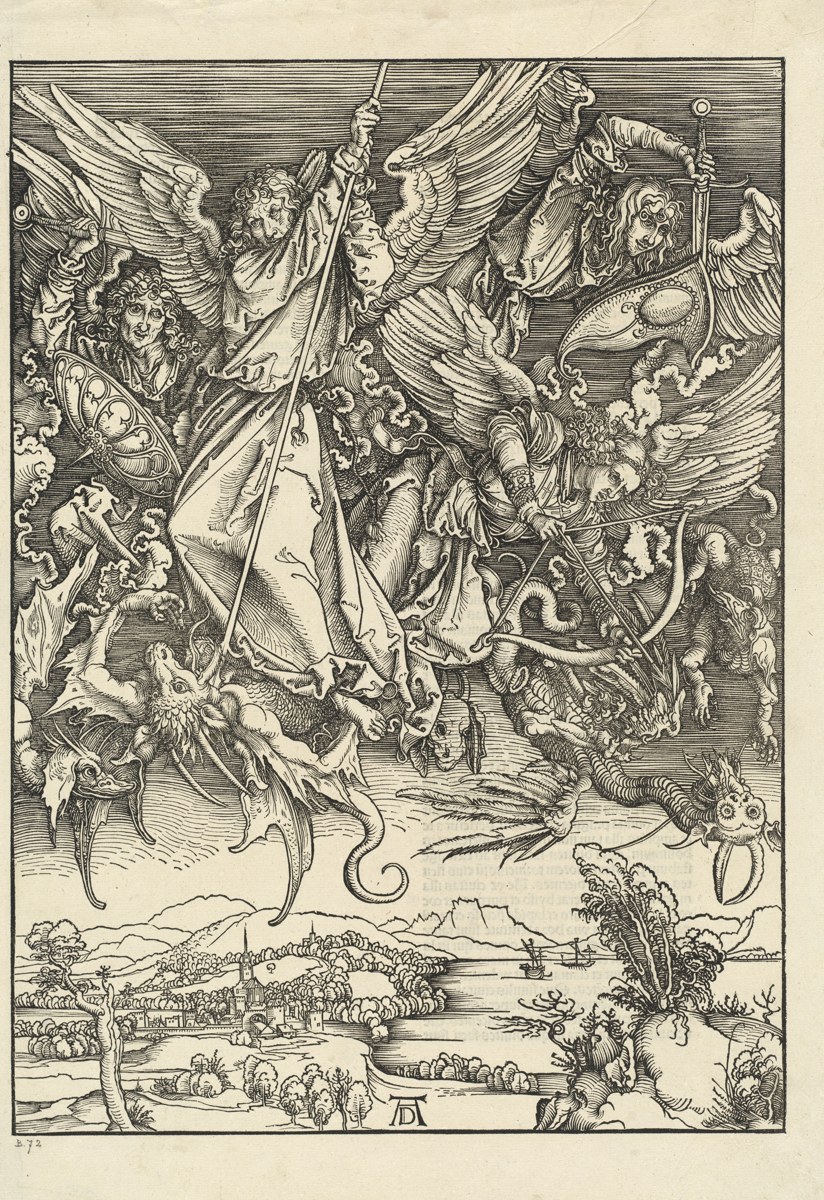
A woman dressed in sunlight, a dragon waiting under her to eat her child, and a war that started long before either of them appears. This is the chapter where Revelation stops describing the conflict and explains it.
A Bible study on Revelation 12 · Arthur Baldwin · StandUp4Jesus.Org · 15 min read
Table of Contents
Eleven chapters in, a reader knows there is a fight on. Churches have been warned, seals opened, trumpets sounded, witnesses killed and raised. What has not been explained is who is fighting, what started it, or why it is allowed to continue. Chapter 12 answers all three, and it does it by going back further than any other chapter in the Bible except Genesis 1.
A Woman Clothed With The Sun
“And there appeared a great wonder in heaven; a woman clothed with the sun, and the moon under her feet, and upon her head a crown of twelve stars:”
Revelation 12:1
A woman in prophecy stands for a people in covenant with God. The prophets use the figure constantly — Israel as a bride, as a wife, and when she goes after other gods, as an unfaithful one. Revelation will show us a second woman later, in scarlet, sitting on a beast. This one is dressed in light.
The two women are the clearest contrast in the book, and it is worth naming now so that chapter 17 is not a surprise. This one wears the sun and stands on the moon — light she did not make, and light she reflects. That one wears purple and scarlet, decked with gold and precious stones, and everything she has on she bought. One is clothed by heaven; the other is dressed by the merchants of the earth.
Sun, moon and twelve stars is not a random arrangement. Joseph dreamed it: “the sun and the moon and the eleven stars made obeisance to me” (Genesis 37:9), and his father understood the picture at once as the family of Israel. Here the sun clothes her, the moon is under her feet, and twelve stars are on her head — the light of the gospel around her, the older economy beneath her feet as a foundation, and the twelve on the crown.
And she is in pain. “She being with child cried, travailing in birth, and pained to be delivered” (Revelation 12:2). The first thing said about God’s people in this chapter is that they were in labour, which is a good description of the centuries before Bethlehem.
And the labour is the fulfilment of the oldest promise in Scripture. In Eden, with the damage done, God said to the serpent: “And I will put enmity between thee and the woman, and between thy seed and her seed; it shall bruise thy head, and thou shalt bruise his heel” (Genesis 3:15). A woman, a seed, and a bruised head. Revelation 12 is that sentence with the pictures filled in.
A Great Red Dragon
“And there appeared another wonder in heaven; and behold a great red dragon, having seven heads and ten horns, and seven crowns upon his heads.”
Revelation 12:3
Seven heads, ten horns, and crowns on the heads. Hold that description, because a beast with the same count comes out of the sea in the next chapter with the crowns moved onto the horns. They are not the same creature, and the family resemblance is the point.
“And his tail drew the third part of the stars of heaven, and did cast them to the earth” (Revelation 12:4). A third of something enormous went with him. Whatever this dragon is, he was persuasive enough to take a third of heaven’s host along.
Then the posture: he “stood before the woman which was ready to be delivered, for to devour her child as soon as it was born.” Not fighting her. Waiting. Positioned over a woman in labour, watching for the head to appear.
The Man Child
“And she brought forth a man child, who was to rule all nations with a rod of iron: and her child was caught up unto God, and to his throne.”
Revelation 12:5
One verse covers the whole earthly life of Christ — born, and caught up to the throne — and it skips everything in between. That is not carelessness. This chapter is being told from the dragon’s side of the conflict, and from that side the birth and the ascension are the two events that mattered, because both of them defeated him.
It is also worth noticing what the verse says the child was born to do: rule all nations with a rod of iron. That is a quotation from the second Psalm, where God installs His King on Zion against the raging of the nations. The dragon was not attacking a baby. He was attacking a coronation.
The attempt to devour the child at birth is not a symbol looking for a fulfilment. Herod sent soldiers to Bethlehem to kill every boy under two years old. Read that story with Revelation 12 open and it is plain who was standing behind it.
War In Heaven
“And there was war in heaven: Michael and his angels fought against the dragon; and the dragon fought and his angels,”
Revelation 12:7
War in heaven. Not on earth, not in some outer darkness — in the one place a reader assumes is safe.
Michael appears by name only a handful of times in Scripture, and every appearance is a confrontation. Daniel is told that “at that time shall Michael stand up, the great prince which standeth for the children of thy people” (Daniel 12:1). Jude has him disputing with the devil over the body of Moses. The name itself is a question — who is like God? — which is exactly the question the rebellion was about.
This site reads Michael as Christ Himself, the Prince who stands for His people, which is the reading of Adventist writers generally; others take him as the chief of the angels. Either way, the chapter has already told us who wins and how, and nothing in it turns on settling the name.
“And the great dragon was cast out, that old serpent, called the Devil, and Satan, which deceiveth the whole world: he was cast out into the earth, and his angels were cast out with him.”
Revelation 12:9
Four names in one verse, and no room left for doubt. The great dragon — the creature of verse 3. That old serpent — the one in the garden. The Devil, the slanderer. Satan, the adversary. Revelation identifies its own symbol, in plain language, and it is the only major symbol in the book that gets that treatment.
What began the war is not described in this chapter, but Scripture supplies it elsewhere. Isaiah records the ambition: “I will exalt my throne above the stars of God” (Isaiah 14:13). And the method was not open revolt at first:
“He worked with mysterious secrecy, and for a time concealed his real purpose under an appearance of reverence for God.”
Patriarchs and Prophets, p. 37
Which raises the question every honest reader asks: why was he not simply ended? God is not short of power, and a rebellion in heaven could have been over in a moment. The answer given is that a moment would have settled the wrong thing.
“Had he been immediately blotted out of existence, some would have served God from fear rather than from love.”
Patriarchs and Prophets, p. 42
“Since only the service of love can be acceptable to God, the allegiance of His creatures must rest upon a conviction of His justice and benevolence.”
Patriarchs and Prophets, p. 42
So the charge had to be answered rather than silenced, and answering it took time and cost a life. That is why the war is still running, and why this book exists.
“The discord which his own course had caused in heaven, Satan charged upon the government of God.”
Patriarchs and Prophets, p. 42
The Accuser Cast Down
“Now is come salvation, and strength, and the kingdom of our God, and the power of his Christ: for the accuser of our brethren is cast down, which accused them before our God day and night.”
Revelation 12:10
Of everything he could have been called, heaven celebrates the loss of one particular function: the accuser of our brethren. Not the tempter. Not the destroyer. The one who stood and made a case against people, day and night, without stopping.
Zechariah was shown that courtroom once — a high priest standing in filthy garments with Satan at his right hand to resist him, and the answer given was not a defence of the man’s record. It was a change of clothes.
That is what the casting down means in practice. The accuser did not run out of material — he ran out of standing. Somebody else had answered for the material.
And They Overcame Him
“And they overcame him by the blood of the Lamb, and by the word of their testimony; and they loved not their lives unto the death.”
Revelation 12:11
If a reader takes one verse out of this chapter, take this one. It is the only place in Revelation that says outright how the thing is done.
By the blood of the Lamb. First, and not by accident. The accusation is answered by a payment, not by a rebuttal. Nobody in that verse argues that the charges were false.
By the word of their testimony. What they said about what happened to them. Not their argument, not their doctrine — their testimony, which is the one thing an accuser cannot cross-examine, because it belongs to the witness.
And they loved not their lives unto the death. They were not fearless; they were unbribable. A man who will not trade his loyalty for his life has nothing left that an enemy can offer him.
And notice the order once more. The blood comes first and the courage comes last. This is not a verse about brave people earning a verdict; it is a verse about people whose verdict was already settled, and who then behaved accordingly.
He Knoweth That He Hath But A Short Time
“Woe to the inhabiters of the earth and of the sea! for the devil is come down unto you, having great wrath, because he knoweth that he hath but a short time.”
Revelation 12:12
This verse explains something people find hard about the state of the world. The wrath is described as increasing, and the reason given is not that he is winning. It is that he knows the clock is running.
A cornered enemy is more dangerous than a confident one, and this chapter says the danger of the present age is exactly that kind — the violence of something that has already read the ending.
Into The Wilderness
“And to the woman were given two wings of a great eagle, that she might fly into the wilderness, into her place, where she is nourished for a time, and times, and half a time, from the face of the serpent.”
Revelation 12:14
A time, times and half a time — the same twelve hundred and sixty years as the sackcloth of chapter 11, arriving from a different direction. During those centuries the woman is not destroyed and not comfortable. She is nourished, in a wilderness, out of sight.
The eagle’s wings are borrowed from the Exodus, where God told Israel He had carried them on eagles’ wings out of Egypt. The wilderness is where He fed a nation for forty years with bread they did not grow. Both pictures say the same thing: this is not abandonment, it is protection in a hard place.
“And the serpent cast out of his mouth water as a flood after the woman, that he might cause her to be carried away of the flood.”
Revelation 12:15
Waters in this book are peoples — Revelation says so outright in chapter 17. A flood out of the serpent’s mouth is a movement of people, roused by what he says, sent to sweep her away. And the rescue is stranger than the attack: “the earth helped the woman, and the earth opened her mouth, and swallowed up the flood” (Revelation 12:16). Where there were no people, the flood had nothing to carry it.
Read as history, that is a striking thing to have written in the first century. The centuries of the wilderness were also the centuries in which the persecuted found room — in the Alpine valleys, in the mountains and forests, and at the end of the period in a continent that had no established church to hunt them. The earth, in the plainest sense, helped the woman.
The Remnant Of Her Seed
“And the dragon was wroth with the woman, and went to make war with the remnant of her seed, which keep the commandments of God, and have the testimony of Jesus Christ.”
Revelation 12:17
The last verse of the chapter is one of the most important in the book, and it is worth taking slowly.
A remnant is the last piece of a length of cloth — the same material as the rest, and what is left at the end. This is not a new people. It is the end of the woman’s own line.
That word rules out two mistakes at once. A remnant is not a new fabric, so nobody can claim this is a different people from the woman of verse 1. And a remnant is not the whole bolt either, so nobody can claim it is everybody who ever used the name.
And they are identified by two marks, not one. They keep the commandments of God — the same law that was seen in the ark at the end of chapter 11. And they have the testimony of Jesus, which Revelation defines for us later: “the testimony of Jesus is the spirit of prophecy” (Revelation 19:10).
Both marks are worth stating carefully, because both are easy to caricature. Keeping the commandments here is not a claim that law-keeping saves — verse 11 has just said what saves, and it is blood. It is a description of what these people are like, not of how they got there. And the testimony of Jesus is not a licence for anybody who claims a vision; the same book tests every prophet against what is already written.
Notice also who starts the fight. The dragon went to make war with them. They are not described as making war on anybody.
What This Asks Of Us
Revelation 12 takes a conflict that looks like history and shows its actual size. The persecutions in the seals, the witnesses dead in the street, the pressure the churches were warned about — all of it turns out to be one war, started in heaven over the character of God, and still running because the question had to be answered rather than silenced.
Two consolations sit in the middle of it.
The accuser has already lost his standing, and the way people overcome him is stated plainly enough to be acted on: the blood of the Lamb, the word of their own testimony, and a loyalty that cannot be bought with survival.
And the wrath is a symptom. He knoweth that he hath but a short time. Whatever else this age is, it is late in the argument, and the outcome was settled at a cross.
Next in this series: The Beast And The Buffalo — two beasts, one wound that heals, and a lamb-horned power that speaks like a dragon.
