Now comes the “strong meat” the writer has been waiting to serve. Who was Melchisedec, the mysterious king-priest who blessed Abraham? And why does it matter that Jesus is “a priest for ever after the order of Melchisedec” rather than after the order of Aaron? Hebrews 7 shows that Christ’s priesthood is greater, permanent and perfect, and it ends with one of the most hopeful verses in the Bible: “he is able also to save them to the uttermost that come unto God by him, seeing he ever liveth to make intercession for them.”
A study in Hebrews 7 · Arthur Baldwin · StandUp4Jesus.Org · 22 min read
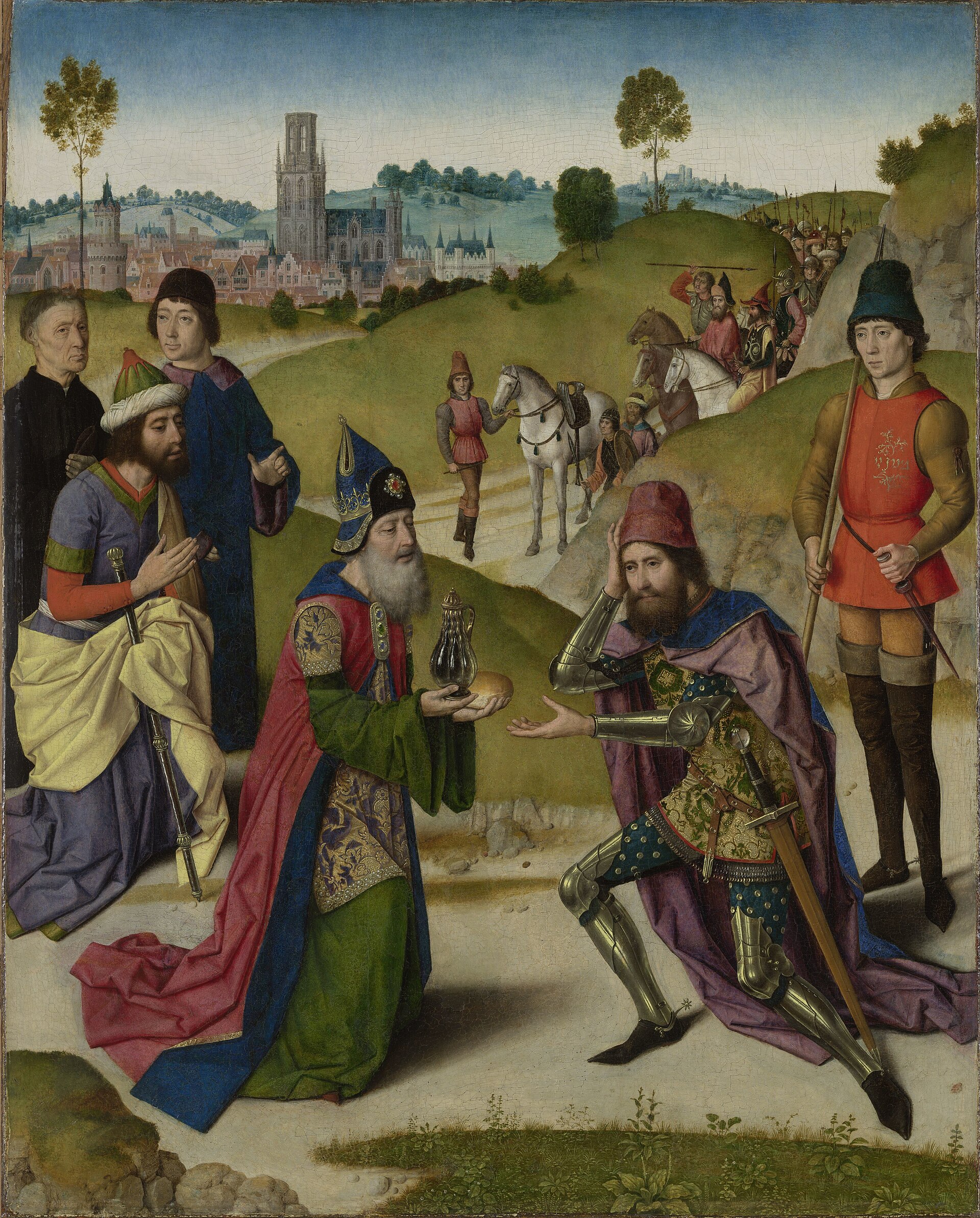
King Of Righteousness, King Of Peace
“For this Melchisedec, king of Salem, priest of the most high God, who met Abraham returning from the slaughter of the kings, and blessed him; To whom also Abraham gave a tenth part of all; first being by interpretation King of righteousness, and after that also King of Salem, which is, King of peace; Without father, without mother, without descent, having neither beginning of days, nor end of life; but made like unto the Son of God; abideth a priest continually.”
Hebrews 7:1-3
Melchisedec appears in only three verses of Genesis (14:18-20). Abraham had just rescued Lot by defeating an alliance of kings, and on his way home he was met by the king of Salem, the city later called Jerusalem.
“Another who came out to welcome the victorious patriarch was Melchizedek, king of Salem, who brought forth bread and wine for the refreshment of his army. As ‘priest of the most high God,’ he pronounced a blessing upon Abraham, and gave thanks to the Lord, who had wrought so great a deliverance by His servant. And Abraham ‘gave him tithes of all.’”
Ellen G. White · Patriarchs and Prophets, p. 136
Everything about him points to Christ. His name means “King of righteousness.” His city’s name means “peace.” He was both king and priest at once, something no king of Israel was ever allowed to be. And Scripture records no father, no mother, no genealogy, no birth and no death for him.
Verse 3 says Melchisedec was “made like unto the Son of God,” and that he “abideth a priest continually.” For Aaron’s priests, genealogy was everything; a man who could not prove his descent from Aaron was barred from the priesthood (Ezra 2:62). Melchisedec’s priesthood owed nothing to family records, and in that he pictures the eternal Priest, who truly has “neither beginning of days, nor end of life.” (For a fuller study of who Melchisedec was, and why it matters to every believer, see this site’s Melchizedek Message.)
Consider How Great This Man Was
“Now consider how great this man was, unto whom even the patriarch Abraham gave the tenth of the spoils. And verily they that are of the sons of Levi, who receive the office of the priesthood, have a commandment to take tithes of the people according to the law, that is, of their brethren, though they come out of the loins of Abraham: But he whose descent is not counted from them received tithes of Abraham, and blessed him that had the promises. And without all contradiction the less is blessed of the better. And here men that die receive tithes; but there he receiveth them, of whom it is witnessed that he liveth. And as I may so say, Levi also, who receiveth tithes, payed tithes in Abraham. For he was yet in the loins of his father, when Melchisedec met him.”
Hebrews 7:4-10
The writer shows Melchisedec’s greatness in three ways. Abraham, the father of the whole nation, gave him a tenth. Melchisedec blessed Abraham, and “the less is blessed of the better.” And Levi himself, the ancestor of every Jewish priest, was in a sense paying tithe to Melchisedec, since he was still “in the loins” of his great-grandfather. So Melchisedec’s priesthood is greater than Levi’s.
Notice something else. Tithing did not begin with the law of Moses. Abraham paid tithe centuries before Sinai, and Jacob vowed it at Bethel (Genesis 28:22). Returning a tenth to God is not one of the ceremonies that ended at the cross. It is older than the Levitical system, and Christ, our priest after Melchisedec’s order, is the One who still “receiveth them, of whom it is witnessed that he liveth.”
“Men were required to offer to God gifts for religious purposes before the definite system was given to Moses, even as far back as the days of Adam. In complying with God’s requirements, they were to manifest in offerings their appreciation of His mercies and blessings to them. This was continued through successive generations, and was carried out by Abraham, who gave tithes to Melchizedek, the priest of the most high God.”
Ellen G. White · Counsels on Stewardship, p. 69
The Priesthood Being Changed
“If therefore perfection were by the Levitical priesthood, (for under it the people received the law,) what further need was there that another priest should rise after the order of Melchisedec, and not be called after the order of Aaron? For the priesthood being changed, there is made of necessity a change also of the law. For he of whom these things are spoken pertaineth to another tribe, of which no man gave attendance at the altar. For it is evident that our Lord sprang out of Juda; of which tribe Moses spake nothing concerning priesthood.”
Hebrews 7:11-14
Here is the heart of the argument. In Psalm 110:4, written about a thousand years before Christ and long after Aaron’s priesthood was established, God announced “another priest,” one after the order of Melchisedec. Why would He do that if Aaron’s priesthood could bring people to “perfection”? The very promise of a new priest showed that the old one was never meant to be final.
“For the priesthood being changed, there is made of necessity a change also of the law.” Some read this as meaning the Ten Commandments were changed or abolished. But look at what “law” the writer is talking about. It is the law that governed the priesthood: which tribe could serve at the altar, who could offer the sacrifices. Jesus came from Judah, “of which tribe Moses spake nothing concerning priesthood.” Under the old regulations He could not have been a priest at all. So the law that restricted the priesthood to Levi had to change. The writer calls it “the law of a carnal commandment” (verse 16), a regulation about physical descent. He is not speaking of the moral law, which the new covenant writes on the heart (8:10).
The Power Of An Endless Life
“And it is yet far more evident: for that after the similitude of Melchisedec there ariseth another priest, Who is made, not after the law of a carnal commandment, but after the power of an endless life. For he testifieth, Thou art a priest for ever after the order of Melchisedec. For there is verily a disannulling of the commandment going before for the weakness and unprofitableness thereof. For the law made nothing perfect, but the bringing in of a better hope did; by the which we draw nigh unto God.”
Hebrews 7:15-19
Aaron’s priests held office because of their ancestry. Christ holds office “after the power of an endless life.” Death ended every Levitical priesthood; it could not end His. He died, and rose, and lives forever.
“The commandment going before” — the regulation establishing the Levitical priesthood — is set aside “for the weakness and unprofitableness thereof.” The sacrificial system could not take away sin (10:4); it could only point to the One who would. “The law made nothing perfect.” It could show what sin is, and it could picture the remedy, but it could not transform the heart. What does that? “The bringing in of a better hope… by the which we draw nigh unto God.” Under the old system only the high priest could draw near, once a year. Through Christ, every believer can come near to God.
“And inasmuch as not without an oath he was made priest: (For those priests were made without an oath; but this with an oath by him that said unto him, The Lord sware and will not repent, Thou art a priest for ever after the order of Melchisedec:) By so much was Jesus made a surety of a better testament. And they truly were many priests, because they were not suffered to continue by reason of death: But this man, because he continueth ever, hath an unchangeable priesthood.”
Hebrews 7:20-24
Two more contrasts. God never swore an oath when He appointed Aaron’s sons. He did swear one when He appointed Christ: “The Lord sware and will not repent.” And there were many Levitical priests, one after another, because each one died. Christ “continueth ever,” so His priesthood is “unchangeable.” It will never pass to anyone else. That makes Him “a surety of a better testament” — the guarantee, the One who personally stands behind the new covenant.
Able To Save Them To The Uttermost
“Wherefore he is able also to save them to the uttermost that come unto God by him, seeing he ever liveth to make intercession for them.”
Hebrews 7:25
This is the practical point of the whole chapter. Because Jesus lives forever, He can save “to the uttermost” — completely, perfectly, all the way to the end, and forever. No sinner is too far gone. No case is too hard. And He does it by His constant intercession: “he ever liveth to make intercession for them.” Right now, in heaven, Jesus is pleading for those who come to God through Him.
“By His spotless life, His obedience, His death on the cross of Calvary, Christ interceded for the lost race. And now, not as a mere petitioner does the Captain of our salvation intercede for us, but as a Conqueror claiming His victory. His offering is complete, and as our Intercessor He executes His self-appointed work, holding before God the censer containing His own spotless merits and the prayers, confessions, and thanksgiving of His people.”
Ellen G. White · Christ’s Object Lessons, p. 156
“For such an high priest became us, who is holy, harmless, undefiled, separate from sinners, and made higher than the heavens; Who needeth not daily, as those high priests, to offer up sacrifice, first for his own sins, and then for the people’s: for this he did once, when he offered up himself. For the law maketh men high priests which have infirmity; but the word of the oath, which was since the law, maketh the Son, who is consecrated for evermore.”
Hebrews 7:26-28
“Such an high priest became us” — He is exactly the High Priest we need. He is “holy, harmless, undefiled, separate from sinners.” And yet, as chapter 2 showed, He is not ashamed to call those sinners His brothers.
“The I AM is the Daysman between God and humanity, laying His hand upon both. He who is ‘holy, harmless, undefiled, separate from sinners,’ is not ashamed to call us brethren. Hebrews 7:26; 2:11. In Christ the family of earth and the family of heaven are bound together. Christ glorified is our brother.”
Ellen G. White · The Desire of Ages, p. 25
The Levitical priests had to offer sacrifices daily, and first for their own sins. Christ offered one sacrifice, “once, when he offered up himself.” It never needs to be repeated. And He is not a weak man appointed under a temporary law, but “the Son, who is consecrated for evermore.” That is the High Priest who is interceding for us today.
A Royal Priesthood
There is one more thing to see. Melchisedec was a king and a priest at the same time. Under the law of Moses, no one could be both; kings came from Judah, priests from Levi. Christ unites the two offices in Himself, and the astonishing news of the New Testament is that He shares them with His people. Peter writes:
“To whom coming, as unto a living stone, disallowed indeed of men, but chosen of God, and precious, Ye also, as lively stones, are built up a spiritual house, an holy priesthood, to offer up spiritual sacrifices, acceptable to God by Jesus Christ.”
1 Peter 2:4-5
“But ye are a chosen generation, a royal priesthood, an holy nation, a peculiar people; that ye should shew forth the praises of him who hath called you out of darkness into his marvellous light: Which in time past were not a people, but are now the people of God: which had not obtained mercy, but now have obtained mercy.”
1 Peter 2:9-10
“A royal priesthood” — kings and priests together. That is the Melchisedec order, not Aaron’s. Aaron’s priesthood was limited to one family of one tribe, and only its men could serve. The priesthood Peter describes belongs to every believer, and it is entered not by birth but by coming to Christ, who is “a living stone.” Every Christian, man or woman, young or old, is a “lively stone” in the spiritual house He is building, and every one is called into this royal priesthood with Jesus Christ, the High Priest of the order of Melchisedec. John says the same: Christ “hath made us kings and priests unto God and his Father” (Revelation 1:6).
What do these priests do? Not offer animals — that system has passed. They “offer up spiritual sacrifices, acceptable to God by Jesus Christ”: praise, thanksgiving, lives given in service (Hebrews 13:15-16; Romans 12:1). And they “shew forth the praises of him who hath called you out of darkness into his marvellous light.” Every believer represents God to the people around them, and brings those people to God in prayer.
This is why the priesthood of Melchisedec is not just a puzzle for scholars. It is our calling. Our High Priest lives forever to intercede for us, and He has made us a royal priesthood to serve with Him. For a fuller study of what that means for the Christian life, see this site’s Melchizedek Message.
