A single sentence about the resurrection turns Paul’s own trial into a brawl between his judges, and that same night Christ Himself appears to tell him exactly where all of this is heading: not death in Jerusalem, but testimony in Rome. Forty men take an oath to starve themselves until Paul is dead, and it is his own nephew, appearing without warning or explanation, who quietly unravels the whole plot.
A study in Acts 23 · Arthur Baldwin · StandUp4Jesus.Org · 16 min read
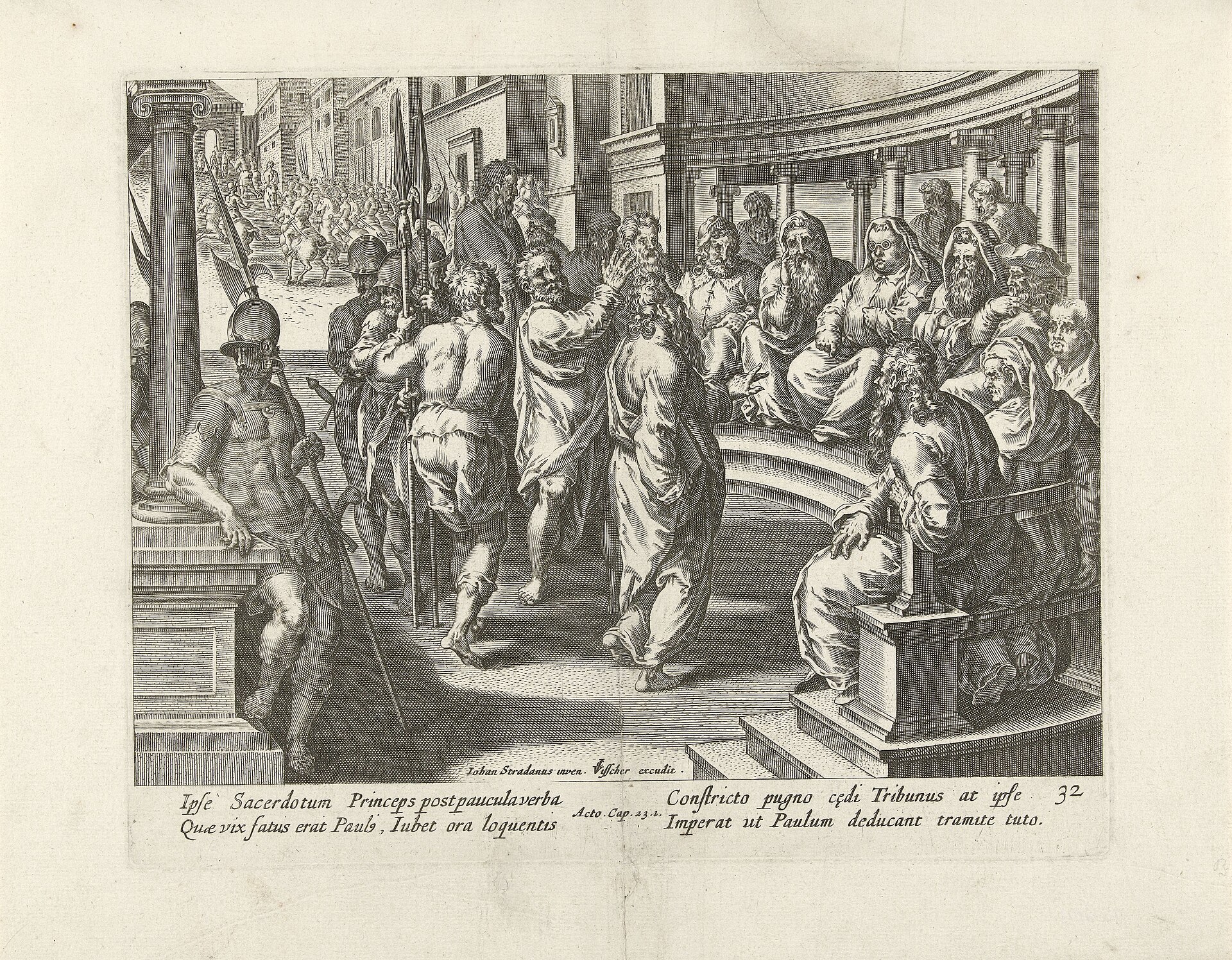
God Shall Smite Thee, Thou Whited Wall
“And Paul, earnestly beholding the council, said, Men and brethren, I have lived in all good conscience before God until this day. And the high priest Ananias commanded them that stood by him to smite him on the mouth.”
Acts 23:1-2
“The apostle was now to be tried by the same tribunal of which he himself had been a member before his conversion. As he stood before the Jewish rulers, his bearing was calm, and his countenance revealed the peace of Christ.”
Ellen G. White · The Acts of the Apostles, p. 410
Paul’s single opening sentence — a simple, calm claim of clear conscience — is met with an illegal order to strike him before a single charge has even been named. The presiding judge himself is the first to break the law this trial is supposedly conducted under.
“Then said Paul unto him, God shall smite thee, thou whited wall: for sittest thou to judge me after the law, and commandest me to be smitten contrary to the law?”
Acts 23:3
“Whited wall” is a precise, cutting image — a wall freshly whitewashed to look clean while the crumbling structure underneath stays exactly as it was, the same accusation Christ Himself once leveled at hypocritical leaders under a different metaphor: white on the outside, decay within.
“And they that stood by said, Revilest thou God’s high priest? Then said Paul, I wist not, brethren, that he was the high priest: for it is written, Thou shalt not speak evil of the ruler of thy people.”
Acts 23:4-5
“With his usual courtesy Paul answered, ‘I wist not, brethren, that he was the high priest: for it is written, Thou shalt not speak evil of the ruler of thy people.’”
Ellen G. White · The Acts of the Apostles, p. 410
Paul retracts nothing about the substance of his rebuke, only the specific way he delivered it — a quick, genuine correction rather than a grudging apology, immediately backed by the very Scripture he is accused of dishonoring.
Be Of Good Cheer, Paul
“But when Paul perceived that the one part were Sadducees, and the other Pharisees, he cried out in the council, Men and brethren, I am a Pharisee, the son of a Pharisee: of the hope and resurrection of the dead I am called in question.”
Acts 23:6
This is not evasion but a genuinely accurate framing — Paul’s whole gospel really does rest on a bodily resurrection, and naming that fault line in a mixed council is enough, on its own, to set two rival factions against each other instead of united against him.
“And when he had so said, there arose a dissension between the Pharisees and the Sadducees: and the multitude was divided. For the Sadducees say that there is no resurrection, neither angel, nor spirit: but the Pharisees confess both.”
Acts 23:7-8
“The two parties began to dispute between themselves, and thus the strength of their opposition against Paul was broken.”
Ellen G. White · The Acts of the Apostles, p. 411
A single sentence accomplishes here what no legal defense could have — not because Paul out-argues the whole Sanhedrin, but because he exposes a fracture that was already there, waiting under the surface of their shared hostility toward him.
“And there arose a great cry: and the scribes that were of the Pharisees’ part arose, and strove, saying, We find no evil in this man: but if a spirit or an angel hath spoken to him, let us not fight against God.”
Acts 23:9
These are the very Pharisees whose whole party once helped drive Christ to the cross, now cautiously entertaining the possibility that Paul really might have seen an angel or a spirit — the same crowd’s own doctrine of the resurrection making room, however briefly, for exactly the miracle Paul is claiming.
“And when there arose a great dissension, the chief captain, fearing lest Paul should have been pulled in pieces of them, commanded the soldiers to go down, and to take him by force from among them, and to bring him into the castle.”
Acts 23:10
For the second time in two chapters, Roman soldiers physically carry Paul away from a Jewish crowd to save his life — this time not from a mob in the street, but from Israel’s own highest religious court, now itself dissolved into a shouting match.
“And the night following the Lord stood by him, and said, Be of good cheer, Paul: for as thou hast testified of me in Jerusalem, so must thou bear witness also at Rome.”
Acts 23:11
“He had guarded him from the murderous throng in the temple courts; He had been with him before the Sanhedrin council; He was with him in the fortress; and He revealed Himself to His faithful witness in response to the earnest prayers of the apostle for guidance.”
Ellen G. White · The Acts of the Apostles, p. 413
This is the answer to a question this study’s own twentieth chapter already raised at Miletus, when Paul admitted “not knowing the things that shall befall me” in Jerusalem — Christ Himself finally names the destination directly. Not death here, but testimony in Rome, a city Paul has wanted to visit for years and will now reach only as a prisoner.
More Than Forty Which Had Made This Conspiracy
“And when it was day, certain of the Jews banded together, and bound themselves under a curse, saying that they would neither eat nor drink till they had killed Paul. And they were more than forty which had made this conspiracy.”
Acts 23:12-13
“Here was a fast such as the Lord through Isaiah had condemned—a fast ‘for strife and debate, and to smite with the fist of wickedness.’”
Ellen G. White · The Acts of the Apostles, p. 413
Forty men have, within hours of Christ’s own reassurance to Paul, already sworn a religious vow to murder him — a stark, immediate contrast between what heaven has just promised and what the men plotting against that promise do not yet know they cannot stop.
“And they came to the chief priests and elders, and said, We have bound ourselves under a great curse, that we will eat nothing until we have slain Paul. Now therefore ye with the council signify to the chief captain that he bring him down unto you to morrow.”
Acts 23:14-15
“Instead of rebuking this cruel scheme, the priests and rulers eagerly agreed to it. Paul had spoken the truth when he compared Ananias to a whited sepulcher.”
Ellen G. White · The Acts of the Apostles, p. 414
The same council that just fractured over theology unites again the moment murder is on the table — a body sworn to uphold the law of Moses lending its own official machinery to a plot that violates that law in its most basic commandment.
“And when Paul’s sister’s son heard of their lying in wait, he went and entered into the castle, and told Paul.”
Acts 23:16
“But God interposed to save the life of His servant. Paul’s sister’s son, hearing of the ‘lying in wait’ of the assassins, ‘went and entered into the castle, and told Paul.’”
Ellen G. White · The Acts of the Apostles, p. 414
This is the only mention anywhere in Scripture of any blood relative of Paul’s own, appearing without introduction and vanishing again just as quickly once his warning is delivered — a completely unnamed young man whose single act of courage saves an apostle’s life and, by extension, everything Acts still has left to record.
“Then Paul called one of the centurions unto him, and said, Bring this young man unto the chief captain: for he hath a certain thing to tell him. … Then the chief captain took him by the hand, and went with him aside privately, and asked him, What is that thou hast to tell me?”
Acts 23:17-19
Claudius Lysias, already once fooled about who Paul was, now takes the young man’s warning with genuine seriousness — a private hearing, a careful hand-hold aside from watching eyes, the appropriate caution of a commander who has already learned once this chapter how costly a wrong assumption can be.
“But do not thou yield unto them: for there lie in wait for him of them more than forty men, which have bound themselves with an oath, that they will neither eat nor drink till they have killed him: and now are they ready, looking for a promise from thee.”
Acts 23:21
Forty men have now, according to their own oath, gone at least a full day without food or water — a detail Scripture leaves the reader to infer rather than state, quietly implying that this whole desperate plot is about to collapse under nothing more dramatic than its own conspirators’ hunger.
Bring Him Safe Unto Felix The Governor
“And he called unto him two centurions, saying, Make ready two hundred soldiers to go to Cæsarea, and horsemen threescore and ten, and spearmen two hundred, at the third hour of the night; And provide them beasts, that they may set Paul on, and bring him safe unto Felix the governor.”
Acts 23:23-24
“Lysias at once decided to transfer Paul from his jurisdiction to that of Felix the procurator. As a people, the Jews were in a state of excitement and irritation, and tumults were of frequent occurrence. The continued presence of the apostle in Jerusalem might lead to consequences dangerous to the city and even to the commandant himself.”
Ellen G. White · The Acts of the Apostles, p. 415
Four hundred and seventy soldiers is a genuinely enormous escort for a single unarmed prisoner — not an overreaction, but an honest measure of exactly how seriously Lysias now takes both the conspiracy and his own political exposure if Paul is killed on his watch.
“This man was taken of the Jews, and should have been killed of them: then came I with an army, and rescued him, having understood that he was a Roman. And when I would have known the cause wherefore they accused him, I brought him forth into their council: Whom I perceived to be accused of questions of their law, but to have nothing laid to his charge worthy of death or of bonds.”
Acts 23:27-29
Lysias’s own letter quietly rewrites the record in his own favor — “having understood that he was a Roman,” as if the discovery preceded the rescue, when Scripture’s own earlier account showed the soldiers arrived first and the citizenship only came up afterward, on the very stairs. It is a small, human vanity from an otherwise genuinely useful ally.
“Then the soldiers, as it was commanded them, took Paul, and brought him by night to Antipatris. On the morrow they left the horsemen to go with him, and returned to the castle.”
Acts 23:31-32
The full infantry force is only needed for the most dangerous stretch, nearest Jerusalem itself; once the immediate danger of ambush has passed, most of the escort turns back, and a smaller mounted detachment finishes the journey — a practical, proportionate response rather than blind overcaution.
“And when the governor had read the letter, he asked of what province he was. And when he understood that he was of Cilicia; I will hear thee, said he, when thine accusers are also come. And he commanded him to be kept in Herod’s judgment hall.”
Acts 23:34-35
The chapter ends on a note of ordinary bureaucratic process — Paul housed, for now, not in a cell but in Herod’s own former palace, awaiting accusers who have every reason, after this chapter’s own failed plot, to take their time arriving.
