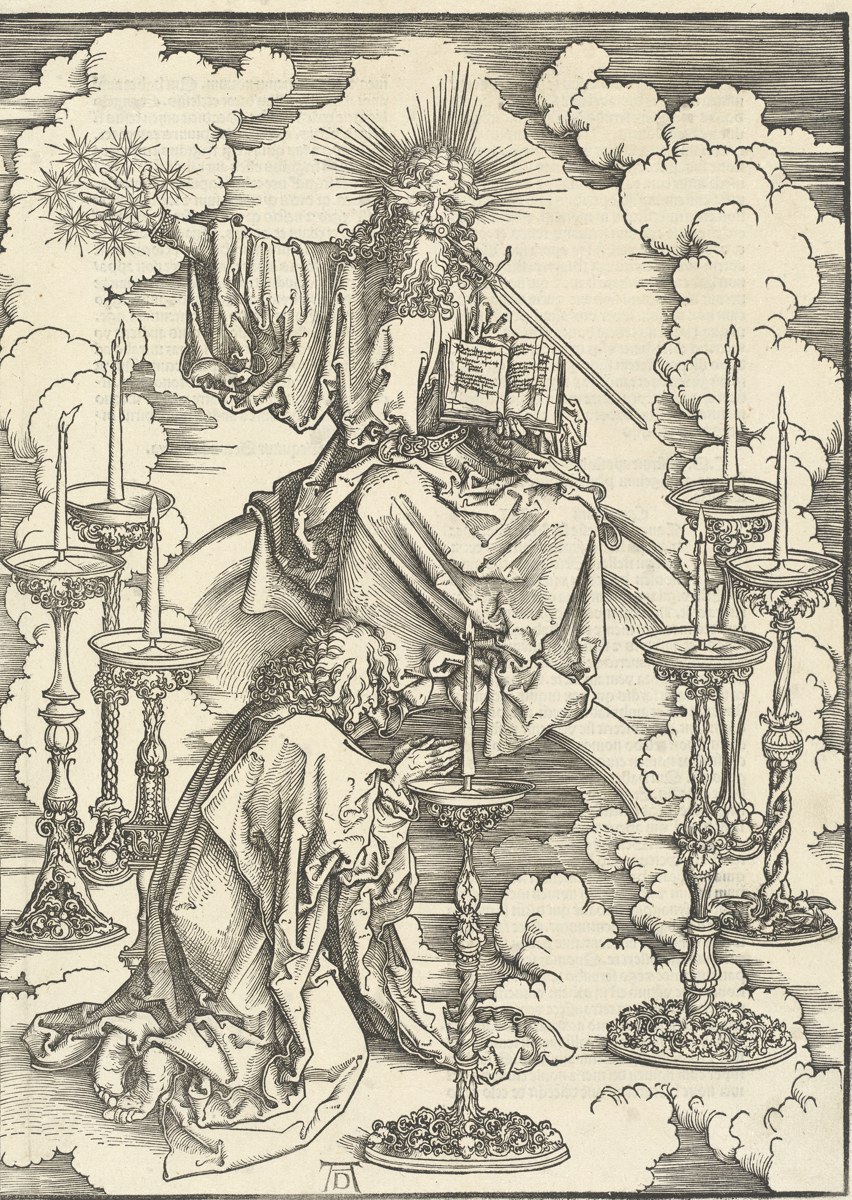
Four letters, dictated by a man walking among lampstands, to four congregations that no longer exist — and every one of them ends with a promise made to a single person.
A Bible study on Revelation 2 · Arthur Baldwin · StandUp4Jesus.Org · 12 min read
Table of Contents
Revelation 1 ended with John face down. Chapter 2 is what the voice said once he was back on his feet, and it is not what a reader expects after that vision. There are no beasts here, no trumpets, no seals. There are four letters to four small congregations in Asia Minor, and they read like a physician’s notes: what is right, what is wrong, what to do about it, and what is waiting for the one who does it.
That ordinariness is the point. Before the book shows anyone the end of the world, it shows the church itself — and it shows the church its own record, in the handwriting of the One who has been walking through it the whole time.
He That Walketh In The Midst
The first letter opens by identifying the speaker, and the identification is taken straight out of the vision John has just described:
“Unto the angel of the church of Ephesus write; These things saith he that holdeth the seven stars in his right hand, who walketh in the midst of the seven golden candlesticks;”
Revelation 2:1
Two gestures, and they pull in opposite directions. The stars are held — gripped, secured, in a right hand. The candlesticks are walked among — and a man who walks among lampstands is close enough to see which ones are guttering. Chapter 1 has already told us what both symbols mean: the stars are the angels of the seven churches, and the candlesticks are the seven churches themselves.
Ellen White read that picture as a promise rather than a threat:
“This assures us that no church faithful to its trust need fear coming to nought, for not a star that has the protection of Omnipotence can be plucked out of the hand of Christ.”
The Acts of the Apostles, p. 586
So the criticism that follows in these letters is not the criticism of an outsider reading a report. It is the assessment of someone who has been in the room the entire time. Every “I know thy works” in this chapter is literal. He was there.
Seven Letters, Seven Ages
Ephesus, Smyrna, Pergamos and Thyatira were real towns with real believers in them, and the letters were sent to those believers about their own situation. Nothing in this study takes that away. But seven is not a random number in this book, and the churches are not the only seven things in it.
“The names of the seven churches are symbolic of the church in different periods of the Christian Era.”
The Acts of the Apostles, p. 585
She gives the reason on the same page:
“The number 7 indicates completeness, and is symbolic of the fact that the messages extend to the end of time, while the symbols used reveal the condition of the church at different periods in the history of the world.”
The Acts of the Apostles, p. 585
That is the reading this series follows: seven letters that were genuinely posted to seven towns, and that together trace the church from the apostles to the last generation. It is worth saying plainly that the two readings do not compete. A letter can be addressed to Ephesus, describe Ephesus accurately, and still describe every church that has ever cooled down. The four in this chapter cover the longest stretch of the seven — from the apostles themselves to the edge of the Reformation.
The Shape Of Every Letter
Before taking them one at a time, notice that all four are built to the same plan. Each opens with a title of Christ drawn from the vision of chapter 1, and the title fits the letter. Each continues with “I know thy works.” Each finds something to commend. Most bring a charge — “I have somewhat against thee” — and give counsel with a consequence attached. And every single one closes the same way: “He that hath an ear, let him hear what the Spirit saith unto the churches,” followed by a promise to “him that overcometh.”
Hold on to that last detail, because it governs the whole chapter. The letters are addressed to congregations. The promises are not. They are singular — one ear, one overcomer, one new name that “no man knoweth saving he that receiveth it” (Revelation 2:17). Whatever a church as a whole is doing, the door out is always open to the person reading.
Ephesus: The Love That Was Left
The commendation given to Ephesus is long, and by most measures it describes a strong church:
“I know thy works, and thy labour, and thy patience, and how thou canst not bear them which are evil: and thou hast tried them which say they are apostles, and are not, and hast found them liars: And hast borne, and hast patience, and for my name’s sake hast laboured, and hast not fainted.”
Revelation 2:2, 3
Labour. Patience. Discernment. Endurance. They tested the men who claimed apostolic authority and would not be imposed upon. They carried a load and did not faint under it. If a church were being graded on effort and doctrinal care, this one passes.
“Nevertheless I have somewhat against thee, because thou hast left thy first love.”
Revelation 2:4
The word is left, not lost. Nothing was mislaid. Something was walked away from, and a thing you walk away from you can walk back to — which is exactly the counsel given: “Remember therefore from whence thou art fallen, and repent, and do the first works” (Revelation 2:5). Remember, repent, and do. Feeling is not commanded first; the doing comes back and the love comes with it.
Ellen White described what the first works had looked like:
“At the first the experience of the church of Ephesus was marked with childlike simplicity and fervor.”
Testimonies for the Church, vol. 6, p. 421
And she put her finger on how the cooling showed itself, which is the most useful sentence in the passage for anybody who wants to test themselves by it:
“Their lack of interest in the salvation of souls showed that they had lost their first love; for none can love God with the whole heart, mind, soul, and strength without loving those for whom Christ died.”
Testimonies for the Church, vol. 6, p. 422
That is a diagnosis you can run on yourself in about ten seconds, and it does not ask what you believe. It asks whether you still care what happens to the people around you.
The consequence is stated without softening: “I will come unto thee quickly, and will remove thy candlestick out of his place, except thou repent” (Revelation 2:5). A candlestick does not make light. It holds light up where it can be seen. To have it removed is not to be destroyed; it is to stop being the place where the light stands. Ephesus, the city, is ruins today.
And then the promise, the first of four: “To him that overcometh will I give to eat of the tree of life, which is in the midst of the paradise of God” (Revelation 2:7). The tree that Adam was barred from is offered back, by name, to one person who overcomes. Genesis 3 is answered in the second chapter of the last book.
Smyrna: Ten Days, And No Rebuke
Smyrna is one of only two churches in the seven that receives no charge at all. There is no “I have somewhat against thee.” And it is the poorest and most hunted of them.
“I know thy works, and tribulation, and poverty, (but thou art rich) and I know the blasphemy of them which say they are Jews, and are not, but are the synagogue of Satan.”
Revelation 2:9
The parenthesis is the whole letter in three words. But thou art rich. Heaven’s accounting and the tax roll disagree, and heaven’s is the one that will be read out.
“Fear none of those things which thou shalt suffer: behold, the devil shall cast some of you into prison, that ye may be tried; and ye shall have tribulation ten days: be thou faithful unto death, and I will give thee a crown of life.”
Revelation 2:10
Notice what is not promised. He does not say the prison door will stay shut, or that the trial will be lifted. He says do not be afraid of it, and He puts a limit on it — ten days — and He names what is on the other side.
Prophetic time in this reading runs on the principle God gave Ezekiel: “I have appointed thee each day for a year” (Ezekiel 4:6). Ten prophetic days are ten years, and the ten years that fit are the final imperial persecution that began in 303 and ended when the persecuting edicts were withdrawn in 313. That is the reckoning this series follows. Whether or not a reader accepts the dating, the letter’s own point stands on its own feet: the suffering has a stated end, and it is God who states it.
Of those centuries Ellen White wrote four words that belong over the door of this letter:
“By defeat they conquered.”
The Great Controversy, p. 41
And on the same page, the reason the strategy failed:
“God’s workmen were slain, but His work went steadily forward.”
The Great Controversy, p. 41
The promise to Smyrna’s overcomer answers the exact fear of a hunted church: “He that overcometh shall not be hurt of the second death” (Revelation 2:11). The first death they were being threatened with every day. It is the second one, He says, that will not touch you.
Pergamos: Faithful In A Hard Place
The third letter names the address before it says anything else:
“I know thy works, and where thou dwellest, even where Satan’s seat is: and thou holdest fast my name, and hast not denied my faith, even in those days wherein Antipas was my faithful martyr, who was slain among you, where Satan dwelleth.”
Revelation 2:13
He knows the postcode, and He counts it in their favour. Holding fast is a different achievement in a place like that, and He says so twice in one verse. He also remembers one man by name. Antipas gets a line in the Bible, and everything else about him is lost.
But the danger in this letter is no longer the sword outside. It is the counsel inside:
“But I have a few things against thee, because thou hast there them that hold the doctrine of Balaam, who taught Balac to cast a stumblingblock before the children of Israel, to eat things sacrificed unto idols, and to commit fornication.”
Revelation 2:14
The reference is exact and it is worth chasing. Balaam could not curse Israel; God would not let the words out of his mouth. So he advised Balak to do by invitation what could not be done by hostility — to bring Israel into the neighbours’ feasts and the neighbours’ beds, and let the blessing lapse from the inside. It worked where cursing had failed.
That is the movement this letter marks. Smyrna’s church was attacked and grew. Pergamos’ church was welcomed, and the danger changed shape. This is the period in which the empire that had been burning Christians began to favour them instead, and the church found that approval is harder to survive than opposition. Nothing in the letter suggests the believers chose this; it says where thou dwellest. The charge is not that they moved to Satan’s seat. It is that they let a doctrine of accommodation live among them once they were there.
The counsel is one word — “Repent” — and the promise is the strangest of the four:
“To him that overcometh will I give to eat of the hidden manna, and will give him a white stone, and in the stone a new name written, which no man knoweth saving he that receiveth it.”
Revelation 2:17
To a church being urged to eat at everyone else’s table, He offers His own food — hidden manna, the bread that fell in a wilderness where there was nothing else to eat, kept in the ark under the mercy seat. And to a church surrounded by people whose names carried weight, He offers a name that carries no weight with anybody, because nobody else can read it. It is the opposite of a title. It is being known.
Thyatira: The Long Night, And A Morning Star
The fourth letter is the longest, and it opens with the only place in Revelation where Christ calls Himself the Son of God outright — with “eyes like unto a flame of fire” and “his feet are like fine brass” (Revelation 2:18). Eyes that see through and feet that do not yield. Both are about to be needed.
“I know thy works, and charity, and service, and faith, and thy patience, and thy works; and the last to be more than the first.”
Revelation 2:19
Read that against Ephesus and it is a quiet reversal. Ephesus had gone backwards from its first works; Thyatira’s last works are more than its first. In the darkest stretch of the seven, the charity and the service are increasing. Whatever else is true of this period, God had people in it who were getting better rather than worse.
The charge concerns what was tolerated:
“Notwithstanding I have a few things against thee, because thou sufferest that woman Jezebel, which calleth herself a prophetess, to teach and to seduce my servants to commit fornication, and to eat things sacrificed unto idols.”
Revelation 2:20
Jezebel is not a stranger to the Bible’s readers. She was a foreign queen who did not abolish Israel’s worship so much as install another one beside it, with royal backing and a payroll of prophets. The name is chosen for a reason: this is the same method as Balaam’s, but with authority behind it rather than advice. And the verb aimed at the church is sufferest — you allow it. The charge is tolerance of the teaching, not agreement with it.
Two mercies sit inside the severity, and they are easy to read past. The first is verse 21: “And I gave her space to repent.” Even here, the door was held open, and for a long time. The second is verse 24, addressed to the believers who had no part in it: “I will put upon you none other burden.” They are not charged with their neighbours’ sin. They are given one instruction only, in verse 25 — “that which ye have already hold fast till I come.”
That is what God asks of people living through a long night: not a campaign, not a strategy. Hold what you have. Do not let go.
And to them He gives the promise that ends the chapter — power over the nations, and then this:
“And I will give him the morning star.”
Revelation 2:28
The morning star is the one that rises last and lowest, when the night has gone on so long that people have stopped expecting anything of it — and it means the night is nearly over. At the end of the book, Jesus tells us who it is: “I am the root and the offspring of David, and the bright and morning star” (Revelation 22:16). The gift promised to the church in the longest darkness is Himself, arriving at the hour when it is still dark.
Four Promises, All Of Them Singular
Set the four promises side by side and they answer the four situations exactly:
- To a church whose love had cooled — the tree of life, the thing lost when love first failed in a garden.
- To a church being killed — no hurt from the second death, the only death that decides anything.
- To a church invited to everyone else’s table — hidden manna and a name known only to the one who receives it.
- To a church holding on in the dark — the morning star.
And every one of them is addressed to him that overcometh. Not to Ephesus. Not to Thyatira. To one person, in a church that may be doing well or badly, who hears and holds on. That is why these letters are not a history lesson even when they are read as history. A period cannot overcome. A person can.
What This Asks Of Us
Four letters, four different problems, and not one of them is a problem of information. Ephesus knew its doctrine and had stopped caring about people. Pergamos held the name and let an accommodating teaching live alongside it. Thyatira’s works were growing and it tolerated what it should have named. Only Smyrna, the one with nothing left to lose, had nothing said against it.
The counsel given is short in every case — remember, repent, do, hold fast — and the promise is always bigger than the counsel. That imbalance is the character of the One dictating. He is walking among the lampstands with the stars in His hand, He knows exactly what He is looking at, and He is still handing out trees of life and morning stars.
“He that hath an ear, let him hear what the Spirit saith unto the churches.” It is said four times in this chapter, and three more in the next. An ear is all that is asked for.
Next in this series: Behold, I Stand At The Door — Sardis, Philadelphia and Laodicea, and the door He is still knocking at.
