God promised enmity between two lines, and you do not have to read far to see it start. Genesis 4 to 11 is that promise working itself out through a murder, a flood and a tower — and Jesus reached back to these chapters, not to Eden, when He described His own return.
Table of Contents
The Promise Was Barely Cold
God had said there would be enmity between two lines — the seed of the woman and the seed of the serpent. You do not have to read far to see it start.
It starts in the next chapter, inside the first family, over a question of worship.
That is worth sitting with before we go any further. The first recorded conflict between the two lines is not a war between nations or a clash of religions. It is two brothers bringing offerings, and one of them being wrong about how a sinner approaches God.
Two Offerings
"3 And in process of time it came to pass, that Cain brought of the fruit of the ground an offering unto the LORD.

4 And Abel, he also brought of the firstlings of his flock and of the fat thereof. And the LORD had respect unto Abel and to his offering:

5 But unto Cain and to his offering he had not respect. And Cain was very wroth, and his countenance fell."

Genesis 4:3-5  KJV
Read that without preconceptions and it can look unfair. Cain was a farmer and brought what a farmer has. Abel was a shepherd and brought what a shepherd has. Why is one accepted and the other not?
The answer is not that God prefers meat to vegetables. It is that an instruction had already been given, and one brother followed it:
“But Cain, disregarding the Lord’s direct and explicit command, presented only an offering of fruit.”
Ellen G. White · Patriarchs and Prophets, p. 71
Remember what happened at the end of Genesis 3. God clothed Adam and Eve in skins, which meant an animal died in front of them. The lesson was already taught, and taught in blood: a covering acceptable to God costs a life, and it is not one you can produce yourself.
Abel brought a lamb because he had understood. Cain brought produce because he had decided the arrangement was unnecessary.
“Cain came before God with murmuring and infidelity in his heart in regard to the promised sacrifice and the necessity of the sacrificial offerings.”
Ellen G. White · Patriarchs and Prophets, p. 72
And the summary of the whole episode, in seven words:
“Abel chose faith and obedience; Cain, unbelief and rebellion.”
Ellen G. White · Patriarchs and Prophets, p. 72
Why this argument never went away
Cain’s offering was not irreligious. That is the point that makes this story permanently relevant.
He worshipped. He came to the right God, at the right time, with something genuinely valuable that he had genuinely worked for. His error was in the one thing he left out, and in his conviction that it did not matter.
“As Cain thought to secure the divine favor by an offering that lacked the blood of a sacrifice, so do these expect to exalt humanity to the divine standard, independent of the atonement.”
Ellen G. White · Patriarchs and Prophets, p. 73
Every religion that offers God human effort in place of a substitute is Cain’s religion wearing later clothes. It is sincere, it is often impressive, and it is the oldest false worship on record.
And notice how patient God is with him. He does not strike Cain down. He reasons:
"7 If thou doest well, shalt thou not be accepted? and if thou doest not well, sin lieth at the door. And unto thee shall be his desire, and thou shalt rule over him."

Genesis 4:7  KJV
That is an open door, not a verdict. Cain could have gone and got a lamb. The distance between the two brothers was one errand.
The First Murder Was A Religious One
"8 And Cain talked with Abel his brother: and it came to pass, when they were in the field, that Cain rose up against Abel his brother, and slew him."

Genesis 4:8  KJV
Consider the motive, because it is not what people assume. Cain did not kill Abel over land, or a woman, or money. He killed him over worship.
“When Cain saw that his offering was rejected, he was angry with the Lord and with Abel; he was angry that God did not accept man’s substitute in place of the sacrifice divinely ordained, and angry with his brother for choosing to obey God instead of joining in rebellion against Him.”
Ellen G. White · Patriarchs and Prophets, p. 73
Angry with his brother for choosing to obey God instead of joining in rebellion. That is the shape of religious persecution in every century since: the one who complies is not resented for what he says, but for what his obedience implies about everyone else.
“Abel’s life of obedience and unswerving faith was to Cain a perpetual reproof.”
Ellen G. White · Patriarchs and Prophets, p. 74
Abel never had to say a word. Simply doing the right thing was the offence.
A second question in the garden’s style
"9 ¶ And the LORD said unto Cain, Where is Abel thy brother? And he said, I know not: Am I my brother's keeper?

10 And he said, What hast thou done? the voice of thy brother's blood crieth unto me from the ground."

Genesis 4:9-10  KJV
God asked Adam “Where art thou?” He asks Cain “Where is Abel thy brother?” Same method, one generation later: a question whose answer He already knows, offered as an opening.
Adam at least admitted where he was. Cain lies, and then produces one of the most brazen sentences in the Bible: Am I my brother’s keeper?
The honest answer to his question is yes. He was, and every reader since has been.
Two Family Trees, Side By Side
Genesis 4 and 5 do something deliberate that is easy to skim past. They give you two genealogies, one after the other, and invite you to compare them.
Cain’s line fills the rest of Genesis 4. It is a record of achievement: the first city, tents and livestock, harp and organ, bronze and iron. These were capable, inventive, cultured people. Civilisation, in the ordinary sense, begins here.
It also produces Lamech, who takes two wives and composes a poem boasting about killing a man. Cain killed and hid it. His descendant kills and writes a song about it. That is what five generations of unchecked rebellion look like.
Seth’s line gets one sentence of accomplishment, and it is not an invention:
"26 And to Seth, to him also there was born a son; and he called his name Enos: then began men to call upon the name of the LORD."

Genesis 4:26  KJV
No cities, no metallurgy, no music. They called on the name of the Lord.
Scripture is not saying that farming and music and metalwork are wicked — they are God’s gifts and the Bible says so elsewhere. It is quietly asking which of the two lists you would rather be remembered for.
“Abel had led a pastoral life, dwelling in tents or booths, and the descendants of Seth followed the same course, counting themselves ‘strangers and pilgrims on the earth,’ seeking ‘a better country, that is, an heavenly.’”
Ellen G. White · Patriarchs and Prophets, p. 81
The drumbeat in chapter 5
Genesis 5 is the chapter most readers skip, and it contains one of the most powerful pieces of writing in Scripture — achieved entirely by repetition.
Eight times the same formula: he lived, he had sons and daughters, and he died.
"5 And all the days that Adam lived were nine hundred and thirty years: and he died."

Genesis 5:5  KJV
And he died. And he died. And he died.
Nine hundred and thirty years is a long time to be wrong about a promise, and the serpent had made one: ye shall not surely die. Genesis 5 is the answer, delivered as a funeral bell that tolls eight times without comment.
Whatever else those long lifespans mean, they establish that death was not quick or merciful or theoretical. It was certain.
The One Man The Bell Does Not Toll For
Seven generations in, the formula breaks.
"24 And Enoch walked with God: and he was not; for God took him."

Genesis 5:24  KJV
No “and he died.” The chapter simply stops saying it, once.
“Walked with God” is a striking phrase because of how ordinary it is. Not saw visions of God, not argued brilliantly for God. Walked. Daily, unremarkable, sustained company — the thing anyone can do and almost nobody keeps up.
“For three centuries he had walked with God.”
Ellen G. White · Patriarchs and Prophets, p. 87
Three hundred years of it. And he was not doing it in a quiet retreat — he was preaching to the generation about to be drowned:
“The antediluvian world rejected the warning words of him who walked with God.”
Ellen G. White · Patriarchs and Prophets, p. 86
Why Enoch is in the Bible at all
Six verses, in a chapter of genealogy. It would be easy to treat him as a curiosity. He is not a curiosity — he is a demonstration, and Scripture uses him as one:
“By faith Enoch ‘was translated that he should not see death; … for before his translation he had this testimony, that he pleased God.’”
Ellen G. White · Patriarchs and Prophets, p. 88
And then the sentence that makes this chapter matter to anyone who has read our article on the last days:
“As Enoch was translated to heaven before the destruction of the world by water, so the living righteous will be translated from the earth before its destruction by fire.”
Ellen G. White · Patriarchs and Prophets, p. 88
Enoch is a working model of the last generation. A man who lived in a doomed civilisation, warned it plainly, was not believed, and was taken out alive before the judgment fell.
Which means these chapters are not only ancient history. They are the pattern the end of history is cut from — and Jesus said so Himself, comparing His return to the days of Noah.
How The Two Lines Became One
Genesis 6 opens with one of the most argued-over verses in the book.
"2 That the sons of God saw the daughters of men that they were fair; and they took them wives of all which they chose."

Genesis 6:2  KJV
A popular reading makes the “sons of God” fallen angels who married human women. It is dramatic, and it has a long history, and it does not fit the passage.
Look at what the chapters have just spent forty-odd verses establishing: two family lines, carefully distinguished. One calls on the name of the Lord; the other builds and boasts. Genesis 6:2 is the sentence where that distinction collapses.
“The children of Seth, attracted by the beauty of the daughters of Cain’s descendants, displeased the Lord by intermarrying with them.”
Ellen G. White · Patriarchs and Prophets, p. 81
That reading has the advantage of making the surrounding chapters make sense. The two genealogies were not filler; they were the setup. And the judgment that follows falls on humanity, which would be odd if the offence were angelic.
Notice also what the offence actually was. Not that they married — marriage was instituted in Eden and is good. The problem was who, and what came with it: the faithful line married into the rebel line, on the basis of appearance, and within a few generations there was no faithful line left to speak of.
The enmity God promised in Genesis 3:15 was the thing keeping the two apart. Remove it and you do not get peace. You get Genesis 6:5.
"5 ¶ And GOD saw that the wickedness of man was great in the earth, and that every imagination of the thoughts of his heart was only evil continually."

Genesis 6:5  KJV
Read the reach of that verdict. Not most men — man. Not many thoughts — every imagination. Not often — only, continually.
There is no way to describe a situation as total as that and leave room for the idea that God acted hastily.
And it showed up as violence
"13 And God said unto Noah, The end of all flesh is come before me; for the earth is filled with violence through them; and, behold, I will destroy them with the earth."

Genesis 6:13  KJV
The stated ground for the Flood is violence. Not unbelief in the abstract — cruelty. A world in which the strong did as they liked to the weak, and nothing stopped them.
People often present the Flood as God losing His temper with people for not being religious enough. Genesis presents it as God ending a world that had become unbearable to live in for anyone without power.
One Man Found Grace
"8 But Noah found grace in the eyes of the LORD."

Genesis 6:8  KJV
The first appearance of the word grace in the Bible, and it is attached to the man God is about to spare. He does not say Noah earned it. He says Noah found it.
What Noah did with it is in the last verse of the chapter, and it is the plainest description of obedience in Scripture:
"22 Thus did Noah; according to all that God commanded him, so did he."

Genesis 6:22  KJV
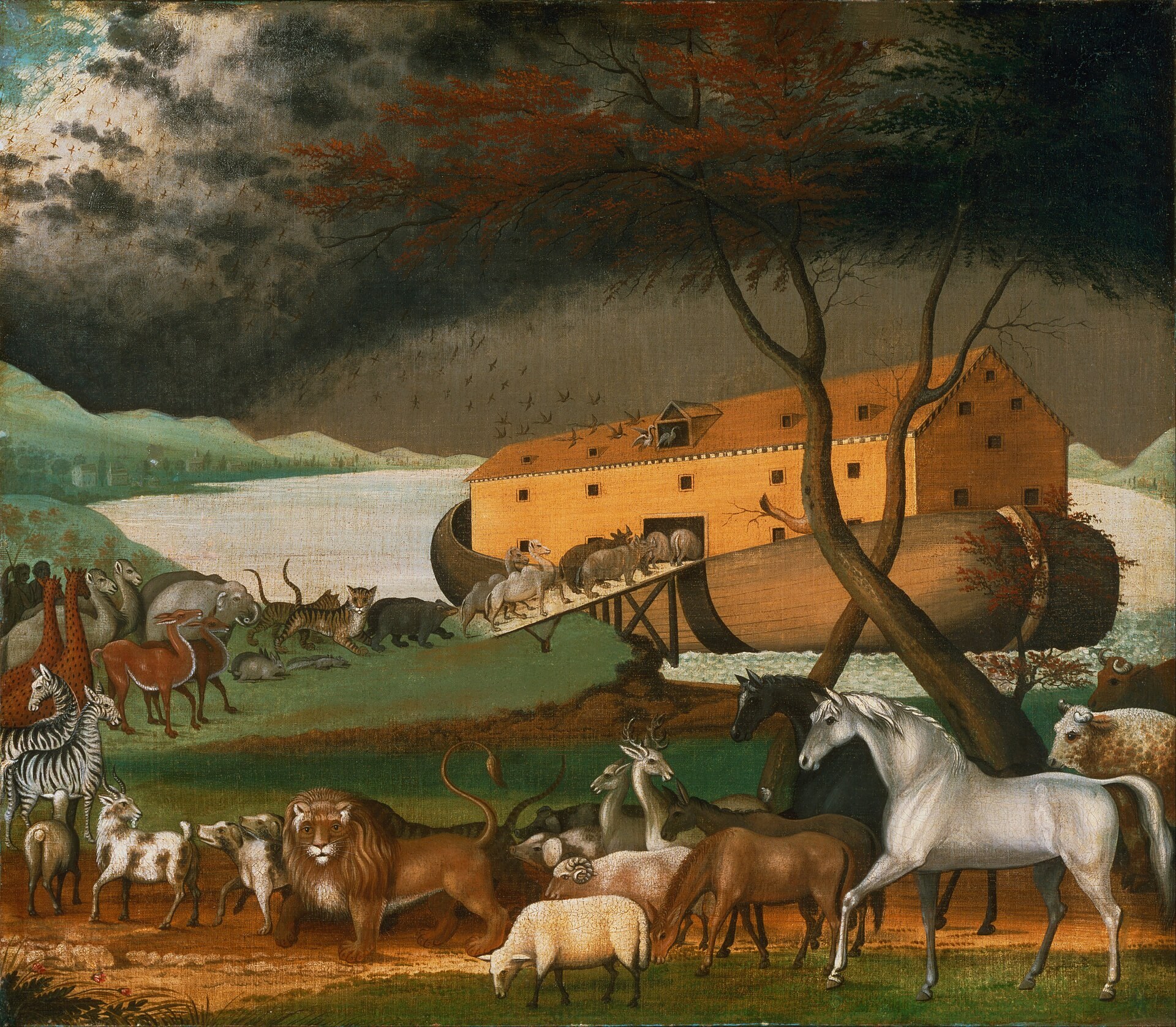
No debate recorded. No request for a smaller boat. He was told to build an ocean-going vessel, inland, for a kind of weather that had not yet been invented, and he did it.
A hundred and twenty years of being laughed at
The building was itself the sermon. Peter calls Noah a preacher of righteousness, and the ark was his pulpit — enormous, absurd, and getting nearer to finished every year.
The response is described in a way any believer will recognise:
“Some were deeply convicted, and would have heeded the words of warning; but there were so many to jest and ridicule, that they partook of the same spirit, resisted the invitations of mercy, and were soon among the boldest and most defiant scoffers.”
Ellen G. White · Patriarchs and Prophets, p. 95
That is worth reading twice. The people who ended up mocking loudest were not the hardest hearts in the crowd. They were the ones who had nearly believed, and could not bear to be laughed at, and settled the discomfort by joining the laughter.
Ridicule did more damage than argument. It usually does.
The Door God Shut
The invitation, when it finally came, was not a warning to flee. It was an invitation to come in:
"1 And the LORD said unto Noah, Come thou and all thy house into the ark; for thee have I seen righteous before me in this generation."

Genesis 7:1  KJV
Come. Not go. God speaks as one already inside, calling them to where He is.
And then five words that carry more weight than anything else in the chapter:
"16 And they that went in, went in male and female of all flesh, as God had commanded him: and the LORD shut him in."

Genesis 7:16  KJV
“Noah and his household were within the ark, ‘and the Lord shut him in.’”
Ellen G. White · Patriarchs and Prophets, p. 98
Noah did not close that door, and this matters in both directions.
It means Noah could not shut anybody out. Whatever he thought of the crowd outside, the decision was not his, and there is mercy in that — he did not have to carry it.
It also means Noah could not open it again. Once God closed that door, no amount of hammering from either side changed anything.
Seven days of nothing
Then comes a detail that most readers miss entirely, and it may be the most frightening thing in these eight chapters:
“For seven days after Noah and his family entered the ark, there appeared no sign of the coming storm.”
Ellen G. White · Patriarchs and Prophets, p. 98
A week. Sunshine, ordinary weather, the animals loaded, the door sealed, and nothing happening.
Imagine the mood outside. This was the best week the scoffers ever had. The old man had finally shut himself in his ridiculous boat and the sky was blue. Business as usual, and the evidence apparently conclusive.
Their fate had been fixed for seven days and they did not know it, because nothing had visibly changed.
Anyone who has read our article on the close of probation will recognise that immediately. A decision made in heaven, an outward world that carries on exactly as before, and a gap between the two in which everything looks fine. Genesis 7 is the working model, and Jesus chose this event, out of all others, as the picture of His own return.
Peter saw the same parallel:
“Says the apostle Peter, ‘There shall come in the last days scoffers, walking after their own lusts, and saying, Where is the promise of His coming? for since the fathers fell asleep, all things continue as they were from the beginning.’”
Ellen G. White · Patriarchs and Prophets, p. 102
“All things continue as they were.” That was true, and it stayed true, right up until it was catastrophically not.
“‘The fountains of the great deep’ were ‘broken up, and the windows of heaven were opened,’ and the scoffers were overwhelmed in the waters of the Flood.”
Ellen G. White · Patriarchs and Prophets, p. 103
The Bow In The Cloud
What God says when the water goes down is remarkable, because of the reason He gives:
"21 And the LORD smelled a sweet savour; and the LORD said in his heart, I will not again curse the ground any more for man's sake; for the imagination of man's heart is evil from his youth; neither will I again smite any more every thing living, as I have done."

Genesis 8:21  KJV
Read the logic. In Genesis 6 the evil imagination of man’s heart was the reason for the Flood. In Genesis 8 the same fact is the reason God will never do it again.
The judgment did not fix the human heart, and God says so plainly. Water can end a civilisation; it cannot cleanse one. Something else would be needed, and Genesis 3:15 had already named it.
"13 I do set my bow in the cloud, and it shall be for a token of a covenant between me and the earth.

14 And it shall come to pass, when I bring a cloud over the earth, that the bow shall be seen in the cloud:

15 And I will remember my covenant, which is between me and you and every living creature of all flesh; and the waters shall no more become a flood to destroy all flesh."

Genesis 9:13-15  KJV
Notice when the sign appears. Not on clear days — when I bring a cloud over the earth. The reassurance is issued precisely when the thing being feared starts to look possible again.
“How great the condescension of God and His compassion for His erring creatures in thus placing the beautiful rainbow in the clouds as a token of His covenant with men!”
Ellen G. White · Patriarchs and Prophets, p. 106
And the bow did not stay on earth:
“In heaven the semblance of a rainbow encircles the throne and overarches the head of Christ.”
Ellen G. White · Patriarchs and Prophets, p. 107
“When man by his great wickedness invites the divine judgments, the Saviour, interceding with the Father in his behalf, points to the bow in the clouds, to the rainbow around the throne and above His own head, as a token of the mercy of God toward the repentant sinner.”
Ellen G. White · Patriarchs and Prophets, p. 107
The same arc John saw around the throne in Revelation is the one Noah saw over a drowned world. It began as a promise about weather and turned out to be a promise about mercy.
The Curse That Was Not On Ham
The man who survived the Flood gets drunk in the next paragraph. Scripture does not protect its heroes.
"20 And Noah began to be an husbandman, and he planted a vineyard:

21 And he drank of the wine, and was drunken; and he was uncovered within his tent.

22 And Ham, the father of Canaan, saw the nakedness of his father, and told his two brethren without."

Genesis 9:20-22  KJV
Notice the contrast the text draws. Ham looked, and went out and talked about it. Shem and Japheth walked in backwards with a garment so that they would not see.
One son treated his father’s disgrace as something to be reported. Two treated it as something to be covered. That is the whole moral test of the passage, and it is not really about nakedness at all.
Then the sentence that has done more damage in Christian history than almost any other:
"25 And he said, Cursed be Canaan; a servant of servants shall he be unto his brethren."

Genesis 9:25  KJV
Read who is actually named
Ham committed the offence. Canaan is the one cursed. Ham is not cursed anywhere in the passage, and neither are his other three sons.
Ellen White notices the oddity and explains it in a single phrase:
“Tracing the descendants of Ham, through the son rather than the father, he declared, ‘Cursed be Canaan; a servant of servants shall he be unto his brethren.’”
Ellen G. White · Patriarchs and Prophets, p. 117
Through the son rather than the father. Noah is not pronouncing a punishment on Ham; he is speaking prophetically about which branch of the family the character would run into.
“These evil characteristics were perpetuated in Canaan and his posterity, whose continued guilt called upon them the judgments of God.”
Ellen G. White · Patriarchs and Prophets, p. 117
Continued guilt. Not inherited status — conduct, sustained across generations, by people who kept choosing it.
The misreading that justified slavery
This has to be said plainly, because for roughly four hundred years this verse was the principal biblical defence of African slavery, and it was called “the curse of Ham.”
Three facts from the text itself dismantle it.
First, the curse is not on Ham. It is on Canaan, named four times in the passage. A doctrine called “the curse of Ham” is misnamed in its own title.
Second, Canaan did not settle in Africa. Genesis 10 tells us exactly where his descendants went, and it is not a matter of inference:
"19 And the border of the Canaanites was from Sidon, as thou comest to Gerar, unto Gaza; as thou goest, unto Sodom, and Gomorrah, and Admah, and Zeboim, even unto Lasha."

Genesis 10:19  KJV
Sidon, Gaza, Sodom. That is the eastern Mediterranean coast — modern Lebanon, Israel and Gaza. The Canaanites are the people Israel later met in the promised land, and Scripture places them there explicitly.
Third, the African lines are Ham’s other sons, and they are not cursed. Cush, Mizraim and Phut — traditionally Ethiopia, Egypt and Libya — appear in the same verse as Canaan and receive no curse whatever.
"6 ¶ And the sons of Ham; Cush, and Mizraim, and Phut, and Canaan."

Genesis 10:6  KJV
So the doctrine cursed the wrong man, moved his descendants to the wrong continent, and then applied the result to people the text never mentions. It was not a hard reading to get wrong by accident. It was got wrong on purpose, by men who wanted a text.
And even against Canaan the judgment was not automatic. God waited generations for it, and said so:
“He told them that the iniquity of the Amorites was not yet full, and their expulsion and extermination could not be justified until they had filled up the cup of their iniquity.”
Ellen G. White · SDA Bible Commentary, vol. 1, p. 1093
Four hundred years of patience, waiting to see whether a people would turn. That is not the behaviour of a God who condemns a bloodline at birth.
Three sons, three futures
“In Shem, Ham, and Japheth, who were to be the founders of the human race, was foreshadowed the character of their posterity.”
Ellen G. White · Patriarchs and Prophets, p. 117
Shem carries the covenant line: “The line of Shem was to be that of the chosen people, of God’s covenant, of the promised Redeemer.” Genesis 3:15 travels here.
Japheth is promised enlargement and a share in Shem’s tents — and Ellen White reads that as the gospel going to the Gentiles: “In the blessings of the gospel the descendants of Japheth were especially to share.”
Canaan is the branch where the rebellion concentrates.
Three brothers who stood in the same tent on the same night, and their choices that night ran forward into history.
The Table Of Nations: Where Everybody Went
Genesis 10 is a list of seventy names, and most readers turn the page. It is one of the most useful chapters in the Bible, because it tells you where the rest of the Old Testament’s cast came from.
A note on order first. Chapter 10 describes the nations already scattered and speaking different languages; chapter 11 explains how that happened. Genesis gives you the outcome and then goes back for the cause — so read 11 as the event and 10 as the map it produced.
Japheth — the isles of the Gentiles
"5 By these were the isles of the Gentiles divided in their lands; every one after his tongue, after their families, in their nations."

Genesis 10:5  KJV
Japheth’s sons — Gomer, Magog, Madai, Javan, Tubal, Meshech, Tiras — go north and west. Javan is the Hebrew name for Greece. Madai is Media, which turns up in Daniel as half of the Medo-Persian empire. Magog reappears in Ezekiel and Revelation.
These are the coastlands and the peoples of Europe and Asia Minor. “Enlarge Japheth” turned out to be an understatement.
Ham — and here is the pathway
Now trace Ham’s four sons, because between them they account for nearly every power that ever oppressed the people of God.
Cush produces the first empire-builder in Scripture:
"8 And Cush begat Nimrod: he began to be a mighty one in the earth.

9 He was a mighty hunter before the LORD: wherefore it is said, Even as Nimrod the mighty hunter before the LORD.

10 And the beginning of his kingdom was Babel, and Erech, and Accad, and Calneh, in the land of Shinar."

Genesis 10:8-10  KJV
Read verse 10 slowly. The beginning of his kingdom was Babel — in the land of Shinar, which is exactly where chapter 11 puts the tower.
So Babel is not merely an incident that happened once and ended. It is the founding city of the first kingdom in the Bible, and Scripture names its founder. “A mighty one in the earth” is the language of conquest, not farming.
And it does not stop there:
"11 Out of that land went forth Asshur, and builded Nineveh, and the city Rehoboth, and Calah,

12 And Resen between Nineveh and Calah: the same is a great city."

Genesis 10:11-12  KJV
Nineveh — the capital of Assyria, the empire that would erase the northern kingdom of Israel. It comes out of the same plain, in the same paragraph, as Babel.
Mizraim is the Hebrew word for Egypt — the house of bondage.
Canaan produces Sidon and Heth, and the list of nations Israel would later face: Jebusite, Amorite, Girgasite, Hivite — with a border running “unto Sodom, and Gomorrah.”
Set them side by side and the shape is hard to miss:
- Cush → Nimrod → Babel → Babylon, and Nineveh → Assyria
- Mizraim → Egypt
- Canaan → the Canaanite nations, Sodom and Gomorrah
- Phut → Libya
Babylon, Assyria, Egypt, Canaan. The four great antagonists of Israel’s history, all in one paragraph of one genealogy.
That is the pathway, and Genesis puts it in writing before any of those powers existed.
Shem — the thin line that matters
"21 ¶ Unto Shem also, the father of all the children of Eber, the brother of Japheth the elder, even to him were children born."

Genesis 10:21  KJV
Eber is the root behind the word Hebrew. Shem’s line is introduced by naming the ancestor the chosen people are called after, before anyone has heard of Abraham.
"25 And unto Eber were born two sons: the name of one was Peleg; for in his days was the earth divided; and his brother's name was Joktan."

Genesis 10:25  KJV
Peleg means division, and he was named for the event. A father in Shem’s line marked the scattering of Babel by naming his son after it — the way people name children after wars.
And Shem’s line runs straight on into chapter 11’s closing genealogy, which narrows generation by generation until it stops on one man in Ur: Abram.
What this does not mean
Having traced the pathway, we have to be careful about what we have and have not shown — because this is precisely where the reasoning has gone badly wrong before.
Genesis 10 shows that certain institutions — a city, an empire, a religious system — descend from a particular branch. It does not show that individuals inherit guilt from ancestors, and Scripture repeatedly says they do not.
The Bible itself supplies the counter-examples. Rahab was a Canaanite, and she is in the genealogy of Jesus Christ. Nineveh repented at the preaching of a reluctant prophet, and God spared it. The Ethiopian in Acts 8 — a son of Cush — is one of the first recorded Gentile converts.
So the pathway is real, and it is a pathway of systems, not of blood. Babel is a way of organising human life without God, and it can be adopted by anyone from any line — which is exactly what Revelation says happens at the end, when the whole world adopts it.
Ellen White’s own summary of the Shinar builders is about a choice, not a bloodline:
“The dwellers on the plain of Shinar established their kingdom for self-exaltation, not for the glory of God.”
Ellen G. White · Testimonies for the Church, vol. 8, p. 213
Self-exaltation instead of the glory of God. That is the pathway, stated as a motive rather than a lineage — and it is available to every one of us.
Babel: The First Organised Rebellion
Genesis 11 is short, and it describes the moment human rebellion stopped being individual and became institutional.
"1 And the whole earth was of one language, and of one speech."

Genesis 11:1  KJV
"4 And they said, Go to, let us build us a city and a tower, whose top may reach unto heaven; and let us make us a name, lest we be scattered abroad upon the face of the whole earth."

Genesis 11:4  KJV
Three motives in one verse, and each is worth naming.
“Whose top may reach unto heaven.” A structure to get them up there themselves — the serpent’s offer in architectural form.
“Let us make us a name.” Compare Seth’s line, who called on the name of the Lord. Same word, opposite direction.
“Lest we be scattered.” God had told them to fill the earth. The tower was a project to avoid obeying, and its purpose was stated openly.
“The magnificent tower, reaching to the heavens, was intended to stand as a monument of the power and wisdom of its builders, perpetuating their fame to the latest generations.”
Ellen G. White · Patriarchs and Prophets, p. 118
And there was a colder motive underneath the monument:
“One object before them in the erection of the tower was to secure their own safety in case of another deluge.”
Ellen G. White · Patriarchs and Prophets, p. 119
That is the detail that exposes the whole enterprise. God had just hung a rainbow in the sky and given His word that there would be no second flood. They built insurance against it anyway.
The tower is a monument to distrust, dressed as ambition. They did not believe the promise, so they poured concrete.
And there was worship going on inside it — just not of God:
“When the tower had been partially completed, a portion of it was occupied as a dwelling place for the builders; other apartments, splendidly furnished and adorned, were devoted to their idols.”
Ellen G. White · Patriarchs and Prophets, p. 119
The confusion was a rescue
"6 And the LORD said, Behold, the people is one, and they have all one language; and this they begin to do: and now nothing will be restrained from them, which they have imagined to do.

7 Go to, let us go down, and there confound their language, that they may not understand one another's speech."

Genesis 11:6-7  KJV
“Nothing will be restrained from them.” God is not describing a threat to Himself. He is describing what a united humanity with no restraint had proved it does — and He had drained the planet over it only a few generations earlier.
So the confusion of languages belongs with the flaming sword at Eden’s gate. Both look like punishment and both are limits placed on how far ruin can run. Scattering a rebellion is gentler than drowning one.
“As messages were thus passing from one to another the language was confounded, so that material was called for which was not needed, and the directions delivered were often the reverse of those that had been given.”
Ellen G. White · Patriarchs and Prophets, p. 119
The project did not fall down. It simply became impossible to coordinate, and stopped.
"9 Therefore is the name of it called Babel; because the LORD did there confound the language of all the earth: and from thence did the LORD scatter them abroad upon the face of all the earth."

Genesis 11:9  KJV
Babel — confusion. They set out to make themselves a name, and they got one. It was not the one they wanted, and the world has used it as a byword ever since.
The name outlives the tower by four thousand years, and it reappears at the far end of Scripture as the label for the final religious confederacy that repeats exactly this: unity without God, worship of what men have made, and a monument to human greatness that falls in an hour.
What These Eight Chapters Are Doing
Read quickly, Genesis 4 to 11 looks like a sequence of disasters — a murder, a flood, a failed tower. Read carefully, it is one argument told three times.
Each episode has the same shape. Human beings decide the arrangement God made is unnecessary. They substitute something of their own — an offering without blood, a civilisation without restraint, a tower without trust. It fails. And in every case God limits the damage and leaves a way through: a mark of protection on Cain, a door in an ark, a scattering instead of a second flood.
And running under all of it, the thin line of Genesis 3:15 keeps going. Abel dies but Seth is born. The faithful line nearly dissolves but Noah is found. Babel scatters the nations, and the very next paragraph narrows to one family, and then to one man, Abram — and the whole rest of the Bible follows him.
The promise never fails and it never travels comfortably. It survives a murder, a flood and an empire, and at no point does it look secure.
And the pattern is not finished
Jesus reached back to these chapters when He described His own return, and He chose Noah rather than Adam. Not the fall — the flood. A world going about its business, a warning nobody believed, a door that closed, and seven days of ordinary weather on the other side of a decision already made.
Enoch is in these chapters for the same reason: a man who walked with God through a doomed generation and was taken out alive before the judgment fell.
So these are not old stories about other people. They are the shape of the thing we are living inside, written down early so that nobody would have to guess.
And the offer has not changed since the day it was first made in a field, to a farmer who was angry about a lamb: if thou doest well, shalt thou not be accepted?
