Paul finally keeps his promise to return to Ephesus, and stays for over three years — the longest single ministry recorded anywhere in this book. In that time a dozen half-informed disciples receive the Holy Spirit for the first time, seven brothers learn the hard way that Jesus’s name is not a magic formula, a whole city’s occult library goes up in a bonfire, and a silversmith’s wounded profits nearly get an apostle killed.
A study in Acts 19 · Arthur Baldwin · StandUp4Jesus.Org · 20 min read
We Have Not So Much As Heard Whether There Be Any Holy Ghost
“And it came to pass, that, while Apollos was at Corinth, Paul having passed through the upper coasts came to Ephesus: and finding certain disciples, He said unto them, Have ye received the Holy Ghost since ye believed? And they said unto him, We have not so much as heard whether there be any Holy Ghost.”
Acts 19:1-2
“On his arrival at Ephesus, Paul found twelve brethren, who, like Apollos, had been disciples of John the Baptist, and like him had gained some knowledge of the mission of Christ. They had not the ability of Apollos, but with the same sincerity and faith they were seeking to spread abroad the knowledge they had received.”
Ellen G. White · The Acts of the Apostles, p. 282
Ephesus produces a second version of exactly the gap this study’s own previous chapter already found in Apollos — sincere, active disciples working from an incomplete gospel, still standing at John the Baptist’s own preparatory message rather than its fulfillment.
“And he said unto them, Unto what then were ye baptized? And they said, Unto John’s baptism. Then said Paul, John verily baptized with the baptism of repentance, saying unto the people, that they should believe on him which should come after him, that is, on Christ Jesus.”
Acts 19:3-4
“Then the apostle set before them the great truths that are the foundation of the Christian’s hope. He told them of Christ’s life on this earth and of His cruel death of shame. He told them how the Lord of life had broken the barriers of the tomb and risen triumphant over death.”
Ellen G. White · The Acts of the Apostles, p. 282
“When they heard this, they were baptized in the name of the Lord Jesus. And when Paul had laid his hands upon them, the Holy Ghost came on them; and they spake with tongues, and prophesied. And all the men were about twelve.”
Acts 19:5-7
“When they received baptism at the hand of John they did not fully comprehend the mission of Jesus as the Sin Bearer. They were holding serious errors. But with clearer light, they gladly accepted Christ as their Redeemer, and with this step of advance came a change in their obligations.”
Ellen G. White · The Acts of the Apostles, p. 285
These twelve are rebaptized, not merely supplemented — a small but pointed detail. Sincere devotion to real but partial light does not exempt a person from moving forward once fuller light arrives; it is a step of advance, taken gladly, not a correction imposed on the reluctant.
Disputing Daily In The School Of One Tyrannus
“And he went into the synagogue, and spake boldly for the space of three months, disputing and persuading the things concerning the kingdom of God. But when divers were hardened, and believed not, but spake evil of that way before the multitude, he departed from them, and separated the disciples, disputing daily in the school of one Tyrannus.”
Acts 19:8-9
“Fearing that the faith of the believers would be endangered by continued association with these opposers of the truth, Paul separated from them and gathered the disciples into a distinct body, continuing his public instructions in the school of Tyrannus, a teacher of some note.”
Ellen G. White · The Acts of the Apostles, p. 285
The separation protects the young believers, not Paul’s own reputation — a lecture hall borrowed from a named local teacher becomes, for the next two years, the daily classroom for the whole province’s evangelization.
“And this continued by the space of two years; so that all they which dwelt in Asia heard the word of the Lord Jesus, both Jews and Greeks.”
Acts 19:10
“Ephesus was not only the most magnificent, but the most corrupt, of the cities of Asia. Superstition and sensual pleasure held sway over her teeming population. … Ephesus was a popular center for the worship of Diana. The fame of the magnificent temple of ‘Diana of the Ephesians’ extended throughout all Asia and the world.”
Ellen G. White · The Acts of the Apostles, p. 286
One verse of Scripture — “all they which dwelt in Asia heard” — understates something remarkable. A single rented lecture hall, in a city famous for one of the ancient world’s great pagan temples, becomes the unlikely source point for an entire province’s exposure to the gospel.
Jesus I Know, And Paul I Know; But Who Are Ye?
“And God wrought special miracles by the hands of Paul: So that from his body were brought unto the sick handkerchiefs or aprons, and the diseases departed from them, and the evil spirits went out of them.”
Acts 19:11-12
“These manifestations of supernatural power were far more potent than had ever before been witnessed in Ephesus, and were of such a character that they could not be imitated by the skill of the juggler or the enchantments of the sorcerer. As these miracles were wrought in the name of Jesus of Nazareth, the people had opportunity to see that the God of heaven was more powerful than the magicians who were worshipers of the goddess Diana.”
Ellen G. White · The Acts of the Apostles, p. 286
These miracles are, this study’s own source is careful to note, deliberately public and specifically calibrated — not private favors but a direct, visible contest of power staged in a city that already worships supernatural power under a different name entirely.
“Then certain of the vagabond Jews, exorcists, took upon them to call over them which had evil spirits the name of the Lord Jesus, saying, We adjure you by Jesus whom Paul preacheth. And there were seven sons of one Sceva, a Jew, and chief of the priests, which did so.”
Acts 19:13-14
“And the evil spirit answered and said, Jesus I know, and Paul I know; but who are ye? And the man in whom the evil spirit was leaped on them, and overcame them, and prevailed against them, so that they fled out of that house naked and wounded.”
Acts 19:15-16
“Thus unmistakable proof was given of the sacredness of the name of Christ, and the peril which they incurred who should invoke it without faith in the divinity of the Saviour’s mission.”
Ellen G. White · The Acts of the Apostles, p. 288
Sceva’s sons treat “the name of the Lord Jesus” as a formula they overheard, a password borrowed rather than a relationship possessed — and the demon’s own reply is a small masterpiece of contempt, naming exactly the one thing they lack: any actual standing with either Jesus or His servant.
They Counted The Price Of Them
“And this was known to all the Jews and Greeks also dwelling at Ephesus; and fear fell on them all, and the name of the Lord Jesus was magnified. And many that believed came, and confessed, and shewed their deeds.”
Acts 19:17-18
“In accepting Christianity, some of the believers had not fully renounced their superstitions. To some extent they still continued the practice of magic. Now, convinced of their error, ‘many that believed came, and confessed, and showed their deeds.’”
Ellen G. White · The Acts of the Apostles, p. 288
The Sceva incident does something a hundred sermons might not have — it exposes believers who had quietly kept one foot in their old practices, converted in name but not fully in conduct, and the shock of it finally moves them to an honest, costly confession.
“Many of them also which used curious arts brought their books together, and burned them before all men: and they counted the price of them, and found it fifty thousand pieces of silver. So mightily grew the word of God and prevailed.”
Acts 19:19-20
“By retaining these books the disciples would have exposed themselves to temptation; by selling them they would have placed temptation in the way of others. They had renounced the kingdom of darkness, and to destroy its power they did not hesitate at any sacrifice. Thus truth triumphed over men’s prejudices and their love of money.”
Ellen G. White · The Acts of the Apostles, p. 288
Fifty thousand pieces of silver is a genuinely enormous sum — a small fortune of occult manuscripts, and the text is careful to note that the owners counted the value before burning it, so the sacrifice is made with clear eyes rather than in some thoughtless rush of enthusiasm. Selling the books to recoup the loss is never even considered; the whole point is to remove the temptation from circulation entirely, whatever it costs.
Great Is Diana Of The Ephesians
“For a certain man named Demetrius, a silversmith, which made silver shrines for Diana, brought no small gain unto the craftsmen; Whom he called together with the workmen of like occupation, and said, Sirs, ye know that by this craft we have our wealth.”
Acts 19:24-25
“Moreover ye see and hear, that not alone at Ephesus, but almost throughout all Asia, this Paul hath persuaded and turned away much people, saying that they be no gods, which are made with hands: So that not only this our craft is in danger to be set at nought; but also that the temple of the great goddess Diana should be despised.”
Acts 19:26-27
“In his speech Demetrius had said, ‘This our craft is in danger.’ These words reveal the real cause of the tumult at Ephesus, and also the cause of much of the persecution which followed the apostles in their work. … The income of pagan priests and artisans was at stake, and for this reason they aroused against Paul the most bitter opposition.”
Ellen G. White · The Acts of the Apostles, p. 295
Demetrius states his own real motive out loud, in the very first sentence, before wrapping the rest of his speech in the language of religious and civic devotion — the same pattern already seen in the slave girl’s owners back in Philippi, a financial grievance dressed up as righteous outrage because outrage moves crowds and lost income does not.
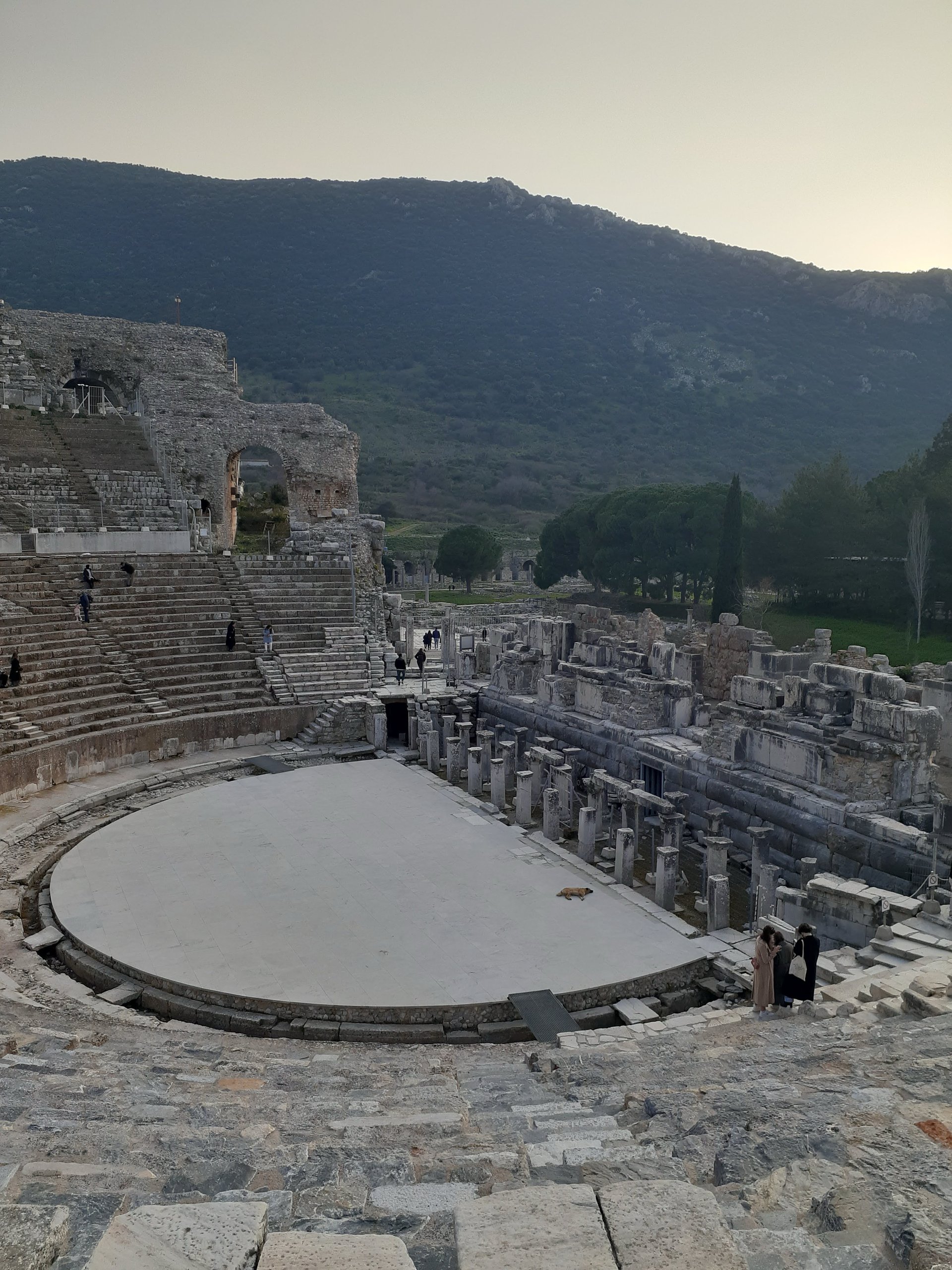
“And when they heard these sayings, they were full of wrath, and cried out, saying, Great is Diana of the Ephesians. And the whole city was filled with confusion: and having caught Gaius and Aristarchus, men of Macedonia, Paul’s companions in travel, they rushed with one accord into the theatre.”
Acts 19:28-29
“And when Paul would have entered in unto the people, the disciples suffered him not. And certain of the chief of Asia, which were his friends, sent unto him, desiring him that he would not adventure himself into the theatre.”
Acts 19:30-31
“Paul’s place of concealment was not far distant, and he soon learned of the peril of his beloved brethren. Forgetful of his own safety, he desired to go at once to the theater to address the rioters. But ‘the disciples suffered him not.’”
Ellen G. White · The Acts of the Apostles, p. 293
Verse 30’s small phrase — “would have entered” — is easy to read past. Paul is not hiding out of self-preservation; he is actively restrained by his own friends from walking into a mob that his own preaching provoked, on his own companions’ behalf rather than his own.
“And they drew Alexander out of the multitude, the Jews putting him forward. And Alexander beckoned with the hand, and would have made his defence unto the people. But when they knew that he was a Jew, all with one voice about the space of two hours cried out, Great is Diana of the Ephesians.”
Acts 19:33-34
Two straight hours of a single chanted phrase is, this study’s own source rightly implies, closer to mass hysteria than argument — the assembly’s own account admits “the more part knew not wherefore they were come together,” a crowd that has entirely lost track of its own original grievance.
Ye Ought To Be Quiet, And To Do Nothing Rashly
“And when the townclerk had appeased the people, he said, Ye men of Ephesus, what man is there that knoweth not how that the city of the Ephesians is a worshipper of the great goddess Diana, and of the image which fell down from Jupiter? Seeing then that these things cannot be spoken against, ye ought to be quiet, and to do nothing rashly.”
Acts 19:35-36
“Then the recorder of the city arrested the attention of the crowd, and by virtue of his office obtained a hearing. He met the people on their own ground and showed that there was no cause for the present tumult. He appealed to their reason.”
Ellen G. White · The Acts of the Apostles, p. 294
The town clerk’s opening move is nearly identical to Paul’s own at Mars’ Hill one chapter earlier — affirm the audience’s own devotion before ever asking them to reconsider anything, using their unquestioned confidence as the very ground on which to talk them down.
“For ye have brought hither these men, which are neither robbers of churches, nor yet blasphemers of your goddess. Wherefore if Demetrius, and the craftsmen which are with him, have a matter against any man, the law is open, and there are deputies: let them implead one another.”
Acts 19:37-38
“For we are in danger to be called in question for this day’s uproar, there being no cause whereby we may give an account of this concourse. And when he had thus spoken, he dismissed the assembly.”
Acts 19:40-41
“The decision of the recorder and of others holding honorable offices in the city had set Paul before the people as one innocent of any unlawful act. This was another triumph of Christianity over error and superstition. God had raised up a great magistrate to vindicate His apostle and hold the tumultuous mob in check.”
Ellen G. White · The Acts of the Apostles, p. 295
This is the third time in three straight chapters that a Roman civic official — Gallio at Corinth, and now an unnamed town clerk at Ephesus — has publicly cleared Paul of wrongdoing on purely practical, legal grounds, with no particular sympathy for the gospel itself. The book keeps quietly building a record: whatever violence the gospel provokes from crowds, it keeps surviving formal, sober scrutiny by the empire’s own officials.
“After the uproar was ceased, Paul called unto him the disciples, and embraced them, and departed for to go into Macedonia.”
Ellen G. White · The Acts of the Apostles, p. 295
The chapter’s own final image is quiet on purpose — not another dramatic escape, but an embrace, three years of shared labor closing not in triumph or tragedy but in the plain affection of people who have genuinely come to love one another.
