In the third chapter of Philippians, Paul opens his own ledger. On one side stands everything he once counted as gain: a perfect pedigree, a strict religious education, a spotless record under the law. On the other side stands one name. Paul tells how he moved everything he once valued into the column marked loss, how he stopped trusting his own righteousness and received the righteousness that comes from God by faith, and how he now runs like an athlete toward a finish line he has not yet reached, looking for a Saviour who will come from heaven.
A study in Philippians 3 · Arthur Baldwin · StandUp4Jesus.Org · 27 min read
Beware Of The Concision
“Finally, my brethren, rejoice in the Lord. To write the same things to you, to me indeed is not grievous, but for you it is safe. Beware of dogs, beware of evil workers, beware of the concision. For we are the circumcision, which worship God in the spirit, and rejoice in Christ Jesus, and have no confidence in the flesh.”
Philippians 3:1-3
“Finally” — and then two more chapters. Paul’s “finally” means something like “as for the rest.” And the rest begins with a sudden, sharp warning. The same teachers who had troubled the Galatian churches, insisting that Gentile believers must be circumcised and keep the ceremonial law of Moses to be saved, were traveling from church to church. Nothing in the letter suggests they had yet won a hearing in Philippi, but Paul wanted the church ready.
His language is deliberately jarring. Jews sometimes called Gentiles “dogs,” the unclean outsiders. Paul turns the word around: the real outsiders are those who insist on the knife. And he refuses to call their practice circumcision at all. He calls it “the concision” — a play on words in Greek, meaning a mere cutting, a mutilation. The true “circumcision” is the people whose hearts God has changed, who “worship God in the spirit” and put “no confidence in the flesh.”
It is important to see what Paul is and is not rejecting. Circumcision was part of the ceremonial system, a sign that pointed forward and found its meaning in Christ; “in Christ Jesus neither circumcision availeth any thing, nor uncircumcision, but a new creature” (Galatians 6:15). But Paul never set aside God’s moral law. “Do we then make void the law through faith? God forbid: yea, we establish the law” (Romans 3:31). What he rejects here is trusting in anything we do, ceremony or otherwise, as the ground of our acceptance with God. (The study of Galatians 3 treats this distinction at length.)
An Hebrew Of The Hebrews
“Though I might also have confidence in the flesh. If any other man thinketh that he hath whereof he might trust in the flesh, I more: Circumcised the eighth day, of the stock of Israel, of the tribe of Benjamin, an Hebrew of the Hebrews; as touching the law, a Pharisee; Concerning zeal, persecuting the church; touching the righteousness which is in the law, blameless.”
Philippians 3:4-6
If religious credentials could save anyone, Paul would have been first in line. He lists seven. Four he was born with: circumcised on the eighth day, exactly as the law required; a true Israelite, not a convert; from Benjamin, the tribe that gave Israel its first king and that stayed loyal to Judah; a Hebrew-speaking son of Hebrew-speaking parents. Three he achieved: a Pharisee, the strictest party; a zealot who proved it by persecuting the church; and, by the law’s outward standard, “blameless.”
“A Roman citizen by birth, Saul was nevertheless a Jew by descent and had been educated in Jerusalem by the most eminent of the rabbis. ‘Of the stock of Israel, of the tribe of Benjamin,’ Saul was ‘a Hebrew of the Hebrews; as touching the law, a Pharisee; concerning zeal, persecuting the church; touching the righteousness which is in the law, blameless.’ Philippians 3:5, 6. He was regarded by the rabbis as a young man of great promise, and high hopes were cherished concerning him as an able and zealous defender of the ancient faith.”
Ellen G. White · The Acts of the Apostles, p. 112
“Blameless” is a remarkable word from the man who elsewhere called himself the chief of sinners. But Paul is speaking of the law as men measured it, the outward keeping of its rules. When he finally saw what the law actually asks of the heart, the picture changed completely.
“Paul says that as ‘touching the righteousness which is in the law’—as far as outward acts were concerned—he was ‘blameless’ (Philippians 3:6); but when the spiritual character of the law was discerned, he saw himself a sinner. Judged by the letter of the law as men apply it to the outward life, he had abstained from sin; but when he looked into the depths of its holy precepts, and saw himself as God saw him, he bowed in humiliation and confessed his guilt.”
Ellen G. White · Steps to Christ, p. 29
I Count All Things But Loss
“But what things were gain to me, those I counted loss for Christ. Yea doubtless, and I count all things but loss for the excellency of the knowledge of Christ Jesus my Lord: for whom I have suffered the loss of all things, and do count them but dung, that I may win Christ,”
Philippians 3:7-8
Paul uses the language of bookkeeping. “Gain” and “loss” are entries in a ledger. On the Damascus road he took every item he had once listed as profit and moved it to the loss column. Notice the tenses: “I counted” — a decision made once, at his conversion — and then “I count,” present tense. Nearly thirty years later, sitting in chains, he has not changed his mind. And he chooses the bluntest word he can find for what he gave up: “dung,” refuse, the garbage thrown out for the dogs. Set beside Christ, the finest things he ever had were worth no more than that.
“Moses renounced a prospective kingdom, Paul the advantages of wealth and honor among his people, for a life of burden bearing in God’s service. To many the life of these men appears one of renunciation and sacrifice. Was it really so? Moses counted the reproach of Christ greater riches than the treasures in Egypt. He counted it so because it was so.”
Ellen G. White · Education, p. 68
“And be found in him, not having mine own righteousness, which is of the law, but that which is through the faith of Christ, the righteousness which is of God by faith: That I may know him, and the power of his resurrection, and the fellowship of his sufferings, being made conformable unto his death; If by any means I might attain unto the resurrection of the dead.”
Philippians 3:9-11
Verse 9 is the gospel in a single sentence, and it is the same gospel Paul laid out in Romans and Galatians. There are only two kinds of righteousness a person can stand in before God. One is “mine own,” built up by my own law-keeping. The other comes “from God” as a gift, received “by faith.” Paul had spent his whole early life building the first kind, and at its best it was not enough. He now wants to be “found in him,” covered by Christ’s righteousness alone. (The study of Romans 1 follows this same thread.)
“His conversation, his influence, his refusal to yield to self-gratification, must show that his religion was not a profession merely, but a daily, living connection with God. One goal he kept ever before him, and strove earnestly to reach—‘the righteousness which is of God by faith.’ Philippians 3:9.”
Ellen G. White · The Acts of the Apostles, p. 314
And this righteousness is not a cold legal status. It opens into a relationship: “That I may know him.” To know Christ is to know “the power of his resurrection” — a power at work now, not only at the end of time.
“This same resurrection power is that which gives life to the soul ‘dead in trespasses and sins.’ Ephesians 2:1. That spirit of life in Christ Jesus, ‘the power of His resurrection,’ sets men ‘free from the law of sin and death.’ Philippians 3:10; Romans 8:2. The dominion of evil is broken, and through faith the soul is kept from sin. He who opens his heart to the Spirit of Christ becomes a partaker of that mighty power which shall bring forth his body from the grave.”
Ellen G. White · The Desire of Ages, p. 209
Verse 11 does not mean Paul doubted his salvation. “If by any means” expresses eager longing, not uncertainty about God. The goal he is reaching toward is the resurrection of the dead at Christ’s return, the moment the next verses and the end of the chapter will describe.
Not As Though I Had Already Attained
“Not as though I had already attained, either were already perfect: but I follow after, if that I may apprehend that for which also I am apprehended of Christ Jesus. Brethren, I count not myself to have apprehended: but this one thing I do, forgetting those things which are behind, and reaching forth unto those things which are before, I press toward the mark for the prize of the high calling of God in Christ Jesus.”
Philippians 3:12-14
After nearly thirty years of following Christ, after planting churches across the Roman world, after being caught up into the third heaven (2 Corinthians 12:2), Paul says he has not arrived. He is still running.
“Let not God be dishonored by the declaration from human lips, ‘I am sinless; I am holy.’ Sanctified lips will never give utterance to such presumptuous words. The apostle Paul had been caught up to the third heaven and had seen and heard things that could not be uttered, and yet his unassuming statement is: ‘Not as though I had already attained, either were already perfect: but I follow after.’ Philippians 3:12.”
Ellen G. White · The Acts of the Apostles, p. 561, 562
Notice the beautiful play on words in verse 12. Paul wants to “apprehend” — to lay hold of — the very thing for which Christ “apprehended” him. He is describing the Damascus road. Christ took hold of Paul first. Everything Paul now reaches for is simply the purpose Christ had in seizing him.
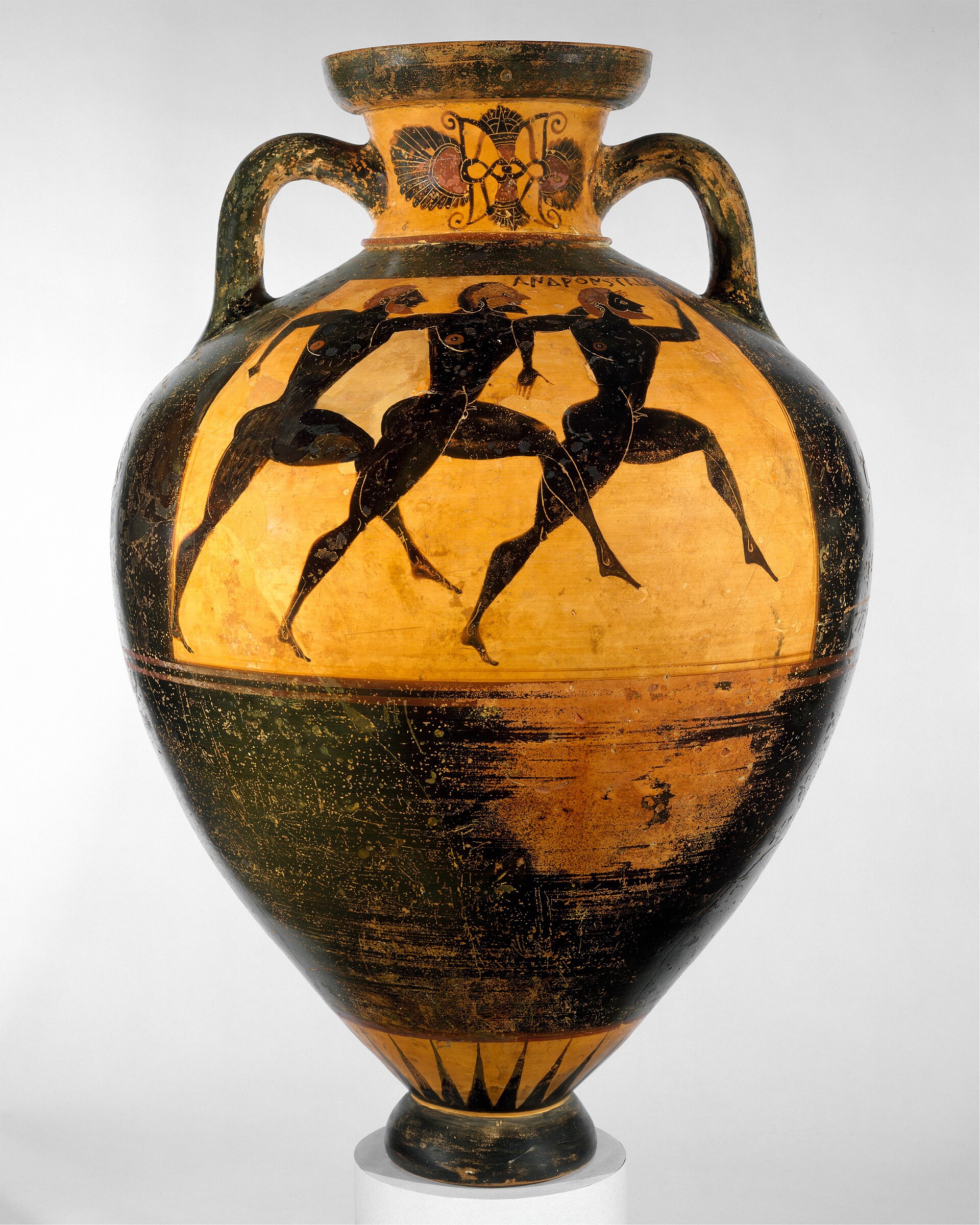
Then comes the picture of a runner in the stadium. A runner who keeps looking over his shoulder loses ground, so Paul is “forgetting those things which are behind” — his old achievements, but also his old failures, including the believers he once dragged to prison. He leans forward, “reaching forth” like a sprinter stretching toward the tape, toward “the prize.” In Greece the prize of a victory in the Panathenaic games was an amphora of sacred olive oil, like the one pictured above. Paul’s prize is “the high calling of God in Christ Jesus,” the upward call that will be complete when Christ calls His people home.
“The Scriptures plainly show that the work of sanctification is progressive. When in conversion the sinner finds peace with God through the blood of the atonement, the Christian life has but just begun. Now he is to ‘go on unto perfection;’ to grow up ‘unto the measure of the stature of the fullness of Christ.’ Says the apostle Paul: ‘This one thing I do, forgetting those things which are behind, and reaching forth unto those things which are before, I press toward the mark for the prize of the high calling of God in Christ Jesus.’ Philippians 3:13, 14.”
Ellen G. White · The Great Controversy, p. 470
“But in all the busy activities of his life, Paul never lost sight of one great purpose—to press toward the prize of his calling. One aim he kept steadfastly before him—to be faithful to the One who at the gate of Damascus had revealed Himself to him. From this aim nothing had power to turn him aside. To exalt the cross of Calvary—this was the all-absorbing motive that inspired his words and acts.”
Ellen G. White · The Acts of the Apostles, p. 483
“Forgetting those things which are behind” is good news for anyone weighed down by the past.
“Whatever the mistakes or failures of the past, we may, with the help of God, rise above them. With the apostle we may say: ‘This one thing I do, forgetting those things which are behind, and reaching forth unto those things which are before, I press toward the mark for the prize of the high calling of God in Christ Jesus.’ Philippians 3:13, 14.”
Ellen G. White · The Ministry of Healing, p. 516
“Let us therefore, as many as be perfect, be thus minded: and if in any thing ye be otherwise minded, God shall reveal even this unto you. Nevertheless, whereto we have already attained, let us walk by the same rule, let us mind the same thing.”
Philippians 3:15-16
Having just said he is not “already perfect,” Paul now speaks of those who “be perfect.” The word means mature, grown up. And the mark of Christian maturity, Paul says, is exactly this mindset: knowing you have not arrived, and pressing on. The mature believer is not the one who claims to be finished, but the one who keeps running. Where the Philippians still see things differently, Paul trusts God to show them, and asks only that they keep walking faithfully in the light they already have.
The Enemies Of The Cross Of Christ
“Brethren, be followers together of me, and mark them which walk so as ye have us for an ensample. (For many walk, of whom I have told you often, and now tell you even weeping, that they are the enemies of the cross of Christ: Whose end is destruction, whose God is their belly, and whose glory is in their shame, who mind earthly things.)”
Philippians 3:17-19
Paul now warns against the opposite error. The teachers of verse 2 added rules to the gospel; these people treated grace as permission to indulge themselves. Their “God is their belly” — their appetites rule them — and they are proud of what should shame them. They “mind earthly things.” Paul calls them “enemies of the cross,” because the cross that saves from sin can never be made an excuse for it.
And notice how he says it: “even weeping.” Paul is not gloating over his opponents. The man who could write the sharpest warnings in the New Testament wrote this one with tears.
Our Conversation Is In Heaven
“For our conversation is in heaven; from whence also we look for the Saviour, the Lord Jesus Christ: Who shall change our vile body, that it may be fashioned like unto his glorious body, according to the working whereby he is able even to subdue all things unto himself.”
Philippians 3:20-21
Philippi was a Roman colony, a little piece of Rome planted in Macedonia. Its citizens lived hundreds of miles from the capital, yet they were governed by Roman law, spoke Latin in their courts, and were enrolled as citizens of Rome itself. Paul takes that picture and applies it to the church. “Conversation” here translates the Greek word for citizenship (as the Revised Version renders it). Believers are a colony of heaven, living on earth under heaven’s laws, and waiting for their King to come.
“Until that time the kingdom of Christ cannot be established on the earth. His kingdom is not of this world. His followers are to account themselves ‘strangers and pilgrims on the earth.’ Paul says, ‘Our citizenship is in heaven; from whence also we wait for a Saviour, the Lord Jesus Christ.’ Hebrews 11:13; Philippians 3:20, R.V.”
Ellen G. White · Patriarchs and Prophets, p. 763
Here the hope Paul spoke of in chapter 1 comes into sharp focus. When does the believer receive the resurrection toward which he has been running (verse 11)? When the Saviour comes from heaven. At His appearing He will “change our vile body” — literally, “the body of our humiliation” — into a body like His own glorious, risen body. Paul described the same moment to the Corinthians:
“Behold, I shew you a mystery; We shall not all sleep, but we shall all be changed, In a moment, in the twinkling of an eye, at the last trump: for the trumpet shall sound, and the dead shall be raised incorruptible, and we shall be changed. For this corruptible must put on incorruption, and this mortal must put on immortality.”
1 Corinthians 15:51-53
“And as the antitype of the wave sheaf our Lord was raised from the dead on the third day, ‘the first fruits of them that slept,’ a sample of all the resurrected just, whose ‘vile body’ shall be changed, and ‘fashioned like unto His glorious body.’ Verse 20; Philippians 3:21.”
Ellen G. White · The Great Controversy, p. 399
The chapter ends with the power that makes it certain: “the working whereby he is able even to subdue all things unto himself.” The same Lord to whom every knee will bow (2:10) has power over death itself. So Paul’s ledger is settled. Everything he once counted as gain is gone, and he does not miss it. What he gained instead is Christ — His righteousness now, His resurrection power now, and at His coming a body like His own. That is worth running for. The last chapter will show what kind of peace such a runner can have, even in chains.