Chapter 6 ended with the whole world hiding in the rocks and asking who could possibly stand. Chapter 7 answers it twice — once with a number, and once with a crowd too large to count.
A Bible study on Revelation 7 · Arthur Baldwin · StandUp4Jesus.Org · 13 min read
Table of Contents
Six seals have been opened and the sky has just been rolled up like a scroll. A reader expects the seventh next. Instead the book stops, holds its breath, and spends a whole chapter on the people who will be standing when it starts again.
That pause is the answer to the question the kings of the earth asked from inside a cave.
Four Angels, Holding The Winds
“And after these things I saw four angels standing on the four corners of the earth, holding the four winds of the earth, that the wind should not blow on the earth, nor on the sea, nor on any tree.”
Revelation 7:1
The first thing that happens after the sixth seal is not an event. It is a restraint. Four angels are standing at the corners of the world holding something back, and the picture is of enormous force under deliberate control — not wind blowing, but wind not blowing, because somebody is holding it.
Wind in prophecy is not weather. Daniel saw the four winds of heaven striving upon the great sea and beasts came up out of it; the sea and the winds together are the movement of nations. So the quiet in Revelation 7:1 is a political quiet, and it is not natural. Every peaceful year in which a person can still make up their mind is a year that somebody is holding open.
“Daniel spake and said, I saw in my vision by night, and, behold, the four winds of the heaven strove upon the great sea.”
Daniel 7:2
Daniel’s winds struck the sea and four beasts came up — the kingdoms of the world, one after another. Held winds mean the opposite: for a while, the powers that tear the world apart are not permitted to. Revelation is showing us the pause between the sixth seal and everything after it, and telling us what the pause is for.
The Seal Of The Living God
“And I saw another angel ascending from the east, having the seal of the living God: and he cried with a loud voice to the four angels, to whom it was given to hurt the earth and the sea,”
Revelation 7:2
“Saying, Hurt not the earth, neither the sea, nor the trees, till we have sealed the servants of our God in their foreheads.”
Revelation 7:3
One word carries the whole chapter: till. The winds are not held forever, and they are not held for nothing. They are held until a work is finished, and the work is sealing people.
A seal in the ancient world did three things. It marked ownership, it authenticated a document, and it secured something so that tampering would show. All three are in view here. And the place it is applied is worth noticing — in their foreheads, not on the hand, not on a garment. The forehead is where a person decides. Whatever this seal is, it is settled in the mind rather than worn on the body.
Ezekiel was shown the same thing centuries earlier, and shown it as the last act of mercy before a judgment. A man with a writer’s inkhorn was sent through a doomed city to set a mark on the foreheads of everyone who sighed and cried for the abominations done in it, and the destroyers were told to touch nobody carrying that mark. The sequence there is exactly the sequence here: the marking finishes, and then the trouble is allowed to begin.
Ellen White described the sealing as something happening quietly, in the middle of an accusation:
“While Satan was urging his accusations and seeking to destroy this company, holy angels, unseen, were passing to and fro, placing upon them the seal of the living God.”
Testimonies for the Church, vol. 5, p. 475
Unseen, and while the accusing is still going on. Nobody in that description feels sealed. It is done to them, not felt by them.
The angel comes ascending from the east — from the sunrise, the direction light comes from in a world that has been dark since chapter 6. He does not carry a weapon. He carries a seal, and he outranks the four holding the winds, because his instruction stops them.
What Is In A Seal
A seal in Scripture is not a vague mark of approval. An official seal carries three things — a name, a title, and the territory the authority covers — which is what makes it a seal rather than a signature. That is worth holding beside the commandments, because there is exactly one of the ten that carries all three: the fourth names God, gives His title as the One who made, and states His domain as heaven, earth and sea.
And that connects this chapter back to the throne room. The elders fell down in chapter 4 and gave one reason for worship: “for thou hast created all things” (Revelation 4:11). The sign that God gave to mark His people has always pointed at the same fact. A seal identifying the Creator, placed on the forehead, in a chapter about who will still be standing — this study takes those three things as one thought, and a reader who wants that laid out from the ground up will find it under His Law.
Hold this seal in mind, because the book will put something else on a forehead six chapters later — a mark, received by everyone who worships the beast, “in their right hand, or in their foreheads” (Revelation 13:16). Two marks, one place, and the whole crisis of the last part of Revelation is about which one a person carries. God’s comes first, and it comes before the winds are let go.
An Hundred And Forty And Four Thousand
“And I heard the number of them which were sealed: and there were sealed an hundred and forty and four thousand of all the tribes of the children of Israel.”
Revelation 7:4
Then comes a list of twelve tribes, twelve thousand from each — the 144,000, as the number is usually written — and the list has been argued over for as long as people have been reading it. This study will not pretend the argument is settled, and the subject has a study of its own on this site — The Hundred Forty And Four Thousand Defined — so what follows is only what the chapter itself puts in front of a reader.
Three things about the list are strange, and they are strange on purpose.
Dan is missing. The tribe that first led Israel into idolatry is not in the roll. Levi is included — the priestly tribe that never received a territory and is never counted in a land-list anywhere in the Old Testament. And Joseph appears by name alongside Manasses, his own son, where the Old Testament lists would normally say Ephraim and Manasseh. Any Jewish reader in the first century would have noticed all three immediately. This is not a census taken from a record book; it is a deliberately reordered list.
Something is being said by the reordering, even to a reader who declines to guess what. The tribe that led the nation into idol worship is left out. The tribe that owned no land is written in. And the family lines are named in a way that no land-register would use. Whoever compiled this roll was not working from a map.
The number is built the same way. Twelve tribes multiplied by twelve thousand gives 144,000: twelve squared, times a thousand — a number of completeness raised on itself and then scaled. It reads like a figure meant to say all of them, none missing rather than a headcount with a queue at the door.
A Multitude No Man Could Number
What happens next is the same move the book made in chapter 5, and once you see it you cannot unsee it. There, John heard that a Lion had prevailed, and then looked and saw a Lamb. Here he hears a number — a hundred and forty-four thousand, counted, organised by tribe — and then looks:
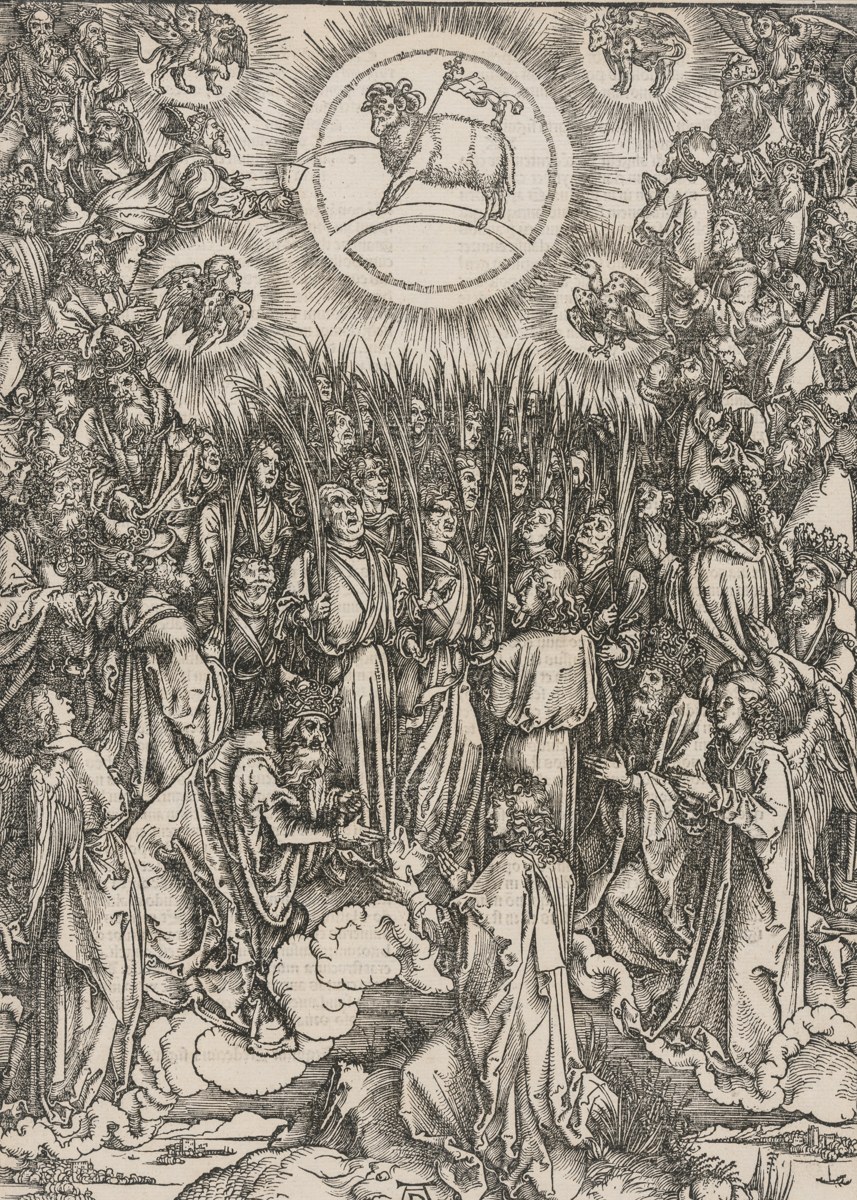
“After this I beheld, and, lo, a great multitude, which no man could number, of all nations, and kindreds, and people, and tongues, stood before the throne, and before the Lamb, clothed with white robes, and palms in their hands;”
Revelation 7:9
Heard: a number. Saw: a crowd nobody can count. Heard: twelve tribes of Israel. Saw: all nations, and kindreds, and people, and tongues — the same four words the new song used in chapter 5 for everyone the Lamb had bought with His blood.
Whether those are two descriptions of one company or two distinct companies is an old question, and it is worth stating the options rather than sliding past them. Some read the sealed number and the countless multitude as the same people seen twice — heard as an army on the muster roll, seen as a crowd at the finish. Others read them as two: the hundred and forty-four thousand as those sealed and living through the final crisis, and the great multitude as the redeemed of every age. The fuller study on this site takes the second, and treats the number as a real one rather than a figure of speech — see The Hundred Forty And Four Thousand Defined. What chapter 7 itself insists on, either way, is that nobody in either group got there by being counted.
They are standing, which is the word the sixth seal ended on. The kings of the earth asked who would be able to stand, and the answer is a company on its feet in front of the throne, holding palm branches — the branches a crowd waves when a victor comes home, and the ones spread on a road outside Jerusalem for a man on a donkey.
And what they shout is a single sentence with no request in it: “Salvation to our God which sitteth upon the throne, and unto the Lamb” (Revelation 7:10). Not a prayer. A verdict about where their rescue came from.
And the angels answer them. In verse 11 every angel around the throne falls on their faces and says Amen — agreeing with a sentence sung by people who were, until recently, hungry, hunted and dressed in nothing worth mentioning. The unfallen universe endorses the testimony of the rescued.
Out Of Great Tribulation
“And one of the elders answered, saying unto me, What are these which are arrayed in white robes? and whence came they?”
Revelation 7:13
An elder asks John a question he cannot answer, and John says so: Sir, thou knowest. It is a good answer. He does not guess.
The elder’s answer names where they came from before it names what they are wearing, and the phrase is great tribulation. Readers differ on whether that means the whole long stretch of trouble the church has walked through since the seals began, or the specific crisis still ahead of us. The grammar allows either. What it does not allow is a company that reached the throne without any tribulation at all.
“These are they which came out of great tribulation, and have washed their robes, and made them white in the blood of the Lamb.”
Revelation 7:14
Two halves, and both are needed. They came out of great tribulation — this is not a company that was spared trouble. And they washed their robes — which is the only reason they are in white.
The image is deliberately impossible. Nothing gets whiter in blood. Every laundry instinct a reader has says the opposite, and the verse says it anyway, because the point is that the cleaning is not a natural process and cannot be self-administered. They did the washing; the blood did the whitening.
Notice, too, what is not given as the reason. Not their endurance, though they endured. Not their number, though it was counted. Not their tribe, though it was listed. The white robes came from somewhere outside themselves.
That is the same order the whole Bible keeps. Israel was brought out of Egypt before Sinai, not after it. The prodigal was given the robe on the road, before he finished the speech he had rehearsed. Here the tribulation is real and the washing is real, and neither of them is what makes a person acceptable — the blood is.
God Shall Wipe Away All Tears
“They shall hunger no more, neither thirst any more; neither shall the sun light on them, nor any heat.”
Revelation 7:16
Every item on that list is a refugee’s problem. Hunger, thirst, sun, heat — this is the vocabulary of people who have been walking, and it answers the black horse and the pale horse of the previous chapter point for point. What the seals took away, this verse gives back.
“For the Lamb which is in the midst of the throne shall feed them, and shall lead them unto living fountains of waters: and God shall wipe away all tears from their eyes.”
Revelation 7:17
The Lamb becomes the shepherd. That is the last reversal in a chapter full of them, and it is quietly the largest: the animal that was led to slaughter is now the one doing the leading, and where He leads is water.
The final clause is the smallest gesture in the book and the one people remember. Not there shall be no more tears — that comes later, in chapter 21. Here, God wipes them away, which requires Him to be close enough to reach, and requires there to have been tears worth wiping. Everything hard that this company came through is acknowledged in that sentence rather than erased from the record.
There is a shepherd psalm underneath these two verses, and it is not hidden. Green pastures and still waters, a table in the presence of enemies, and a house to dwell in at the end — Revelation 7:15-17 is that psalm arriving. The Lamb “shall feed them, and shall lead them unto living fountains of waters.” The Shepherd of Psalm 23 turns out to have been the Lamb all along.
What This Asks Of Us
Revelation 7 is a chapter of delay, and the delay is the mercy. Four angels are holding back forces that would end the argument, and they are holding them till a sealing is finished. Every day the winds stay held is a day somebody can still be sealed.
The seal goes on the forehead, which means it is not administered to people who have not decided anything. And it is the only thing in this chapter that happens before the trouble rather than after it. The robes are washed, the palms are held and the tears are wiped afterwards — but the sealing comes first, in ordinary time, while the wind is still not blowing.
The men in the rocks asked who shall be able to stand, and they meant it as a closed question. The answer given here has two parts, and neither is a name a reader could have guessed: a company sealed before the storm, and a crowd out of every nation that nobody can count — standing, in white, holding palms, and giving the credit somewhere else.
Next in this series: Silence In Heaven — the seventh seal at last, half an hour of quiet, and then the trumpets.
