A tomb that should hold a body holds folded linen instead. A grieving woman mistakes the risen Lord of the universe for a gardener. A locked door does nothing to keep Him out of the room. And one skeptical disciple, given the one piece of proof he demanded, ends up saying the truest sentence in this entire Gospel. Everything chapter 1 opened by declaring about the Word who was God is confirmed here, in a garden, on the first Easter morning.
A study in John 20 · Arthur Baldwin · StandUp4Jesus.Org · 25 min read
He Saw, And Believed
“The first day of the week cometh Mary Magdalene early, when it was yet dark, unto the sepulchre, and seeth the stone taken away from the sepulchre. Then she runneth, and cometh to Simon Peter, and to the other disciple, whom Jesus loved, and saith unto them, They have taken away the Lord out of the sepulchre, and we know not where they have laid him.”
John 20:1-2
“Mary Magdalene was the first to reach the place; and upon seeing that the stone was removed, she hurried away to tell the disciples.”
Ellen G. White · The Desire of Ages, p. 788
Nobody in this chapter is expecting a resurrection. Mary’s own first assumption is theft, not miracle — a grave robbed, not a grave emptied by its own occupant walking out of it.
“Peter therefore went forth, and that other disciple, and came to the sepulchre. So they ran both together: and the other disciple did outrun Peter, and came first to the sepulchre. And he stooping down, and looking in, saw the linen clothes lying; yet went he not in.”
John 20:3-5
Decades later, the author of this Gospel is still remembering, with a specificity that feels genuinely personal rather than theological, that he was the faster runner.
“Then cometh Simon Peter following him, and went into the sepulchre, and seeth the linen clothes lie, And the napkin, that was about his head, not lying with the linen clothes, but wrapped together in a place by itself. Then went in also that other disciple, which came first to the sepulchre, and he saw, and believed.”
John 20:6-8
“They saw the shroud and the napkin, but they did not find their Lord. Yet even here was testimony that He had risen. The graveclothes were not thrown heedlessly aside, but carefully folded, each in a place by itself. John ‘saw, and believed.’ He did not yet understand the scripture that Christ must rise from the dead; but he now remembered the Saviour’s words foretelling His resurrection.”
Ellen G. White · The Desire of Ages, p. 789
Grave robbers do not pause to fold anything. A body carried off in haste leaves its wrappings scattered, not arranged with the napkin set apart from the linen in its own careful place. It is a small, quiet detail, and it is the detail that convinces John before a single angel has spoken a word to him.
“It was Christ Himself who had placed those graveclothes with such care. … But it was the Saviour’s hand that folded each, and laid it in its place. In His sight who guides alike the star and the atom, there is nothing unimportant. Order and perfection are seen in all His work.”
Ellen G. White · The Desire of Ages, p. 789
“Who guides alike the star and the atom” is the same attention to scale this Gospel opened with — the Word by whom every single thing that exists was made, now folding a piece of cloth with the same care He once used to fling galaxies into place.
“For as yet they knew not the scripture, that he must rise again from the dead. Then the disciples went away again unto their own home.”
John 20:9-10
John’s own honesty about his slowness is worth noting: he believed the tomb was empty before he understood why. Faith, here, arrives ahead of full comprehension, not after it.
Rabboni
“But Mary stood without at the sepulchre weeping: and as she wept, she stooped down, and looked into the sepulchre, And seeth two angels in white sitting, the one at the head, and the other at the feet, where the body of Jesus had lain. And they say unto her, Woman, why weepest thou? She saith unto them, Because they have taken away my Lord, and I know not where they have laid him.”
John 20:11-13
“Mary had followed John and Peter to the tomb; when they returned to Jerusalem, she remained. As she looked into the empty tomb, grief filled her heart. Looking in, she saw the two angels, one at the head and the other at the foot where Jesus had lain. ‘Woman, why weepest thou?’ they asked her. ‘Because they have taken away my Lord,’ she answered, ‘and I know not where they have laid Him.’”
Ellen G. White · The Desire of Ages, p. 789
Two angels sitting where a corpse should be lying does not, by itself, comfort her. Grief this deep does not notice angels; it keeps searching for a body.
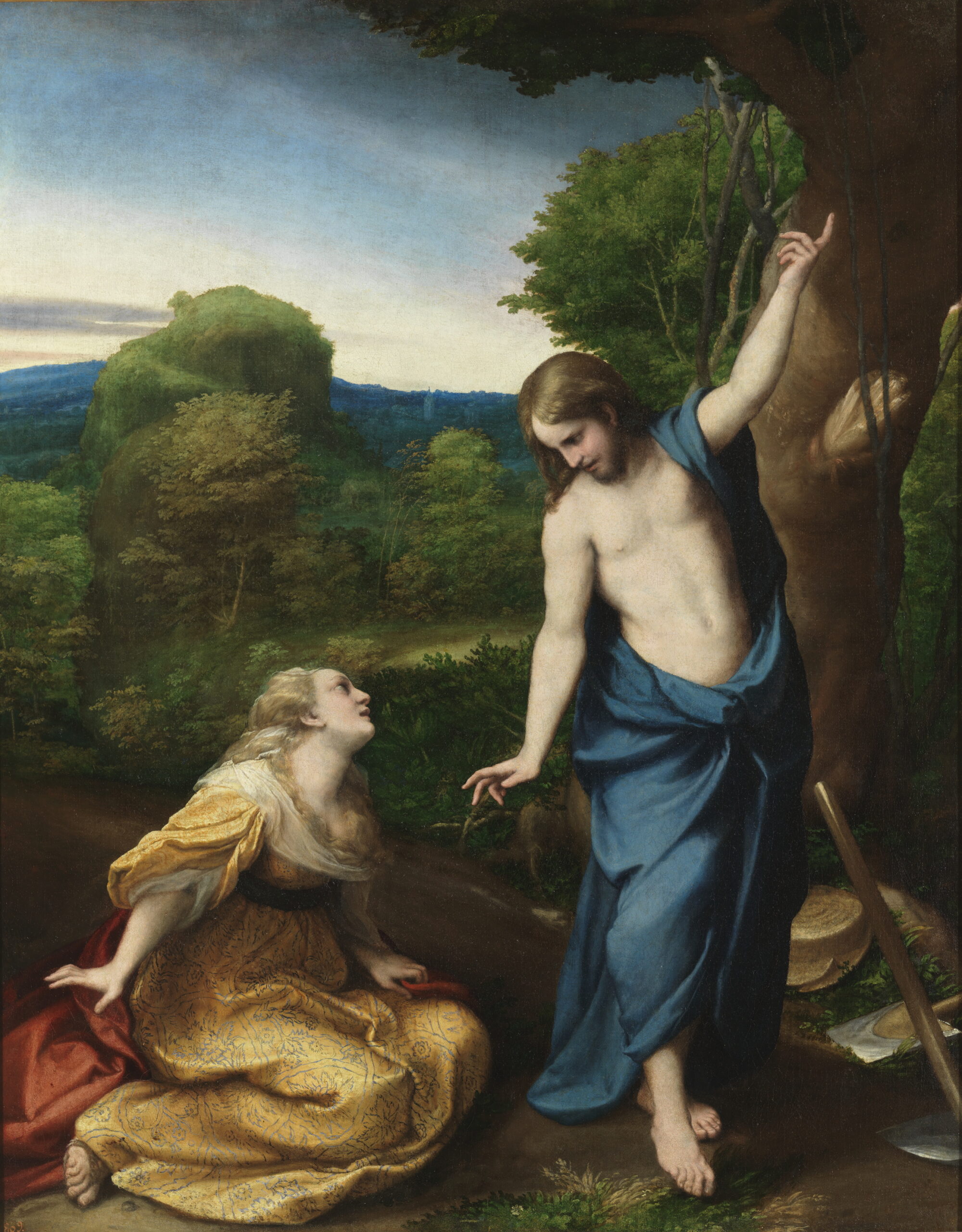
“And when she had thus said, she turned herself back, and saw Jesus standing, and knew not that it was Jesus. Jesus saith unto her, Woman, why weepest thou? whom seekest thou? She, supposing him to be the gardener, saith unto him, Sir, if thou have borne him hence, tell me where thou hast laid him, and I will take him away.”
John 20:14-15
“Then she turned away, even from the angels, thinking that she must find someone who could tell her what had been done with the body of Jesus. Another voice addressed her, ‘Woman, why weepest thou? whom seekest thou?’ Through her tear-dimmed eyes, Mary saw the form of a man, and thinking that it was the gardener, she said, ‘Sir, if thou have borne Him hence, tell me where thou hast laid Him, and I will take Him away.’”
Ellen G. White · The Desire of Ages, p. 790
She is offering to personally carry the crucified body of the Creator of the universe wherever it needs to go, mistaking Him for the man who trims the hedges — the same quiet pattern this Gospel keeps circling back to since its own first chapter, where “he was in the world, and the world knew him not.”
“Jesus saith unto her, Mary. She turned herself, and saith unto him, Rabboni; which is to say, Master.”
John 20:16
“But now in His own familiar voice Jesus said to her, ‘Mary.’ Now she knew that it was not a stranger who was addressing her, and turning she saw before her the living Christ. In her joy she forgot that He had been crucified. Springing toward Him, as if to embrace His feet, she said, ‘Rabboni.’”
Ellen G. White · The Desire of Ages, p. 790
It takes exactly one word to undo the entire mistaken identity — not an announcement, not a miracle performed on the spot, just her own name spoken in a voice she has heard call it before. The Good Shepherd of chapter 10 said His sheep “know his voice.” Here is the proof, played out in a single syllable.
“Jesus saith unto her, Touch me not; for I am not yet ascended to my Father: but go to my brethren, and say unto them, I ascend unto my Father, and your Father; and to my God, and your God.”
John 20:17
“But Christ raised His hand, saying, Detain Me not; ‘for I am not yet ascended to My Father: but go to My brethren, and say unto them, I ascend unto My Father, and your Father; and to My God, and your God.’”
Ellen G. White · The Desire of Ages, p. 790
“Detain Me not” is worth sitting with for what it quietly admits: Mary is, in fact, detaining Him. Soldiers could not stop this Man. A sealed tomb, a Roman guard, a stone that took several strong men to move — none of it held Him for a moment longer than He chose. The only person in this entire Gospel who manages to make the risen, glorified Christ pause on His way to the Father is a weeping woman clinging to His feet, and He pauses for her not because she has any power to compel Him, but because He loves her enough to let her.
“Jesus refused to receive the homage of His people until He had the assurance that His sacrifice was accepted by the Father. He ascended to the heavenly courts, and from God Himself heard the assurance that His atonement for the sins of men had been ample, that through His blood all might gain eternal life.”
Ellen G. White · The Desire of Ages, p. 790
“My Father, and your Father; my God, and your God” draws a careful, deliberate line even in this moment of triumph: the same Father, but not the same relationship to Him — His by nature, theirs only by adoption through Him. Mary is sent away not empty-handed but as the very first messenger of the resurrection, entrusted with news the male disciples themselves have not yet heard.
“Mary Magdalene came and told the disciples that she had seen the Lord, and that he had spoken these things unto her.”
John 20:18
Peace Be Unto You
“Then the same day at evening, being the first day of the week, when the doors were shut where the disciples were assembled for fear of the Jews, came Jesus and stood in the midst, and saith unto them, Peace be unto you.”
John 20:19
“And now at His first appearance to the disciples after His resurrection, the Saviour addressed them with the blessed words, ‘Peace be unto you.’ Jesus is ever ready to speak peace to souls that are burdened with doubts and fears.”
Ellen G. White · The Desire of Ages, p. 803
Locked doors were meant to keep armed men out. They do nothing at all to a body that has already conquered death; a barred room is no more an obstacle to the risen Christ than a sealed tomb had been three days earlier.
“And when he had so said, he shewed unto them his hands and his side. Then were the disciples glad, when they saw the Lord.”
John 20:20
“‘Then were the disciples glad, when they saw the Lord.’ Faith and joy took the place of unbelief, and with feelings which no words could express they acknowledged their risen Saviour.”
Ellen G. White · The Desire of Ages, p. 803
John, the same eyewitness who insisted so carefully back in chapter 19 that he had personally watched a spear open that exact wound in Christ’s side, is the one Gospel writer who records Jesus showing that particular scar here rather than any other. The wound that proved His death now helps prove His identity in resurrection.
“Then said Jesus to them again, Peace be unto you: as my Father hath sent me, even so send I you.”
John 20:21
The same sending language this Gospel has used again and again for Christ’s own mission — “as my Father hath sent me” — is now, in the same breath, extended to eleven ordinary men standing in a locked room. The commission is not new; it is a share in the one He has always carried Himself.
“And when he had said this, he breathed on them, and saith unto them, Receive ye the Holy Ghost: Whose soever sins ye remit, they are remitted unto them; and whose soever sins ye retain, they are retained.”
John 20:22-23
“‘And when He had said this, He breathed on them, and saith unto them, Receive ye the Holy Ghost.’ … The Holy Spirit was not yet fully manifested; for Christ had not yet been glorified. The more abundant impartation of the Spirit did not take place till after Christ’s ascension. … But the Spirit was now given for a special purpose.”
Ellen G. White · The Desire of Ages, p. 805
“The Holy Spirit is the breath of spiritual life in the soul. The impartation of the Spirit is the impartation of the life of Christ. It imbues the receiver with the attributes of Christ.”
Ellen G. White · The Desire of Ages, p. 805
The same breath that once moved over the waters at creation, and that formed the first man from dust in Eden, is now breathed directly onto a small room of frightened disciples — the risen Creator personally imparting the very life He alone possesses “in Himself,” exactly as He told the Jews He would back in chapter 5.
My Lord And My God
“But Thomas, one of the twelve, called Didymus, was not with them when Jesus came. The other disciples therefore said unto him, We have seen the Lord. But he said unto them, Except I shall see in his hands the print of the nails, and put my finger into the print of the nails, and thrust my hand into his side, I will not believe.”
John 20:24-25
“When Jesus first met the disciples in the upper chamber, Thomas was not with them. He heard the reports of the others, and received abundant proof that Jesus had risen; but gloom and unbelief filled his heart. … He was determined not to believe, and for a whole week he brooded over his wretchedness, which seemed all the darker in contrast with the hope and faith of his brethren.”
Ellen G. White · The Desire of Ages, p. 806
A week is a long time to sit alone with a doubt, especially surrounded by ten friends who keep insisting the thing you cannot make yourself believe is true.
“And after eight days again his disciples were within, and Thomas with them: then came Jesus, the doors being shut, and stood in the midst, and said, Peace be unto you. Then saith he to Thomas, Reach hither thy finger, and behold my hands; and reach hither thy hand, and thrust it into my side: and be not faithless, but believing.”
John 20:26-27
“Turning to Thomas He said, ‘Reach hither thy finger, and behold My hands; and reach hither thy hand, and thrust it into My side: and be not faithless, but believing.’ These words showed that He was acquainted with the thoughts and words of Thomas.”
Ellen G. White · The Desire of Ages, p. 807
Jesus repeats Thomas’s own private demand back to him almost word for word — proof, before a single wound is even touched, that He was present in spirit for a conversation He was not physically there to hear.
“And Thomas answered and said unto him, My Lord and my God.”
John 20:28
“He recognized the One before him as his Lord. He had no desire for further proof. His heart leaped for joy, and he cast himself at the feet of Jesus crying, ‘My Lord and my God.’”
Ellen G. White · The Desire of Ages, p. 807
No other confession anywhere in the four Gospels states Christ’s deity in plainer, more direct words than this one. Not a title borrowed from prophecy, not a parable’s implication, not even Peter’s “thou art the Christ, the Son of the living God” — a bare, unqualified God, spoken straight to His face by a Jewish monotheist who would never have used the word carelessly. The most stubborn skeptic among the twelve ends up making the single boldest theological statement in the whole book.
“Jesus saith unto him, Thomas, because thou hast seen me, thou hast believed: blessed are they that have not seen, and yet have believed.”
John 20:29
“Jesus accepted his acknowledgment, but gently reproved his unbelief: ‘Thomas, because thou hast seen Me, thou hast believed: blessed are they that have not seen, and yet have believed.’ The faith of Thomas would have been more pleasing to Christ if he had been willing to believe upon the testimony of his brethren.”
Ellen G. White · The Desire of Ages, p. 807
“But let Jesus, in His love and mercy, be revealed as the crucified Saviour, and from many once unwilling lips will be heard the acknowledgment of Thomas, ‘My Lord and my God.’”
Ellen G. White · The Desire of Ages, p. 808
That last line reaches straight out of the first century and into whoever happens to be reading this sentence now. The “blessed” Jesus pronounces is not aimed at the ten disciples who saw Him first; it is aimed forward, past every generation since, at everyone who was never going to get the chance to put a finger in the print of the nails and had to believe on someone else’s word instead.
That Believing Ye Might Have Life Through His Name
“And many other signs truly did Jesus in the presence of his disciples, which are not written in this book: But these are written, that ye might believe that Jesus is the Christ, the Son of God; and that believing ye might have life through his name.”
John 20:30-31
This is where John’s own Gospel was originally meant to end. Everything since “In the beginning was the Word” has been building to exactly this sentence — the author himself stepping out from behind the narrative to state, in his own voice, the one purpose behind every page: not merely a historical record, but a case built deliberately, witness by witness and sign by sign, so that a reader who never touched the nail prints could still say what Thomas said and mean it just as fully. The water made wine, the man born blind, the friend called back from four days dead, the bread and the light and the vine and the door, the folded graveclothes and the wound in the side — every one of them points to the same conclusion this whole book asked its readers to reach from its very first verse: that this Man, who bled and died and rose again, was and is God. One chapter remains, added later almost as an afterthought by the same hand — but the Gospel itself is already, by every measure that matters, finished.
