The last chapter of Ephesians carries the Spirit-filled life into every relationship of an ancient household — children and parents, servants and masters — and then steps back to show the battle behind it all. Every home, every church, every believer stands in a conflict with unseen powers, and Paul, chained to a Roman soldier as he writes, describes the armour God provides for it. The letter that opened in the heavenly places with every spiritual blessing ends in the heavenly places with the whole armour of God.
A study in Ephesians 6 · Arthur Baldwin · StandUp4Jesus.Org · 19 min read
Children, Obey Your Parents In The Lord
“Children, obey your parents in the Lord: for this is right. Honour thy father and mother; (which is the first commandment with promise;) That it may be well with thee, and thou mayest live long on the earth.”
Ephesians 6:1-3
Paul speaks directly to the children in the congregation, expecting them to be present when the letter is read aloud. And he grounds his instruction in the Ten Commandments themselves, quoting the fifth as still binding on Gentile believers — the same commandment the study of chapter 2 pointed to as proof that “the law of commandments contained in ordinances” abolished at the cross was never the moral law.
“This, says the apostle, ‘is the first commandment with promise.’ … To Israel, expecting soon to enter Canaan, it was a pledge to the obedient, of long life in that good land; but it has a wider meaning, including all the Israel of God, and promising eternal life upon the earth when it shall be freed from the curse of sin.”
Ellen G. White · Patriarchs and Prophets, p. 308
“And, ye fathers, provoke not your children to wrath: but bring them up in the nurture and admonition of the Lord.”
Ephesians 6:4
In the Roman world a father held nearly unlimited power over his children. Paul places a limit on that power in a single phrase: do not provoke them to wrath. Harshness, unfairness and constant criticism can drive a child away from the very faith a parent wants to pass on. Instead, fathers are to “bring them up” — the same word Paul used in 5:29 for the way Christ “nourisheth” His church.
“What does this mean—the nurture and admonition of the Lord? It means to teach them to order the life by the requirements and lessons of the word; to help them to gain a clear understanding of the terms of entrance into the city of God.”
Ellen G. White · Counsels to Parents, Teachers, and Students, p. 109
As The Servants Of Christ
“Servants, be obedient to them that are your masters according to the flesh, with fear and trembling, in singleness of your heart, as unto Christ; Not with eyeservice, as menpleasers; but as the servants of Christ, doing the will of God from the heart; With good will doing service, as to the Lord, and not to men: Knowing that whatsoever good thing any man doeth, the same shall he receive of the Lord, whether he be bond or free. And, ye masters, do the same things unto them, forbearing threatening: knowing that your Master also is in heaven; neither is there respect of persons with him.”
Ephesians 6:5-9
Slavery was woven through the whole Roman economy, and many of Paul’s readers were slaves. He does not command a revolt, but notice what he does. He tells slaves that their true Master is Christ, and that God rewards them “whether he be bond or free.” And he turns to the masters — something almost no one in that world would have done — and tells them they have a Master too, one who shows no favoritism between the man who owns and the man who is owned.
“It was not the apostle’s work to overturn arbitrarily or suddenly the established order of society. To attempt this would be to prevent the success of the gospel. But he taught principles which struck at the very foundation of slavery and which, if carried into effect, would surely undermine the whole system. … When converted, the slave became a member of the body of Christ, and as such was to be loved and treated as a brother, a fellow heir with his master to the blessings of God and the privileges of the gospel.”
Ellen G. White · The Acts of the Apostles, p. 459
The principle reaches every workplace today. Whoever we work for, we are finally working for Christ — not with “eyeservice,” working hard only while the boss is watching, but “from the heart.” And whoever we have authority over, we answer for it to a Master in heaven.
We Wrestle Not Against Flesh And Blood
“Finally, my brethren, be strong in the Lord, and in the power of his might. Put on the whole armour of God, that ye may be able to stand against the wiles of the devil. For we wrestle not against flesh and blood, but against principalities, against powers, against the rulers of the darkness of this world, against spiritual wickedness in high places.”
Ephesians 6:10-12
Here the thread traced through this whole letter reaches its end. The phrase “in high places” is the same Greek expression translated “in heavenly places” everywhere else in Ephesians (see the study of chapter 3). The heavenly realm where believers have been blessed (1:3), where Christ is enthroned (1:20), where they sit with Him (2:6), and before whose powers the church displays God’s wisdom (3:10), is also the arena of a real war. The enemy is not the person across the table, the unkind master, or the hostile neighbor. Behind every human conflict stand “the wiles of the devil” — his schemes and strategies.
“Till the close of time there will be a conflict between the church of God and those who are under the control of evil angels.”
Ellen G. White · The Acts of the Apostles, p. 219
“But the church must and will fight against seen and unseen foes. Satan’s agencies in human form are on the ground. … This is no time for the people of God to be weaklings. We cannot afford to be off our guard for one moment.”
Ellen G. White · Testimonies for the Church, vol. 8, p. 42
Yet the call is not to fear but to strength — strength “in the Lord, and in the power of his might,” the same might that raised Christ from the dead (1:19-20). The devil is real, but he is not all-powerful.
“No man without his own consent can be overcome by Satan. The tempter has no power to control the will or to force the soul to sin. He may distress, but he cannot contaminate. He can cause agony, but not defilement. The fact that Christ has conquered should inspire His followers with courage to fight manfully the battle against sin and Satan.”
Ellen G. White · The Great Controversy, p. 510
The Whole Armour Of God
“Wherefore take unto you the whole armour of God, that ye may be able to withstand in the evil day, and having done all, to stand. Stand therefore, having your loins girt about with truth, and having on the breastplate of righteousness; And your feet shod with the preparation of the gospel of peace; Above all, taking the shield of faith, wherewith ye shall be able to quench all the fiery darts of the wicked. And take the helmet of salvation, and the sword of the Spirit, which is the word of God:”
Ephesians 6:13-17
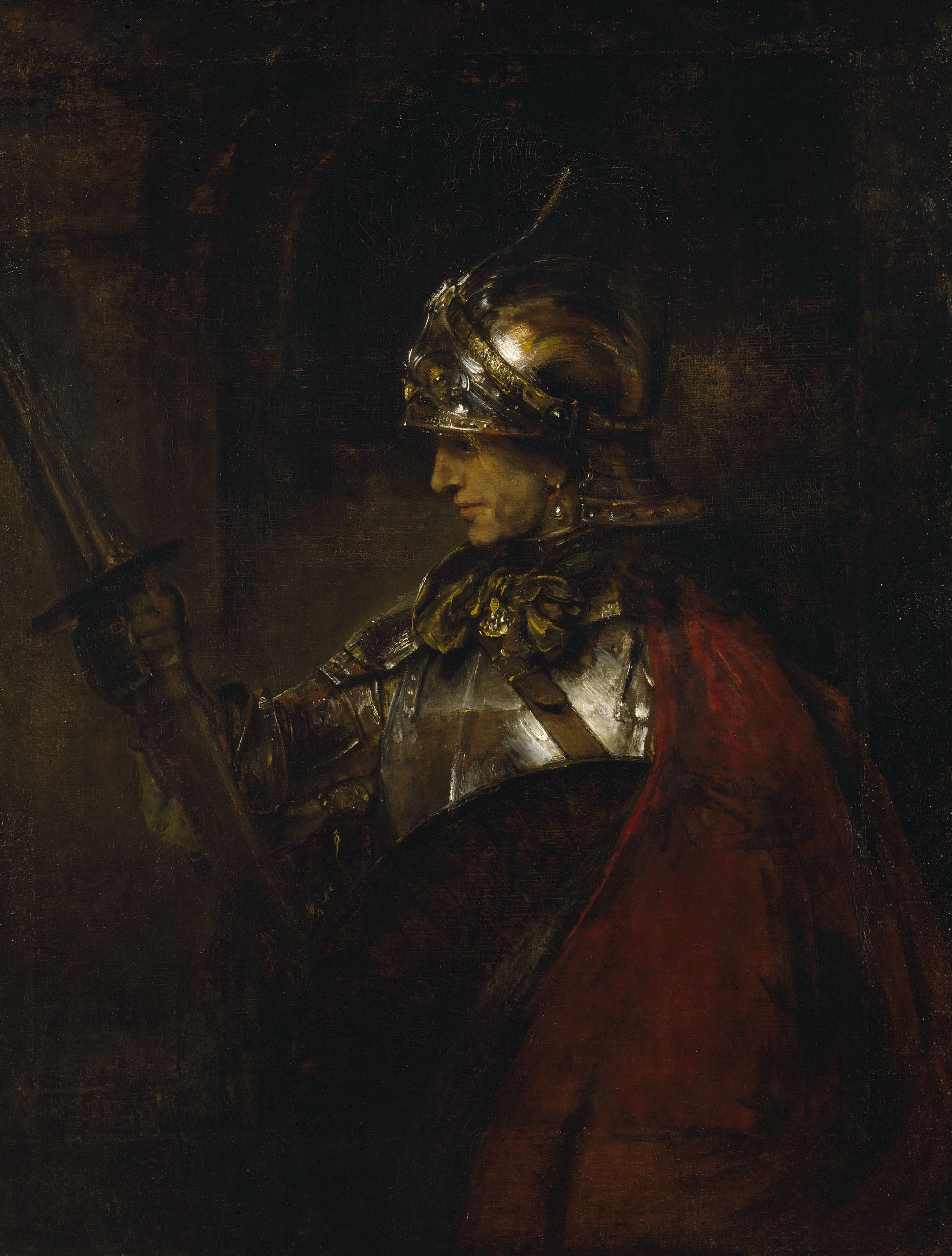
Paul wrote these words as a prisoner in Rome, where, Luke tells us, he lived “with a soldier that kept him” (Acts 28:16). He had a model of Roman armour in front of him every day. But the armour he describes is not Rome’s. Almost every piece comes from Isaiah, where it is worn by God Himself: “he put on righteousness as a breastplate, and an helmet of salvation upon his head” (Isaiah 59:17); righteousness is “the girdle of his loins” (Isaiah 11:5); and beautiful are “the feet of him that bringeth good tidings, that publisheth peace” (Isaiah 52:7). This is literally the armour of God — the Lord’s own battle gear, handed to His people.
Each piece has its place. The girdle of truth gathered up the soldier’s tunic so he could move freely; without it nothing else stays in place. The breastplate of righteousness guards the heart. The shoes of the gospel of peace give sure footing and readiness to go. The shield of faith was the large Roman shield, shaped like a door and faced with leather that could be soaked in water to put out flaming arrows. The helmet of salvation guards the mind with the certainty of what God has done. And the sword of the Spirit, which is the word of God, is the only weapon for attack — the very weapon Jesus used in the wilderness when He answered each temptation with “It is written.”
Notice the word that runs through these verses: “stand.” Paul does not tell the soldier to march out and conquer new ground. Christ has already won the victory. The believer’s task is to hold the ground Christ has taken — to “withstand in the evil day, and having done all, to stand.” And chapter 1’s teaching on election comes back here in the most practical form.
“Every soul is elected who will work out his own salvation with fear and trembling. He is elected who will put on the armor and fight the good fight of faith. He is elected who will watch unto prayer, who will search the Scriptures, and flee from temptation.”
Ellen G. White · Patriarchs and Prophets, p. 208
“Praying always with all prayer and supplication in the Spirit, and watching thereunto with all perseverance and supplication for all saints;”
Ephesians 6:18
Prayer is not listed as a piece of armour, but it is what makes the armour work. Paul uses the word “all” four times in one verse: always, all prayer, all perseverance, all saints. A soldier in armour who never speaks to his commander is still fighting alone.
An Ambassador In Bonds
“And for me, that utterance may be given unto me, that I may open my mouth boldly, to make known the mystery of the gospel, For which I am an ambassador in bonds: that therein I may speak boldly, as I ought to speak.”
Ephesians 6:19-20
An ambassador in the ancient world was protected; to lay hands on one was an insult to the king who sent him. Yet the ambassador of the King of kings sits in a chain. And Paul does not ask his readers to pray for his release. He asks them to pray for boldness — that he might keep making known “the mystery of the gospel,” the same mystery of Jew and Gentile made one that chapter 3 unfolded.
“But that ye also may know my affairs, and how I do, Tychicus, a beloved brother and faithful minister in the Lord, shall make known to you all things: Whom I have sent unto you for the same purpose, that ye might know our affairs, and that he might comfort your hearts. Peace be to the brethren, and love with faith, from God the Father and the Lord Jesus Christ. Grace be with all them that love our Lord Jesus Christ in sincerity. Amen.”
Ephesians 6:21-24
Tychicus, a believer from the province of Asia (Acts 20:4), carried this letter to Ephesus. And Paul closes as he opened: with “grace” and “peace.” The last words, “in sincerity,” translate a Greek word that literally means “incorruption” — a love for Christ that will not decay.
That is the whole of Ephesians. It began before the foundation of the world, with a people chosen in Christ to be “holy and without blame before him in love.” It traced how grace raised them from death, broke down every wall between them, and built them into one temple, one body, one bride. It called them to walk worthy of that calling in their churches, their marriages, their homes and their work. And it ends with them standing — clothed in God’s own armour, praying, and holding firm in the heavenly places until the Bridegroom comes to present His church to Himself, holy and without blemish.
