The man who stood watching coats while Stephen was stoned, fully persuaded he was defending God against blasphemers, is riding toward Damascus with signed authority to drag believers back to Jerusalem in chains. By the end of this one chapter he cannot see, cannot eat, and has to be led into the city by the hand — and within days he is the one being hunted, lowered over a city wall in a basket to save his own life. No single chapter in this book changes more, faster, than this one.
A study in Acts 9 · Arthur Baldwin · StandUp4Jesus.Org · 26 min read
Saul, Saul, Why Persecutest Thou Me?
“And Saul, yet breathing out threatenings and slaughter against the disciples of the Lord, went unto the high priest, And desired of him letters to Damascus to the synagogues, that if he found any of this way, whether they were men or women, he might bring them bound unto Jerusalem.”
Acts 9:1-2
“Saul of Tarsus, in the strength and vigor of manhood, and fired with mistaken zeal, set out on that memorable journey, the strange occurrences of which were to change the whole current of his life.”
Ellen G. White · The Acts of the Apostles, p. 113
Damascus is roughly a six-day journey from Jerusalem, plenty of time for Saul’s certainty to harden with every mile — and no time at all to prepare him for what is waiting at the very end of the road.
“And as he journeyed, he came near Damascus: and suddenly there shined round about him a light from heaven: And he fell to the earth, and heard a voice saying unto him, Saul, Saul, why persecutest thou me?”
Acts 9:3-4
“On the last day of the journey, ‘at midday,’ as the weary travelers neared Damascus, they came within full view of broad stretches of fertile lands, beautiful gardens, and fruitful orchards, watered by cool streams from the surrounding mountains. … While Saul, with his companions, gazed with admiration on the fruitful plain and the fair city below, ‘suddenly,’ as he afterward declared, there shone ‘round about me and them which journeyed with me’ ‘a light from heaven, above the brightness of the sun’ … too glorious for mortal eyes to bear.”
Ellen G. White · The Acts of the Apostles, p. 114
The interruption comes at the very moment the journey’s goal finally comes into view — the city Saul has traveled so far to reach, spread out beautifully below him, right as everything he thought he was riding toward is about to be overturned.
“And he said, Who art thou, Lord? And the Lord said, I am Jesus whom thou persecutest: it is hard for thee to kick against the pricks.”
Acts 9:5
“Christ here identifies Himself with His people. In persecuting the followers of Jesus, Saul had struck directly against the Lord of heaven. In falsely accusing and testifying against them, he had falsely accused and testified against the Saviour of the world.”
Ellen G. White · The Acts of the Apostles, p. 117
Saul has never once laid a hand on Jesus of Nazareth himself — every arrest, every imprisonment, every vote for death has been against ordinary believers. Christ’s own choice of words makes the union total: whoever touches His people touches Him.
“Stephen’s sermon at the time of his martyrdom was brought forcibly to Saul’s mind, and he realized that the martyr had indeed beheld ‘the glory of God’ when he said, ‘Behold, I see the heavens opened, and the Son of man standing on the right hand of God.’ … The priests had pronounced these words blasphemy, but Saul now knew them to be truth.”
Ellen G. White · The Acts of the Apostles, p. 115
Everything Saul refused to believe when Stephen said it under threat of death, he is now forced to believe when the same risen Christ says it directly to his own face. The seed planted at that stoning, noted at the very end of this study’s own chapter 7, finally breaks the surface here.
“And he trembling and astonished said, Lord, what wilt thou have me to do? And the Lord said unto him, Arise, and go into the city, and it shall be told thee what thou must do. And the men which journeyed with him stood speechless, hearing a voice, but seeing no man.”
Acts 9:6-7
Notice the very first word out of the mouth of a man who a moment ago held signed papers authorizing arrests: “Lord.” Saul’s whole identity reorganizes itself around a single new center in the space of one sentence, before he has even been told a single thing about what comes next.
“And Saul arose from the earth; and when his eyes were opened, he saw no man: but they led him by the hand, and brought him into Damascus. And he was three days without sight, and neither did eat nor drink.”
Acts 9:8-9
“These days of soul agony were to him as years. Again and again he recalled, with anguish of spirit, the part he had taken in the martyrdom of Stephen. … In sadness and brokenness of spirit he recounted the many times he had closed his eyes and ears against the most striking evidences and had relentlessly urged on the persecution of the believers.”
Ellen G. White · The Acts of the Apostles, p. 118
The man who once entered houses to drag believers out by force now sits in total darkness inside a stranger’s house, unable to eat, unable to see, with nothing left to do but face, hour after hour, exactly what he has done.
A Chosen Vessel
“And there was a certain disciple at Damascus, named Ananias; and to him said the Lord in a vision, Ananias. And he said, Behold, I am here, Lord. And the Lord said unto him, Arise, and go into the street which is called Straight, and enquire in the house of Judas for one called Saul, of Tarsus: for, behold, he prayeth.”
Acts 9:10-11
Three days of praying, and Saul’s whole prayer life until this moment has apparently been built on absolute confidence that he already knew God’s will. Now, blind and helpless, the single detail heaven chooses to highlight about him is simply: “he prayeth.”
“Then Ananias answered, Lord, I have heard by many of this man, how much evil he hath done to thy saints at Jerusalem: And here he hath authority from the chief priests to bind all that call on thy name.”
Acts 9:13-14
“Ananias could scarcely credit the words of the angel; for the reports of Saul’s bitter persecution of the saints at Jerusalem had spread far and wide. He presumed to expostulate.”
Ellen G. White · The Acts of the Apostles, p. 121
Ananias’s hesitation is entirely reasonable. Every believer in the region knows exactly why Saul came to Damascus; being told to walk directly into the house of the man carrying warrants for their arrest sounds, on its face, like walking into a trap.
“But the Lord said unto him, Go thy way: for he is a chosen vessel unto me, to bear my name before the Gentiles, and kings, and the children of Israel: For I will shew him how great things he must suffer for my name’s sake.”
Acts 9:15-16
God’s answer does not dispute a single fact in Ananias’s objection; it simply overrides it with a plan already decided. The very man whose zeal made him the church’s worst enemy is about to become, by that same zeal redirected, one of its greatest assets.
“And Ananias went his way, and entered into the house; and putting his hands on him said, Brother Saul, the Lord, even Jesus, that appeared unto thee in the way as thou camest, hath sent me, that thou mightest receive thy sight, and be filled with the Holy Ghost.”
Acts 9:17
“Brother Saul” is the very first thing Saul hears from any believer since his arrest on the road — not accusation, not suspicion, but a word of family spoken by a man he came to that city specifically to imprison.
“And immediately there fell from his eyes as it had been scales: and he received sight forthwith, and arose, and was baptized. And when he had received meat, he was strengthened.”
Acts 9:18-19
“In this case Ananias represents Christ, and also represents Christ’s ministers upon the earth, who are appointed to act in His stead. In Christ’s stead Ananias touches the eyes of Saul, that they may receive sight. In Christ’s stead he places his hands upon him, and, as he prays in Christ’s name, Saul receives the Holy Ghost. All is done in the name and by the authority of Christ. Christ is the fountain; the church is the channel of communication.”
Ellen G. White · The Acts of the Apostles, p. 122
Christ could easily have restored Saul’s sight Himself, the same way He first struck him blind. Instead the risen Lord who appeared to Saul in glorious, overwhelming light deliberately routes his healing through the hands of an ordinary, previously unknown disciple — the same pattern this book already showed with Philip and the Ethiopian eunuch one chapter earlier.
Is Not This He?
“Then was Saul certain days with the disciples which were at Damascus. And straightway he preached Christ in the synagogues, that he is the Son of God. But all that heard him were amazed, and said; Is not this he that destroyed them which called on this name in Jerusalem, and came hither for that intent, that he might bring them bound unto the chief priests?”
Acts 9:19-21
“The news of Paul’s conversion had come to the Jews as a great surprise. He who had journeyed to Damascus ‘with authority and commission from the chief priests’ … to apprehend and persecute the believers was now preaching the gospel of a crucified and risen Saviour, strengthening the hands of those who were already its disciples, and continually bringing in new converts to the faith he had once so bitterly opposed.”
Ellen G. White · The Acts of the Apostles, p. 123
There is no faster or more public reversal recorded anywhere in this book. Days earlier Saul’s arrival in this exact city would have meant arrest for anyone who confessed the name of Jesus; now he is standing in its synagogues proclaiming that very name himself.
“But Saul increased the more in strength, and confounded the Jews which dwelt at Damascus, proving that this is very Christ.”
Acts 9:22
“A general slain in battle is lost to his army, but his death gives no additional strength to the enemy. But when a man of prominence joins the opposing force, not only are his services lost, but those to whom he joins himself gain a decided advantage. … God in His providence not only spared Saul’s life, but converted him, thus transferring a champion from the side of the enemy to the side of Christ.”
Ellen G. White · The Acts of the Apostles, p. 124
Every gift that once made Saul so dangerous to the church — his training, his sharp reasoning, his fearlessness — is still fully intact. Only its direction has changed, and that single change makes him more valuable to the church than his death ever could have made the persecution weaker.
“And after that many days were fulfilled, the Jews took counsel to kill him: But their laying await was known of Saul. And they watched the gates day and night to kill him. Then the disciples took him by night, and let him down by the wall in a basket.”
Acts 9:23-25
The very tactic Saul once used against others — watching, hunting, closing off every exit — is now turned against him by his own former allies. He escapes the way no self-respecting rabbi would ever choose to travel: lowered undignified over a wall in a basket, in the dark, simply to survive the night.
Barnabas Took Him
“And when Saul was come to Jerusalem, he assayed to join himself to the disciples: but they were all afraid of him, and believed not that he was a disciple.”
Acts 9:26
“It was difficult for them to believe that so bigoted a Pharisee, and one who had done so much to destroy the church, could become a sincere follower of Jesus.”
Ellen G. White · The Acts of the Apostles, p. 128
Three years have now passed since the Damascus road, and Saul’s own reputation in Jerusalem is still exactly what it was the day he left — the church’s most feared enemy, not yet its newest brother. A changed heart, it turns out, is not always enough by itself to earn back trust.
“But Barnabas took him, and brought him to the apostles, and declared unto them how he had seen the Lord in the way, and that he had spoken to him, and how he had preached boldly at Damascus in the name of Jesus.”
Acts 9:27
The same man introduced in chapter 4 as “the son of consolation,” selling his own land to comfort strangers, is the one willing to personally vouch for the most feared name in the whole church. Barnabas’s own gift, first shown in generosity toward the poor, now shows itself in generosity toward a man everyone else still has good reason to fear.
“And he was with them coming in and going out at Jerusalem. And he spake boldly in the name of the Lord Jesus, and disputed against the Grecians: but they went about to slay him.”
Acts 9:28-29
“With shame he thought of the active part he had taken in the martyrdom of Stephen, and now in his anxiety to wipe out the stain resting upon one so falsely accused, he sought to vindicate the truth for which Stephen had given his life.”
Ellen G. White · The Acts of the Apostles, p. 129
Saul is now debating in the very city, and quite possibly against some of the very men, who once stood with him against Stephen — carrying a personal debt to that martyr’s memory that no one watching him argue could have any way of knowing.
“Which when the brethren knew, they brought him down to Cæsarea, and sent him forth to Tarsus. Then had the churches rest throughout all Judæa and Galilee and Samaria, and were edified; and walking in the fear of the Lord, and in the comfort of the Holy Ghost, were multiplied.”
Acts 9:30-31
Saul’s own presence, remarkably, is what has to be removed for the persecuted church to finally rest. The single man most responsible for scattering this church in chapter 8 becomes, indirectly, the reason for its first real peace once he himself is sent quietly home to Tarsus.
Tabitha, Arise
“And it came to pass, as Peter passed throughout all quarters, he came down also to the saints which dwelt at Lydda. And there he found a certain man named Æneas, which had kept his bed eight years, and was sick of the palsy. And Peter said unto him, Æneas, Jesus Christ maketh thee whole: arise, and make thy bed. And he arose immediately.”
Acts 9:32-34
Eight years bedridden is the whole of this man’s introduction to the story, and the whole of his healing takes one sentence. Luke, so patient with Saul’s long conversion, moves through Aeneas’s own miracle almost as quickly as Peter performs it.
“Now there was at Joppa a certain disciple named Tabitha, which by interpretation is called Dorcas: this woman was full of good works and almsdeeds which she did.”
Acts 9:36
“She was a worthy disciple of Jesus, and her life was filled with acts of kindness. She knew who needed comfortable clothing and who needed sympathy, and she freely ministered to the poor and the sorrowful. Her skillful fingers were more active than her tongue.”
Ellen G. White · The Acts of the Apostles, p. 131
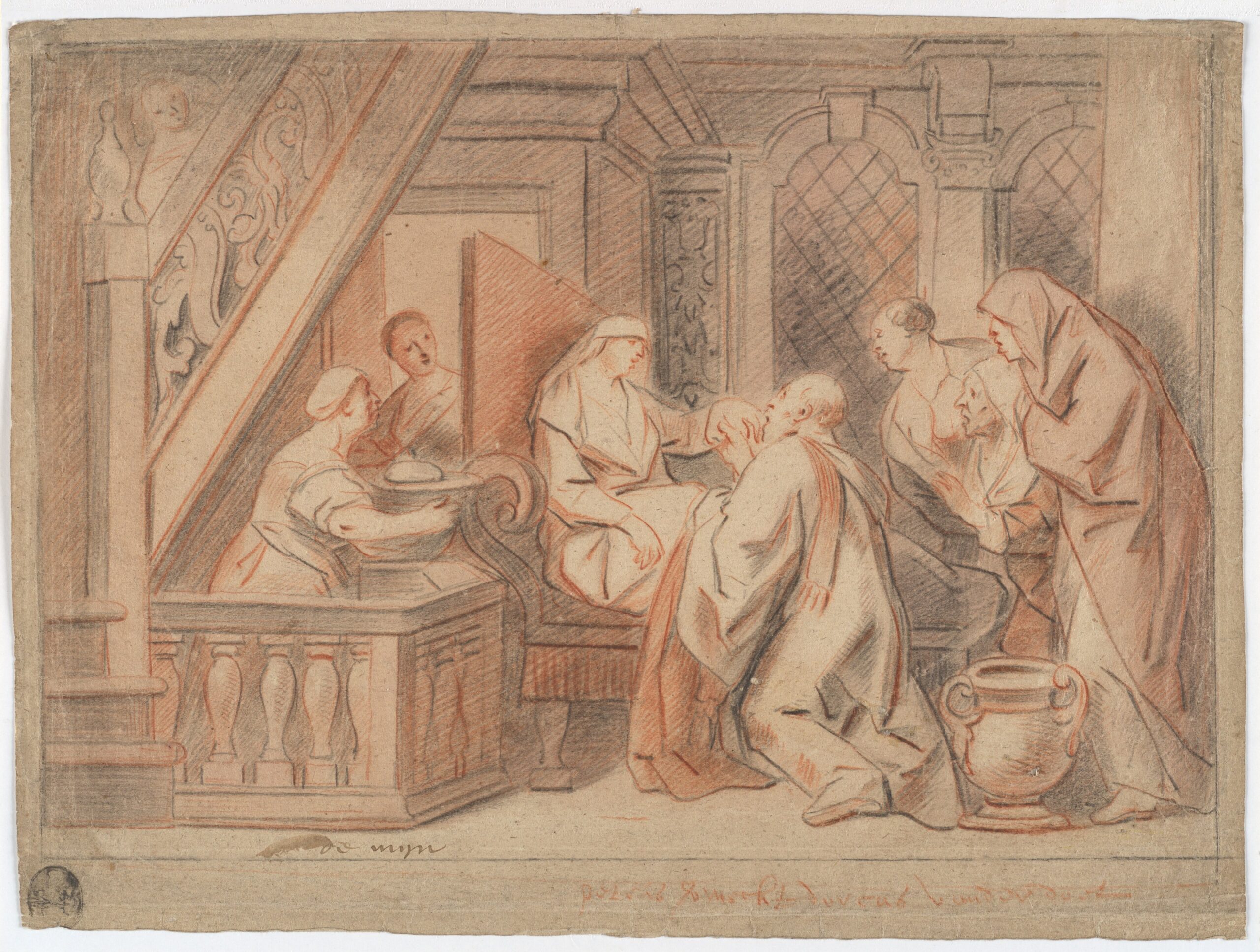
Dorcas is the only woman in this entire book given the specific title “disciple” in the Greek text, and her particular ministry was never public preaching but quiet, practical sewing — proof that this young church already understood service done with a needle and thread as every bit as genuine a calling as service done with a voice.
“Then Peter arose and went with them. When he was come, they brought him into the upper chamber: and all the widows stood by him weeping, and shewing the coats and garments which Dorcas made, while she was with them.”
Acts 9:39
“In view of the life of service that Dorcas had lived, it is little wonder that they mourned, that warm teardrops fell upon the inanimate clay.”
Ellen G. White · The Acts of the Apostles, p. 131
The widows do not simply describe what Dorcas meant to them; they hold up the actual, physical evidence of it, garment by garment. Grief this specific, this tangible, is its own quiet argument for why her death matters enough to ask an apostle to come.
“But Peter put them all forth, and kneeled down, and prayed; and turning him to the body said, Tabitha, arise. And she opened her eyes: and when she saw Peter, she sat up.”
Acts 9:40
“Dorcas had been of great service to the church, and God saw fit to bring her back from the land of the enemy, that her skill and energy might still be a blessing to others, and also that by this manifestation of His power the cause of Christ might be strengthened.”
Ellen G. White · The Acts of the Apostles, p. 132
Peter clears the room before he prays, alone with the body the way his own Master once was alone with a dead girl in her father’s house. The words themselves are nearly identical — “Tabitha, arise” answering “Talitha, cumi” across the years — a servant now doing, in his Lord’s name, exactly the kind of thing he once watched his Lord do himself.
“And it was known throughout all Joppa; and many believed in the Lord. And it came to pass, that he tarried many days in Joppa with one Simon a tanner.”
Acts 9:42-43
Two miracles, two very different lives restored — a bedridden man and a beloved seamstress — and Luke closes the chapter with Peter simply staying on in Joppa, lodging with a humble tanner, with no idea yet that this ordinary house by the sea is about to become the setting for the most consequential vision of his entire ministry.
