Some of the believers in Thessalonica had died, and the church was grieving in a way Paul had not expected. They had been waiting for Christ’s return, and now they feared their loved ones had missed it. The fourth chapter of 1 Thessalonians begins with holy living and brotherly love, and then gives Scripture’s clearest answer to the question every grieving Christian asks: what happens to those who die in Christ? They are asleep. And when the Lord Himself descends from heaven with a shout and the trump of God, they will rise first, and all His people together will meet Him, and so shall we ever be with the Lord.
A study in 1 Thessalonians 4 · Arthur Baldwin · StandUp4Jesus.Org · 24 min read
This Is The Will Of God, Even Your Sanctification
“Furthermore then we beseech you, brethren, and exhort you by the Lord Jesus, that as ye have received of us how ye ought to walk and to please God, so ye would abound more and more. For ye know what commandments we gave you by the Lord Jesus. For this is the will of God, even your sanctification, that ye should abstain from fornication: That every one of you should know how to possess his vessel in sanctification and honour; Not in the lust of concupiscence, even as the Gentiles which know not God:”
1 Thessalonians 4:1-5
Paul had just prayed that their hearts would be “unblameable in holiness” at Christ’s coming (3:13). Now he explains what holiness looks like. The Thessalonians were already walking to please God; he asks them to “abound more and more.” And the first area he names is sexual purity. In the Greek and Roman world, sex outside marriage was widely accepted, and even woven into pagan religion. For new believers from that background, this was a sharp break. Paul does not treat the body as unimportant. Every believer is to “possess his vessel” — his own body, or as some read it, his own wife — “in sanctification and honour.”
“‘This is the will of God,’ the apostle Paul wrote, ‘even your sanctification.’ 1 Thessalonians 4:3. The sanctification of the church is God’s object in all His dealings with His people. He has chosen them from eternity, that they might be holy. He gave His Son to die for them, that they might be sanctified through obedience to the truth, divested of all the littleness of self.”
Ellen G. White · The Acts of the Apostles, p. 559
“That no man go beyond and defraud his brother in any matter: because that the Lord is the avenger of all such, as we also have forewarned you and testified. For God hath not called us unto uncleanness, but unto holiness. He therefore that despiseth, despiseth not man, but God, who hath also given unto us his holy Spirit.”
1 Thessalonians 4:6-8
Sexual sin is never private. It “defrauds” someone — a spouse, a future spouse, a family, a brother in the church. And Paul makes clear these are not his own rules. Whoever rejects them “despiseth not man, but God,” the God who has given His Holy Spirit to live in His people. A body the Holy Spirit lives in is holy ground.
Taught Of God To Love One Another
“But as touching brotherly love ye need not that I write unto you: for ye yourselves are taught of God to love one another. And indeed ye do it toward all the brethren which are in all Macedonia: but we beseech you, brethren, that ye increase more and more; And that ye study to be quiet, and to do your own business, and to work with your own hands, as we commanded you; That ye may walk honestly toward them that are without, and that ye may have lack of nothing.”
1 Thessalonians 4:9-12
Their love was genuine; Paul only asks for more of it. But he adds a practical warning. Some in the church, excited by the hope of Christ’s soon return, seem to have stopped working, expecting others to support them. Paul tells them to “study to be quiet” — literally, to make it your ambition to be calm — to mind their own affairs, and to earn their own living, as he himself had done among them (2:9). Waiting for Christ does not mean sitting idle. It means being found faithful at our work when He comes.
“One of the strongest evidences of true conversion is love to God and man. Those who accept Jesus as their Redeemer have a deep, sincere love for others of like precious faith. Thus it was with the believers at Thessalonica.”
Ellen G. White · The Acts of the Apostles, p. 262
Concerning Them Which Are Asleep
“But I would not have you to be ignorant, brethren, concerning them which are asleep, that ye sorrow not, even as others which have no hope. For if we believe that Jesus died and rose again, even so them also which sleep in Jesus will God bring with him.”
1 Thessalonians 4:13-14
Now Paul reaches the question that had been troubling the church. Paul had taught them that Jesus was coming back, and they had been waiting eagerly. But then believers began to die. Would they miss the coming of the Lord? Had they lost everything? The church was grieving as if their loved ones were gone forever.
“The Thessalonians had eagerly grasped the idea that Christ was coming to change the faithful who were alive, and to take them to Himself. They had carefully guarded the lives of their friends, lest they should die and lose the blessing which they looked forward to receiving at the coming of their Lord. But one after another their loved ones had been taken from them, and with anguish the Thessalonians had looked for the last time upon the faces of their dead, hardly daring to hope to meet them in a future life.”
Ellen G. White · The Acts of the Apostles, p. 258
Paul’s answer begins with a single word: “asleep.” He uses it three times in these verses. It was the word Jesus Himself used. When Lazarus died, Jesus said, “Our friend Lazarus sleepeth; but I go, that I may awake him out of sleep.” When the disciples misunderstood, “Then said Jesus unto them plainly, Lazarus is dead” (John 11:11, 14; see the study of John 11). Death, for a believer, is a sleep: a state of rest and unconsciousness, from which Christ will wake His people.
“In his first epistle to the Thessalonian believers, Paul endeavored to instruct them regarding the true state of the dead. He spoke of those who die as being asleep—in a state of unconsciousness.”
Ellen G. White · The Acts of the Apostles, p. 257
Notice what Paul does not say. He does not comfort the Thessalonians by telling them their loved ones are already in heaven, watching over them. If that were true, it would have been the obvious thing to say — and it would have made the rest of his answer unnecessary. Instead, he points them forward, to the resurrection at Christ’s coming. That is where their hope lay.
And the foundation of that hope is the resurrection of Jesus: “if we believe that Jesus died and rose again, even so them also which sleep in Jesus will God bring with him.” What does “bring with him” mean? Some read it as if the dead were already with Christ in heaven and would come back down with Him. But Paul explains the phrase himself two verses later: the dead in Christ “shall rise first.” God brings them with Jesus in the same way He brought Jesus — out of the grave.
“‘Even so them also which sleep in Jesus will God bring with Him,’ Paul wrote. Many interpret this passage to mean that the sleeping ones will be brought with Christ from heaven; but Paul meant that as Christ was raised from the dead, so God will call the sleeping saints from their graves and take them with Him to heaven. Precious consolation! glorious hope! not only to the church of Thessalonica, but to all Christians wherever they may be.”
Ellen G. White · The Acts of the Apostles, p. 259
Christ’s resurrection is the firstfruits of the harvest. The rest of the harvest is sure to follow.
“So Christ the first fruits represented the great spiritual harvest to be gathered for the kingdom of God. His resurrection is the type and pledge of the resurrection of all the righteous dead. ‘For if we believe that Jesus died and rose again, even so them also which sleep in Jesus will God bring with Him.’ 1 Thessalonians 4:14.”
Ellen G. White · The Desire of Ages, p. 786
The Lord Himself Shall Descend From Heaven
“For this we say unto you by the word of the Lord, that we which are alive and remain unto the coming of the Lord shall not prevent them which are asleep. For the Lord himself shall descend from heaven with a shout, with the voice of the archangel, and with the trump of God: and the dead in Christ shall rise first: Then we which are alive and remain shall be caught up together with them in the clouds, to meet the Lord in the air: and so shall we ever be with the Lord.”
1 Thessalonians 4:15-17
“Prevent” in the English of 1611 meant “go before.” Those who are alive when Jesus comes will have no advantage over those who have died. The sleeping saints will not miss anything. In fact, they will go first.
Then Paul describes the coming itself, and every detail matters.
“The Lord himself.” Not a spiritual influence, not the believer’s death, not an angel sent in His place. The same Jesus who ascended will return in person, just as He promised: “I will come again, and receive you unto myself; that where I am, there ye may be also” (John 14:3).
“With a shout, with the voice of the archangel, and with the trump of God.” This is the loudest verse in the Bible. There is nothing quiet or secret about the coming Paul describes. Some teach that Christ will first come invisibly to remove believers from the earth without warning, leaving the world puzzled over their disappearance. But this passage, the one most often used for that idea, describes a shout, a voice, and a trumpet, loud enough to wake the dead. Jesus said His coming would be like lightning flashing across the whole sky (Matthew 24:27), and John wrote, “every eye shall see him” (Revelation 1:7).
“Satan is not permitted to counterfeit the manner of Christ’s advent. The Saviour has warned His people against deception upon this point, and has clearly foretold the manner of His second coming. … This coming there is no possibility of counterfeiting. It will be universally known—witnessed by the whole world.”
Ellen G. White · The Great Controversy, p. 625
“The dead in Christ shall rise first.” This is the moment the dead have been sleeping toward. The voice of Christ reaches every grave where one of His people lies.
“Amid the reeling of the earth, the flash of lightning, and the roar of thunder, the voice of the Son of God calls forth the sleeping saints. He looks upon the graves of the righteous, then, raising His hands to heaven, He cries: ‘Awake, awake, awake, ye that sleep in the dust, and arise!’ Throughout the length and breadth of the earth the dead shall hear that voice, and they that hear shall live. … From the prison house of death they come, clothed with immortal glory, crying: ‘O death, where is thy sting? O grave, where is thy victory?’ 1 Corinthians 15:55. And the living righteous and the risen saints unite their voices in a long, glad shout of victory.”
Ellen G. White · The Great Controversy, p. 644
“Then we which are alive and remain shall be caught up together with them.” The living believers are not taken first, or separately. They are “caught up together with them.” The whole family of God, from Abel to the last believer alive on earth, rises to meet the Lord at the same moment. The living are changed “in a moment, in the twinkling of an eye” (1 Corinthians 15:52; see the study of 1 Corinthians 15).
“At His coming the righteous dead will be raised, and the righteous living will be changed. … And in his letter to the Thessalonians, after describing the coming of the Lord, he says: ‘The dead in Christ shall rise first: then we which are alive and remain shall be caught up together with them in the clouds, to meet the Lord in the air: and so shall we ever be with the Lord.’ 1 Thessalonians 4:16, 17. Not until the personal advent of Christ can His people receive the kingdom.”
Ellen G. White · The Great Controversy, p. 322
“And so shall we ever be with the Lord.” This is the goal of everything. Not a place first, but a Person. Wherever He is, His people will be, forever.
Comfort One Another With These Words
“Wherefore comfort one another with these words.”
1 Thessalonians 4:18
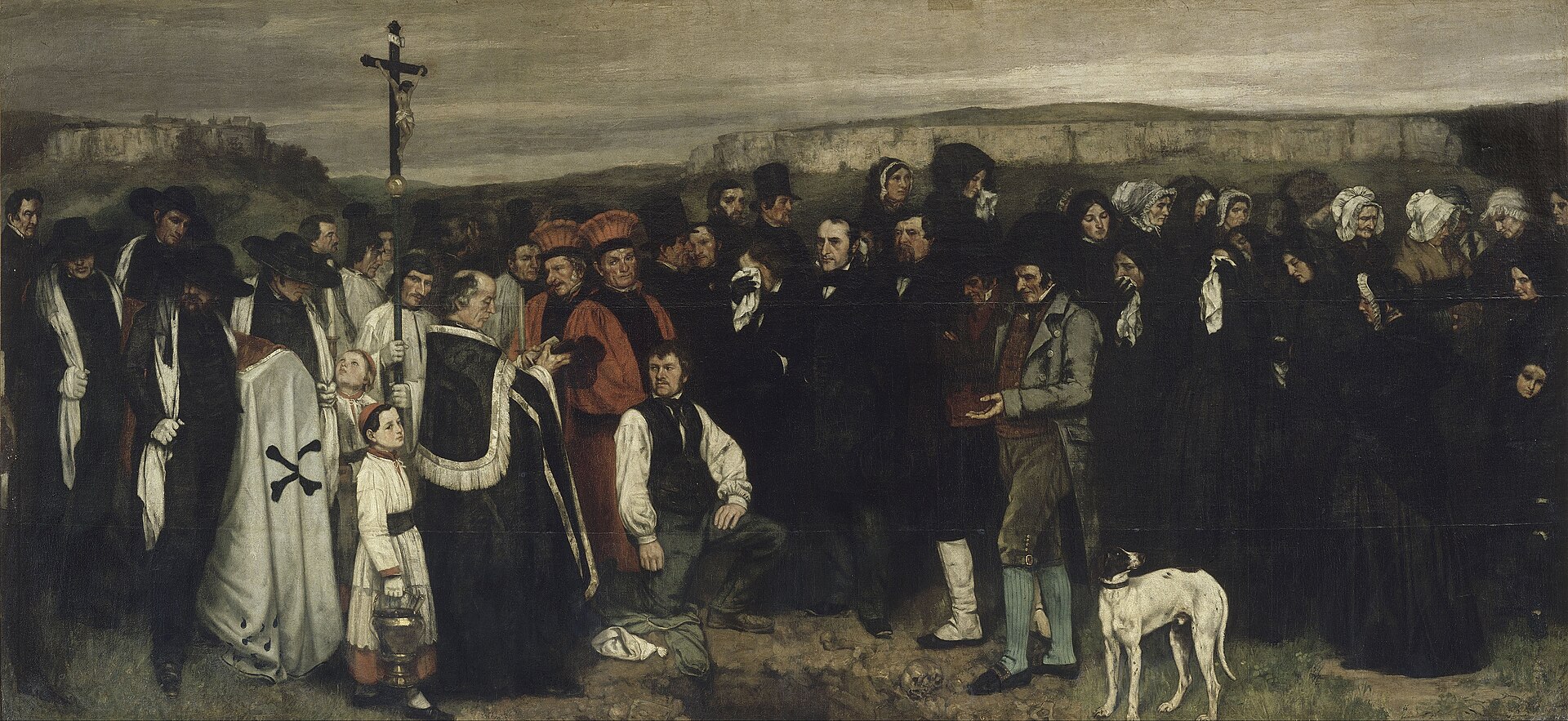
Paul did not write this passage to satisfy curiosity about the end of the world. He wrote it to comfort grieving people. And the comfort is not that death does not matter, or that we should not grieve. Christians do grieve. But they do not grieve “as others which have no hope.” They stand at the graveside, like the mourners in the painting above, knowing that the one they have laid in the ground is only asleep, and that the next voice that person will hear is the voice of Christ.
“But when about to leave His disciples, Jesus did not tell them that they would soon come to Him. ‘I go to prepare a place for you,’ He said. ‘And if I go and prepare a place for you, I will come again, and receive you unto Myself.’ John 14:2, 3. … Paul points his brethren to the future coming of the Lord, when the fetters of the tomb shall be broken, and the ‘dead in Christ’ shall be raised to eternal life.”
Ellen G. White · The Great Controversy, p. 548
“The hope and joy that this assurance brought to the young church at Thessalonica can scarcely be appreciated by us. … Now they rejoiced in the knowledge that their believing friends would be raised from the grave to live forever in the kingdom of God. The darkness that had enshrouded the resting place of the dead was dispelled. A new splendor crowned the Christian faith, and they saw a new glory in the life, death, and resurrection of Christ.”
Ellen G. White · The Acts of the Apostles, p. 259
This truth fits with everything else Scripture says. Philippians 1 spoke of Paul’s desire “to depart, and to be with Christ” (see that study); here we learn when that meeting happens. For the believer who dies, the time of sleep passes in what seems a moment. They close their eyes in death, and the next thing they know is the shout, the trumpet, and the face of their Lord. For those left behind, the waiting is real and the grief is real. But so is the hope. Jesus died and rose again. He is coming back. And so shall we ever be with the Lord.
