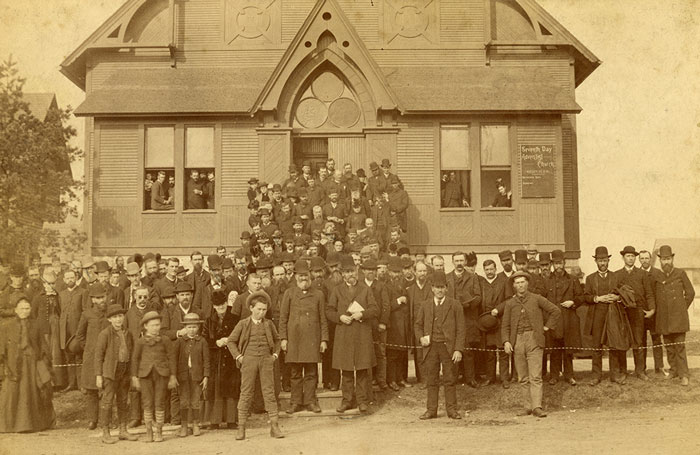
A message came to a church that had been waiting for it for forty years — and a good many of the people who had done the waiting could not receive it. This is what happened, and why it still matters.
A study on Righteousness By Faith · Arthur Baldwin · StandUp4Jesus.Org · 14 min read
Table of Contents
It has been 137+ years since that fateful General Conference Campmeeting held in Minneapolis, Minnesota. What was the message, who rejected it, and why? What was the result? These are some of the questions we will do our best to answer in this article.
What Was In The Air Before Anyone Reached Minneapolis
The session opened on October 17, 1888 and ran to November 4. It was preceded by a week-long Bible institute, and the two together are what people mean when they say “Minneapolis.”
The church that gathered there was small. At the close of 1887 the world membership stood at 25,841 — fewer people than fill a mid-sized stadium, scattered across twenty-six local conferences in North America and a handful of missions overseas. Nearly everyone in the room knew nearly everyone else. That is worth holding in mind, because what happened at Minneapolis was not a clash between an institution and a stranger. It was a family argument.
Two disagreements had been building for a year or two beforehand, and both arrived in the hall already sharpened.
The first was about prophecy. In the list of ten kingdoms that came out of the Roman Empire — the ten horns of Daniel 7 — should the tenth be the Huns or the Alemanni? Uriah Smith, the veteran editor of the Review and Herald at Battle Creek and the author of the standard denominational commentary on Daniel and Revelation, held one position. A. T. Jones, editor of the Signs of the Times in California, held the other. To a modern reader this looks like a footnote. In 1888 it was not, because Smith’s book was how the whole church read prophecy, and a young editor correcting it in public was correcting far more than a list.
The second was about the law in Galatians, and it was the real one. When Paul writes that “the law was our schoolmaster to bring us unto Christ” (Galatians 3:24), which law does he mean? The older leaders held that Paul meant the ceremonial law — the sacrifices and services that ended at the cross. E. J. Waggoner, Jones’s colleague at the Signs, held that Paul meant the moral law, the Ten Commandments, driving the sinner to Christ because it can convict but cannot save.
You can feel why that alarmed men who had spent thirty years defending the fourth commandment against every kind of attack. If the moral law is the schoolmaster we are brought away from — so the fear ran — then how long before somebody concludes that the Sabbath went to the cross with it? The two journals had been publishing opposing views, and Ellen White, then in Europe, had written to the editors counselling them not to fight it out in print.
Two other facts of the setting matter. George I. Butler, the General Conference president, was ill and never came — but he had already placed himself with those on the negative side, and an absent president who has taken a side is still in the room. And there is no transcript. It was not the custom of the day to publish conference addresses; the Bulletin was a news sheet. Apart from Ellen White’s own talks, we have no verbatim record of what Jones and Waggoner actually said at Minneapolis. Everything since is reconstructed from letters, memories, and what the two men wrote elsewhere.
What The Message Actually Was
Strip away the argument about Galatians and the Huns, and what was being preached was not complicated. Ellen White set it down herself, years later, in the plainest paragraph she ever wrote on the subject:
“The Lord in His great mercy sent a most precious message to His people through Elders Waggoner and Jones… This message was to bring more prominently before the world the uplifted Saviour, the sacrifice for the sins of the whole world. It presented justification through faith in the Surety; it invited the people to receive the righteousness of Christ, which is made manifest in obedience to all the commandments of God. Many had lost sight of Jesus. They needed to have their eyes directed to His divine person, His merits, and His changeless love for the human family.”
Ellen G. White · Testimonies to Ministers and Gospel Workers, p. 91, 92
Read the third sentence slowly, because it is the hinge of the whole controversy and it refuses both of the ditches. The righteousness we receive is Christ’s, received by faith — not manufactured by us. And it is made manifest in obedience to all the commandments of God — not a legal fiction that leaves the life untouched. Faith and works were never the alternatives; one is the root and the other is the fruit, and the study on Faith And Works follows that out.
The same paragraph goes on to say why it had to be preached then, and this sentence is the sharpest self-criticism in the passage:
“The message of the gospel of His grace was to be given to the church in clear and distinct lines, that the world should no longer say that Seventh-day Adventists talk the law, the law, but do not teach or believe Christ.”
Ellen G. White · Testimonies to Ministers and Gospel Workers, p. 92
That was the diagnosis. A people who had recovered the Sabbath, the sanctuary, the state of the dead and the second coming — every one of them a genuine recovery — had come to be known for what they insisted on rather than for Whom they loved. The message was not a new doctrine to be added to the list. It was the Person the whole list had always been about.
And when people wrote asking her to rank it against the church’s central commission, she declined to rank it at all:
“Several have written to me, inquiring if the message of justification by faith is the third angel’s message, and I have answered, ‘It is the third angel’s message in verity.’”
Ellen G. White · Evangelism, p. 190
In verity — in reality, in substance, the thing itself. Not a helpful companion to the third angel’s message of Revelation 14. Its content.
Why Good Men Resisted It
It would be easy, and lazy, to write the next part as a story about villains. It was not. The men who dug in at Minneapolis were, most of them, the men who had built the work — who had been mocked in print, turned out of churches, and had kept the Sabbath when keeping it cost them their employment. Whatever else they were, they were not casual about truth.
Several things went wrong at once.
The issue got attached to particular men. Once a question is identified with a person, agreeing with the question means conceding to the person, and that is a much harder thing to do. Two young editors from California, correcting the church’s most respected author in front of the assembled leadership, were never going to be heard on the merits alone.
Some came to debate rather than to study. There is a specific state of mind in which a person listens only to find the weak point, and it can be maintained for a lifetime by someone who reads his Bible daily. Ellen White pleaded with the delegates to come at the presentations with open minds and to study prayerfully. Some did. Some had already decided.
And the fear underneath was real. These were men who had watched the wider Christian world set the law aside in the name of grace, and they had built their lives on refusing that. When a message arrived preaching righteousness by faith, it sounded to some of them like the first note of a tune they had spent thirty years arguing against — and they defended the fort without noticing that the One the fort was built to honour had walked in the gate.
Ellen White put her finger on the deepest problem, and it was not doctrinal:
“Finite men should beware of seeking to control their fellowmen, taking the place assigned to the Holy Spirit. Let no men feel that it is their prerogative to give to the world what they suppose to be truth, and refuse that anything should be given contrary to their ideas.”
Ellen G. White · Testimonies to Ministers and Gospel Workers, p. 75, 76
That is the mechanism. Not a wrong answer about Galatians — a settled certainty that no further light could come except through the accustomed channels. It is the one failure that makes every other failure permanent, because it disables the instrument by which a mistake would ordinarily be corrected.
Who Rejected It — And How Far That Word Goes
Here we have to be careful, because this is the point at which the story is most often told badly in both directions.
The session took no vote on any of the questions in dispute. There is no minute anywhere in which a body of Seventh-day Adventists formally rejected righteousness by faith, and anyone who says there is has not looked. What there was, instead, was a division that ran through the delegates and then went home with them. W. C. White, writing to the incoming General Conference president three weeks after the meeting closed, said the delegates carried away “very different impressions” — many felt it was one of the most profitable meetings they had ever attended, others that it was the most unfortunate conference ever held.
Both halves of that sentence are true, and any account that drops either half is propaganda.
So who resisted? A group of leaders connected with the General Conference and the institutions at Battle Creek — the administrative and publishing heart of the church — took the negative side and kept it. Butler had taken it from his sickbed before the meeting began; he left the presidency at that session, went into a decade of retirement caring for his invalid wife, and later returned to responsible service in the church. Uriah Smith stood with the cautious side and remained at the Review. Within a few years a good many of those who had opposed the message saw what they had done and said so plainly. Some never did.
That is the accurate shape of it: not a church-wide vote of rejection, but a hard core of resistance lodged in the exact place where it could do the most damage, surrounded by a much larger body of believers who were being genuinely fed.
One more piece of honesty is owed here, because a reader who goes looking will find it anyway. Neither Jones nor Waggoner finished well. Jones’s ministerial credentials were withdrawn in 1907 after years of warfare against the church’s leadership, and he was disfellowshipped in 1909; Waggoner’s credentials and membership ended around the same period, and he died in 1916. That history is real and it should not be hidden — but notice what it does and does not prove. A message is not verified by its messengers. What Ellen White endorsed in 1888 was the truth they preached, which is Paul’s and not theirs, and the later collapse of two men no more unmakes it than Solomon’s end unmakes Proverbs. There is a study on this site devoted to the messages those two men presented; the men themselves are a warning about something else entirely.
What She Said Afterward
Ellen White’s own assessment hardened over the following decade, and it is the strongest language she ever used about fellow believers. Writing in 1895 of men still cherishing the spirit of that meeting:
“Some have been cultivating hatred against the men whom God has commissioned to bear a special message to the world. They began this satanic work at Minneapolis. Afterward, when they saw and felt the demonstration of the Holy Spirit testifying that the message was of God, they hated it the more, because it was a testimony against them.”
Ellen G. White · Testimonies to Ministers and Gospel Workers, p. 79, 80
Note the sequence in the middle of that. They saw and felt the evidence, and the evidence made it worse — because by then admitting the message was of God meant admitting what they had done to it. That is a description of how a heart hardens, and it has nothing to do with the nineteenth century in particular.
Years later still, she was writing that the thing had not been dealt with, only covered:
“The prejudices and opinions that prevailed at Minneapolis… are not dead by any means; the seeds sown there in some hearts are ready to spring into life and bear a like harvest. The tops have been cut down, but the roots have never been eradicated, and they still bear their unholy fruit…”
Ellen G. White · Testimonies to Ministers and Gospel Workers, p. 467
The tops cut down and the roots left is exactly what a settled controversy looks like when it has been managed rather than repented of. Everyone stops saying the thing out loud. Nobody changes.
What The Result Was
Arthur’s question — what was the result? — has an answer in two parts, and the first part is usually left out.
There was a revival, and it was immediate. Ellen White spent the next two years in the field preaching righteousness by faith to congregation after congregation, calling it “old truth in new framework.” At the following General Conference session, in Battle Creek in the autumn of 1889, she reported that the spirit of Minneapolis was simply not in the room: all moved off in harmony, the five o’clock morning meetings were full, and the testimonies she listened to said that the past year had been the best of their lives — the light from the word of God clear and distinct, justification by faith, Christ our righteousness. Jones was speaking every morning at eight on justification by faith to great interest. Whatever was lost at Minneapolis, the year that followed it was one of the best the church had ever had.
And the resistance survived anyway, in the institutions, through the 1890s — which is why so much of Testimonies to Ministers is addressed to Battle Creek. By 1895 she was writing the sentence that sums up the whole cost:
“The righteousness of Christ by faith has been ignored by some; for it is contrary to their spirit and their whole life experience. Rule, rule, has been their course of action.”
Ellen G. White · Testimonies to Ministers and Gospel Workers, p. 363
Contrary to their spirit. That is the real reason a message like this gets refused, then and now. Not the exegesis of Galatians 3:24. The fact that receiving Christ’s righteousness requires a man to stop presenting his own — and a lifetime of achievement is a very expensive thing to lay down.
What It Has Cost
This is where the discussion usually leaves the evidence behind, so let us be exact about what can and cannot be shown.
Ellen White never wrote a sentence dating the second coming to the response of one conference. What she did write, repeatedly and in the plainest terms, is that the delay is ours:
“Had the purpose of God been carried out by His people in giving to the world the message of mercy, Christ would, ere this, have come to the earth, and the saints would have received their welcome into the city of God.”
Ellen G. White · Testimonies for the Church, vol. 6, p. 450
That is the citable version of the claim, and it is quite strong enough. It does not name 1888; it names the purpose of God not carried out by His people — which includes Minneapolis and does not stop there, and which implicates the generation reading this page as squarely as it implicates the men in the photograph above.
Some writers go further, and argue that the message of 1888 was the beginning of the latter rain and the loud cry, that its rejection turned the church back into the wilderness the way Kadesh-barnea turned Israel back, and that everything since has been the long consequence. That reading has been argued seriously for a century, and other faithful students of this history have contested it just as seriously. This site does not need to settle it, and honestly cannot. What is beyond dispute is smaller and heavier: a message God called most precious was sent, and a body of people who had every reason to recognize it did not.
If you want the number that is not in dispute, it is the one at the top of Arthur’s paragraph. A hundred and thirty-seven years.
The Only Version Of This Question That Still Matters
There is a way of studying 1888 that is pure self-congratulation — a chance to be indignant at men who have been dead for a century and cannot answer, while quietly assuming that we would have been in the other half of the hall. It is worth asking what makes anyone confident of that.
Because the message that came to Minneapolis is addressed, word for word, to the church of Revelation 3 — and that letter’s charge is not that its readers are wicked but that they do not know their condition:
“Because thou sayest, I am rich, and increased with goods, and have need of nothing; and knowest not that thou art wretched, and miserable, and poor, and blind, and naked: I counsel thee to buy of me gold tried in the fire, that thou mayest be rich; and white raiment, that thou mayest be clothed, and that the shame of thy nakedness do not appear.”
Revelation 3:17, 18
White raiment offered by Someone else, to people who believed they were already dressed. That is the 1888 message in one verse, and it was written to us long before there was a Minneapolis to reject it. The chapter is studied in full in Behold, I Stand At The Door.
So the useful question is not who rejected it in 1888? The record answers that as well as it ever will. The useful question is the one the record cannot answer, and only you can:
Have you received it? Not agreed with it — received it. Is the righteousness you expect to stand in at the judgment Christ’s, or your own, patched and mended and privately hoped to be enough? Every generation of this church has been asked that question, and the men in the photograph were not asked it any more sharply than the person reading this page.
The message is still most precious. It is still on offer. And there is still no vote to be taken — only the answer each of us gives when nobody else is in the room.
