The doctrine is settled; now Paul turns to what it actually feels like to live inside it. Peace with God, joy even in suffering, a love poured into the heart — and then, in the chapter’s own second half, the single boldest comparison in the whole letter: one man’s disobedience wrecked the whole human race, and one man’s obedience does something greater still.
A study in Romans 5 · Arthur Baldwin · StandUp4Jesus.Org · 14 min read
Being Justified By Faith, We Have Peace With God
“Therefore being justified by faith, we have peace with God through our Lord Jesus Christ: By whom also we have access by faith into this grace wherein we stand, and rejoice in hope of the glory of God.”
Romans 5:1-2
“Christ is ‘the Prince of Peace,’ … and it is His mission to restore to earth and heaven the peace that sin has broken. ‘Being justified by faith, we have peace with God through our Lord Jesus Christ.’ … Whoever consents to renounce sin and open his heart to the love of Christ, becomes a partaker of this heavenly peace.”
Ellen G. White · Thoughts From the Mount of Blessing, p. 27
“Therefore” ties this entire chapter back to the doctrine just finished — peace is not a separate blessing tacked onto justification, but its immediate, natural consequence. A war has actually ended, not merely been declared over on paper.
“And not only so, but we glory in tribulations also: knowing that tribulation worketh patience; And patience, experience; and experience, hope.”
Romans 5:3-4
“They have not the genuine article that Paul possessed, that could glory in tribulation, because ‘tribulation worketh patience; and patience, experience; and experience, hope: and hope maketh not ashamed; because the love of God is shed abroad in our hearts.’ … They have a religion of circumstance.”
Ellen G. White · Gospel Workers 1892, p. 115
This study’s own source draws a sharp line between two kinds of faith: one that only holds up when circumstances cooperate, and Paul’s own kind, sturdy enough to actually glory in the very tribulations most people would count as evidence against it.
“And hope maketh not ashamed; because the love of God is shed abroad in our hearts by the Holy Ghost which is given unto us.”
Romans 5:5
Paul builds this short chain — tribulation to patience, patience to experience, experience to hope — deliberately, link by link, so that hope arrives not as wishful thinking but as something tested and proven along the way, incapable of disappointing because it was never resting on circumstances in the first place.
While We Were Yet Sinners, Christ Died For Us
“For when we were yet without strength, in due time Christ died for the ungodly. For scarcely for a righteous man will one die: yet peradventure for a good man some would even dare to die.”
Romans 5:6-7
Paul is careful to distinguish ordinary human sacrifice from what Christ actually did. Rare, noble people occasionally die for someone genuinely good; what Christ did was die for people who were neither righteous nor good, but “without strength” and “ungodly” — a category human generosity almost never extends to.
“But God commendeth his love toward us, in that, while we were yet sinners, Christ died for us.”
Romans 5:8
“‘God commendeth His love toward us, in that, while we were yet sinners, Christ died for us.’ … And ‘if God be for us, who can be against us? He that spared not His own Son, but delivered Him up for us all, how shall He not with Him also freely give us all things?’”
Ellen G. White · The Ministry of Healing, p. 66
This is the whole gospel compressed into a single timing detail — not after repentance, not once the sinner had cleaned up, but “while we were yet sinners,” love arriving before any change in the recipient had happened at all.
“Much more then, being now justified by his blood, we shall be saved from wrath through him. For if, when we were enemies, we were reconciled to God by the death of his Son, much more, being reconciled, we shall be saved by his life.”
Romans 5:9-10
“The continual cry of the heart is, ‘More of Thee,’ and ever the Spirit’s answer is, ‘Much more.’”
Ellen G. White · Thoughts From the Mount of Blessing, p. 20
“Much more” appears twice in these two verses, and the logic behind it is worth following closely: if God did the harder thing — reconciling actual enemies through His Son’s death — the easier thing that follows, preserving already-reconciled friends through His ongoing life, is all but guaranteed.
“And not only so, but we also joy in God through our Lord Jesus Christ, by whom we have now received the atonement.”
Romans 5:11
This section’s own progression is worth naming plainly — it moves from peace (v.1) to joy in tribulation (v.3) to now joy in God Himself (v.11), each stage built on the one before, culminating not merely in relief from wrath but in an actual relationship restored.
As By One Man Sin Entered Into The World
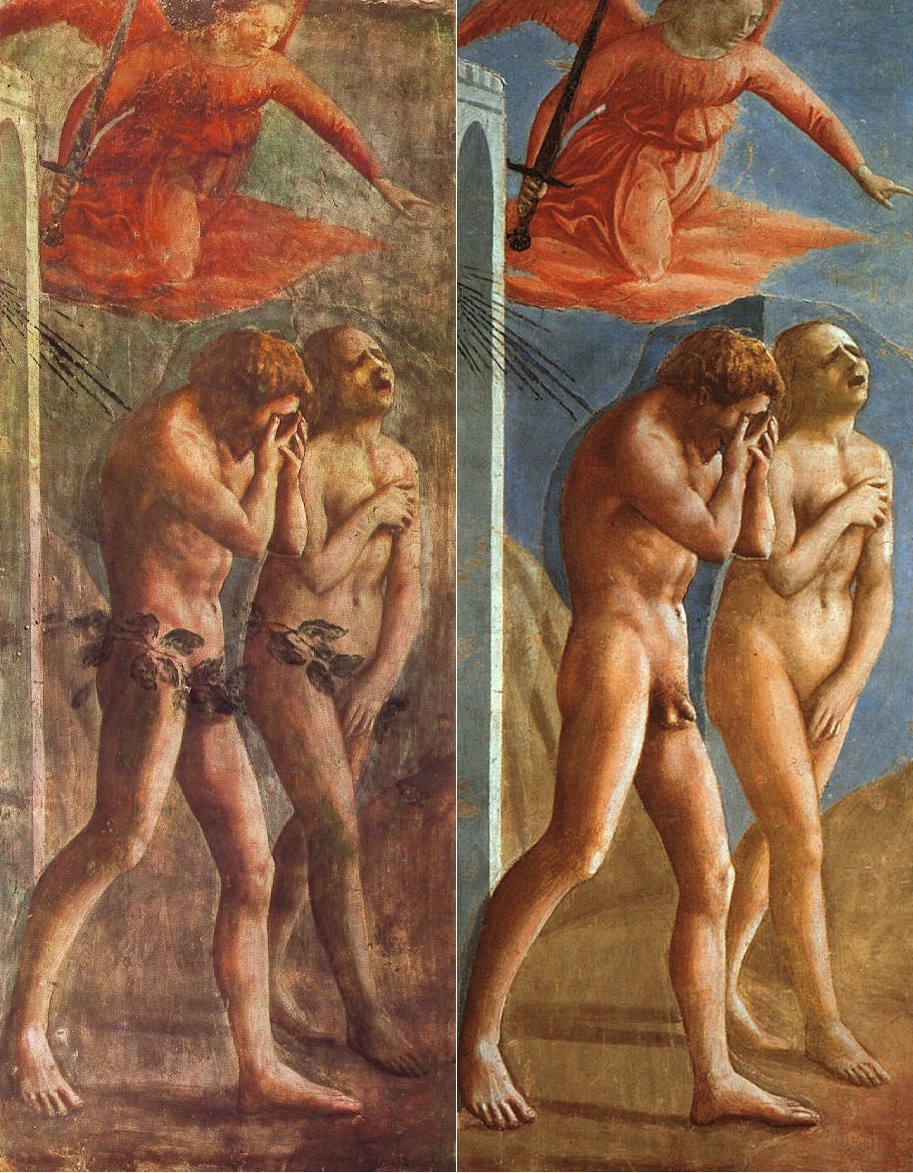
“Wherefore, as by one man sin entered into the world, and death by sin; and so death passed upon all men, for that all have sinned.”
Romans 5:12
This verse quietly answers a question chapters 1 through 4 never directly addressed: why does the whole world stand guilty in the first place? Paul’s answer reaches back past Israel, past Abraham, all the way to a single man and a single act, the common ancestor every reader of this letter, Jew and Gentile, actually shares.
“(For until the law sin was in the world: but sin is not imputed when there is no law. Nevertheless death reigned from Adam to Moses, even over them that had not sinned after the similitude of Adam’s transgression, who is the figure of him that was to come.”
Romans 5:13-14
Between Adam and Moses stretches a long era with no written law yet given, and death reigned through the entire span anyway — proof, Paul argues, that death’s power was never simply a penalty attached to breaking specific commandments. It traces back to Adam’s own original transgression, inherited rather than individually earned by everyone who died in between.
“The figure of him that was to come” is a striking phrase to apply to Adam — a shadow, of all things, cast forward by the man whose failure this whole passage is documenting, anticipating the one whose success will answer it.
Much More The Grace Of God
“But not as the offence, so also is the free gift. For if through the offence of one many be dead, much more the grace of God, and the gift by grace, which is by one man, Jesus Christ, hath abounded unto many.”
Romans 5:15
Paul is careful, here and in the verses that follow, never to let the parallel between Adam and Christ collapse into a simple equivalence. Both acts had far-reaching consequences through one man, but every single comparison Paul draws insists the second act is greater than the first, not merely its mirror image.
“And not as it was by one that sinned, so is the gift: for the judgment was by one to condemnation, but the free gift is of many offences unto justification.”
Romans 5:16
The asymmetry sharpens further here — one offense produced condemnation, but the free gift somehow covers “many offences,” an accumulated weight of sin far heavier than the single transgression that started the whole crisis, answered by grace that is still sufficient.
“For if by one man’s offence death reigned by one; much more they which receive abundance of grace and of the gift of righteousness shall reign in life by one, Jesus Christ.)”
Romans 5:17
Even the verbs shift in this comparison, worth noticing on a careful read: death itself “reigned” over humanity through Adam, a kind of tyranny, but believers are not merely spared from that reign — they are said to “reign in life” themselves, promoted rather than simply rescued.
Where Sin Abounded, Grace Did Much More Abound
“Therefore as by the offence of one judgment came upon all men to condemnation; even so by the righteousness of one the free gift came upon all men unto justification of life.”
Romans 5:18
“For as by one man’s disobedience many were made sinners, so by the obedience of one shall many be made righteous.”
Romans 5:19
“Disobedience” and “obedience” are the two words this entire passage has really been building toward — not two different kinds of act, but the same moral category, exercised in two opposite directions by two different men, with consequences flowing from each in exact, mirrored proportion.
“Moreover the law entered, that the offence might abound. But where sin abounded, grace did much more abound.”
Romans 5:20
“The work of redemption will be complete. In the place where sin abounded, God’s grace much more abounds. The earth itself, the very field that Satan claims as his, is to be not only ransomed but exalted. Our little world, under the curse of sin the one dark blot in His glorious creation, will be honored above all other worlds in the universe of God.”
Ellen G. White · The Desire of Ages, p. 26
This is one of the most quietly astonishing claims in the whole Bible, and this study’s own source takes it all the way to its final, cosmic conclusion: not merely that grace matches sin’s damage and repairs it, but that the very planet where sin did its worst damage will, in the end, be honored above every unfallen world in God’s entire universe. The place of the deepest wound becomes the place of the greatest glory.
“That as sin hath reigned unto death, even so might grace reign through righteousness unto eternal life by Jesus Christ our Lord.”
Romans 5:21
The chapter’s own final verse trades one reign for another — sin’s reign ending in death, replaced by grace’s reign ending in eternal life — the same royal language used throughout this whole passage, insisting to the very last word that grace does not merely cancel sin’s damage but actually outranks it.
