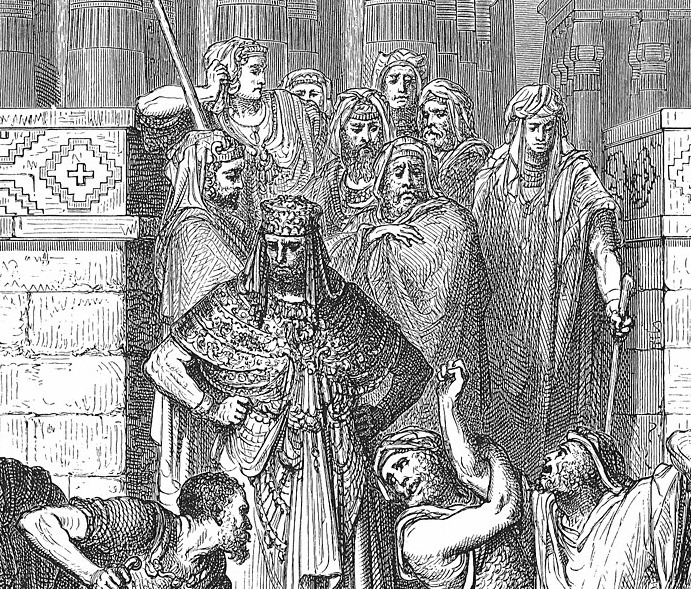
A funeral song for a royal family, a sword sharpened and polished, and a sentence on a crown that would not be lifted for six hundred years.
A Bible study on Ezekiel 19 and 21 · Arthur Baldwin · StandUp4Jesus.Org · 12 min read
Table of Contents
Somewhere in the middle of chapter 21 is a sentence that reaches further than anything else in the book of Ezekiel. It is spoken to one disgraced king in one doomed city, and it does not finish being fulfilled for another six hundred years.
Why These Two Chapters Belong Together
Chapter 20 sits between these two, and we have already taken it up on its own in The Sign Between Us. Read 19 and 21 side by side and you find they are one subject: the end of the royal house of David as a governing dynasty.
Chapter 19 mourns the princes who have already fallen. Chapter 21 pronounces sentence on the last one left. One is a funeral; the other is the verdict that makes the funeral final.
The Lioness And Her Whelps
“Moreover take thou up a lamentation for the princes of Israel, And say, What is thy mother? A lioness: she lay down among lions, she nourished her whelps among young lions.”
Ezekiel 19:1, 2
A lamentation is a technical word — a funeral dirge, with its own limping meter. Ezekiel is told to sing at a graveside, and the corpse is the monarchy.
The lioness raises a cub who “learned to catch the prey; it devoured men.” The nations trap him and “brought him with chains unto the land of Egypt” (19:4). She waits, gives up hope, and raises a second. He does the same, and the nations take him too — “they brought him to the king of Babylon… that his voice should no more be heard upon the mountains of Israel” (19:9).
The history is not hard to match. Jehoahaz reigned three months and was carried off to Egypt by Pharaoh Necho. Jehoiachin reigned three months and was carried off to Babylon by Nebuchadnezzar — and he was still alive in Babylon as Ezekiel sang this, which is why the exiles dated everything by his captivity.
Notice what the song does not do. It does not excuse them. Both cubs learned to tear, and both devoured men. The lament is genuine grief over a family that destroyed itself — which is a harder and more honest kind of mourning than the sort that tidies up the deceased on the way to the grave.
No Strong Rod To Be A Sceptre
Halfway through, the figure changes from a lion to a vine — the image we followed through chapters 15 and 17 in A Vine, A Bride, And Two Eagles:
“Thy mother is like a vine in thy blood, planted by the waters: she was fruitful and full of branches by reason of many waters. And she had strong rods for the sceptres of them that bare rule, and her stature was exalted among the thick branches.”
Ezekiel 19:10, 11
A strong rod is a straight branch thick enough to cut into a ruler’s staff. The vine that was good for nothing as timber in chapter 15 did produce this one thing — sceptres. Kings came out of it.
And then it is pulled up, thrown down, dried by the east wind, and burned. The last line of the chapter is the one that matters:
“And fire is gone out of a rod of her branches, which hath devoured her fruit, so that she hath no strong rod to be a sceptre to rule. This is a lamentation, and shall be for a lamentation.”
Ezekiel 19:14
Fire is gone out of a rod of her branches. The vine was not destroyed only from outside. The fire that consumed it came out of one of its own branches — a king of her own producing. Zedekiah’s rebellion, which we followed in chapter 17, is the rod that burned the vine.
And the closing words are a double: this is a lamentation, and shall be for a lamentation. Not only a funeral song — a funeral song that will keep being sung.
The Song Of The Sword
Chapter 21 opens with one of the hardest sentences in the prophets:
“Behold, I am against thee, and will draw forth my sword out of his sheath, and will cut off from thee the righteous and the wicked.”
Ezekiel 21:3
That deserves care rather than a quick pass. It sounds as though it contradicts chapter 18, which had just spent thirty-two verses proving that God deals with each person on his own account.
It does not, because the two verses are about different things. Chapter 18 is about a verdict. Chapter 21 is about a catastrophe. When a city falls, the invading army does not check the spiritual standing of the people in the street, and Scripture never pretends otherwise. Godly people died in the siege of Jerusalem. Daniel and Ezekiel themselves went into exile as young men with everybody else.
What chapter 18 promises is that the righteous man’s standing with God is not swept away with his circumstances. What chapter 21 says is that his circumstances may very well be swept away. Both are true, and only the second one is visible from the street.
Then Ezekiel is given a piece of theater, and it is a strange one — he is to grieve in public, on purpose, until people ask him why:
“Sigh therefore, thou son of man, with the breaking of thy loins; and with bitterness sigh before their eyes. And it shall be, when they say unto thee, Wherefore sighest thou? that thou shalt answer, For the tidings; because it cometh.”
Ezekiel 21:6, 7
He is not performing grief he does not feel. He is refusing to hide grief he does feel, so that the question gets asked. It is the same instinct as the sign-acts of chapter 4 — a man made into an exhibit — but this time the exhibit is his own face.
Then the sword song itself, which in Hebrew is jagged and repetitive on purpose:
“A sword, a sword is sharpened, and also furbished: It is sharpened to make a sore slaughter; it is furbished that it may glitter.”
Ezekiel 21:9, 10
Furbished is polished. The sword is not merely sharp — it has been made to shine, so that the sight of it does half the work before it lands. And Ezekiel is told to “smite therefore upon thy thigh” (21:12), the ancient gesture of grief and horror.
A Pagan King At The Crossroads
Now a scene that ought to be better known, because of what it quietly claims:
“For the king of Babylon stood at the parting of the way, at the head of the two ways, to use divination: he made his arrows bright, he consulted with images, he looked in the liver. At his right hand was the divination for Jerusalem.”
Ezekiel 21:21, 22
Nebuchadnezzar has marched out with one army and two possible targets — Rabbah of the Ammonites, or Jerusalem. At the fork in the road he stops and consults his gods: he shakes arrows to see which falls out, he questions his household idols, he has a sheep killed and reads its liver.
Every one of those methods is worthless, and Scripture says so elsewhere without hedging. And the omen comes up Jerusalem.
Ezekiel is not endorsing divination. He is doing something far more startling: he is telling the exiles, in advance, which way the arrow will fall — because the God who is not consulted at that crossroads is nevertheless the one deciding it. Proverbs states the principle without the drama: “The lot is cast into the lap; but the whole disposing thereof is of the LORD” (Proverbs 16:33).
A superstitious king performing an empty ritual still ends up doing exactly what God had already declared. That is the same throne on wheels we met in chapter 1 — the hand among the wheels, running the affairs of an empire that has no idea it is being run.
Until He Come Whose Right It Is
And now the sentence the whole book has been walking toward:
“And thou, profane wicked prince of Israel, whose day is come, when iniquity shall have an end, Thus saith the Lord GOD; Remove the diadem, and take off the crown: this shall not be the same: exalt him that is low, and abase him that is high. I will overturn, overturn, overturn, it: and it shall be no more, until he come whose right it is; and I will give it him.”
Ezekiel 21:25–27
The profane wicked prince is Zedekiah — the man who broke the oath he had sworn in God’s name, whose story we followed in chapters 12 and 17.
Remove the diadem, and take off the crown. Not give it to someone better. Take it off, and leave it off.
Ellen White states the consequence plainly:
“To the ‘profane wicked prince’ had come the day of final reckoning. ‘Remove the diadem,’ the Lord decreed, ‘and take off the crown.’ Not until Christ Himself should set up His kingdom was Judah again to be permitted to have a king.”
Ellen G. White · Prophets and Kings, p. 451
And that is what happened. Zedekiah, blinded at Riblah, is the last king of David’s line to sit on a throne in Jerusalem. Governors came after — Zerubbabel, Nehemiah. Foreign kings ruled. Herod wore a crown in Jerusalem and was an Edomite by blood and a Roman appointee by office. But no son of David reigned again.
Six centuries later an angel stood in a house in Nazareth and used the missing word:
“He shall be great, and shall be called the Son of the Highest: and the Lord God shall give unto him the throne of his father David: And he shall reign over the house of Jacob for ever; and of his kingdom there shall be no end.”
Luke 1:32, 33
He come whose right it is. The word carries a legal sense — the one with the claim, the rightful heir. Jacob had said the same thing on his deathbed about the same tribe: “The sceptre shall not depart from Judah… until Shiloh come; and unto him shall the gathering of the people be” (Genesis 49:10).
Now, a word about the three overturns, because this is where popular preaching often adds more than the text does. Threefold repetition in Hebrew is the language of finality — holy, holy, holy; earth, earth, earth, hear the word of the LORD (Jeremiah 22:29). The most natural reading is that the crown is being overturned utterly, not that three specific empires are being counted off.
Ellen White reads it that way too. What she supplies is not a numbered list matching the three overturns, but the sequel:
“The crown removed from Israel passed successively to the kingdoms of Babylon, Medo-Persia, Greece, and Rome. God says, ‘It shall be no more, until He come whose right it is; and I will give it Him.’”
Ellen G. White · Education, p. 179
Count them: four kingdoms, not three. So the overturns are not being matched one-to-one with empires. What she does do is connect this sentence to the succession of world powers we already know from Daniel 2 and Daniel 7 — the same four, running down to a kingdom that is not made with hands.
She introduces the passage as “the final overthrow of all earthly dominions” (p. 178), and follows it with a sentence worth ending on: “That time is at hand.”
What This Asks Of Us
Grieve honestly over what deserves grief. Ezekiel’s lament neither excuses the princes nor gloats over them. Both cubs devoured men, and he still sang at their funeral.
The fire came out of her own branches. The vine was not only cut down from outside. What finished it was produced by it.
A verdict and a catastrophe are different things. Chapter 18 says your standing is your own; chapter 21 says the city may still fall around you. Faithful people are not exempt from history, and Scripture never promised they would be.
God rules the crossroads He is not consulted at. Nebuchadnezzar shook his arrows and read a liver, and did precisely what had already been announced.
And the crown is not vacant — it is reserved. It shall be no more, until he come whose right it is. Every throne since has been held on a temporary lease, and the last word on all of them was spoken to a blinded king in a burning city.
Next in this series: Ezekiel 22 through 24 — dross in the furnace, two sisters, and the death of Ezekiel’s wife on the day the siege began.
In one breath
- Chapters 19 and 21 are one subject: the end of David’s line as a governing dynasty. Chapter 19 mourns the princes already fallen; 21 sentences the last one.
- The lioness’s two whelps are Jehoahaz (taken to Egypt) and Jehoiachin (taken to Babylon) — and the lament excuses neither; both “devoured men”.
- The vine ends with “no strong rod to be a sceptre” (19:14), and the fire that consumed it came out of one of her own branches.
- “Cut off … the righteous and the wicked” (21:3) is not a contradiction of chapter 18: a verdict and a catastrophe are different things.
- Nebuchadnezzar divines at the crossroads with arrows, images and a liver — and the omen falls on Jerusalem exactly as announced (21:21, 22). “The whole disposing thereof is of the LORD.”
- “Remove the diadem, and take off the crown” (21:26). PK 451: “Not until Christ Himself should set up His kingdom was Judah again to be permitted to have a king.” No son of David reigned in Jerusalem again.
- The three overturns are emphatic, not a count of empires — Ed 179 lists four kingdoms after it, tying the sentence to Daniel 2 and 7.
- “Until he come whose right it is” — the rightful heir of Genesis 49:10, named to Mary in Luke 1:32, 33.
