Chapter 2 ended by showing that man-made rules cannot change a human heart. Chapter 3 shows what can. Believers have died and risen with Christ, and their real life is now hidden with Him in God, waiting to be revealed when He appears. From that new position comes a new way of living: the old life put off like soiled clothing, the character of Christ put on in its place, His peace ruling the heart, His word dwelling richly in the church, and His lordship reaching into every home and every workplace.
A study in Colossians 3 · Arthur Baldwin · StandUp4Jesus.Org · 22 min read
Seek Those Things Which Are Above
“If ye then be risen with Christ, seek those things which are above, where Christ sitteth on the right hand of God. Set your affection on things above, not on things on the earth. For ye are dead, and your life is hid with Christ in God. When Christ, who is our life, shall appear, then shall ye also appear with him in glory.”
Colossians 3:1-4
The false teachers told the Colossians to look down at rules: what to touch, what to taste. Paul tells them to look up. In baptism they were “buried with him” and “risen with him” (2:12). So their true home is now where Christ is — “on the right hand of God,” ministering for them as High Priest in the heavenly sanctuary. What fills their hearts and minds should come from there.
“At the time of their conversion and baptism the Colossian believers pledged themselves to put away beliefs and practices that had hitherto been a part of their lives, and to be true to their allegiance to Christ. In his letter, Paul reminded them of this, and entreated them not to forget that in order to keep their pledge they must put forth constant effort against the evils that would seek for mastery over them.”
Ellen G. White · The Acts of the Apostles, p. 475
“Your life is hid with Christ in God.” The believer’s real life is not visible yet. The world sees an ordinary person, sometimes a weak and struggling one. But the life God has given is kept safe with Christ, out of reach of every enemy — even death. Ellen White drew on this verse in describing what death means for a believer:
“To the believer, death is but a small matter. Christ speaks of it as if it were of little moment. … To the Christian, death is but a sleep, a moment of silence and darkness. The life is hid with Christ in God, and ‘when Christ, who is our life, shall appear, then shall ye also appear with Him in glory.’”
Ellen G. White · The Desire of Ages, p. 787
Notice when the hidden life is revealed: “when Christ … shall appear.” Not at death, but at His coming. Then what is now hidden will be seen by everyone, and those who belong to Him will “appear with him in glory.” The same hope ran through the study of Philippians 3: the Saviour comes from heaven and changes the body of our humiliation.
Put Off The Old Man
“Mortify therefore your members which are upon the earth; fornication, uncleanness, inordinate affection, evil concupiscence, and covetousness, which is idolatry: For which things’ sake the wrath of God cometh on the children of disobedience: In the which ye also walked some time, when ye lived in them. But now ye also put off all these; anger, wrath, malice, blasphemy, filthy communication out of your mouth. Lie not one to another, seeing that ye have put off the old man with his deeds; And have put on the new man, which is renewed in knowledge after the image of him that created him:”
Colossians 3:5-10
Looking upward does not mean ignoring what is below. “Mortify” means “put to death.” Having died with Christ, the believer is to treat the old sinful habits as things that belong to a dead man. Paul’s first list names sins of desire, and it ends with a surprise: “covetousness, which is idolatry.” Greed is worship — it puts possessions in the place of God. The second list names sins of the tongue and temper: anger, malice, slander, foul talk, lies. These were the sins most likely to divide a church.
Then comes the picture of changing clothes. The “old man” is taken off like a filthy garment, and the “new man” is put on. And the new man is “renewed … after the image of him that created him.” In chapter 1 Christ was “the image of the invisible God.” Now the purpose of the gospel is clear: to restore in us the image of God that sin defaced, by making us like Christ.
“But because this experience is his, the Christian is not therefore to fold his hands, content with that which has been accomplished for him. He who has determined to enter the spiritual kingdom will find that all the powers and passions of unregenerate nature, backed by the forces of the kingdom of darkness, are arrayed against him. Each day he must renew his consecration, each day do battle with evil. Old habits, hereditary tendencies to wrong, will strive for the mastery, and against these he is to be ever on guard, striving in Christ’s strength for victory.”
Ellen G. White · The Acts of the Apostles, p. 476
Christ Is All, And In All
“Where there is neither Greek nor Jew, circumcision nor uncircumcision, Barbarian, Scythian, bond nor free: but Christ is all, and in all.”
Colossians 3:11
In the new humanity, the great divisions of the ancient world disappear. Greek and Jew, the religious divide. Circumcised and uncircumcised, the ritual divide. “Barbarian” (anyone who did not speak Greek) and “Scythian” (the tribes the ancient world regarded as the most savage), the cultural divide. Slave and free, the social divide. None of these determines anyone’s standing in Christ. The Colossian church would soon receive a runaway slave, Onesimus, back as “a faithful and beloved brother” (4:9). That was a revolution.
“From every quarter were coming accounts of the spread of the new doctrine by which Jews were released from the observance of the rites of the ceremonial law and Gentiles were admitted to equal privileges with the Jews as children of Abraham. Paul, in his preaching at Corinth, presented the same arguments which he urged so forcibly in his epistles. His emphatic statement, ‘There is neither Greek nor Jew, circumcision nor uncircumcision’ (Colossians 3:11), was regarded by his enemies as daring blasphemy, and they determined that his voice should be silenced.”
Ellen G. White · The Acts of the Apostles, p. 390
Put On Charity
“Put on therefore, as the elect of God, holy and beloved, bowels of mercies, kindness, humbleness of mind, meekness, longsuffering; Forbearing one another, and forgiving one another, if any man have a quarrel against any: even as Christ forgave you, so also do ye. And above all these things put on charity, which is the bond of perfectness. And let the peace of God rule in your hearts, to the which also ye are called in one body; and be ye thankful.”
Colossians 3:12-15
Before the command comes the identity. Believers are “the elect of God, holy and beloved” — chosen, set apart, and loved. They do not put on these virtues to earn that status; they put them on because it is already theirs. And the new wardrobe is the character of Christ Himself: compassion, kindness, humility, gentleness, patience.
Paul is realistic. He expects that some will “have a quarrel against” others. The answer is forgiveness, and its measure is breathtaking: “even as Christ forgave you.” No one who remembers how much they have been forgiven can hold on to a grudge for long. Over everything goes “charity,” love, the belt that holds the whole outfit together, “the bond of perfectness.”
“The letter to the Colossians is filled with lessons of highest value to all who are engaged in the service of Christ, lessons that show the singleness of purpose and the loftiness of aim which will be seen in the life of him who rightly represents the Saviour. Renouncing all that would hinder him from making progress in the upward way or that would turn the feet of another from the narrow path, the believer will reveal in his daily life mercy, kindness, humility, meekness, forbearance, and the love of Christ.”
Ellen G. White · The Acts of the Apostles, p. 477
“Let the peace of God rule” uses a word taken from athletics: to act as umpire. When a believer is torn between two responses, Christ’s peace is to make the call. And the chapter keeps returning to one small command: “be ye thankful.”
“Never should we forget that we are children of the heavenly King, sons and daughters of the Lord of hosts. It is our privilege to maintain a calm repose in God. ‘Let the peace of God rule in your hearts; … and be ye thankful.’ Colossians 3:15. Forgetting our own difficulties and troubles, let us praise God for an opportunity to live for the glory of His name.”
Ellen G. White · The Ministry of Healing, p. 253
Let The Word Of Christ Dwell In You Richly
“Let the word of Christ dwell in you richly in all wisdom; teaching and admonishing one another in psalms and hymns and spiritual songs, singing with grace in your hearts to the Lord. And whatsoever ye do in word or deed, do all in the name of the Lord Jesus, giving thanks to God and the Father by him.”
Colossians 3:16-17
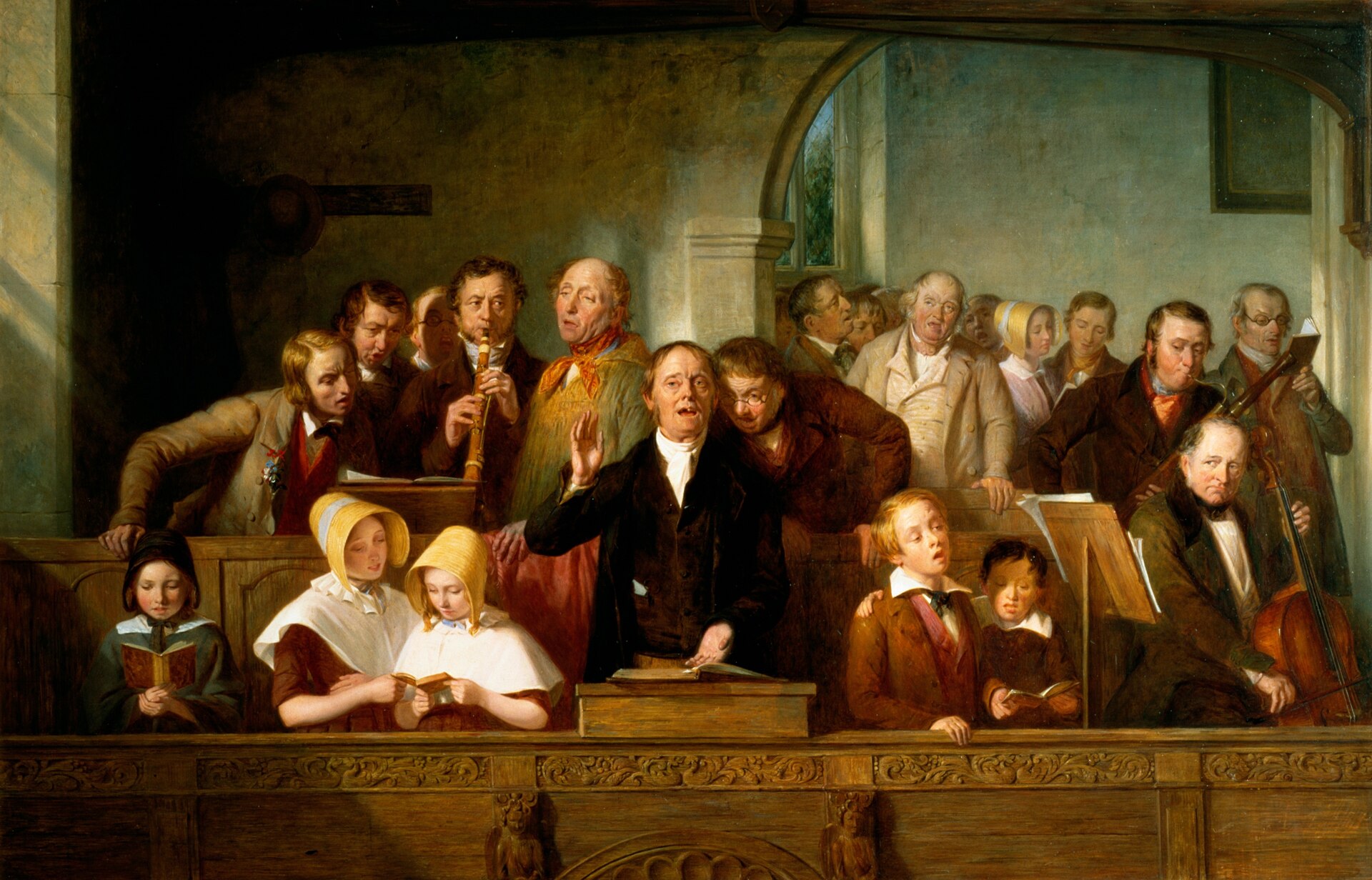
The false teachers promised wisdom through philosophy and visions. Paul points to the word of Christ, living in the church “richly.” And one of the ways it is taught is through song. Early Christians sang the Psalms, hymns of praise, and new songs of the faith — some scholars believe the great passage about Christ in 1:15-20 may itself have been sung. Music was not entertainment in the church; it was teaching and worship at once.
“Let there be singing in the home, of songs that are sweet and pure, and there will be fewer words of censure and more of cheerfulness and hope and joy. … As a part of religious service, singing is as much an act of worship as is prayer. Indeed, many a song is prayer.”
Ellen G. White · Education, p. 168
Verse 17 widens the circle to everything. There is no part of life that stands outside Christ’s name — no separate compartment for sacred and ordinary. Every word and every act can be done “in the name of the Lord Jesus,” as His representative, and with thanks.
As It Is Fit In The Lord
“Wives, submit yourselves unto your own husbands, as it is fit in the Lord. Husbands, love your wives, and be not bitter against them. Children, obey your parents in all things: for this is well pleasing unto the Lord. Fathers, provoke not your children to anger, lest they be discouraged.”
Colossians 3:18-21
“Whatsoever ye do” now comes home. These verses are a shorter version of the household instructions Paul gave in Ephesians 5 and 6, written at the same time and carried by the same messenger. Each relationship is placed “in the Lord.” Wives are to submit “as it is fit in the Lord” — not as the world demanded, but in the way that fits a disciple. Husbands are commanded, as no pagan moralist would have commanded them, to love their wives and never to be harsh with them. (The study of Ephesians 5 explores these roles in depth.)
“The spirit that Christ manifests toward us is the spirit that husband and wife are to manifest toward each other. … Neither the husband nor the wife should attempt to exercise over the other an arbitrary control. Do not try to compel each other to yield to your wishes. You cannot do this and retain each other’s love. Be kind, patient, and forbearing, considerate, and courteous.”
Ellen G. White · The Ministry of Healing, p. 361
Children are addressed directly, as full members of the church. And fathers receive a warning with a tender reason: do not keep provoking your children, “lest they be discouraged.” A child who can never please a parent will eventually stop trying. Constant criticism breaks a young spirit; encouragement builds it.
“Servants, obey in all things your masters according to the flesh; not with eyeservice, as menpleasers; but in singleness of heart, fearing God: And whatsoever ye do, do it heartily, as to the Lord, and not unto men; Knowing that of the Lord ye shall receive the reward of the inheritance: for ye serve the Lord Christ. But he that doeth wrong shall receive for the wrong which he hath done: and there is no respect of persons.”
Colossians 3:22-25
Paul speaks at greatest length to the slaves, perhaps because Onesimus was traveling with this very letter. Their earthly situation might be hard and unjust, but their work could be offered to a different Master: “ye serve the Lord Christ.” Slaves in Roman law could inherit nothing. Paul promises them “the reward of the inheritance.” And God’s justice has “no respect of persons” — He will call to account the master who does wrong as surely as the slave.
“God’s plan of life has a place for every human being. Each is to improve his talents to the utmost; and faithfulness in doing this, be the gifts few or many, entitles one to honor. In God’s plan there is no place for selfish rivalry. … It is to be done ‘heartily, as to the Lord, and not unto men; knowing that of the Lord ye shall receive the reward of the inheritance: for ye serve the Lord Christ.’ Colossians 3:23, 24.”
Ellen G. White · Education, p. 225
So the chapter that began in the heavenly places ends in the kitchen, the nursery and the workshop. That is the answer to the false teachers. Real spirituality is not found in secret knowledge or harsh rules, but in a life hidden with Christ in God and lived out, day by day, in ordinary places — clothed in His character, ruled by His peace, filled with His word, and done in His name.
