Every engineer knows the feeling: you study a machine someone else built, and little by little you realize how much the designer understood. Now try that with a hummingbird, a bumblebee, or a butterfly. This study looks at the skill of the One who made them: who He is, how He works, what His creatures show about Him, and why the redeemed will spend eternity learning from Him.
A Bible study · Arthur Baldwin · StandUp4Jesus.Org · 20 min read
The Whole Godhead At Work
The His Skill page on this site begins with a bold statement: “All three persons in the Godhead are involved in every act of creation!” Scripture agrees. John names the Son as the One through whom everything was made:
“In the beginning was the Word, and the Word was with God, and the Word was God. The same was in the beginning with God. All things were made by him; and without him was not any thing made that was made.”
John 1:1-3
Paul describes the Father as the Source and the Son as the Agent:
“But to us there is but one God, the Father, of whom are all things, and we in him; and one Lord Jesus Christ, by whom are all things, and we by him.”
1 Corinthians 8:6
“For by him were all things created, that are in heaven, and that are in earth, visible and invisible, whether they be thrones, or dominions, or principalities, or powers: all things were created by him, and for him: And he is before all things, and by him all things consist.”
Colossians 1:16-17
And the Spirit is there from the second verse of the Bible:
“In the beginning God created the heaven and the earth. And the earth was without form, and void; and darkness was upon the face of the deep. And the Spirit of God moved upon the face of the waters.”
Genesis 1:1-2
“The Spirit of God hath made me, and the breath of the Almighty hath given me life.”
Job 33:4
Ellen White describes the Father and the Son planning creation together, and working as one:
“The Father and the Son engaged in the mighty, wondrous work they had contemplated, of creating the world.”
Ellen G. White · The Spirit of Prophecy, vol. 1, p. 24
“After the earth was created, and the beasts upon it, the Father and Son carried out their purpose, which was designed before the fall of Satan, to make man in their own image. They had wrought together in the creation of the earth and every living thing upon it.”
Ellen G. White · The Spirit of Prophecy, vol. 1, p. 24
Exactly how the work was divided, the Bible does not say. The His Skill page offers a thoughtful suggestion: “Jesus spoke the words. Perhaps the Holy Spirit provided the energy that slowed down into matter!” Scripture tells us that the visible world was not made out of anything that already existed:
“Through faith we understand that the worlds were framed by the word of God, so that things which are seen were not made of things which do appear.”
Hebrews 11:3
“In the creation of the earth, God was not indebted to pre-existing matter.”
Ellen G. White · The Ministry of Healing, p. 414
But as the page itself says, the article is “NOT about the technical details of Who did What.” The page is about the skill, and so is this study. (For more on the Persons of the Godhead, see The Godhead and The Holy Spirit.)
The Engineer With A Compass
In Proverbs 8, divine Wisdom speaks, and the Christian church has long heard in her voice the Son of God. Notice the language. It is the language of a builder:
“When he prepared the heavens, I was there: when he set a compass upon the face of the depth: When he established the clouds above: when he strengthened the fountains of the deep: When he gave to the sea his decree, that the waters should not pass his commandment: when he appointed the foundations of the earth: Then I was by him, as one brought up with him: and I was daily his delight, rejoicing always before him;”
Proverbs 8:27-30
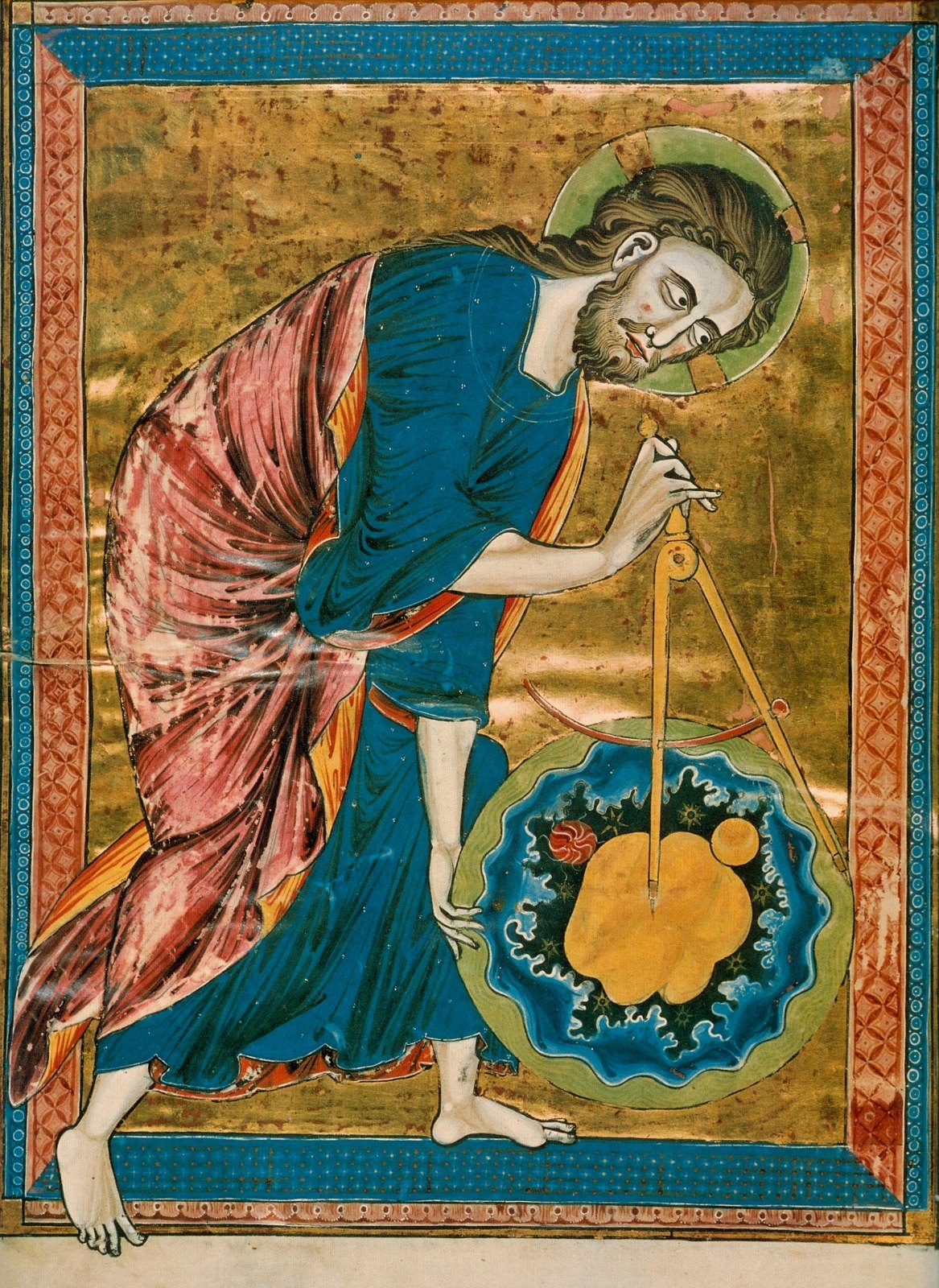
“When he set a compass upon the face of the depth.” The medieval artist who painted the header of this article took that line literally: the Creator bending over an unformed world with a pair of dividers in His hand. Engineers still work with compass and measure. God invented measuring. (See The Lord Possessed Me In The Beginning Of His Way on Proverbs 8.)
“He who set the starry worlds on high and tinted with delicate skill the flowers of the field, who filled the earth and the heavens with the wonders of His power, when He came to crown His glorious work, to place one in the midst to stand as ruler of the fair earth, did not fail to create a being worthy of the hand that gave him life.”
Ellen G. White · Patriarchs and Prophets, p. 44
“Delicate skill.” That is the subject of this study.
All The Parts At Once
The His Skill page puts the problem for evolution in one sentence: “unless every part of the biological system is ‘in place’ at the beginning, the creature will die.” In 1996 the biochemist Michael Behe gave this a name, irreducible complexity. His simple illustration was an ordinary mousetrap. Take away the spring, the hammer, the catch or the base, and you do not have a slightly worse mousetrap. You have no mousetrap at all. Such a machine cannot be built one small, useful step at a time, because the in-between steps do nothing.
Living things are full of systems like that. Blood clotting depends on a cascade of proteins, each switching on the next. Leave one out and a small cut can be fatal; let it switch on at the wrong time and the blood clots in the veins. The whole cascade has to be there, and it has to be regulated, from the first day.
Ellen White describes the moment Adam came to life in exactly those terms, with every system starting together:
“When God had made man in His image, the human form was perfect in all its arrangements, but it was without life. Then a personal, self-existing God breathed into that form the breath of life, and man became a living, intelligent being. All parts of the human organism were set in action. The heart, the arteries, the veins, the tongue, the hands, the feet, the senses, the faculties of the mind, all began their work, and all were placed under law.”
Ellen G. White · The Ministry of Healing, p. 415
David, looking at his own body, could only worship:
“I will praise thee; for I am fearfully and wonderfully made: marvellous are thy works; and that my soul knoweth right well. My substance was not hid from thee, when I was made in secret, and curiously wrought in the lowest parts of the earth. Thine eyes did see my substance, yet being unperfect; and in thy book all my members were written, which in continuance were fashioned, when as yet there was none of them.”
Psalm 139:14-16
“In thy book all my members were written.” Three thousand years later we found the book: the genetic code, written in every cell. (See His Fingerprint! on DNA, and O Lord, Thou Hast Searched Me And Known Me on Psalm 139.)
A Creature Showcase
Job was told to go and ask the animals. They still have a great deal to say:
“But ask now the beasts, and they shall teach thee; and the fowls of the air, and they shall tell thee: Or speak to the earth, and it shall teach thee: and the fishes of the sea shall declare unto thee. Who knoweth not in all these that the hand of the LORD hath wrought this? In whose hand is the soul of every living thing, and the breath of all mankind.”
Job 12:7-10
Here are three of the Master Engineer’s smallest masterpieces.
The Hummingbird
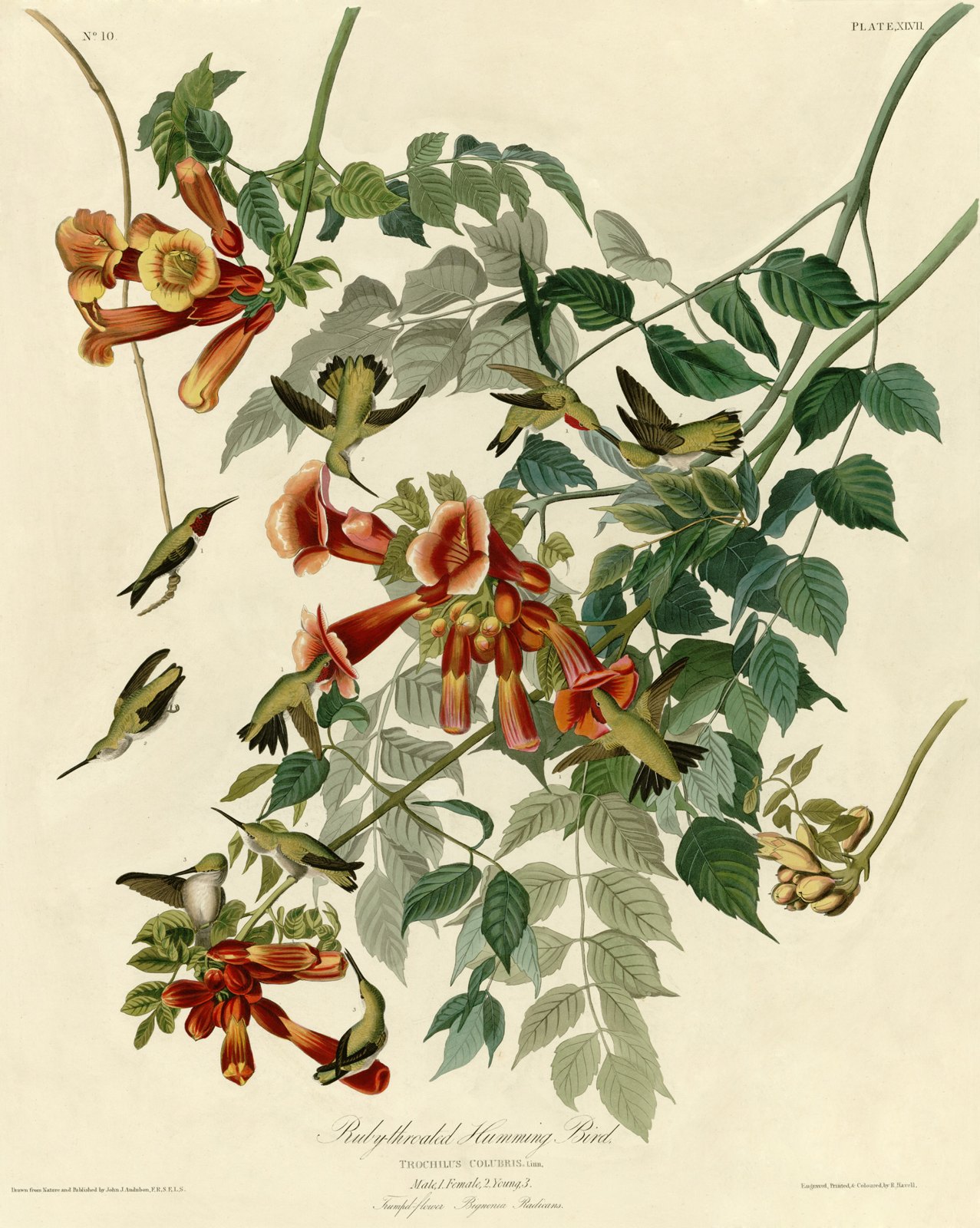
The smallest bird in the world, the bee hummingbird of Cuba, weighs less than two grams. The ruby-throated hummingbird of North America weighs about three grams, roughly the weight of a penny. Packed into that tiny body:
- A helicopter’s abilities. Its wings beat about fifty times a second in a sideways figure-eight, and the shoulder joint lets the wing turn over so it gives lift on the backstroke as well as the forward stroke. It can hover perfectly still, fly sideways, and even fly backward.
- A racing engine. In flight its heart can beat more than a thousand times a minute. It must refuel all day long, visiting hundreds of flowers.
- A night-time power-saving mode. A hummingbird cannot eat in the dark, and without a way to cut its energy use it could starve overnight. So on cold nights it drops into torpor: its body temperature falls and its heart and breathing slow way down, a kind of overnight hibernation. At dawn it warms itself back up and goes to work.
- A pump for a tongue. High-speed cameras have shown that the tip of its forked tongue unrolls fringes that trap nectar, and that the tongue springs open like an elastic pump to draw the nectar in, many times a second.
- A navigator and long-distance flyer. Every autumn many ruby-throats nearly double their weight in fat, then fly nonstop across the Gulf of Mexico, some five hundred miles, with no place to land.
Now ask the engineer’s question. What good is hovering flight without the metabolism to power it? What good is that metabolism without a nectar pump to fuel it, or without torpor to survive the night? A half-built hummingbird is not a slower hummingbird. It is a dead one.
The Bumblebee
There is an old story that “science proved the bumblebee cannot fly.” It came from a calculation that treated the bee’s wing like a stiff airplane wing. The bee, of course, kept flying. Its wings do not glide; they sweep and twist roughly two hundred times a second, and each stroke spins up a little whirlwind of air along the wing’s front edge that gives far more lift than a fixed wing could. Engineers needed high-speed cameras and robotic wings to understand what the bee has always known how to do.
- Its own heater. On a cold morning a bumblebee disconnects its wings and shivers its flight muscles until its chest reaches about 86°F (30°C). That is why bumblebees are out working in weather that keeps other insects grounded.
- Buzz pollination. Some flowers, such as tomatoes and blueberries, lock their pollen inside tiny capsules. A bumblebee grabs the flower and vibrates its flight muscles at just the right frequency, and the pollen shakes out. Honeybees do not do this, which is why greenhouse tomato growers buy boxes of bumblebees.
- An electric sense. Flowers carry a faint electric charge, and a bee carries the opposite charge. In 2013 researchers showed that bumblebees can sense a flower’s electric field, and that the field changes after a bee visits, so the next bee can tell the flower has just been emptied.
The Butterfly
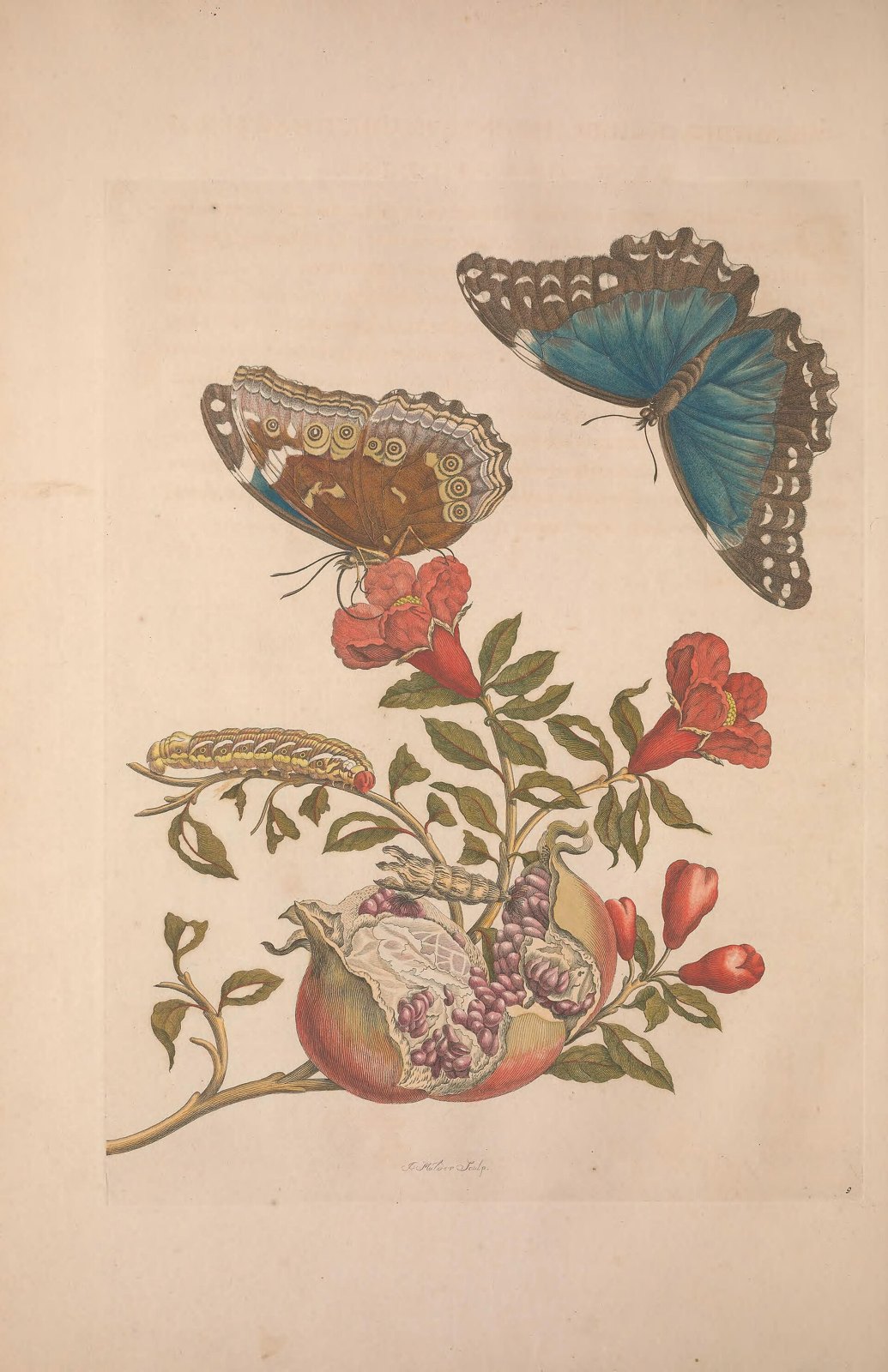
In 1699 the artist and naturalist Maria Sibylla Merian sailed to South America to raise caterpillars and paint every stage of their change. What she recorded is one of the most astonishing processes in nature.
- Metamorphosis. Inside the chrysalis most of the caterpillar’s body breaks down. Small clusters of cells that were set aside inside it from the beginning then build an entirely new body: wings, long legs, compound eyes, a coiled drinking tube. As the His Fingerprint page points out, the DNA never changes; the instructions for both creatures were there all along, switched on and off in the right order. The plan for the butterfly was written before the caterpillar hatched.
- The monarch’s migration. Every autumn, monarchs from the eastern United States and Canada fly as far as three thousand miles to a few mountain fir forests in central Mexico. None of them has ever been there. The migrating generation lives for months instead of weeks, and steers by the sun, correcting for the time of day with a clock in its antennae.
- Blue without blue. The blazing blue of the morpho in Merian’s plate is not a pigment. The scales on its wings are covered with microscopic ridges shaped to reflect blue light and cancel the other colors. Engineers study those scales for new kinds of displays, sensors and anti-counterfeiting marks.
A caterpillar that is half-way to being a butterfly is neither. The whole program has to be present before the first stage begins. (See also the monarch in Evolution And Common Sense.)
And Many More
The list never ends. A woodpecker’s long tongue slides back into a sheath that wraps around the back of its skull. A gecko walks up glass on millions of microscopic hairs, each split into hundreds of tips so fine that they cling by the faint attraction between molecules. The Arctic tern flies from the Arctic to the Antarctic and back every year, some forty-four thousand miles. The prophet Jeremiah had already noticed the birds’ built-in calendars:
“Yea, the stork in the heaven knoweth her appointed times; and the turtle and the crane and the swallow observe the time of their coming; but my people know not the judgment of the LORD.”
Jeremiah 8:7
“For the invisible things of him from the creation of the world are clearly seen, being understood by the things that are made, even his eternal power and Godhead; so that they are without excuse:”
Romans 1:20
Evolution Or Adaptation?
Here is the His Skill page’s central claim: “Much of what is referred to as evidence of Evolution is an adaptation, the result of God’s excellent engineering ability to make His creatures ‘able to adapt’ to different environments.”
Look at the textbook examples. On the Galapagos Islands, a severe drought in 1977 left only large, hard seeds, and the average beak size of a finch population grew. When the rains returned, the average shifted back. In England, the proportion of dark peppered moths rose when soot darkened the trees, and fell again when the air was cleaned up; both forms had been there all along. Dog breeders have produced everything from Chihuahuas to Great Danes, and every one of them is still a dog.
Real, observable change? Yes. A new kind of creature? No. Every one of these is a range of variation built into the kind, exactly what Genesis describes:
“And God said, Let the earth bring forth the living creature after his kind, cattle, and creeping thing, and beast of the earth after his kind: and it was so. And God made the beast of the earth after his kind, and cattle after their kind, and every thing that creepeth upon the earth after his kind: and God saw that it was good.”
Genesis 1:24-25
Engineers have a name for a design that keeps working when conditions change: robust. A robust design is not less designed. It is more designed. The designer had to foresee the changes and build in the capacity to meet them. After the Flood, animals had to spread into deserts, forests and frozen north, and God had equipped them to do it. Ellen White uses the same word:
“Even in their blighted state all things reveal the handiwork of the great Master Artist. Though sin has marred the form and beauty of the things of nature, though on them may be seen traces of the work of the prince of the power of the air, yet they still speak of God. In the briers, the thistles, the thorns, the tares, we may read the law of condemnation; but from the beauty of natural things, and from their wonderful adaptation to our needs and our happiness, we may learn that God still loves us, that His mercy is yet manifested to the world.”
Ellen G. White · Testimonies for the Church, vol. 8, p. 256
Adaptation is not evidence against the Designer. It is one of His finest features.
“There is no ground for the supposition that man was evolved by slow degrees of development from the lower forms of animal or vegetable life. Such teaching lowers the great work of the Creator to the level of man’s narrow, earthly conceptions.”
Ellen G. White · Patriarchs and Prophets, p. 44
(For the full scientific case, see The Evidence For Creation, An Engineer Speaks On Evolution and Evolution Is Finished!.)
Machines That Repair Themselves
The His Skill page ends with an honest comparison: “mankind’s products require appropriate use, excellent care, and maintenance, without which they become trash! We have a bit of catching up to do!”
Your car cannot fix its own dented fender. Your laptop cannot replace its own worn-out battery. But cut your finger and, within days, the skin has closed over. Break a bone and it knits back together, often stronger at the break. Your skeleton is quietly rebuilding itself all the time. Every cell carries teams of enzymes that proofread and repair damaged DNA; the scientists who mapped how that repair works received the Nobel Prize in Chemistry in 2015. Your immune system learns each new invader and remembers it for years.
“Nature’s process of healing and upbuilding is gradual, and to the impatient it seems slow. The surrender of hurtful indulgences requires sacrifice. But in the end it will be found that nature, untrammeled, does her work wisely and well.”
Ellen G. White · The Ministry of Healing, p. 127
(That is why the practical side of this subject is The Health Message: cooperating with the repair systems God built in.)
But none of it runs on its own, like a clock wound up once and left to tick. The Engineer never left the building:
“It is not because the mechanism that has once been set in motion continues to act by its own inherent energy that the pulse beats and breath follows breath; but every breath, every pulsation of the heart, is an evidence of the all-pervading care of Him in whom ‘we live, and move, and have our being.’”
Ellen G. White · Patriarchs and Prophets, p. 115
“The mechanism of the human body cannot be fully understood; it presents mysteries that baffle the most intelligent.”
Ellen G. White · The Ministry of Healing, p. 417
Why, then, does anything wear out? Because sin entered, and the whole creation now groans under it:
“For the creature was made subject to vanity, not willingly, but by reason of him who hath subjected the same in hope, Because the creature itself also shall be delivered from the bondage of corruption into the glorious liberty of the children of God. For we know that the whole creation groaneth and travaileth in pain together until now.”
Romans 8:20-22
Decay was not in the original design. And the Designer has promised to remove it:
“And he that sat upon the throne said, Behold, I make all things new. And he said unto me, Write: for these words are true and faithful.”
Revelation 21:5
Made In The Image Of A Maker
Why do human beings build things at all? Because we were made in the image of One who does:
“And God said, Let us make man in our image, after our likeness: and let them have dominion over the fish of the sea, and over the fowl of the air, and over the cattle, and over all the earth, and over every creeping thing that creepeth upon the earth.”
Genesis 1:26
“Every human being, created in the image of God, is endowed with a power akin to that of the Creator—individuality, power to think and to do.”
Ellen G. White · Education, p. 17
The first person in the Bible said to be filled with the Spirit of God was not a prophet or a priest. He was a craftsman:
“And the LORD spake unto Moses, saying, See, I have called by name Bezaleel the son of Uri, the son of Hur, of the tribe of Judah: And I have filled him with the spirit of God, in wisdom, and in understanding, and in knowledge, and in all manner of workmanship, To devise cunning works, to work in gold, and in silver, and in brass, And in cutting of stones, to set them, and in carving of timber, to work in all manner of workmanship.”
Exodus 31:1-5
“A structure of surpassing splendor, demanding for its construction the most costly material and the highest artistic skill, was to be erected in the wilderness, by a people just escaped from slavery. It seemed a stupendous task. But He who had given the plan of the building stood pledged to co-operate with the builders.”
Ellen G. White · Education, p. 36
So every talent for design, invention and workmanship is a gift of the same Spirit who moved on the waters at creation. (See Written With The Finger Of God on Exodus 31.) Some of our best inventions are simply copies of His. Velcro was modeled on the hooks of burdock burrs. The nose of Japan’s bullet train was reshaped after the kingfisher’s beak, to make it quieter and more efficient. Engineers call it biomimicry. It is really taking notes from the Master.
The Engineer Who Became A Carpenter
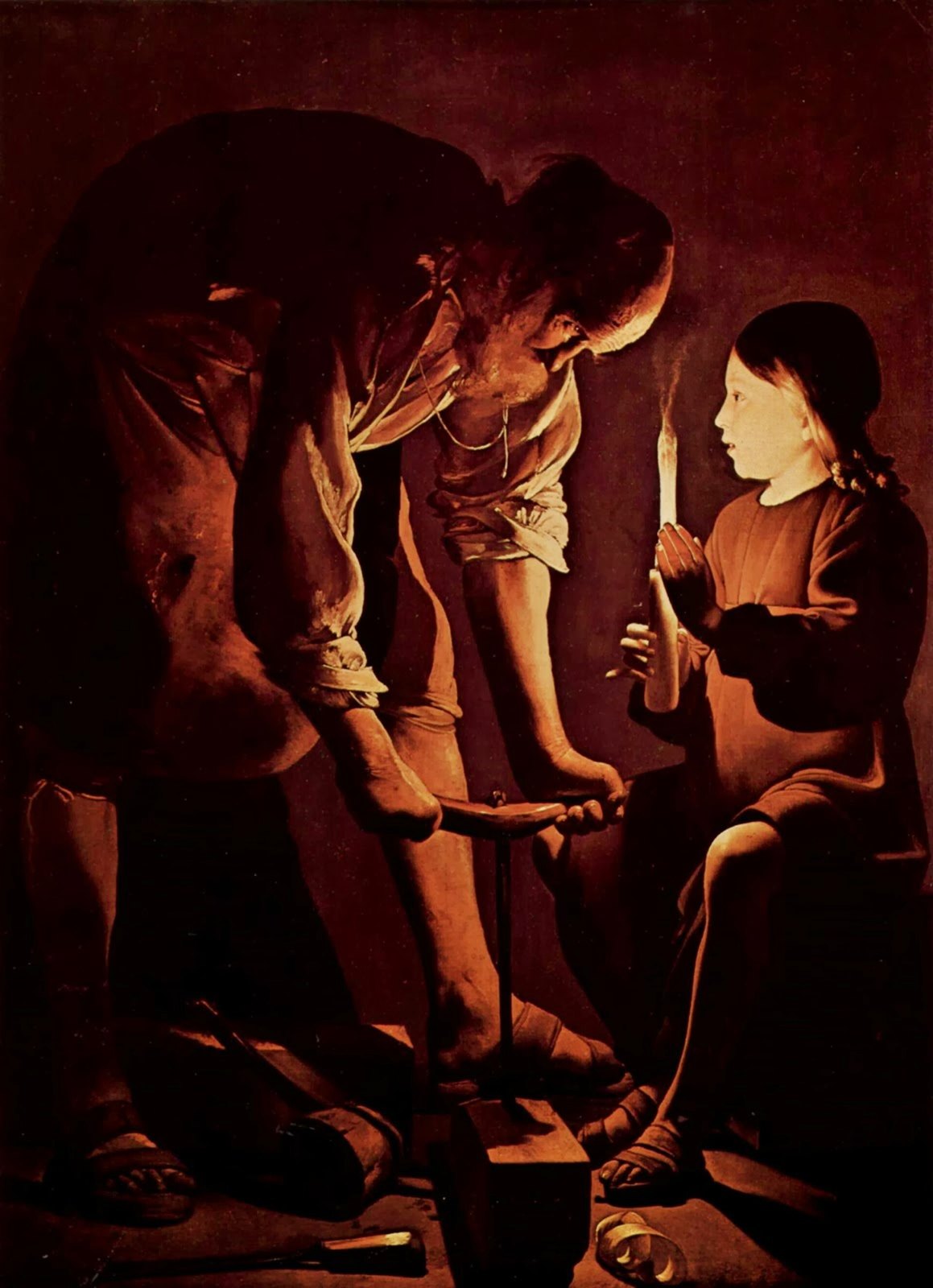
Here is the most amazing fact of all. The One who designed the hummingbird came to this world and worked with His hands in a small-town workshop:
“Is not this the carpenter, the son of Mary, the brother of James, and Joses, and of Juda, and Simon? and are not his sisters here with us? And they were offended at him.”
Mark 6:3
“He was the Son of the infinite God, yet He worked at the carpenter’s trade with His father Joseph. His trade was significant. He had come into the world as the character builder, and as such all His work was perfect. Into all His secular labor He brought the same perfection as into the characters He was transforming by His divine power.”
Ellen G. White · Christ’s Object Lessons, p. 345
His greatest engineering project is not the universe. It is you: taking a life that sin has broken and rebuilding it in His own image. “If any man be in Christ, he is a new creature” (2 Corinthians 5:17). (See Is Not This The Carpenter on Mark 6.)
Catching Up In Eternity
“We have a bit of catching up to do!” We certainly do, and God has given us forever to do it:
“There, immortal minds will contemplate with never-failing delight the wonders of creative power, the mysteries of redeeming love.”
Ellen G. White · The Great Controversy, p. 677
“Every faculty will be developed, every capacity increased. The acquirement of knowledge will not weary the mind or exhaust the energies. There the grandest enterprises may be carried forward, the loftiest aspirations reached, the highest ambitions realized; and still there will arise new heights to surmount, new wonders to admire, new truths to comprehend, fresh objects to call forth the powers of mind and soul and body.”
Ellen G. White · The Great Controversy, p. 677
Every engineer, scientist, builder and curious child will finally get to study under the Master Himself, with no deadline, no decay, and no end to the questions. And the more we learn about His skill, the more we will love the One who used it for us:
“Thou art worthy, O Lord, to receive glory and honour and power: for thou hast created all things, and for thy pleasure they are and were created.”
Revelation 4:11
Keep Studying
- His Skill: where these ideas began
- His Fingerprint!: Fibonacci, DNA and the Mandelbrot set
- Genesis 1-3: Where Everything Begins
- Where Wast Thou When I Laid The Foundations Of The Earth?: God’s own tour of creation in Job 38-39
- Thou Sendest Forth Thy Spirit: Psalm 104
- In The Beginning Was The Word: John 1
- The Image Of The Invisible God: Colossians 1
- Evolution And Common Sense
- The Two Laws Of Intelligence
