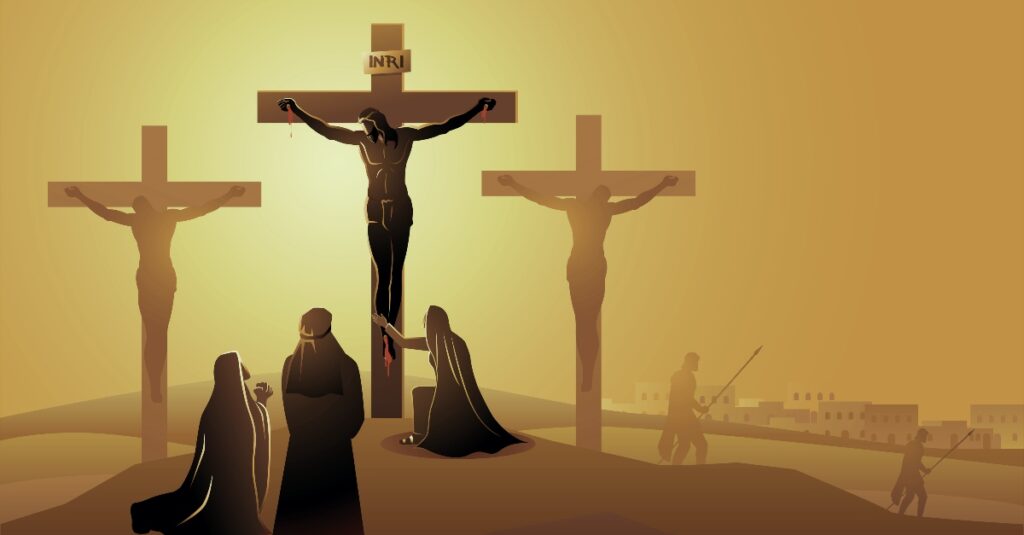
We are used to reading the crucifixion as something that was done to Jesus. Scripture reads it the other way round: He is the One who planned it, announced it centuries in advance, and then kept every appointment He had made with Himself.
A study on the cross of Jesus Christ · Arthur Baldwin · StandUp4Jesus.Org · 14 min read
Table of Contents
The Cross
Another Resource: The Old Rugged Cross
The Cross is God’s Love On Full Display! For more than 4,000 years, the entire Godhead and the angels worked together to ensure that the prophecies concerning the Messiah would come to pass! Then, Jesus was born of Mary by the Holy Spirit.
He was the son of a carpenter, one of the lowest trades, and spent 30 years in that trade before beginning His ministry! Many towns were “disease-free” after He passed through them! He spent most of His time healing people! And He taught them about God as time and opportunity permitted.
Then He allowed Himself to be arrested at just the right time! He submitted Himself to the worst “mockery” of justice ever witnessed in the history of the world! He willingly “became sin for us,” “Who knew no sin”! He accepted our punishment for sin! His love for us held Him to that Cross, not the nails!
That paragraph above holds the whole thing, and there is one word in it worth stopping on: worked. Four thousand years of work. Not four thousand years of waiting for a bad situation to reach its crisis — work, deliberate and sustained, to bring about a set of prophecies. Which raises a question most of us have never thought to ask.
Who was doing the work?
Because the answer Scripture gives is not heaven in general. It is a Person with a name and a rank, and the astonishing thing about Him is that the outcome He laboured for was His own execution.
The Name He Answered To Before Bethlehem
There is a figure in the Old Testament called Michael — the name is a question, Who is like God? — and He turns up at exactly the points where the whole plan is at risk.
“And at that time shall Michael stand up, the great prince which standeth for the children of thy people: and there shall be a time of trouble, such as never was since there was a nation even to that same time: and at that time thy people shall be delivered, every one that shall be found written in the book.”
Daniel 12:1
Jude calls Him “Michael the archangel” and shows Him in single combat with Satan over the body of Moses (Jude 9). John shows Him leading the armies of heaven: “Michael and his angels fought against the dragon” (Revelation 12:7). Paul says the Lord Himself will descend “with the voice of the archangel” (1 Thessalonians 4:16) — and Jesus said plainly that the dead will hear His voice and come out of their graves. One voice raises the dead, and Scripture assigns it to both.
A necessary guard here, because this is where people get lost. Archangel does not mean a very senior created angel. Angel is a job — messenger — and arch means chief. Michael is the Commander of the messengers, not the finest specimen of them, and Hebrews spends its entire first chapter insisting the Son is in a different category altogether: “unto which of the angels said he at any time, Thou art my Son?” (Hebrews 1:5), and of the Son He says, “Thy throne, O God, is for ever and ever” (Hebrews 1:8). Notice, too, how Michael speaks in Jude 9 — “The Lord rebuke thee” — which is word for word what the LORD Himself says to Satan in Zechariah 3:2.
Michael is not a created being. Michael is the pre-incarnate Christ, the Prince and Commander of heaven — and the full case, verse by verse, is laid out in World History Explained, Part 4. Ellen White states the identification in one line while describing the resurrection of Moses:
“Michael, or Christ, with the angels that buried Moses, came down from heaven, after he had remained in the grave a short time, and resurrected him and took him to heaven.”
Ellen G. White · The Story of Redemption, p. 173
Hold that name in mind for the rest of this study, because it changes the grammar of the whole story. The One on the cross was not a bystander who got caught in history. He had been running it.
Three Weeks In A Persian Palace
Here is the clearest recorded instance of that work, and it is in a chapter most readers skip on their way to somewhere else.
Daniel has been fasting for three weeks. A messenger finally arrives and explains the delay. The one speaking is Gabriel — this is his account, in the first person, and it matters that we get the speaker right:
“But the prince of the kingdom of Persia withstood me one and twenty days: but, lo, Michael, one of the chief princes, came to help me; and I remained there with the kings of Persia.”
Daniel 10:13
Gabriel is the one withstood. Michael is the one who arrives. And at the end of the chapter Gabriel adds that in this business he has exactly one ally: “there is none that holdeth with me in these things, but Michael your prince” (Daniel 10:21).
Now, what was the fight actually about? Not a Persian king’s temper. Something was working on the mind of the king, and something else was working against it:
“For three weeks Gabriel wrestled with the powers of darkness, seeking to counteract the influences at work on the mind of Cyrus; and before the contest closed, Christ Himself came to Gabriel’s aid.”
Ellen G. White · Prophets and Kings, p. 571
Read what is at stake in that sentence. A Persian throne is deciding whether the Jews may go home and rebuild Jerusalem. Isaiah had named Cyrus by name more than a century before he was born and said he would give the order (Isaiah 44:28); Ezra records that “the LORD stirred up the spirit of Cyrus king of Persia” and the decree went out (Ezra 1:1). The rebuilding was finally accomplished under a succession of those decrees — “the commandment of Cyrus, and Darius, and Artaxerxes king of Persia” (Ezra 6:14).
And that commandment is the starting gun of the most precise time prophecy in Scripture:
“Know therefore and understand, that from the going forth of the commandment to restore and to build Jerusalem unto the Messiah the Prince shall be seven weeks, and threescore and two weeks… And after threescore and two weeks shall Messiah be cut off, but not for himself.”
Daniel 9:25, 26
Put the two chapters side by side and look at what you are actually being shown. Christ came in person into a fight over a Persian king’s decree — and that decree is what starts the countdown to the day Messiah would be cut off. He was not merely permitting the machinery of His own death to assemble itself. He crossed the room to make sure it did.
There is nothing else like it. Every man who has ever known his death was coming has spent his strength trying to postpone it. This One spent three weeks in a Persian palace making certain the clock started on time.
He Wrote The Prophecies That Convicted Him
We are used to saying that Jesus fulfilled prophecy, as though the prophecies were sitting there like an exam paper set by somebody else. Peter says something far stranger about where they came from:
“Of which salvation the prophets have enquired and searched diligently, who prophesied of the grace that should come unto you: Searching what, or what manner of time the Spirit of Christ which was in them did signify, when it testified beforehand the sufferings of Christ, and the glory that should follow.”
1 Peter 1:10, 11
The Spirit of Christ which was in them… testified beforehand the sufferings of Christ. The prophets did not merely predict Him. He spoke through them, about Himself, in advance — and the prophets themselves went back over their own writing trying to work out what it meant and when it would happen. He was the author of the description that would one day be used to identify Him on a Roman cross.
Consider the details He chose to release, each of them a hostage to fortune:
- The very first promise given to the human race is a promise of His own wounding — the seed of the woman would bruise the serpent’s head, “and thou shalt bruise his heel” (Genesis 3:15). Spoken in Eden, in the hearing of Adam and Eve and of the serpent, before there was a single line of Scripture in existence.
- The manner of His silence. “He was oppressed, and he was afflicted, yet he opened not his mouth: he is brought as a lamb to the slaughter” (Isaiah 53:7) — written seven centuries before a governor marvelled that the prisoner would not answer him.
- The wounds themselves: “they pierced my hands and my feet” (Psalm 22:16), written by a man describing a form of execution the Romans had not invented yet.
- Even the price. “So they weighed for my price thirty pieces of silver” (Zechariah 11:12). He named His own market value, and the men who paid it thought they were setting it.
Every one of those is a chain He forged and then walked into. A man who wants to escape does not publish the map.
Four Thousand Years Of Rehearsal
Then there is the part of the plan that was not written down at all, but acted out — every day, in public, for fifteen centuries.
The sanctuary service was not a piece of ancient Near Eastern religion that God tolerated and later repurposed. It was designed, in detail, by the One it was about. “It was Christ who directed the education of Israel,” Ellen White writes (Christ’s Object Lessons, p. 23) — and the central lesson in that education was a lamb, a knife, and blood, morning and evening, without a day off, until the sight of it was in the bones of a nation.
He wrote the liturgy of His own death and then had His people rehearse it twice a day until the Passover when the real Lamb kept the appointment. Paul says it in five words: “For even Christ our passover is sacrificed for us” (1 Corinthians 5:7).
“With the great sacrifice offered upon Calvary, ended that system of offerings which for four thousand years had pointed forward to the Lamb of God.”
Ellen G. White · The Great Controversy, p. 327
Four thousand years — the same figure as the paragraph at the top of this page, arrived at independently. Every lamb that ever died in Israel was a sentence in a message He was sending forward through time to the generation that would have to recognize Him. And when John the Baptist finally saw Him coming, the only thing he could think to say was the caption to fifteen hundred years of visual aids: Behold the Lamb of God.
The Man He Raised Came Back To Talk About It
Two of these threads tie together in a way that is easy to read past, and it is one of the most moving details in the Gospels.
Jude tells us that Michael contended with the devil over the body of Moses (Jude 9). That contention was a resurrection, and it was won — which is why, on a mountain in Galilee fifteen centuries later, Moses is standing there alive:
“And, behold, there talked with him two men, which were Moses and Elias: who appeared in glory, and spake of his decease which he should accomplish at Jerusalem.”
Luke 9:30, 31
The man Michael raised from the dead came back to talk with Him about His dying — and look at the word Luke chooses. Not suffer. Not undergo. Accomplish. It is the language of a work to be finished, a commission to be discharged. The two visitors from the other side did not come to talk Him out of it. They came, as far as the record shows, to strengthen Him for it.
That is what the cross looked like from heaven’s side while the disciples on the same mountain were still trying to work out how to build shelters.
The Descent Was Something He Did, Not Something Done To Him
Paul’s account of the incarnation is a staircase, and every step is in the active voice:
“Who, being in the form of God, thought it not robbery to be equal with God: but made himself of no reputation, and took upon him the form of a servant, and was made in the likeness of men: and being found in fashion as a man, he humbled himself, and became obedient unto death, even the death of the cross.”
Philippians 2:6, 7, 8
Made himself. Took upon him. Humbled himself. Nobody demoted Him. There is no point in the sentence where something happens to Him that He did not choose, and the staircase does not stop at the manger or at the workshop — it goes all the way down to a particular kind of death, the one reserved for slaves and rebels, and Paul names it separately as though it were a further step down from dying: even the death of the cross.
The paragraph at the top of this page puts the middle of that descent exactly right — the son of a carpenter, one of the lowest trades, thirty years at a bench. Thirty years is not a delay. It is part of the humbling: the Commander of the armies of heaven spending three decades making door frames for people who would one day shout for His execution, and doing it well, because He was not pretending.
Nobody Took It From Him
If the cross was something inflicted on Jesus, then the Roman soldiers and the Sanhedrin are the actors and He is the object of the sentence. He would not allow that reading even while it was still in the future:
“Therefore doth my Father love me, because I lay down my life, that I might take it again. No man taketh it from me, but I lay it down of myself. I have power to lay it down, and I have power to take it again.”
John 10:17, 18
“He could have withstood the advances of death, and refused to come under its dominion; but voluntarily He laid down His life, that He might bring life and immortality to light.”
Ellen G. White · The Desire of Ages, p. 484
Luke gives us the moment the decision became a direction of travel: “when the time was come that he should be received up, he stedfastly set his face to go to Jerusalem” (Luke 9:51). Everything after that is a man walking toward something, not fleeing it. And in the garden, with the arrest already under way, He tells Peter exactly how available the exit still was — twelve legions of angels, for the asking (Matthew 26:53). A Roman legion was six thousand men, so He is naming better than seventy thousand of the beings He commanded — one prayer away, and He did not pray it.
That is the sense in which the sentence at the top of this page is precisely true: His love for us held Him to that Cross, not the nails. The nails were never structurally necessary. The One who came to Gabriel’s aid in Persia could have come to His own.
And let us be honest about the comparison, because it is the point of the whole study. If it had been one of us, we would have shirked it. Not at the last minute either — we would have found the exit somewhere back in the four thousand years, in the long stretch where nobody was watching and the prophecy could quietly have been left a little vague. Any of us given advance notice of a death like that, plus the power to arrange the circumstances, would have arranged them differently. That is not cynicism about ourselves; it is the plain evidence of every ordinary day, in which we duck far smaller duties for far smaller reasons.
He had every power we lack and every reason we would have used, and He used none of them. He kept an appointment He had made with Himself before Adam was created, and He kept it on the day and to the hour.
Delivered From The Power Of Sin
Now the purpose of all that work — because a plan this long was not laid merely to get us pardoned. Pardon is the first half. Deliverance is the rest, and the New Testament keeps the two together:
“Forasmuch then as the children are partakers of flesh and blood, he also himself likewise took part of the same; that through death he might destroy him that had the power of death, that is, the devil; and deliver them who through fear of death were all their lifetime subject to bondage.”
Hebrews 2:14, 15
Two things are named there and they are not the same thing. There is the penalty of sin, which is death, and He took that. And there is the bondage — a whole lifetime of it — which He came to break. Paul states the second half as a flat promise: “sin shall not have dominion over you” (Romans 6:14). Not sin will be overlooked. Sin shall not rule you.
And the transfer is described as a change of kingdom, not a change of paperwork: “Who hath delivered us from the power of darkness, and hath translated us into the kingdom of his dear Son” (Colossians 1:13). You were under one government. He came, at the cost of His life, to move you to another — which is exactly what a Commander does for prisoners of war, and it is why the name Michael belongs in a study about the cross at all.
How that deliverance is actually received — by faith, and never by our own effort at reform — is the subject of Righteousness By Faith, and it is the message this church very nearly lost in 1888.
What This Changes
Read the crucifixion as a tragedy that befell a good man and you will feel sorry for Him, which is the one response He never asked for. Read it the way Scripture writes it — as a work He planned, announced, rehearsed, defended in a Persian palace, walked toward with His face set, and finished — and three things follow.
He was never in danger of losing. The plan was not improvised in a crisis. From the promise in Eden to the last rehearsal in the temple courts, every piece was placed by the One it would cost.
He knew exactly what He was buying. This was not generosity at a distance from the invoice. He priced it, in detail, four thousand years in advance, and paid it without renegotiating.
And He wanted you. That is the only sane explanation for any of it. A Commander who could have stayed where He was set His face toward a Roman scaffold and worked for forty centuries to be sure He arrived on time.
The cross is God’s love on full display, as the paragraph at the top of this page says. It is also the longest, most deliberate piece of work in the history of the universe — and it was carried out by the Person it killed.
List Of Articles
His Sacrifice
What the cross cost the Father — who could have stopped it at any second, and did not.
The Ultimate Human Sacrifice!
It isn’t death. It is something harder.
