A sealed book lies in the right hand of God, an angel asks who is worthy to open it, and the search comes back empty. The only man in the room who understands what that means bursts into tears.
A Bible study on Revelation 5 · Arthur Baldwin · StandUp4Jesus.Org · 13 min read
Table of Contents
Revelation 4 and 5 are one scene. Nobody leaves the room between them, the singing does not stop, and the throne is where it was. What changes is that something is now in the hand of the One sitting on it, and the whole chapter turns on whether anybody can take it.
A Book Nobody Could Open
“And I saw in the right hand of him that sat on the throne a book written within and on the backside, sealed with seven seals.”
Revelation 5:1
Two details are worth slowing down for. The book is written within and on the backside — written on both sides, which in a world of expensive writing material meant a document with nothing left to add. It is finished. And it is sealed with seven seals, so its contents are closed to everyone who has not the right to open it.
It is also in the right hand of God — held out, not locked away. This is not a book being hidden. It is a book being offered, and the search that follows is for someone qualified to receive it.
“And I saw a strong angel proclaiming with a loud voice, Who is worthy to open the book, and to loose the seals thereof?”
Revelation 5:2
Notice the question. Not who is strong enough, or who is clever enough, or who has the rank. Who is worthy. In a room that has just finished singing “Thou art worthy” to the One on the throne, the word has already been defined by the company it keeps.
“And no man in heaven, nor in earth, neither under the earth, was able to open the book, neither to look thereon.”
Revelation 5:3
Three regions, and the search is thorough in all of them. Not in heaven — not among the elders with their crowns, not among the creatures full of eyes, not among ten thousand times ten thousand angels. Not on earth. Not under it. Nobody could open it, and the verse adds something even smaller and sadder: nobody was able so much as to look thereon.
What Is In The Book?
The chapter never says outright, and any honest study has to admit that first. What it gives instead are three clues: the book is in God’s own hand, opening it requires worthiness rather than strength, and the moment the seals begin to come off in chapter 6, history starts to move. Whatever is written there, it is the future of this world and the people in it.
One further clue comes from the book Revelation keeps leaning on. Daniel was told to shut up his words and seal the book “even to the time of the end” (Daniel 12:4) — and Ellen White drew the two together directly:
“The book that was sealed is not the Revelation, but that portion of the prophecy of Daniel relating to the last days.”
The Acts of the Apostles, p. 585
On the same page she calls Revelation the complement of the book of Daniel — one a prophecy, the other a revelation. A reader who wants the seals of chapter 6 to make sense will get further with Daniel open beside them than with any commentary, which is the reason this site treats the two books as one study.
And I Wept Much
“And I wept much, because no man was found worthy to open and to read the book, neither to look thereon.”
Revelation 5:4
This is the only weeping recorded in the throne room, and it comes from the one human being present. The angels do not weep. The elders do not weep. John does, and he weeps much.
Why does a sealed book make a man cry? Because of what he had just been promised. The voice at the door said, “I will shew thee things which must be hereafter” (Revelation 4:1) — and now the future is in a book that no one can open. An old man on a prison island, whose churches are struggling and whose friends are dead, has been brought within sight of the answer and told that nobody qualifies to give it to him.
His tears are not a failure of faith. They are the honest response of somebody who understands exactly what is at stake, and they are recorded rather than corrected.
The Lion Who Turned Out To Be A Lamb
“And one of the elders saith unto me, Weep not: behold, the Lion of the tribe of Juda, the Root of David, hath prevailed to open the book, and to loose the seven seals thereof.”
Revelation 5:5
An elder — one of the crowned figures from the previous chapter — leaves his seat, in effect, to comfort a crying man. Weep not. And he announces a Lion.
Every expectation in that title is about power. The Lion of the tribe of Judah is the royal animal of the royal tribe. Jacob’s blessing gave Judah the lion; David came from Judah; the Root of David is the promised King. If any title in Scripture prepares a reader to see strength walk into a room, it is this one.
Then John looks.
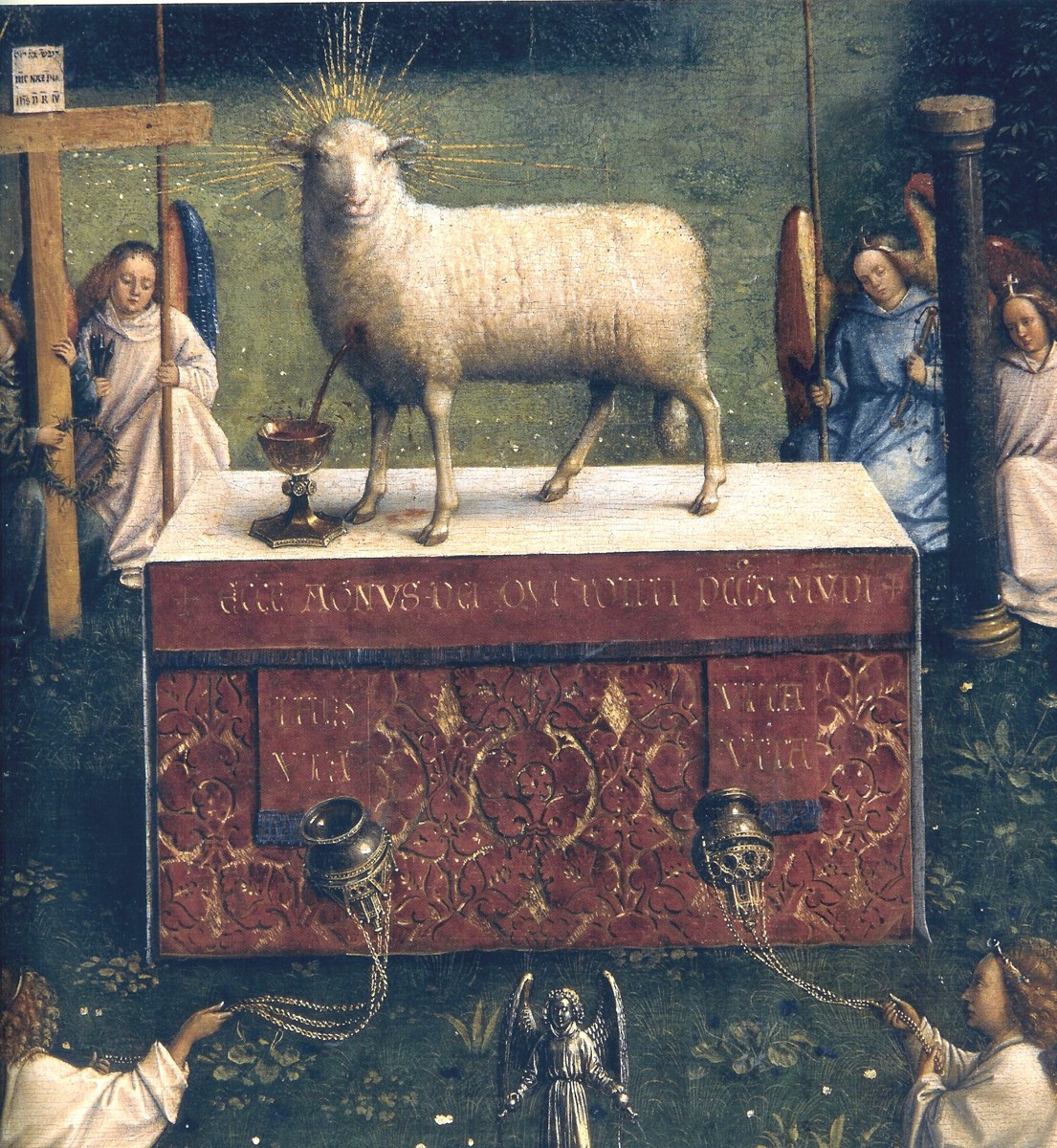
“And I beheld, and, lo, in the midst of the throne and of the four beasts, and in the midst of the elders, stood a Lamb as it had been slain, having seven horns and seven eyes, which are the seven Spirits of God sent forth into all the earth.”
Revelation 5:6
He is told Lion and he sees Lamb. Not a lamb in a field — a Lamb as it had been slain, still carrying the marks of its death, standing up in the middle of the throne. That is the central exchange of the whole Bible, and Revelation puts it in one verse.
“The Saviour is presented before John under the symbols of ‘the Lion of the tribe of Judah’ and of ‘a Lamb as it had been slain.’”
The Acts of the Apostles, p. 589
Both symbols, one Person. The Lion did prevail — the elder’s word was accurate. But the way He prevailed is what John is shown, and it is not the way lions usually win.
And that verb is a thread worth pulling. The elder says the Lion hath prevailed — He overcame. It is the same word that ended all seven letters, where every promise was made to him that overcometh, and it is the word Christ used of Himself in the last of them: “even as I also overcame, and am set down with my Father in his throne” (Revelation 3:21). The overcoming asked of a struggling church in chapter 3 is the overcoming demonstrated at the throne in chapter 5, and it looks like a Lamb that was slain.
The horns and eyes belong to the same picture. A horn in prophecy is power, and there are seven of them: complete power, not partial. Seven eyes are complete sight, and they are identified as the seven Spirits of God sent forth into all the earth — the same sevenfold Spirit that was burning in lamps before the throne in chapter 4, now described as going out. All the power there is, all the sight there is, in something that looks like it lost.
Where He stands is part of the picture too: in the midst of the throne, and in the midst of the creatures, and in the midst of the elders. Not brought in from outside as a candidate, and not standing at a distance as a petitioner. The Lamb was already at the centre of the room John has been describing since chapter 4 — the reader simply had not been shown Him yet.
He Came And Took The Book
“And he came and took the book out of the right hand of him that sat upon the throne.”
Revelation 5:7
Eighteen words, no ceremony, and heaven erupts. There is no vote, no coronation, no argument about whether He qualifies. He walks up and takes it, and the taking settles the question the strong angel asked.
It is worth saying plainly that the plan behind that moment was not improvised when the search failed. Ellen White put its date beyond the world’s beginning:
“The plan of salvation had been laid before the creation of the earth; for Christ is “the Lamb slain from the foundation of the world” (Revelation 13:8); yet it was a struggle, even with the King of the universe, to yield up His Son to die for the guilty race.”
Patriarchs and Prophets, p. 63
Harps, And Golden Vials Full Of Odours
“And when he had taken the book, the four beasts and four and twenty elders fell down before the Lamb, having every one of them harps, and golden vials full of odours, which are the prayers of saints.”
Revelation 5:8
The elders who cast their crowns down in chapter 4 are holding two things now, and one of them is ours. Golden vials full of odours, which are the prayers of saints. The verse takes the trouble to explain the symbol so that nobody can miss it.
Every prayer that was ever prayed in a hospital corridor, in a prison cell, in a kitchen at two in the morning by somebody who did not know whether anyone was listening — collected, kept, and carried in gold vessels in the throne room. Not one of them was lost in transit.
“And as the prayers of the saints in faith came up to Jesus, and he offered them to his Father, a sweet fragrance arose from the incense.”
Spiritual Gifts, vol. 1, p. 158
And notice the timing. The vials come out when the Lamb takes the book. The prayers of ordinary people are part of the ceremony in which the future is handed over.
A New Song
“And they sung a new song, saying, Thou art worthy to take the book, and to open the seals thereof: for thou wast slain, and hast redeemed us to God by thy blood out of every kindred, and tongue, and people, and nation;”
Revelation 5:9
Put this beside the song that closed chapter 4 and the two reasons stand side by side. There: “Thou art worthy … for thou hast created all things.” Here: “Thou art worthy … for thou wast slain.” Creation and redemption, the same word, the same throne, one chapter apart.
The reach of it is spelled out in four terms — kindred, tongue, people, nation — and that phrase will come back later in the book, once in the mouth of the first angel carrying the everlasting gospel to exactly the same four groups. What is bought here is what is preached there.
“And hast made us unto our God kings and priests: and we shall reign on the earth.”
Revelation 5:10
Two offices that almost never belonged to the same person in Israel. Kings came from Judah and priests from Levi, and a king who tried to burn incense was struck with leprosy for it. The one figure in the Old Testament who held both at once was Melchizedek, king of Salem and priest of the most high God — which is the thread followed at length in The Melchizedek Message. Here the redeemed are told they are both, and the tense is worth noticing: hast made, past, already done.
It is called a new song, and the newness is not in the tune. Creation had been sung about since creation; chapter 4 was still singing it. This is the first song in the universe that could only be sung by people who had been bought back — and it is sung in the presence of beings who have never sinned and cannot sing it. There is something in the experience of a forgiven human being that the unfallen universe can listen to and admire but never reproduce.
Ten Thousand Times Ten Thousand
“And I beheld, and I heard the voice of many angels round about the throne and the beasts and the elders: and the number of them was ten thousand times ten thousand, and thousands of thousands;”
Revelation 5:11
The song moves outward in rings. The four creatures and the elders sang first, closest in. Now the angels take it up — a hundred million, and then a number the language gives up on: thousands of thousands.
And what they sing is not the new song. They cannot sing that one; the new song says thou hast redeemed us, and angels were never lost. They sing the sevenfold shout instead: “Worthy is the Lamb that was slain to receive power, and riches, and wisdom, and strength, and honour, and glory, and blessing” (Revelation 5:12). Seven things, which in this book is the number of a complete list.
And Every Creature
“And every creature which is in heaven, and on the earth, and under the earth, and such as are in the sea, and all that are in them, heard I saying, Blessing, and honour, and glory, and power, be unto him that sitteth upon the throne, and unto the Lamb for ever and ever.”
Revelation 5:13
The last ring is the widest, and it is exactly the search area from verse 3. Heaven, earth, under the earth — the three regions where nobody could be found worthy — plus the sea. The places that came up empty are the places now full of singing.
And the praise goes to two: him that sitteth upon the throne, and … the Lamb. One song, one honour, addressed to both, which is a quiet answer to a very large question about who the Lamb is.
What This Asks Of Us
Chapter 5 answers a question most people never think to ask: by what right does anyone run history? The answer is not power, though He has all of it. The answer given in the room, twice, in song, is that He was slain and bought people with His own blood.
That matters for how the rest of this book reads. Seven seals are about to be opened, and some of what comes out of them is hard. Every one of them is opened by the Lamb — by the only Being in the universe who has already paid for the people He is about to lead through it.
It matters, too, that John’s tears were answered rather than rebuked. Nobody in the room told him that a man who trusted God would not cry. An elder came over, said weep not, and gave him a reason — and the reason was a Person, not an explanation. That is generally how this book comforts people.
John wept because the future was sealed. He stopped because of who took it. That is the whole chapter, and it is enough to be going on with.
Next in this series: Who Shall Be Able To Stand? — the seals come off, four riders go out, and the chapter ends on a question.
