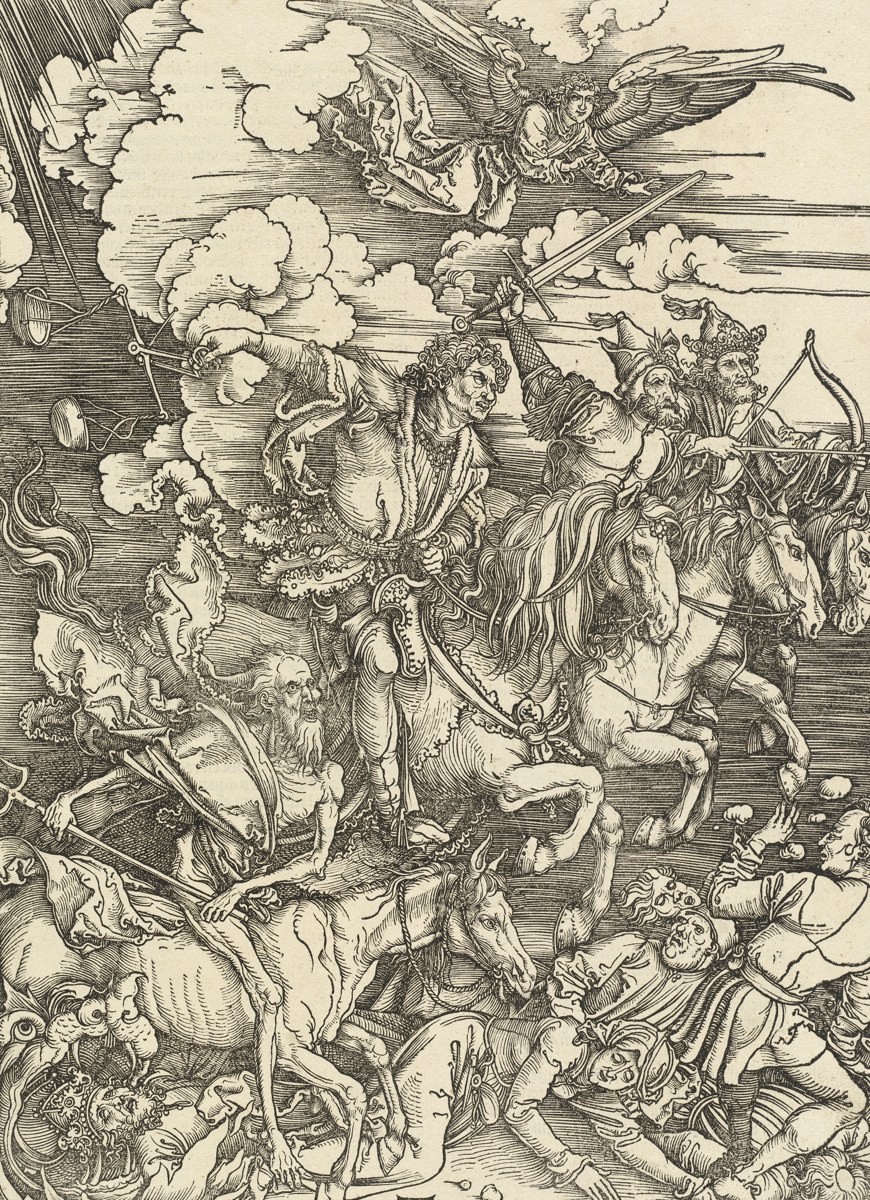
The Lamb starts opening the book, and history rides out of it — four horses, a cry from under an altar, and a sky that rolls up like a scroll. The chapter ends on a question nobody in it can answer.
A Bible study on Revelation 6 · Arthur Baldwin · StandUp4Jesus.Org · 14 min read
Table of Contents
Before a single seal comes off, remember whose hands are on the book. The search in chapter 5 came back empty in heaven, on earth and under it, and the one Person found worthy was a Lamb still carrying the marks of His death. Everything in this chapter is opened by Him.
That is not a decoration on a hard chapter. It is the only thing that makes the hard chapter bearable.
Come And See
“And I saw when the Lamb opened one of the seals, and I heard, as it were the noise of thunder, one of the four beasts saying, Come and see.”
Revelation 6:1
The four creatures full of eyes, who in chapter 4 did nothing but say Holy, holy, holy, now speak to John, one at each of the first four seals. The invitation is the same every time and it is not a warning. Come and see. John is not being shown this against his will.
It is worth holding the seals and the letters together rather than treating them as two unrelated surveys. Chapters 2 and 3 asked how the church was doing, congregation by congregation, and the answers were about love, endurance, compromise and complacency. Chapters 6 and following ask what was happening to the world while all that went on. The letters are the inside of the story and the seals are the outside, and the same Person is speaking in both.
Four seals, four horses, and the pattern is deliberate. Zechariah saw coloured horses going out to walk through the earth; here they go out one at a time, each after a seal, in a sequence. This study reads them as the church’s own story running forward from John’s day — a reading built on what the riders carry, which is where we will keep the weight.
A White Horse, Conquering
“And I saw, and behold a white horse: and he that sat on him had a bow; and a crown was given unto him: and he went forth conquering, and to conquer.”
Revelation 6:2
White is the colour this book reserves for purity — white robes, white raiment, white stones, and at the end a rider on a white horse whose name is Faithful and True. The first seal opens on something clean, and it is winning.
Read as the church’s story, this is the first generation: the gospel going out from an upper room and reaching, within a lifetime, further than the eagles of Rome ever did. The crown is given — nobody in this chapter takes a crown, and the elders in chapter 4 had already thrown theirs on the floor. And the rider goes out conquering, and to conquer: winning, and still going.
Whatever else the seals contain, they do not begin with disaster. They begin with the gospel moving fast.
One reading of the first rider deserves a hearing even though this study does not follow it: that the rider is Christ Himself, since the only other white horse in the book carries One “called Faithful and True” (Revelation 19:11). The objection is the company he keeps. These four ride out together as a set, and the three behind him bring slaughter, scarcity and death. It reads more naturally as the gospel going out in its first purity than as Christ riding at the head of a column that ends with the grave — but the picture is close enough to Revelation 19 that the resemblance is surely meant, and a reader who takes it the other way is not being careless.
A Red Horse, And A Great Sword
“And there went out another horse that was red: and power was given to him that sat thereon to take peace from the earth, and that they should kill one another: and there was given unto him a great sword.”
Revelation 6:4
The second rider does not bring war so much as remove something: power was given to him … to take peace from the earth. What follows is what people do when peace is withdrawn — they should kill one another.
This is the age the letter to Smyrna was written into: the centuries when following Christ was a capital matter and the church grew anyway. Notice again the passive verbs. Power was given. The sword was given. Nothing in this chapter is seizing an authority it was not handed, and the hand it comes from is not in doubt — the seals are being opened one at a time by the Lamb.
A Black Horse, And A Pair Of Balances
“And I beheld, and lo a black horse; and he that sat on him had a pair of balances in his hand.”
Revelation 6:5
Scales in a rider’s hand mean rationing. The voice that follows prices it:
“A measure of wheat for a penny, and three measures of barley for a penny; and see thou hurt not the oil and the wine.”
Revelation 6:6
A penny was a day’s wage. A day’s work for a day’s bread, with nothing left over — hunger with the paperwork in order. And then the odd instruction: the oil and the wine are not to be touched. Whatever the scarcity is, it is selective.
Read as history, this is the church at the point where the light in it begins to be measured out rather than given away — the period we met in the letter to Pergamos, where the danger stopped being the sword outside and became the accommodation inside. Amos names the worst kind of shortage: not a famine of bread, but of hearing the words of the Lord. When Scripture is rationed, most people go hungry and a few keep the oil.
Amos had already named that shortage centuries earlier, and named it as the worst one available:
“Behold, the days come, saith the Lord GOD, that I will send a famine in the land, not a famine of bread, nor a thirst for water, but of hearing the words of the LORD:”
Amos 8:11
A famine of bread empties a stomach. A famine of hearing empties a generation, and the people living through it are usually the last to notice, because nobody misses a book they have never been handed.
A Pale Horse
“And I looked, and behold a pale horse: and his name that sat on him was Death, and Hell followed with him. And power was given unto them over the fourth part of the earth, to kill with sword, and with hunger, and with death, and with the beasts of the earth.”
Revelation 6:8
This is the only rider given a name, and the name is Death. The colour is the grey-green of a corpse. Everything the first three riders carried separately — the sword, the hunger, the removal of peace — now arrives together, with the grave walking behind to collect.
And still there is a limit written into the verse: over the fourth part of the earth. Even here, at the darkest point of the four, the authority is bounded. Somebody set the fraction.
That is worth saying once plainly, because a chapter like this one can leave a reader with the impression of a world running loose. Every rider is summoned. Every authority is granted. Every reach is measured — a fourth part, not the whole. The book is not describing chaos; it is describing something terrible held on a leash.
How Long, O Lord?
The fifth seal has no horse. It has an altar, and something underneath it.
“And when he had opened the fifth seal, I saw under the altar the souls of them that were slain for the word of God, and for the testimony which they held:”
Revelation 6:9
It is worth being careful here, because this verse is often read as a description of where the dead are conscious. The picture itself comes from the sanctuary service, and it is about blood rather than ghosts. When a sacrifice was offered, the priest “shall pour all the blood … at the bottom of the altar” (Leviticus 4:7). The life of the victim ended up under the altar, and Scripture says plainly that the life is in the blood.
“For the life of the flesh is in the blood: and I have given it to you upon the altar to make an atonement for your souls: for it is the blood that maketh an atonement for the soul.”
Leviticus 17:11
There is already a Bible story of blood that speaks. God said to Cain, “the voice of thy brother’s blood crieth unto me from the ground” (Genesis 4:10). Abel was dead and silent; his blood was neither. Nobody imagines Abel was conscious in the soil. The martyrs under the altar cry in exactly that sense — the record of what was done to them is in God’s presence and will not be quiet.
This matters beyond one verse, because a great deal has been built on the idea that the dead are awake somewhere. What Scripture teaches about death is worked through at length in Deceptions & Warnings; here it is enough to say that the fifth seal is sanctuary language, and that reading it as sanctuary language costs nothing and explains everything in the verse.
“And they cried with a loud voice, saying, How long, O Lord, holy and true, dost thou not judge and avenge our blood on them that dwell on the earth?”
Revelation 6:10
How long is the oldest prayer in Scripture that never gets a date for an answer. It is prayed by David, by Habakkuk, by Job in his own words — and here by the whole company of those killed for holding the word of God.
The reply is two gifts and one hard sentence: “And white robes were given unto every one of them; and it was said unto them, that they should rest yet for a little season” (Revelation 6:11). A robe — the verdict already delivered, in advance of the trial they are asking for. And rest — which is the kindest word available for people who cannot be told yet how long. The waiting is not explained. It is furnished.
And there is one more thing in the answer, easily missed: the season is short but it is not empty. They are to rest “until their fellowservants also and their brethren, that should be killed as they were, should be fulfilled” (Revelation 6:11). The delay is not indifference. It is room being held open for people who have not been born yet, and who will need the same robes.
The Sixth Seal
“And I beheld when he had opened the sixth seal, and, lo, there was a great earthquake; and the sun became black as sackcloth of hair, and the moon became as blood;”
Revelation 6:12
Three signs, in order: an earthquake, a darkened sun with a blood-red moon, and stars falling. Adventist readers have long pointed to three events that arrived in that order in the space of seventy-eight years, and it is worth setting down what was actually said about them.
That language is not new with John. Joel had said it first — “The sun shall be turned into darkness, and the moon into blood, before the great and the terrible day of the LORD come” (Joel 2:31) — and John takes the phrase whole. Whatever else the sixth seal is, he is telling his readers it is the day Joel described.
“In fulfillment of this prophecy there occurred, in the year 1755, the most terrible earthquake that has ever been recorded.”
The Great Controversy, p. 304
That is the Lisbon earthquake, and its reach is the reason it is named here rather than any other: “Though commonly known as the earthquake of Lisbon, it extended to the greater part of Europe, Africa, and America” (The Great Controversy, p. 304).
Twenty-five years later came the darkness:
“Since the time of Moses no period of darkness of equal density, extent, and duration, has ever been recorded.”
The Great Controversy, p. 308
And then the stars:
“This prophecy received a striking and impressive fulfillment in the great meteoric shower of November 13, 1833.”
The Great Controversy, p. 333
John’s own comparison for that night is a fig tree in a gale — “even as a fig tree casteth her untimely figs, when she is shaken of a mighty wind” (Revelation 6:13) — and an eyewitness in 1833, with no interest in proving a prophecy, reached for the same picture without being prompted.
Then the seal moves past anything that has happened yet: “the heaven departed as a scroll when it is rolled together; and every mountain and island were moved out of their places” (Revelation 6:14). Whatever a reader makes of the first three signs, that one is still ahead.
Who Shall Be Able To Stand?
“And the kings of the earth, and the great men, and the rich men, and the chief captains, and the mighty men, and every bondman, and every free man, hid themselves in the dens and in the rocks of the mountains;”
Revelation 6:15
Seven categories, and the list is built to leave nobody out — from kings at one end to slaves at the other, from the mighty to the free. Every distinction that organises human society is named and then flattened, because all seven groups are doing the same thing in the same place.
And what they say is the strangest sentence in the chapter:
“And said to the mountains and rocks, Fall on us, and hide us from the face of him that sitteth on the throne, and from the wrath of the Lamb:”
Revelation 6:16
The wrath of the Lamb. Put those three words together and they should not work. A lamb is the least frightening animal in the pastoral world, and this one has been described as slain. Yet the thing these people cannot face is not a lion or an army. It is the face of the One who was killed for them.
They ask to be buried alive rather than seen. That is what the chapter is telling us about the day it describes: the terror is not damage. It is exposure.
And notice who is not in the list of seven. The people hiding are kings, captains, rich men, mighty men, bondmen and free — everybody, on the face of it. But the next chapter will show a company that is not in the rocks, and the difference between them is not rank, wealth or strength. It is a mark on the forehead, put there before the winds were let loose.
“For the great day of his wrath is come; and who shall be able to stand?”
Revelation 6:17
The chapter ends there, on a question, with no answer offered inside it. That is deliberate. The people asking are the ones hiding, and they ask it as a way of saying nobody.
What This Asks Of Us
Revelation 6 is the hardest chapter in the book so far, and two things hold it steady.
The first is who is opening the seals. Not one of the four riders goes anywhere until a hand with a nail-mark in it breaks a seal, and every grant of power in the chapter is described as given rather than taken. History is not loose.
The second is that the question at the end is answered on the next page. Chapter 7 opens with four angels holding back the four winds so that they will not blow — “Hurt not the earth, neither the sea, nor the trees, till we have sealed the servants of our God in their foreheads” (Revelation 7:3) — and then a company nobody can number is shown standing exactly where the kings of the earth could not.
The men in the rocks answered their own question with nobody. Heaven’s answer is a number too large to count.
Next in this series: Sealed Before The Winds Are Loosed — four angels holding the winds, a seal on the forehead, and a multitude no man could number.
