A key is handed to a fallen star, a pit is opened, and what comes out of the smoke is given one instruction: hurt only the people who are not sealed. Two woes, and at the end of them, the sentence the chapter was written for.
A Bible study on Revelation 9 · Arthur Baldwin · StandUp4Jesus.Org · 13 min read
Table of Contents
The first four trumpets struck the world: land, sea, rivers, and the lights in the sky. The last three are aimed at people, and an angel has already flown across heaven to say so. This chapter holds two of them.
It is the strangest chapter in Revelation so far, and it ends with the least strange and most alarming sentence in the book.
A Star Fallen, And A Key
“And the fifth angel sounded, and I saw a star fall from heaven unto the earth: and to him was given the key of the bottomless pit.”
Revelation 9:1
Note the pronoun. The star is a him. Whatever fell, it is somebody rather than something, and the key is given — the same passive that has run through every one of these chapters. Nothing in Revelation takes authority; it is issued.
Who the fallen star is, the chapter does not say. Revelation uses stars for angels in chapter 1 and for a teacher fallen from his place in chapter 8, and Isaiah has a famous passage about a bright one falling from heaven. The text here is content to leave it unnamed and to keep the emphasis on the key, which is the thing that was handed over.
The first thing out of the pit is not an army. It is smoke, “as the smoke of a great furnace”, and it darkens the sun and the air (Revelation 9:2). Before anything can hurt anyone, the light goes. That order is worth keeping: the darkening comes first, and what comes out of the smoke is only visible once you cannot see properly.
It is worth saying that a bottomless pit is not a place on a map. The word describes depth without a floor — somewhere nothing can be built on and nothing settles. What Revelation shows coming out of it is not native to the world it lands in.
Locusts With Orders
“And it was commanded them that they should not hurt the grass of the earth, neither any green thing, neither any tree; but only those men which have not the seal of God in their foreheads.”
Revelation 9:4
A locust plague that is forbidden to touch vegetation is not a locust plague. Everything a real swarm exists to do is on the prohibited list, and the one thing it is permitted to do is not something locusts do at all.
So the picture is a swarm in shape and a campaign in purpose. Read as history, the older commentators saw an invasion out of the desert that spread across the southern and eastern edges of the old Christian world — arriving like a swarm, organised like an army, and leaving the fields alone. Read as a warning, it is the fifth trumpet: another alarm, aimed at a world that has not answered the first four.
And the permission is defined by the seal. Two chapters ago four angels held the winds “till we have sealed the servants of our God in their foreheads” (Revelation 7:3). Here is why the sealing had to finish first. The mark placed in chapter 7 is the boundary these creatures cannot cross in chapter 9 — which means the sealing was not a decoration or a reward. It was protection issued in advance of a danger the recipients could not yet see coming.
And there is a second thing hidden in that command. The creatures are told what they may not touch. Somebody is giving orders to the contents of the pit — which is the quiet claim this whole book keeps making, that even the powers set on ruin are on a leash held from the throne room.
“And to them it was given that they should not kill them, but that they should be tormented five months: and their torment was as the torment of a scorpion, when he striketh a man.”
Revelation 9:5
Two limits in one verse: they may not kill, and they have five months. Even a woe comes with a fence around it.
Then verse 6, which is the bleakest line in the chapter: “And in those days shall men seek death, and shall not find it; and shall desire to die, and death shall flee from them.” Whatever the torment is, it is the kind that makes life unbearable without ending it. A scorpion’s sting is agony and rarely fatal — a precise choice of comparison.
There is a kind of suffering being described here that is not physical damage. People who want to die and cannot are not usually people in pain; they are people who have run out of reasons. Whatever comes up out of that smoke, its work is done in the mind, in a world where the light has already been dimmed.
The Shape Of Them
“And the shapes of the locusts were like unto horses prepared unto battle; and on their heads were as it were crowns like gold, and their faces were as the faces of men.”
Revelation 9:7
John is doing his best with something he has no vocabulary for, and the tell is how often he writes as it were and like unto. Horses ready for war. Crowns that look like gold. Faces of men. Hair like women’s hair, teeth like a lion’s, breastplates that seem to be iron, wings that sound like massed chariots, and tails with stings in them.
It reads like a man describing cavalry he has never seen before, in the only terms available to a first-century islander — and that is exactly how the older commentators took it.
Joel had already described an invading army as a swarm in almost these words — “The appearance of them is as the appearance of horses; and as horsemen, so shall they run” (Joel 2:4), and “Like the noise of chariots on the tops of mountains shall they leap” (Joel 2:5). John is not inventing a new symbol; he is using one the prophets had already established, and using it as they used it: for an army arriving in numbers nobody can stand against.
“And they had a king over them, which is the angel of the bottomless pit, whose name in the Hebrew tongue is Abaddon, but in the Greek tongue hath his name Apollyon.”
Revelation 9:11
Real locusts famously have no king; Proverbs says so outright. These have one, and he is named twice so that no reader in either language can miss the meaning. Abaddon is destruction. Apollyon is the destroyer. Whoever is behind this, his job description is his name, and Revelation does not want it lost in translation.
“The locusts have no king, yet go they forth all of them by bands;”
Proverbs 30:27
Two sentences of Scripture side by side, and the difference between them is the point. Ordinary locusts are a natural disaster — devastating, mindless, leaderless. What comes out of the pit is organised, and somebody is in command of it.
Loose The Four Angels
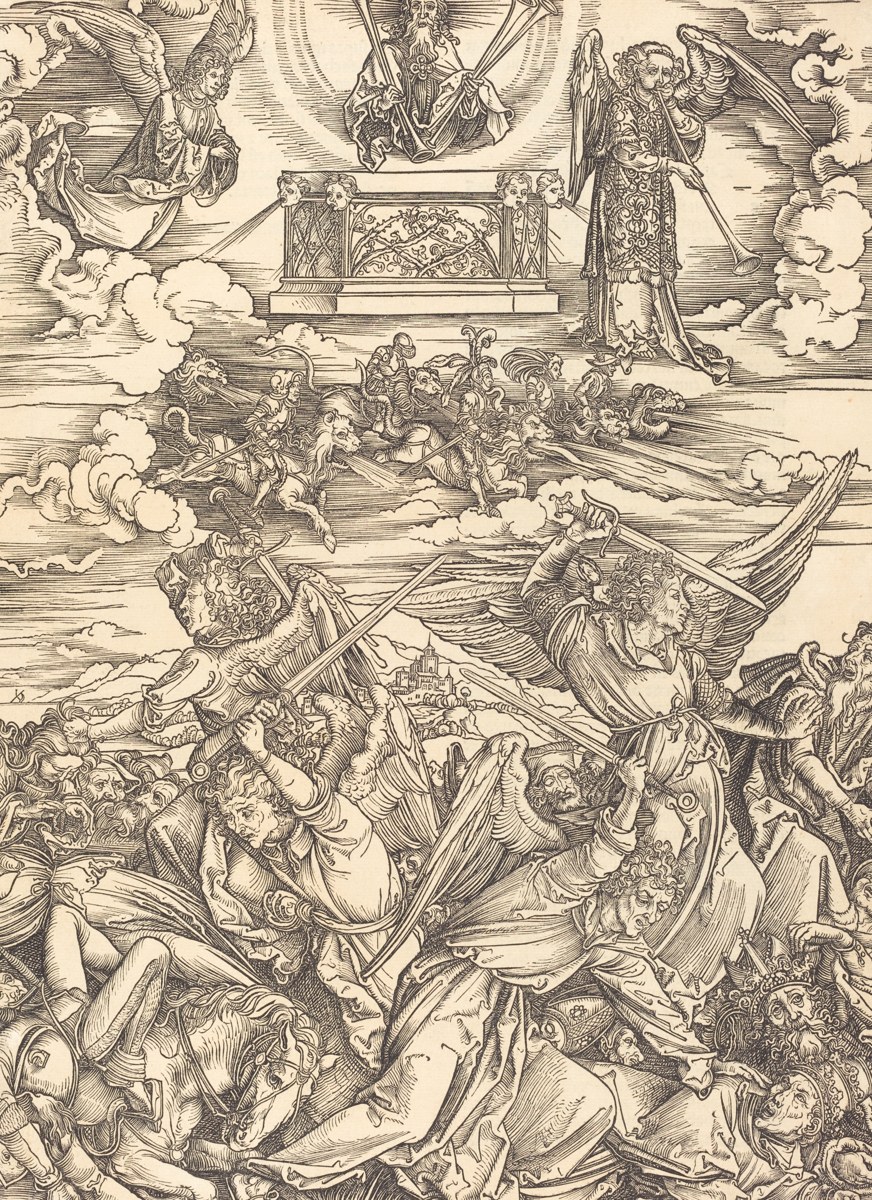
“And the sixth angel sounded, and I heard a voice from the four horns of the golden altar which is before God,”
Revelation 9:13
The order for the sixth trumpet comes from the golden altar — the altar of incense, where the prayers of the saints were offered one chapter ago. The same piece of furniture that carried prayers upward is the place the next command comes from. Whatever is loosed here is loosed from the spot where God’s people were last heard.
That is a detail worth sitting with. The prayers went up from that altar; the order comes down from it. A reader who has been asking, through eight chapters, whether anybody in heaven is listening has just been told where the answer originates — and the answer, in this case, is a hard one.
“And the four angels were loosed, which were prepared for an hour, and a day, and a month, and a year, for to slay the third part of men.”
Revelation 9:15
Four angels bound, then loosed on a schedule so precise it is given to the hour. And the number that comes is two hundred thousand thousand — two hundred million horsemen, a figure so far beyond any first-century army that John adds, almost apologetically, “and I heard the number of them.” He did not count. He was told.
The description that follows is fire, smoke and brimstone coming out of the mouths of the horses, and power in their mouths and in their tails. Whatever else it pictures, it is a weapon that kills from the front and at a distance — which is why almost every commentator who has looked closely at verse 17 has thought about gunpowder, and why the ones writing in the eighteen hundreds thought about it hardest.
About Those Dates
The five months of the fifth trumpet and the hour, day, month and year of the sixth are the most specific time measurements in this part of Revelation, and they have carried a great deal of argument. On the day-year principle five prophetic months come to a hundred and fifty years, and the hour-day-month-year of verse 15 has been reckoned at three hundred and ninety-one years and fifteen days. Commentators of the last two centuries matched both to the rise and the decline of Ottoman power, and worked the dates out to the day.
This study is content to note that the calculations exist, to name them as the work of the older commentators, and to leave the matching where they made it. What the chapter itself asks of a reader does not depend on settling it — the periods are bounded, they are given in advance, and the last two verses say what the whole exercise was for.
It is also worth noticing what the precision itself says. A period given to the hour is a period somebody scheduled. Whether or not the calendars work out, the text is describing constraint rather than chaos: prepared for an hour, and a day, and a month, and a year — and not one hour longer.
And They Repented Not
“And the rest of the men which were not killed by these plagues yet repented not of the works of their hands, that they should not worship devils, and idols of gold, and silver, and brass, and stone, and of wood: which neither can see, nor hear, nor walk:”
Revelation 9:20
There it is. Every trumpet in these two chapters has been a warning with a limit on it — a third and not the whole, five months and not forever, torment and not death. Alarms, sounded so that people would be remembered before the LORD. And the summary of the entire exercise is four words: they repented not.
The detail that follows is almost unbearable in its dryness. They went on worshipping things that “neither can see, nor hear, nor walk” — objects with less capacity than the people bowing to them. Verse 21 adds the ordinary list: murders, sorceries, fornication, thefts. Nothing exotic. The world went on exactly as before.
Two verbs carry the weight, and both are repeated: repented not, in verse 20 and again in verse 21. The chapter does not say they were unconvinced, or that they misunderstood, or that the evidence was thin. It says they did not turn.
That is the answer to a question a reader of these chapters keeps wanting to ask: why does God not simply do something dramatic enough to convince everyone? Revelation 8 and 9 are the dramatic thing. A third of the sea, a third of the rivers, a third of the light, a pit opened, an army of two hundred million — and at the end of it, the survivors carried on.
“Or despisest thou the riches of his goodness and forbearance and longsuffering; not knowing that the goodness of God leadeth thee to repentance?”
Romans 2:4
Paul had already named which of God’s attributes actually changes people, and it is not the one on display in these two chapters. Jesus said the same thing more bluntly at the end of a parable: “If they hear not Moses and the prophets, neither will they be persuaded, though one rose from the dead” (Luke 16:31). Revelation 9 is that principle demonstrated at the scale of a planet.
What This Asks Of Us
Three things stand out of a difficult chapter.
The first is the seal. The one boundary the creatures out of the pit are not allowed to cross is a mark on a forehead, given before the trouble started. Protection in this book is issued early, quietly, and to people who are not yet aware they will need it.
The second is the fencing. Every horror here is measured: not the grass, not the trees, not the sealed; not killing, only five months; a third of men, not all. Even the destroyer works inside a boundary he did not set.
The third is the ending, and it is the one to take home. Judgment does not produce repentance. It never has. What produces repentance is somewhere else entirely — a Lamb, an altar, incense mixed with the prayers of ordinary people, a voice at a door. This chapter is what the alternative looks like, written down so that nobody has to find out.
Next in this series: Sweet As Honey, Bitter In The Belly — a mighty angel, a little book, and an instruction to eat it.