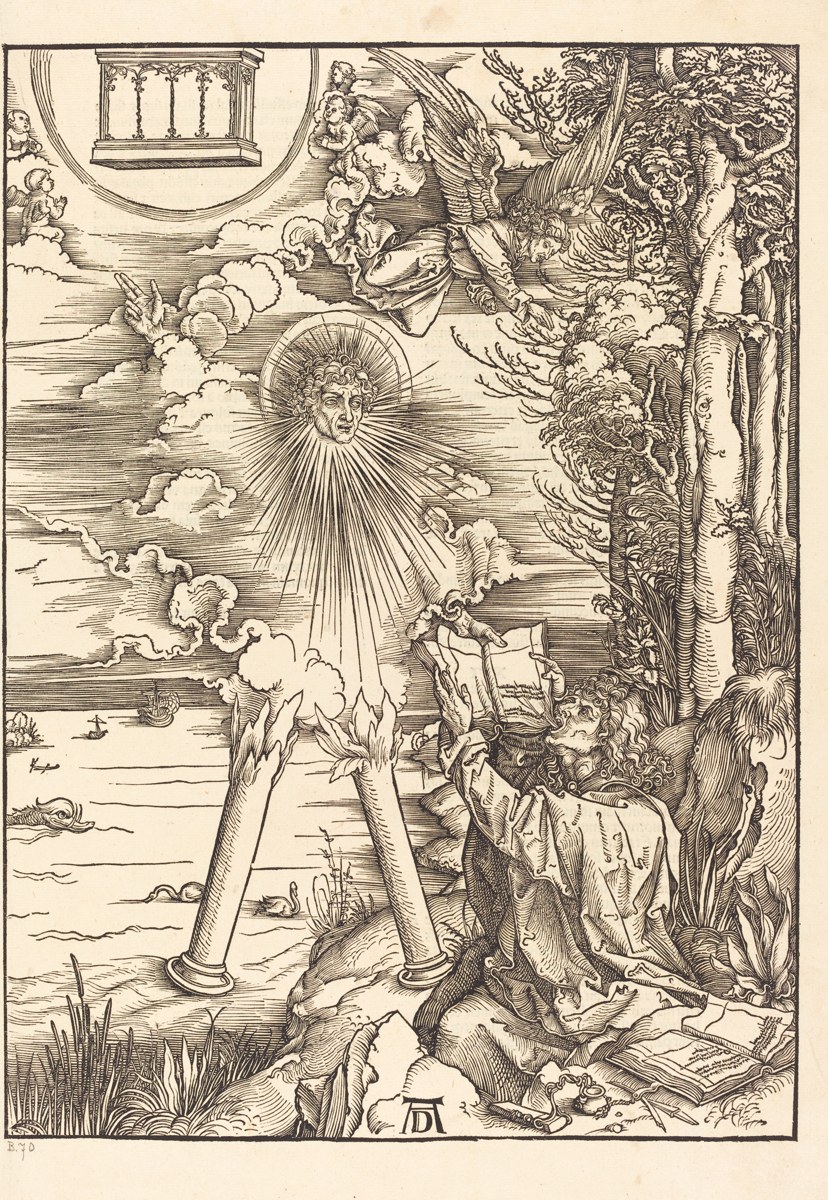
An angel with a rainbow on his head plants one foot on the sea and one on the land, holds out a little book, and tells John to eat it. It goes down like honey. Then it turns bitter — and the bitterness has a date on it.
A Bible study on Revelation 10 · Arthur Baldwin · StandUp4Jesus.Org · 14 min read
Table of Contents
The sixth trumpet has sounded and the seventh has not. Between them the book stops again — and what it puts in the gap is not another catastrophe. It is a book being handed to a man, and a promise that he will be sick after reading it.
A Mighty Angel, Clothed With A Cloud
“And I saw another mighty angel come down from heaven, clothed with a cloud: and a rainbow was upon his head, and his face was as it were the sun, and his feet as pillars of fire:”
Revelation 10:1
Every detail in that verse has been used before in this book, and always of one Person. A cloud is what He comes with. A rainbow was round about the throne in chapter 4. A face like the sun was how chapter 1 described the One walking among the lampstands. Feet like fire were in the same description. Readers have long taken this angel as Christ Himself, and the description is the reason.
Then the stance: “he set his right foot upon the sea, and his left foot on the earth” (Revelation 10:2). Nobody stands like that unless they own both. It is the posture of a claim, and it is made while holding out a book that is open — the first open book in Revelation since the sealed one in chapter 5.
And an open book is the point. Daniel was told the opposite: “shut up the words, and seal the book, even to the time of the end” (Daniel 12:4). What was sealed in Daniel is standing open in the hand of the angel in Revelation 10 — which tells a reader roughly when this scene belongs, without any arithmetic at all.
Seven Thunders, Sealed Up
“And when the seven thunders had uttered their voices, I was about to write: and I heard a voice from heaven saying unto me, Seal up those things which the seven thunders uttered, and write them not.”
Revelation 10:4
This is the only place in the whole book where John is told to stop writing. He heard something, he understood it well enough to begin recording it, and he was told to seal it up.
Which means that the honest thing to say about the seven thunders is that we do not know what they said. People have guessed for centuries. The text withholds it on purpose, and a study that fills the gap with speculation is doing exactly what the voice from heaven forbade.
It is worth noticing the shape of the restriction, though. John is not told to forget them, or that they were unimportant. He is told to seal them up — the same word used of Daniel’s book, which was sealed for a time and then opened. Something was said that was not for the readers of the first century.
That There Should Be Time No Longer
“And sware by him that liveth for ever and ever, who created heaven, and the things that therein are, and the earth, and the things that therein are, and the sea, and the things which are therein, that there should be time no longer:”
Revelation 10:6
An angel raising a hand and swearing an oath is rare enough to notice, and what he swears by is the Creator — described in the same three-part terms the elders used in chapter 4, and in the same terms as the fourth commandment.
The oath itself has been read two ways. Plainly, it can mean that delay is over. In the reading this site follows it means something narrower and more useful: that prophetic time — the long dated periods of Daniel and Revelation — runs out here. After the last of those dates there is no further prophetic period to calculate, and anyone waiting for the next number to land will be waiting a long while.
Verse 7 sets the boundary at the other end: “in the days of the voice of the seventh angel, when he shall begin to sound, the mystery of God should be finished.” So the chapter sits in a gap it describes — after the dated prophecies have run out, before the last trumpet sounds. That is the address of this little book, and it is where the next part of the story takes place.
That reading matters because of what happens next in the chapter, and because of what happened next in history.
Take It, And Eat It Up
“And he said unto me, Take it, and eat it up; and it shall make thy belly bitter, but it shall be in thy mouth sweet as honey.”
Revelation 10:9
Ezekiel was given the same instruction six centuries earlier, and we followed it in Eat This Roll. He was handed a book full of lamentations and told to fill his stomach with it, and he reported the result: “Then did I eat it; and it was in my mouth as honey for sweetness” (Ezekiel 3:3).
Ezekiel’s roll was sweet. John’s is sweet and then bitter, and he is warned about the second half before he swallows. Eating a book is a picture of taking a message so far inside you that it becomes part of your body — and this one is going to disagree with him.
“And I took the little book out of the angel’s hand, and ate it up; and it was in my mouth sweet as honey: and as soon as I had eaten it, my belly was bitter.”
Revelation 10:10
Sweet first. That order is not incidental. The message was not sour going in — it was the best news anybody had heard in a lifetime.
And it is worth asking what makes a message sweet and then bitter, since most disappointing news is unpleasant from the first mouthful. A message tastes like honey when it says the waiting is over and the One you love is coming. It turns bitter when the day arrives and He does not — not because the message was false, but because you understood something in it wrongly, and the correction costs everything you staked on it.
What The Millerites Faced
There is a stretch of American history that reads like this chapter acted out, and it is worth telling properly.
In the 1830s a New England farmer named William Miller, who had come to faith out of scepticism by reading the Bible for himself, worked his way through the prophecies of Daniel. The verse that arrested him was Daniel 8:14: “Unto two thousand and three hundred days; then shall the sanctuary be cleansed.” On the day-year principle those 2,300 days are years. Miller took the sanctuary to be the earth, and its cleansing to be the second coming, and by that arithmetic the return of Christ fell in 1844.
The preaching spread further and faster than anyone expected. By the summer of 1844 the date had been sharpened to the twenty-second of October. Somewhere between fifty and a hundred thousand people in North America were living with that date in front of them.
Consider what that meant in practice. Farmers left crops standing in the fields, because a harvest is for next winter and there was not going to be a next winter. Shopkeepers settled accounts and closed up. Debts were paid off and quarrels made up, because nobody wanted to meet the Lord with either outstanding. Ministers who preached the message were turned out of their pulpits; members who accepted it were disfellowshipped from congregations they had belonged to all their lives, and the expulsions ran into the thousands. Families split. The newspapers ran cartoons.
One detail from that autumn is worth setting down because it is so ordinary. In the last weeks, believers went round settling debts. If a man owed money he paid it; if he had wronged a neighbour he went and said so. Whatever anyone thinks of their arithmetic, that is what people do when they genuinely expect to see God on a particular Tuesday, and it is not the behaviour of cranks.
And here is the thing worth holding on to about them — the people who did all that were not fanatics scanning the sky. Ellen White, who was seventeen years old that October, described them like this:
“Every morning they felt that it was their first duty to secure the evidence of their acceptance with God.”
The Great Controversy, p. 403
“The assurance of the Saviour’s approval was more necessary to them than their daily food; and if a cloud darkened their minds, they did not rest until it was swept away.”
The Great Controversy, p. 403
That was the sweetness in the mouth. Then the twenty-second of October came, and went, and the sun rose on the twenty-third.
“Those who with sincere faith and love had looked for their Saviour, experienced a bitter disappointment.”
The Great Controversy, p. 374
What they faced the next morning was worse than the silence of the sky. There were the unsold crops and the closed shops and no way back into the churches that had put them out. There were neighbours who had been afraid enough to be quiet in the last weeks and were not quiet now:
“After the passing of the time this did not at once disappear; at first they dared not triumph over the disappointed ones; but as no tokens of God’s wrath were seen, they recovered from their fears and resumed their reproach and ridicule.”
The Great Controversy, p. 403
And there was the particular cruelty of people who had professed the faith without holding it:
“They were among the first to ridicule the sorrow of the true believers.”
The Great Controversy, p. 374
Most of the movement fell apart. “A large class who had professed to believe in the Lord’s soon coming, renounced their faith” (The Great Controversy, p. 403). Those who did not, met in small groups in fields and groves because there was nowhere else to go, and prayed.
The comparison Ellen White reaches for is the one that fits: they felt as Mary did at an empty tomb, saying “They have taken away my Lord, and I know not where they have laid Him.” Which is worth remembering, because Mary was standing about ten feet from the risen Christ when she said it.
That is the whole comparison. Her facts were wrong in every particular — the body had not been taken, nobody had moved it, and He was not where she thought. Her grief was entirely genuine and entirely misinformed, and the answer to it was standing behind her, waiting to say her name.
The Right Message At The Right Time
The obvious conclusion, then and now, is that the whole thing was a mistake. The verdict this site holds is more careful, and it is the one Ellen White stated:
“Those who proclaimed this warning gave the right message at the right time.”
The Great Controversy, p. 352
The date was not the error. The expected event was:
“Like the first disciples, William Miller and his associates did not, themselves, fully comprehend the import of the message which they bore.”
The Great Controversy, p. 351
Miller had inherited the popular assumption that the sanctuary of Daniel 8:14 was the earth. Read instead as the sanctuary in heaven — the one Hebrews spends whole chapters on — the same date marks the beginning of the final work of Israel’s High Priest rather than the end of the world. Something did happen in 1844. It happened somewhere the Millerites were not looking.
That is not a rescue of a failed prediction after the fact; it is the reading the disappointed themselves arrived at by going back to the text. A handful of them — including a young woman in Portland, Maine — worked through Daniel and Hebrews again and found that the Bible never once calls the earth God’s sanctuary, and that Hebrews describes a real ministry in a real sanctuary in heaven, with a day of atonement at the end of it. What they had was a right date attached to the wrong room.
And the parallel she draws is the kindest thing in the whole account:
“Both classes fulfilled the will of God in delivering the message which He desired to be given, and both, through their own misapprehension of their message, suffered disappointment.”
The Great Controversy, p. 352
The disciples who shouted for a king on Palm Sunday were not wrong about Jesus. They were wrong about the week. Six days later they were as bitter as any Millerite, and they were not disowned for it.
“But Jesus and all the heavenly host looked with love and sympathy upon the tried and faithful yet disappointed ones.”
The Great Controversy, p. 374
Thou Must Prophesy Again
“And he said unto me, Thou must prophesy again before many peoples, and nations, and tongues, and kings.”
Revelation 10:11
That is how the chapter ends. Not with an explanation, not with an apology, and not with permission to stop. Thou must prophesy again.
The word again assumes there was a first time that did not go as expected. The commission is given to somebody with a bitter stomach, and the audience is widened rather than narrowed — many peoples, and nations, and tongues, and kings, which is the same four-part phrase the book keeps using for everyone the Lamb bought.
Historically that is exactly what happened. Out of the wreckage of 1844 came a small group who went back to their Bibles rather than away from them, and what they found sent them out again — with a message about a sanctuary, a judgment, a Sabbath and a soon-coming Saviour, to the peoples and nations and tongues and kings of verse 11.
What This Asks Of Us
Revelation 10 is the chapter for anybody whose faith has cost them something and not paid out on schedule.
The bitterness was predicted before the book was eaten. God did not spare them the disappointment, and He did not pretend afterwards that it had not happened. What He did was tell John in advance that the message would taste like honey and sit badly — and then hand him a wider commission than he had before.
There is a warning in it too, and it is not aimed at the Millerites. They were mistaken about an event, at real cost, while doing what they believed God had asked. The people this chapter treats least kindly are the ones who never believed at all and were first in line to laugh.
Next in this series: The Two Witnesses — a reed like a measuring rod, twelve hundred and sixty days in sackcloth, and a resurrection in the street.
