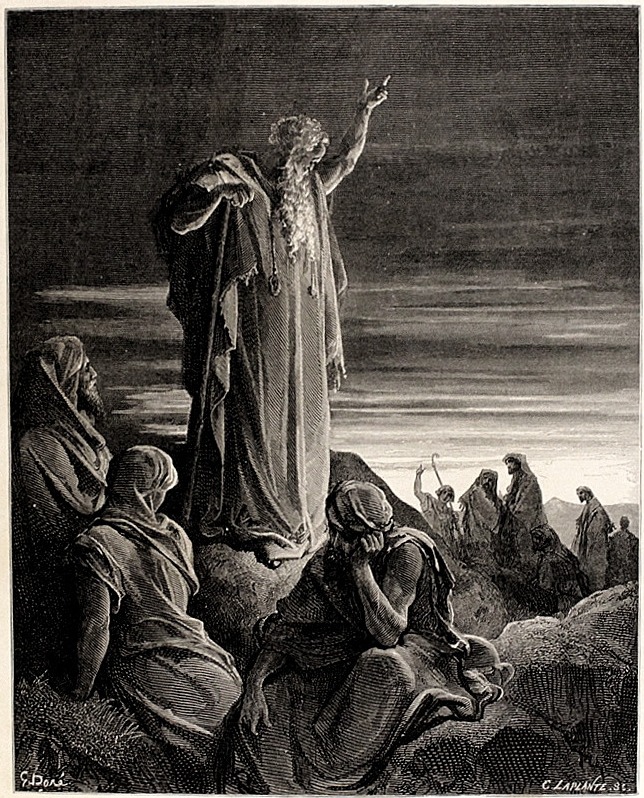
Ezekiel is set on his feet, handed a book full of lamentations, and told to eat it. Then he is sent to a people God tells him in advance will not listen.
A Bible study on Ezekiel 2–3 · Arthur Baldwin · StandUp4Jesus.Org · 11 min read
Table of Contents
A vision is not a commission. Ezekiel 1 showed us the chariot-throne arriving over Babylon, and it ended with the prophet flat on his face. Chapters 2 and 3 are what happens to a man after he has seen that — and they are far more uncomfortable than the wheels ever were.
Read Carefully The Third Chapter
In God And His Throne we leaned on a single sentence from Testimonies to Ministers, page 213:
“Let God’s workmen study the sixth chapter of Isaiah, and the first and second chapters of Ezekiel.”
Testimonies to Ministers, p. 213
What we did not say at the time is that she was not finished. One page later, in the middle of a passage about Jericho and about who gets the credit for a work God does, she adds this:
“The glory is not to be given to human agencies; the Lord alone is to be magnified. Please read carefully the third chapter of Ezekiel. We must learn to put our entire dependence upon God, and yet we must ever bear in mind that the Lord God has need of every agency that holds the truth in righteousness.”
Testimonies to Ministers, p. 214
So the reading list is Isaiah 6, then Ezekiel 1 and 2, then Ezekiel 3 — and the reason given is the tension every worker for God eventually runs into. The work is entirely His. And He still uses people. Ezekiel 2 and 3 are where a man is told both of those things at once, in the same week, by the same voice.
Her pairing with Isaiah 6 is worth holding onto as we go, because the two call narratives run on the same rails and then diverge in a way that tells us something. Isaiah sees the throne and cries “Woe is me! for I am undone” (Isaiah 6:5). A coal from the altar touches his lips. Then he volunteers: “Here am I; send me.” And the first thing he is sent to say is that the people will hear and not understand.
Ezekiel is given no coal, and he is not asked to volunteer.
Stand Upon Thy Feet
“And he said unto me, Son of man, stand upon thy feet, and I will speak unto thee. And the spirit entered into me when he spake unto me, and set me upon my feet, that I heard him that spake unto me.”
Ezekiel 2:1, 2
Notice the order carefully, because it is the whole doctrine of this passage in miniature. He is told to stand. He does not stand. The Spirit enters him and sets him on his feet. And only then does he hear.
The command was real and the obedience was real, but the strength to obey it was supplied from outside the man. That is not a technicality. It is exactly the point Ellen White was making on the page where she sent us here: “no human hand touched the walls of Jericho.” If Ezekiel had gotten up on his own, the book would be about a brave man. He did not, and it is not.
And then the name. Son of man. It arrives here for the first time and it will follow him through ninety-odd verses before the book is done — God never once addresses him by his name. Standing in front of the throne he has just described, the man is addressed by the one title that means, plainly, mortal. Son of Adam. Dust.
It is not an insult. It is a working relationship. He has seen what no one around him has seen, and the address he receives for the next forty-eight chapters makes sure he never confuses the seeing with the seer. It is also, of course, the title our Lord took for Himself more than any other — the Son of man who was sent to a rebellious house, and who was heard no better.
Whether They Will Hear, Or Whether They Will Forbear
Now the terms of the assignment, and they are bracing:
“Son of man, I send thee to the children of Israel, to a rebellious nation that hath rebelled against me: they and their fathers have transgressed against me, even unto this very day. For they are impudent children and stiffhearted. I do send thee unto them; and thou shalt say unto them, Thus saith the Lord GOD. And they, whether they will hear, or whether they will forbear, (for they are a rebellious house,) yet shall know that there hath been a prophet among them.”
Ezekiel 2:3–5
That phrase — whether they will hear, or whether they will forbear — lands three times in these two chapters (2:5, 2:7, 3:11). God says it before the man has opened his mouth. He is being told the outcome in advance, and the outcome is not encouraging.
Chapter 3 sharpens it into something almost bitter:
“For thou art not sent to a people of a strange speech and of an hard language, but to the house of Israel; Not to many people of a strange speech and of an hard language, whose words thou canst not understand. Surely, had I sent thee to them, they would have hearkened unto thee. But the house of Israel will not hearken unto thee; for they will not hearken unto me.”
Ezekiel 3:5–7
Read that again. Foreigners who did not share his language, his covenant or his history would have listened. The people who had everything in common with him would not. Jonah found out the same thing at Nineveh, and hated it. Our Lord said it of Tyre and Sidon, and of Sodom, and it is one of the hardest sayings in the Gospels.
And note where the refusal actually lands: “the house of Israel will not hearken unto thee; for they will not hearken unto me.” The prophet is not being rejected. He is standing in the place where the rejection of God arrives. Any of us who has tried to say something true to people we love, and watched it slide off, has stood in a small corner of that same place — and it is worth knowing that the sting we felt there was not really aimed at us.
Then the equipping, which matches the assignment exactly:
“Behold, I have made thy face strong against their faces, and thy forehead strong against their foreheads. As an adamant harder than flint have I made thy forehead: fear them not, neither be dismayed at their looks, though they be a rebellious house.”
Ezekiel 3:8, 9
Adamant is the hardest thing the old translators had a word for. God does not remove the hard faces in front of Ezekiel; He hardens the face pointed at them. He does not change the audience. He changes the messenger — and the change is specifically the ability to keep speaking into a room that is not moving.
So what is the measure of success? Verse 5 already gave it: “yet shall know that there hath been a prophet among them.” Not conversion. Not a revival. That they will know a word from God was actually delivered. The delivery is the errand. The response belongs to somebody else.
Ellen White puts these two verses side by side and applies them straight to the present:
“Anciently the Lord declared to one who spoke in His name: ‘The house of Israel will not hearken unto thee; for they will not hearken unto Me.’ Nevertheless He said: ‘Thou shalt speak My words unto them, whether they will hear, or whether they will forbear.’ Ezekiel 3:7; 2:7.”
The Great Controversy, p. 459
Nevertheless He said. The refusal was stated as a fact, and the commission was issued anyway — and she is arguing there that a messenger today has “no more reason for withholding the testimony of God’s word, because it excites opposition,” than the Reformers had.
Be Not Thou Rebellious
Between the sending and the scroll there is one line that is easy to read straight past, and it may be the most searching sentence in the two chapters:
“But thou, son of man, hear what I say unto thee; Be not thou rebellious like that rebellious house: open thy mouth, and eat that I give thee.”
Ezekiel 2:8
The word rebellious has been used of Israel five times in seven verses. Now it is turned around and pointed at the prophet. God has just spent a paragraph describing how bad they are, and the next thing He says to the man He is sending is, do not be like them.
There is a particular danger in being handed a message about other people’s sin. It is possible to carry a true warning for years and be quietly ruined by it — to develop the ear that hears everything God says about them and nothing He says about you. The safeguard God gives is not a caution about pride. It is a command to eat.
Eat That I Give Thee
“And when I looked, behold, an hand was sent unto me; and, lo, a roll of a book was therein; And he spread it before me; and it was written within and without: and there was written therein lamentations, and mourning, and woe.”
Ezekiel 2:9, 10
Two details in one verse. Written within and without — an ancient scroll was normally written on one side only, so a scroll covered front and back is a scroll with no room left for additions. The message is fixed. Nothing of Ezekiel’s is going on that document.
And the contents: lamentations, and mourning, and woe. That is what he is asked to swallow. Not a promise. Not a vision of restoration — those come, and this series has spent a good deal of time in them, but they are not what is in his hand today.
Then comes the command this study is named for:
“Moreover he said unto me, Son of man, eat that thou findest; eat this roll, and go speak unto the house of Israel.”
Ezekiel 3:1
He is told twice, and the second time with more force — not to taste it and not to read it, but to fill himself with it:
“Son of man, cause thy belly to eat, and fill thy bowels with this roll that I give thee. Then did I eat it; and it was in my mouth as honey for sweetness.”
Ezekiel 3:3
Eating is the Bible’s picture for taking something all the way in, past the part of you that performs and into the part of you that is fed. Jeremiah, who was prophesying in Jerusalem while Ezekiel was prophesying in Babylon, used the same figure: “Thy words were found, and I did eat them; and thy word was unto me the joy and rejoicing of mine heart” (Jeremiah 15:16).
A man cannot deliver a message he has not digested. He can repeat it — that is easy, and there is a great deal of it about. But the scroll of lamentations had to become part of Ezekiel’s own body before he was allowed to read it to anyone else. That is the answer to “be not thou rebellious”: the warning goes through the messenger first.
And here is the surprise. A book of lamentations, mourning and woe, and it tasted like honey. Not because judgment is sweet. Because it is God’s word, and the man who loves God finds any word from Him sweet — even a hard one, even one addressed against his own people. “Sweeter also than honey and the honeycomb” is what David says of the judgments of the Lord, in the same breath as calling them true and righteous altogether (Psalm 19:9, 10).
Honey In The Mouth, Bitterness In The Going
The sweetness does not last, and Scripture is honest about how long it takes to fade — eleven verses.
“So the spirit lifted me up, and took me away, and I went in bitterness, in the heat of my spirit; but the hand of the LORD was strong upon me.”
Ezekiel 3:14
Honey in the mouth at verse 3; bitterness in the going at verse 14. The word was sweet to receive and bitter to carry. Anyone who has ever been given something true and then had to live with what it costs will recognize the sequence, and will be glad the Bible does not tidy it away.
It is hard to read those two verses without hearing John on Patmos:
“Take it, and eat it up; and it shall make thy belly bitter, but it shall be in thy mouth sweet as honey. And I took the little book out of the angel’s hand, and ate it up; and it was in my mouth sweet as honey: and as soon as I had eaten it, my belly was bitter.”
Revelation 10:9, 10
Same hand held out, same open book, same command to eat it, same honey, same bitterness. John is being given Ezekiel’s commission in Ezekiel’s own language — and then told, “Thou must prophesy again before many peoples, and nations, and tongues, and kings” (Revelation 10:11).
Those of us who trace our beginnings to 1844 have felt the shape of that verse from the inside. A message about the coming of the Lord was sweet in the mouth of a generation, and the disappointment that followed was bitter in the belly. And the answer given to those who had swallowed it was not you were wrong to eat. It was prophesy again. The bitterness was in the assignment from the start, written into the description of the book before anyone tasted it.
Which is worth saying plainly to anyone tempted to measure a message by how it feels afterward. Ezekiel’s errand was sweet, then bitter, then twenty-two more years of work. Bitterness in the belly is not evidence that the book was the wrong one.
Seven Days Before A Word
“Then I came to them of the captivity at Tel-abib, that dwelt by the river of Chebar, and I sat where they sat, and remained there astonished among them seven days.”
Ezekiel 3:15
He has been commissioned, equipped with a face like adamant, fed the scroll and carried by the Spirit to the settlement. And then he says nothing for a week.
“I sat where they sat.” Five short words, and they are the reason the rest of the book is bearable. He does not stand over the exiles and read the lamentations at them. He sits down in their situation — an exile among exiles, by the same river, under the same defeat — and stays there, astonished, until God speaks again at the end of the seventh day. Seven days is the length of mourning for the dead in Israel, and the length of a priest’s consecration. Ezekiel was a priest. Both readings fit, and both come to the same thing: he grieves before he warns.
There is a whole ministry philosophy in verse 15, and it is not the one that comes naturally to people who are sure they are right. The word came first, the sitting came second, and the speaking came a week after that.
A Watchman Unto The House Of Israel
“Son of man, I have made thee a watchman unto the house of Israel: therefore hear the word at my mouth, and give them warning from me. When I say unto the wicked, Thou shalt surely die; and thou givest him not warning, nor speakest to warn the wicked from his wicked way, to save his life; the same wicked man shall die in his iniquity; but his blood will I require at thine hand. Yet if thou warn the wicked, and he turn not from his wickedness, nor from his wicked way, he shall die in his iniquity; but thou hast delivered thy soul.”
Ezekiel 3:17–19
A watchman on a city wall has one job and it is not fighting. He looks, and when he sees something coming he sounds. If he sounds and the city ignores him, the city is answerable. If he sees and stays quiet, the deaths are on his account.
Two things follow from that, and they pull in opposite directions, which is why the passage is so often quoted badly.
The responsibility is terrifyingly real. “His blood will I require at thine hand” is not a figure of speech. It is the reason Paul could say to the Ephesian elders, “I am pure from the blood of all men” — a man does not say that unless he believes he could have failed to be (Acts 20:26).
And the responsibility has a limit. Verse 19 is the mercy in the passage: warn him, watch him refuse, and “thou hast delivered thy soul.” The watchman is not charged with the outcome. He is charged with the warning. Which is precisely the point already made in chapter 2 — whether they will hear, or whether they will forbear — now attached to a consequence.
Ellen White returns to this charge again and again, and the sentence she almost always quotes is the second telling of it, in Ezekiel 33 — which is where we will take it up properly. It is worth noticing now, though, how far she widens it:
“So far as his opportunities extend, everyone who has received the light of truth is under the same solemn and fearful responsibility as was the prophet of Israel, to whom the word of the Lord came, saying: ‘Son of man, I have set thee a watchman unto the house of Israel; therefore thou shalt hear the word at My mouth, and warn them from Me.’”
The Great Controversy, pp. 459, 460
Every one who has received the light of truth, so far as his opportunities extend. Not only the prophet. Not only the minister.
One verse in this section does need care. Verse 20 says of a righteous man who turns, “I lay a stumblingblock before him.” That reads badly in English, and it belongs to the same family of statements as Ezekiel 20:25, which we looked at in The Sign Between Us. Scripture does not permit us to read it as God enticing anyone to sin — “neither tempteth he any man” (James 1:13). It is the language of a restraint withdrawn: a man who has decided to go is allowed to meet what his own road contains. The whole burden of chapter 3 is God sending a warning to prevent exactly that.
Shut Thyself Within Thine House
The chapter ends strangely, and most readers find it an anticlimax. Ezekiel is told to go out into the plain, where the glory meets him again:
“And, behold, the glory of the LORD stood there, as the glory which I saw by the river of Chebar: and I fell on my face.”
Ezekiel 3:23
Same glory, same posture, same recovery — “Then the spirit entered into me, and set me upon my feet.” The chariot-throne of chapter 1 was not a one-off spectacle. It is the standing reality behind everything he will say, and it will return at the hinge of the book and again at the very end.
And then the odd instruction: go home, shut the door, be bound, be silent.
“And I will make thy tongue cleave to the roof of thy mouth, that thou shalt be dumb, and shalt not be to them a reprover: for they are a rebellious house. But when I speak with thee, I will open thy mouth, and thou shalt say unto them, Thus saith the Lord GOD.”
Ezekiel 3:26, 27
Read the two verses together and the silence has a very precise shape. He is not struck mute for seven years — he speaks constantly through the chapters that follow. He is silenced as a reprover. His own commentary, his own appeals, his own attempts to argue the exiles round: those are shut off. When God gives him a word, his mouth opens. When God does not, he has nothing to say to them.
That is the strictest possible application of written within and without. And the restriction runs until a runaway arrives from the ruined city — “and my mouth was opened, and I was no more dumb” (33:22). The silence lifts on the night the news comes true.
What This Asks Of Us
Get up when you are told, and know who lifted you. The command and the strength to obey it arrived in the same verse, from opposite directions. Ellen White sent workers to this chapter precisely so they would stop confusing the two.
Eat it before you carry it. The one warning God gave Ezekiel about himself was be not thou rebellious like that rebellious house, and the remedy attached to it was a command to swallow the book. A message that has not gone through you is a message you are only repeating.
Sit where they sit. Seven days of silence stand between the commission and the first sermon. He grieved with the people before he warned them, and he was one of them the whole time.
Deliver the warning; leave the result alone. Whether they will hear, or whether they will forbear is not fatalism. It is freedom. The watchman who sounds has delivered his soul, and the city’s answer is the city’s.
And expect the taste to change. Honey first, bitterness after, and the hand of the Lord strong upon him through both. That is not a sign that something went wrong. It is the description of the book he was handed.
Next in this series: Ezekiel 4 and 5, where the prophet stops preaching and starts acting — and where God says a sentence that unlocks the prophecies of Daniel and Revelation: “I have appointed thee each day for a year.”
In one breath
- Ellen White’s reading list for God’s workmen runs Isaiah 6, Ezekiel 1–2 (TM 213), and then “Please read carefully the third chapter of Ezekiel” (TM 214) — in a passage about not taking the glory.
- He is told to stand and then set on his feet by the Spirit (2:1, 2). The command and the power come from the same voice.
- “Whether they will hear, or whether they will forbear” — three times. The measure of the errand is that “there hath been a prophet among them” (2:5), not that they repented.
- God hardens the messenger’s face rather than softening the audience’s (3:8, 9), and warns him not to become rebellious like the house he is sent to (2:8).
- The scroll is written within and without — no room for additions — and full of lamentations, and mourning, and woe. He has to eat it, and it tastes like honey (2:10; 3:3).
- Eleven verses later he goes “in bitterness, in the heat of my spirit” (3:14) — the same sweet-then-bitter book John is handed in Revelation 10:9, 10, and told to prophesy again.
- He sits where the exiles sit for seven days before he says a word (3:15).
- The watchman charge (3:17–21) makes him answerable for the warning, never for the outcome — and Ellen White extends it to “everyone who has received the light of truth” (GC 459).
- The dumbness of 3:26 is specific: silenced as a reprover, with his mouth opened whenever God gives him a word — until the city falls and the silence lifts (33:22).
