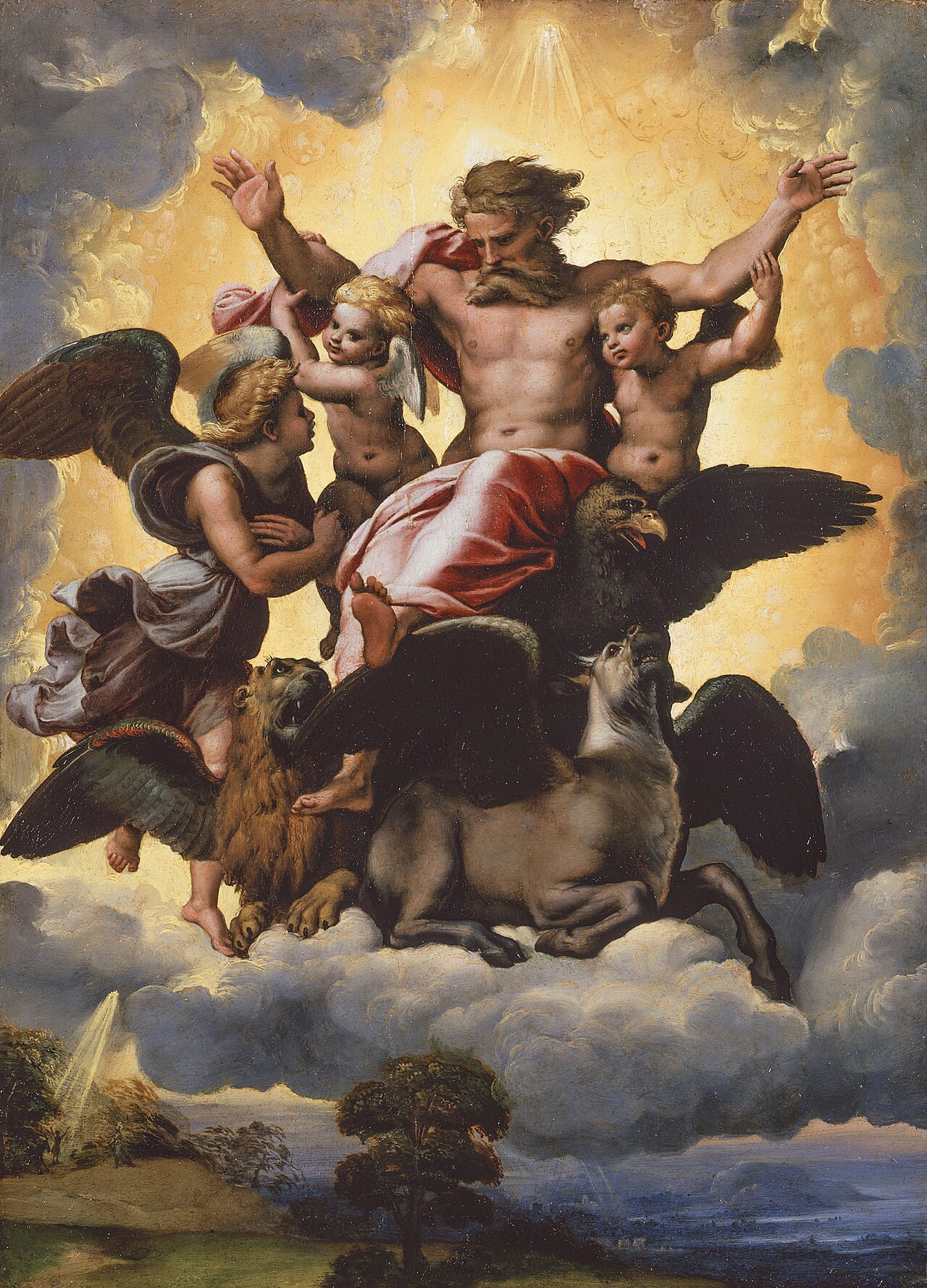
Ezekiel chapter one is where most readers of Ezekiel stop. Here is why it is really the door, and what it opens.
A Bible study on Ezekiel 1 · Arthur Baldwin · StandUp4Jesus.Org · 9 min read
Table of Contents
Four living creatures with four faces each. Wheels inside of wheels. Rings so high they were dreadful, and full of eyes all the way around. A crystal firmament, a sapphire throne, and fire. More sincere readers have given up on the book of Ezekiel in chapter one than anywhere else in it, and I understand why. It reads like a description of something the describer could barely hold still long enough to look at.
But chapter one is not a riddle set at the door to keep you out. It is the door. And once you see what is actually happening in it, chapters eight through eleven open with it — which is exactly where so many of us have been lost.
Here is the whole of it in one sentence: a throne arrives. Everything else in the chapter is the equipment of that arrival.
Why We Were Sent To This Chapter
We were not left to decide on our own whether this chapter is worth the trouble. In counsel written to workers in the cause, Ellen White named it directly:
“Let God’s workmen study the sixth chapter of Isaiah, and the first and second chapters of Ezekiel.”
Ellen G. White · Testimonies to Ministers and Gospel Workers, p. 213
Notice what those two passages have in common. Isaiah 6 is a throne vision that ends in a commission — whom shall I send, and who will go for us? Ezekiel 1 and 2 are a throne vision that ends in a commission — Son of man, stand upon thy feet, and I will speak unto thee… I send thee to the children of Israel. In both, a man sees the throne first and receives his assignment second. The order is not accidental. Nobody in Scripture is sent until he has seen who is sending him.
So chapter one is not scenery before the real message begins. It is the credentials of the One giving the message.
A Priest In The Wrong Country
“Now it came to pass in the thirtieth year, in the fourth month, in the fifth day of the month, as I was among the captives by the river of Chebar, that the heavens were opened, and I saw visions of God… The word of the LORD came expressly unto Ezekiel the priest, the son of Buzi, in the land of the Chaldeans by the river Chebar; and the hand of the LORD was there upon him.”
Ezekiel 1:1, 3
Read those two verses slowly, because four facts are packed into them and every one of them matters.
He dates it. The fifth year of Jehoiachin’s captivity — roughly 593 or 592 BC, depending on how you count the reckoning. Ezekiel does this at the head of nearly every vision in the book. As I said in Ezekiel Foundations, this is a man documenting, and documentation is a claim: this happened, on this day, and you may check me.
He is a priest. Verse 3 says so plainly. And a priest of that generation had exactly one place on earth where his office meant anything — the temple in Jerusalem, which at this moment is still standing, still staffed, still burning incense some eight hundred miles to the west.
He is nowhere near it. He is by the river Chebar, an irrigation canal in Babylon, among the captives — a deported priest, cut off from the altar for the rest of his life.
And the heavens open anyway.
That is the first shock of the book, and the whole vision is built on it. The glory of God shows up in the wrong country. Not in the temple where it was supposed to be kept, but out in the mud of an enemy empire, over a work camp full of prisoners. Before Ezekiel is told a single thing about Jerusalem’s fate, he is shown that God is not confined to the building Jerusalem was so sure of.
The Throne Has Wheels
Now ask the question that unlocks the chapter. Of all the ways to show a throne, why this one? Why the wheels at all?
“And when the living creatures went, the wheels went by them: and when the living creatures were lifted up from the earth, the wheels were lifted up. Whithersoever the spirit was to go, they went, thither was their spirit to go; and the wheels were lifted up over against them: for the spirit of the living creature was in the wheels.”
Ezekiel 1:19, 20
Wheels are for one thing. Thrones do not normally need them, because the whole point of a throne is that it stays put — it marks the one place where the king is to be found. Put wheels under a throne and you have said something startling: this King is not tied to a location. He travels. And the wheels are not pushed from outside; the spirit of the living creature is in them. The movement comes from within the throne itself.
Daniel, who was Ezekiel’s contemporary in the same empire, saw the same thing and described it the same way — a throne of fire with burning wheels, moving into a courtroom for judgment (Daniel 7:9, 10). What Ezekiel sees is a chariot-throne, and it is on the move for a purpose. God is coming down to deal with His own professed people. The Adventist scholar William Shea worked this out in a study whose title says the whole thing in six words — The Investigative Judgment of Judah: Ezekiel 1–10 — and Pastor Stephen Bohr has taught the same connection.
Two details in the opening verse tell you the same thing before the wheels are ever mentioned. Ezekiel says the storm came “out of the north” (1:4) — and in Scripture the north is not a weather direction, it is an address. It is the direction Lucifer named when he said what he wanted: “I will exalt my throne above the stars of God: I will sit also upon the mount of the congregation, in the sides of the north” (Isaiah 14:13). He was not describing a place on a map. He was describing where the throne of God is. So a storm coming out of the north is not bad weather blowing in off the desert. It is an arrival from heaven.
And the storm is the escort. Watch what the psalmist does with exactly these three elements — cloud, wind, and fire:
“Who layeth the beams of his chambers in the waters: who maketh the clouds his chariot: who walketh upon the wings of the wind: Who maketh his angels spirits; his ministers a flaming fire.”
Psalm 104:3, 4
The clouds are His chariot; the wind is what He walks on; and the angels are the spirits and the flame of fire. That is not a private reading — the book of Hebrews quotes this very verse and applies it to angels outright: “Who maketh his angels spirits, and his ministers a flame of fire” (Hebrews 1:7). And lest there be any doubt what a chariot of God is made of, “The chariots of God are twenty thousand, even thousands of angels” (Psalm 68:17).
So the whirlwind, the great cloud and the infolding fire of verse 4 are not stage effects placed around the throne. They are the retinue that brings it. Ezekiel is watching an escorted arrival, and every element of the storm is a company of angels.
That single realization changes how the rest of the chapter reads. The storm out of the north, the fire, the burnished brass, the noise of the wings like the noise of great waters, as the voice of the Almighty — this is not a light show. It is the sound of a court arriving.
The Wheel, And What It Is For
I have to confess something here. For a long time I hunted for a picture of Ezekiel’s wheel that made sense to me as an engineer — some arrangement I could sketch, where the mechanism would finally click into place. I never found one, and I have come to believe I was looking for the wrong thing.
Look at how Ezekiel himself writes it:
“The appearance of the wheels and their work was like unto the colour of a beryl: and they four had one likeness: and their appearance and their work was as it were a wheel in the middle of a wheel.”
Ezekiel 1:16
As it were. Like unto. The appearance of. The whole chapter is written in that register — a man reaching for comparisons because he has no vocabulary for what he is looking at. He is not handing us a blueprint. He is telling us honestly that the thing exceeded his ability to say it.
That said, the instinct to picture it is not foolish, and it is not left entirely without help. When Ellen White describes this same vision she reaches for a word that is unmistakably geometric:
“A number of wheels, intersecting one another, were moved by four living beings.”
Ellen G. White · Education, p. 177
Intersecting — not tangled, not impossible. Two circles crossing each other. Pastor Stephen Bohr reads the wheel within a wheel as two wheels set at right angles: one turning forward, one turning sideways, sharing a center. And the moment you picture that, the strangest line in the passage stops being strange:
“When they went, they went upon their four sides: and they turned not when they went.”
Ezekiel 1:17
A wheel at right angles to another wheel can roll in any of four directions without the throne ever pivoting to face where it is going. That is precisely what verse 17 claims, and it is a sensible thing to picture. So I want to say plainly, to anyone who has hunted for this the way I did: there is a geometry here. Your instinct was not wrong. What there is not is a blueprint — and, far more importantly, the geometry is not the point.
Because when Ellen White turns from describing the wheels to saying what they mean, she goes somewhere else entirely:
“To the prophet the wheel within a wheel, the appearances of living creatures connected with them, all seemed intricate and unexplainable. But the hand of Infinite Wisdom is seen among the wheels, and perfect order is the result of its work. Every wheel works in perfect harmony with every other.”
Ellen G. White · Testimonies to Ministers and Gospel Workers, p. 213
It seemed intricate and unexplainable to the prophet — the man who was standing there watching it. If it looks that way to you, you are not failing. You are seeing what he saw.
What she directs our attention to is not the mechanism but the hand among the wheels. What appears to be confusion is under perfect control. That is the lesson the vision was given to teach, and it is a lesson a man in a Babylonian labor camp needed more than a diagram.
And in another place she says the same thing with the empire named out loud — which is worth reading slowly, because it is the entire vision in four sentences:
“Above the proud and cruel monarchs of Assyria and Babylon the God of mercy and truth was enthroned. The wheellike complications that appeared to the prophet to be involved in such confusion were under the guidance of an infinite hand. The Spirit of God, revealed to him as moving and directing these wheels, brought harmony out of confusion; so the whole world was under His control.”
Ellen G. White · Testimonies for the Church, vol. 5, p. 752
Above the proud and cruel monarchs of Assyria and Babylon. Ezekiel was sitting in Babylon when he saw this. Nebuchadnezzar was the most powerful man on earth, the temple was doomed, and the covenant people were slave labor on an irrigation canal. And the vision God gave the prophet was of a throne positioned above that empire — not competing with it, not hiding from it, over it.
The Faces, And All Those Eyes
We are not left guessing about who the four living creatures are. Ezekiel tells us himself, nine chapters later, when he sees them again:
“This is the living creature that I saw under the God of Israel by the river of Chebar; and I knew that they were the cherubims.”
Ezekiel 10:20
Cherubim. The same order of being that stood over the mercy seat in the sanctuary, with wings spread over the law of God. Ezekiel does not identify them in chapter one; he identifies them in chapter ten, once he has seen them in their proper setting — over the temple. That is Scripture interpreting itself, and it is worth more than any outside speculation.
And chapter ten adds one more detail about them that chapter one only hints at. These are not free agents:
“And there appeared in the cherubims the form of a man’s hand under their wings.”
Ezekiel 10:8
A man’s hand, under the wings, guiding. Whatever else is true of these creatures, they are being directed — and directed by hands that look human. Ezekiel repeats the detail at 10:21 so that we do not read past it. There is one figure in these chapters who is described as a man and who is sent in among the wheels: the man clothed with linen, who is told “Go in between the wheels, even under the cherub” (10:2), and who in chapter nine carries the writer’s inkhorn and sets the mark on the foreheads of those who sigh and cry. We take up who he is in Begin At My Sanctuary. For now it is enough to notice that the hand among the wheels — the one Ellen White will point us to — is a hand the vision itself puts there.
Then there are the eyes:
“As for their rings, they were so high that they were dreadful; and their rings were full of eyes round about them four.”
Ezekiel 1:18
Eyes are for seeing, and a court that is arriving to judge needs evidence. Nothing about Jerusalem’s condition is going to be assessed from a distance or taken on report. The throne that is rolling toward that city sees everything, from every side, all the way around. Hold that thought — in chapter eight, Ezekiel is going to be taken back to Jerusalem in vision and shown, room by room, exactly what those eyes have already seen.
The Man Above The Throne
The chapter climbs. Creatures, then wheels, then a crystal firmament over their heads — and then, above all of it:
“And above the firmament that was over their heads was the likeness of a throne, as the appearance of a sapphire stone: and upon the likeness of the throne was the likeness as the appearance of a man above upon it… As the appearance of the bow that is in the cloud in the day of rain, so was the appearance of the brightness round about. This was the appearance of the likeness of the glory of the LORD. And when I saw it, I fell upon my face, and I heard a voice of one that spake.”
Ezekiel 1:26, 28
Two details deserve everything you have.
First, the form on the throne is human. Out of a vision of fire and crystal and creatures unlike anything on earth, the figure at the summit is described as a man. And the first words He speaks, in the very next verse, are “Son of man, stand upon thy feet.” The One on the throne addresses the prophet by the title He will later carry Himself.
Second, there is a rainbow around the throne. That bow has meant one thing since Genesis 9 — a covenant promise that God will not destroy without remembering mercy. It is not an ornament here. A throne has just come rolling out of the north in fire, on its way to judge a city, and the last thing Ezekiel records before he falls on his face is the sign of mercy arched over it. John saw the same throne and the same bow (Revelation 4:2, 3).
Judgment ringed with mercy. That is the throne of God, and Ezekiel saw it before he was told one word about what was coming.
What Chapter One Is Opening
Here is why this chapter has to be understood before the rest of the book will move. The chariot-throne that arrives in chapter one does not simply appear and depart. Watch where it goes:
- The investigation. In chapter eight Ezekiel is carried to Jerusalem and shown the abominations being committed inside the temple itself. In chapter nine the glory rises from the cherub, and a man with a writer’s inkhorn is sent through the city to “set a mark upon the foreheads of the men that sigh and that cry for all the abominations that be done in the midst thereof” (Ezekiel 9:4).
- The sentence — and where it starts. “Slay utterly old and young… but come not near any man upon whom is the mark; and begin at my sanctuary” (Ezekiel 9:6). Judgment does not begin with Babylon. It begins at the house of God, among the people who carry His name. Peter says the same thing in one line: “For the time is come that judgment must begin at the house of God” (1 Peter 4:17).
- The departure. “And the glory of the LORD went up from the midst of the city, and stood upon the mountain which is on the east side of the city” (Ezekiel 11:23). The throne that came on wheels leaves on them. Jerusalem falls to Nebuchadnezzar in 586 BC — but it was empty before it was destroyed.
Chapters one through eleven are a single movement: the court convenes, the evidence is examined, the faithful are marked, the sentence falls, and the glory withdraws. Chapter one is the opening of that court. Read it as a curiosity and chapters eight through eleven will feel like a disconnected horror story. Read it as an arrival, and they are the rest of the same sentence.
And if that sequence sounds familiar to you, it should. It is the same order of events you already know from Daniel — a throne with burning wheels, a court seated, books opened, and a verdict. Ezekiel watched it happen to one city in his own lifetime. We will take up that connection properly in the articles on chapters eight through eleven.
Why This Matters Where You Sit
Ezekiel’s first readers were people whose whole religious world had collapsed. The temple was far away and about to be rubble. The priesthood was scattered. Everything that had told them where God was, was gone.
And God’s answer to them was not a promise that the building would be restored soon. It was a vision of a throne with wheels under it — a throne that had already crossed eight hundred miles of desert to be standing over their heads in Babylon, before they had any idea it was coming.
He is not held in place by institutions, buildings, or the state of the visible church. He goes where His people are. And the same wheels that carried Him to a camp of exiles to comfort them carried Him to a temple full of abominations to judge it. Both journeys are in this vision, and both are made by the same throne.
Ellen White draws the application out further than the exile, and further than us:
“The wheels were so complicated in arrangement that at first sight they appeared to be in confusion; but they moved in perfect harmony. … As the wheel like complications were under the guidance of the hand beneath the wings of the cherubim, so the complicated play of human events is under divine control. Amidst the strife and tumult of nations, He that sitteth above the cherubim still guides the affairs of the earth.”
Ellen G. White · Education, pp. 177, 178
That is the transfer. The wheels are not machinery to be reverse-engineered; they are history — the complicated play of human events, which at first sight appears to be in confusion. Read the news of any week and you will have no trouble with the phrase. What Ezekiel was given, and what we are being handed with him, is the sight of whose hand is underneath it.
That is what Ezekiel saw before he was ever told to stand on his feet. It is worth seeing before we go any further into the book.
In one breath
- Ezekiel 1 is a throne arriving, not a puzzle to be solved — wheels mean a King who is not tied to one place.
- The glory of God appears in Babylon, over a camp of captives, while the temple in Jerusalem is still standing.
- Ellen White sends God’s workmen to this chapter, and points not to the mechanism but to “the hand of Infinite Wisdom … among the wheels.”
- The living creatures are identified by Ezekiel himself as cherubim (Ezekiel 10:20), and the rings full of eyes belong to a court gathering evidence.
- The figure on the throne is in the form of a man, with the rainbow of Genesis 9 arched over Him — judgment ringed with mercy.
- Chapter 1 opens a court that runs to chapter 11: investigation, the mark, the sentence beginning at the sanctuary, and the glory departing.
Further reading: William H. Shea, “The Investigative Judgment of Judah: Ezekiel 1–10,” in The Sanctuary and the Atonement (Review and Herald, 1981), is the study behind the reading taken here. Pastor Stephen Bohr treats the link between Daniel 7 and Ezekiel 1–11 in his study notes on Studies in Revelation — The Seven Seals, and works through the vision detail by detail in his sermon Ezekiel Chapter 1 Vision.
