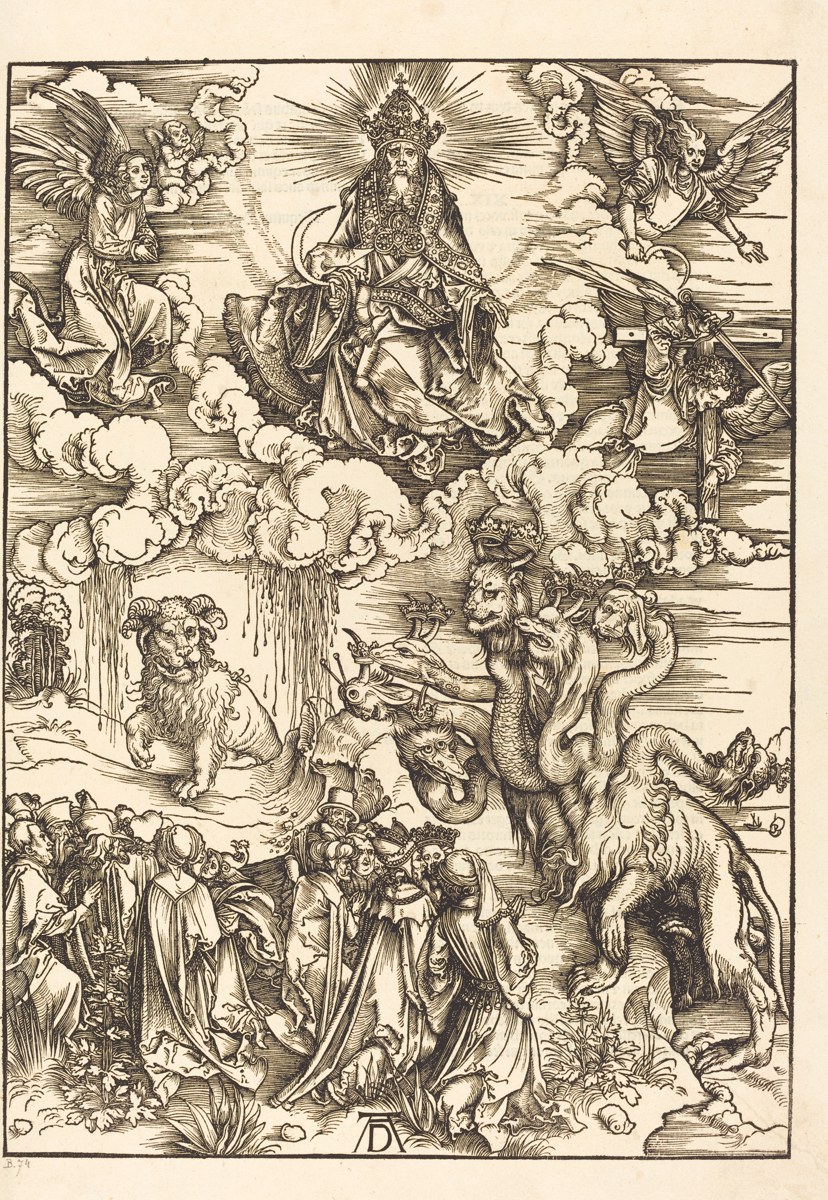
Two beasts in one chapter. The first rises out of the sea wearing the dragon’s own shape; the second comes up out of the earth with two horns like a lamb — and then opens its mouth and speaks like a dragon. That second one is the buffalo.
A Bible study on Revelation 13 · Arthur Baldwin · StandUp4Jesus.Org · 14 min read
Table of Contents
Chapter 12 ended with the dragon going off to make war on the remnant. He does not fight that war himself. Chapter 13 introduces the two powers he works through, and a reader who has just watched him thrown out of heaven will recognise the family likeness immediately.
In Revelation 13, there are two main characters: the beast with 7 heads and 10 horns, and the “lamb-like” beast with two horns.
The second of those is the one this study calls the buffalo, and the name is worth explaining before we go any further. The animal in verse 11 has two horns like a lamb — not the seven heads and ten crowns of an old world empire, but two horns and a young, harmless look. It comes up out of the earth rather than the sea. And the American buffalo is exactly that: a two-horned animal, native to a continent nobody in John’s world had heard of, that looks placid until it moves. The figure is a shorthand, not a doctrine — but it holds the two things the verse insists on, which are the horns and the mildness.
Revelation 13, In Full
"1 And I stood upon the sand of the sea, and saw a beast rise up out of the sea, having seven heads and ten horns, and upon his horns ten crowns, and upon his heads the name of blasphemy.

2 And the beast which I saw was like unto a leopard, and his feet were as the feet of a bear, and his mouth as the mouth of a lion: and the dragon gave him his power, and his seat, and great authority.

3 And I saw one of his heads as it were wounded to death; and his deadly wound was healed: and all the world wondered after the beast.

4 And they worshipped the dragon which gave power unto the beast: and they worshipped the beast, saying, Who is like unto the beast? who is able to make war with him?

5 And there was given unto him a mouth speaking great things and blasphemies; and power was given unto him to continue forty and two months.

6 And he opened his mouth in blasphemy against God, to blaspheme his name, and his tabernacle, and them that dwell in heaven.

7 And it was given unto him to make war with the saints, and to overcome them: and power was given him over all kindreds, and tongues, and nations.

8 And all that dwell upon the earth shall worship him, whose names are not written in the book of life of the Lamb slain from the foundation of the world.

9 If any man have an ear, let him hear.

10 He that leadeth into captivity shall go into captivity: he that killeth with the sword must be killed with the sword. Here is the patience and the faith of the saints.

11 And I beheld another beast coming up out of the earth; and he had two horns like a lamb, and he spake as a dragon.

12 And he exerciseth all the power of the first beast before him, and causeth the earth and them which dwell therein to worship the first beast, whose deadly wound was healed.

13 And he doeth great wonders, so that he maketh fire come down from heaven on the earth in the sight of men,

14 And deceiveth them that dwell on the earth by the means of those miracles which he had power to do in the sight of the beast; saying to them that dwell on the earth, that they should make an image to the beast, which had the wound by a sword, and did live.

15 And he had power to give life unto the image of the beast, that the image of the beast should both speak, and cause that as many as would not worship the image of the beast should be killed.

16 And he causeth all, both small and great, rich and poor, free and bond, to receive a mark in their right hand, or in their foreheads:

17 And that no man might buy or sell, save he that had the mark, or the name of the beast, or the number of his name.

18 Here is wisdom. Let him that hath understanding count the number of the beast: for it is the number of a man; and his number is Six hundred threescore and six.

Revelation 13:1-18  KJV
One Dragon, Two Beasts
The beast introduced in verses 1 through 7 has 7 heads and ten horns, just like the beast in Revelation 12, but they are NOT the same beasts! Revelation makes it very clear that the primary beast of chapter 12 is none other than Lucifer or Satan. On the other hand, the beast of Revelation 13:1-7 has some very common characteristics with the “Dragon” described in Revelation 12! Even though they are not the same entity, these common characteristics clearly show that both the Dragon and the Beast share similar thoughts, goals, and character traits.
This is a very serious implication because it shows that the Beast of Revelation 13:1-7 is very much like Satan himself!
The detail that makes the point is where the crowns sit. The dragon of chapter 12 wore seven crowns upon his heads; this beast has upon his horns ten crowns (Revelation 13:1). Same heads, same horns, the diadems moved. It is the difference between a power and the authority it delegates — and verse 2 says so outright: “the dragon gave him his power, and his seat, and great authority.”
The composite body says the rest. A leopard, a bear’s feet, a lion’s mouth — the three beasts Daniel saw coming up out of the sea, assembled into one animal. Whatever this power is, it inherits what came before it rather than arriving from nowhere.
What the beast does with that inheritance is described in three verbs, and none of them is military. It opens its mouth in blasphemy against God and against His tabernacle (verse 6). It makes war with the saints and overcomes them (verse 7). And it is worshipped — which is the verb the chapter keeps returning to. This is a religious power before it is anything else, and the thing at stake is who receives worship.
Verse 8 draws the line: “all that dwell upon the earth shall worship him, whose names are not written in the book of life of the Lamb slain from the foundation of the world.” Even in the darkest verse of the chapter there is a register with names in it, kept by somebody whose death was planned before the world began.
And then verse 10, which is the strangest thing in the passage: “Here is the patience and the faith of the saints.” Not the resistance of the saints. Not the strategy. In a chapter about a power that overcomes them, what is asked of God’s people is patience and faith — and that same pairing will come back in chapter 14 as the mark of those who keep the commandments of God.
A Wound That Healed
“And I saw one of his heads as it were wounded to death; and his deadly wound was healed: and all the world wondered after the beast.”
Revelation 13:3
Two halves, and both matter. The wound is unto death — this is not a scratch, and for a period the power is finished. Then it heals, and the reaction is not fear but fascination: all the world wondered. A recovery nobody expected is the most persuasive thing a fallen power can do.
And the forty-two months of verse 5 are the period this series has now met four times — as the trampling of the holy city, as the sackcloth of the two witnesses, as the woman’s stay in the wilderness, and here as the term of the beast’s authority. Twelve hundred and sixty years, counted from four directions. The wound falls at the end of it.
This series has already put a date on the end of that period. Chapter 11 followed the two witnesses out of their sackcloth in 1798 — the year the same authority that had held the forty-two months was itself broken. The wound and the end of the months arrive together, which is what a reader should expect if the two describe one power.
The Buffalo Comes Up
“And I beheld another beast coming up out of the earth; and he had two horns like a lamb, and he spake as a dragon.”
Revelation 13:11
Everything in that verse is a contrast with the first beast. It comes up out of the earth, not the sea — and the sea, Revelation says later, is “peoples, and multitudes, and nations, and tongues” (Revelation 17:15). A power rising where the crowds are not is a power rising in empty country.
It has two horns and no crowns. It looks like a lamb, which in this book is the one figure reserved for Christ. And it speaks as a dragon — the voice does not match the face.
This study takes that beast as the United States, which is the reading Adventist writers have held since the eighteen fifties: a nation that came up in open land, without a crown, founded on two principles as harmless as horns on a lamb — civil liberty and religious liberty — and which the verse says will eventually speak with another voice entirely. The text does not name it, and an honest study says so. What the text does insist on is the shape: young, mild, uncrowned, and in the end not what it appeared to be.
An Image To The Beast
“Saying to them that dwell on the earth, that they should make an image to the beast, which had the wound by a sword, and did live.”
Revelation 13:14
An image is a likeness — something made to resemble something else. The second beast does not set up a new system; it persuades people to build a copy of the old one. Whatever the first beast was when it held authority for forty-two months, the lamb-horned power eventually reproduces, in a place that had been founded to be different.
And the machinery of verses 16 and 17 is economic before it is anything else: no man might buy or sell without the mark. Not prison first. Not death first. The livelihood.
How it persuades is worth reading slowly, because it is not by argument. “And he doeth great wonders, so that he maketh fire come down from heaven on the earth in the sight of men” (Revelation 13:13). Fire from heaven is the sign Elijah called down on Carmel to settle who the true God was. A power that can reproduce the proof is a power that can win the argument Elijah won, on the other side.
And the image is not merely erected. It is animated: “he had power to give life unto the image of the beast, that the image of the beast should both speak, and cause that as many as would not worship the image of the beast should be killed” (Revelation 13:15). A copy that talks, and a copy with the power of life and death. Whatever else that pictures, it is a religious institution that has acquired the machinery of the state.
In Their Right Hand, Or In Their Foreheads
“And he causeth all, both small and great, rich and poor, free and bond, to receive a mark in their right hand, or in their foreheads:”
Revelation 13:16
Two places, and the difference between them is the whole moral question. Revelation 7 put a seal on the foreheads of the servants of God, and the forehead is where a person decides. Here the mark may be taken in the forehead — conviction — or in the right hand, which is where a person works. One is agreement. The other is compliance by somebody who has to eat.
Notice too that the list is the same seven-part list as the sixth seal: small and great, rich and poor, free and bond. Every social distinction named and then flattened, because the question put to all of them is identical.
What the mark is, this study does not argue here. The site’s full case — that the issue is worship, and that the seal and the mark are opposite answers to the same question about whose authority stands behind a day — is set out at length in The Mark Of The Beast. What chapter 13 establishes on its own is narrower and harder to argue with: that the final crisis is about worship, that it is enforced through the ability to buy and sell, and that God has already marked His own people before any of it begins.
Here Is Wisdom
“Here is wisdom. Let him that hath understanding count the number of the beast: for it is the number of a man; and his number is Six hundred threescore and six.”
Revelation 13:18
More ink has been spilled on this verse than on any other in the book, and most of it has been wasted. Two things it does say: the number belongs to a man — a human system, not a supernatural one — and counting it is called wisdom rather than arithmetic.
Six is the number that falls short of seven everywhere else in Scripture: six days of work before a seventh of rest, a man made on the sixth day. Six repeated three times is falling short, insisted on, three times over — a system that keeps almost arriving at completeness and never does.
What This Asks Of Us
Revelation 13 is the chapter people are most afraid of, and it is worth seeing what it actually does to a reader who has come through chapter 12.
Everything the two beasts have was given to them. The dragon gave the first its power and seat; the second was given power to do wonders; even the war on the saints in verse 7 is something that was given. This is the same passive that has run through the seals and the trumpets. Nothing in this chapter seized anything.
And the sealing came first. The mark of chapter 13 is answered in advance by the seal of chapter 7, placed on foreheads while the winds were still being held. The book does not ask anyone to survive this chapter unprepared; it went to some trouble to describe the preparation six chapters early.
What it asks for, in the end, is the thing verse 10 named: patience and faith. Not a plan for the crisis, and not a way of avoiding it. The people this chapter describes as overcome are the same people chapter 12 described as overcoming — by the blood of the Lamb, by the word of their testimony, and by not loving their lives unto the death. Both sentences are true at once, and holding them together is most of what it means to read this book well.
Next in this series: The Everlasting Gospel To Every Nation — three angels with the last message the world gets, and a harvest at the end of it.
