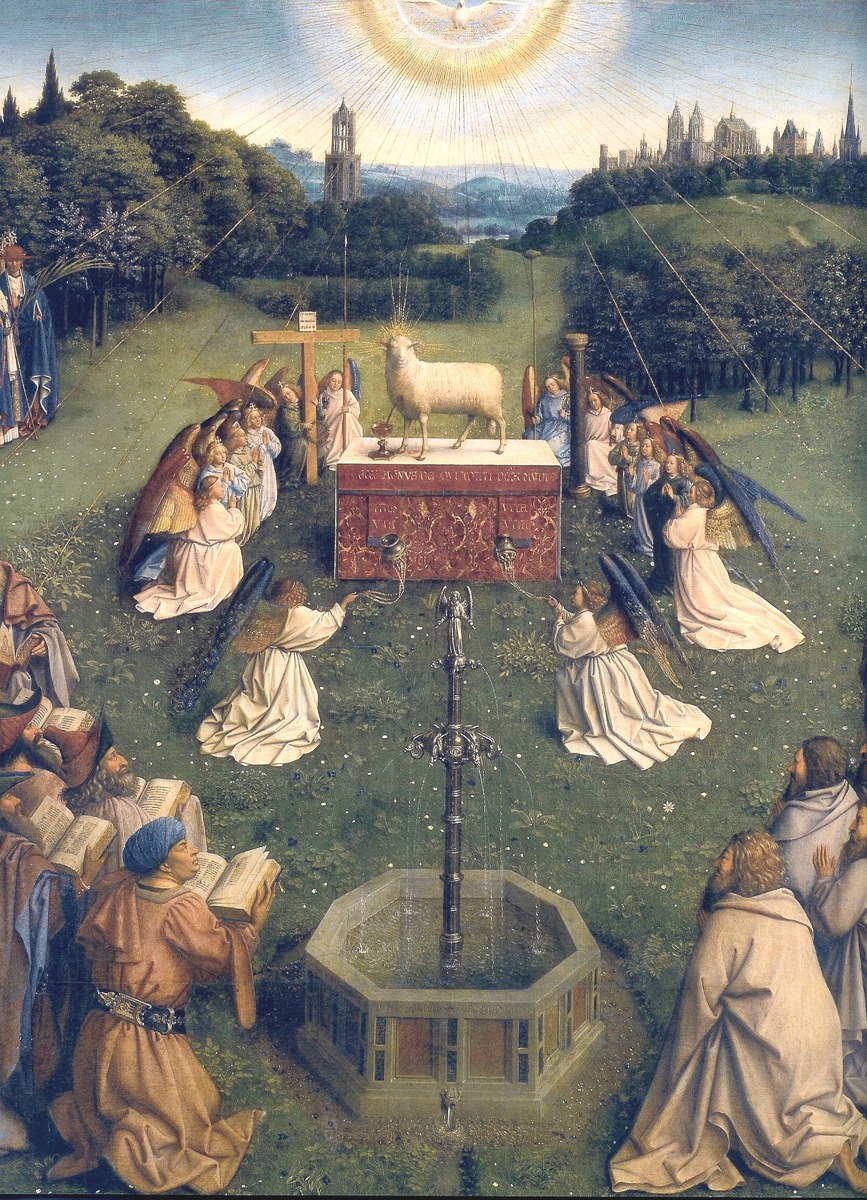
Chapter 13 ended with a mark on every hand and forehead that would take one. Chapter 14 opens on a hill with a company wearing a different name — and then three angels fly through heaven with the last message the world is going to get.
A Bible study on Revelation 14 · Arthur Baldwin · StandUp4Jesus.Org · 15 min read
Table of Contents
Read chapters 13 and 14 back to back, without the chapter break, and the effect is deliberate. The last thing seen is a world sorted by a mark. The first thing seen is a company standing with the Lamb, and the only thing said about their appearance is what is written on their foreheads.
A Lamb On Mount Zion
“And I looked, and, lo, a Lamb stood on the mount Sion, and with him an hundred forty and four thousand, having his Father’s name written in their foreheads.”
Revelation 14:1
Two marks, two chapters, same place on the body. The beast wrote its name on hands and foreheads; these carry the Father’s name on theirs. Nobody in Revelation ends up unmarked — the question the book puts is only ever whose name you are wearing. And the number has been met before: the 144,000 sealed in chapter 7 are the company standing here, and the seal there and the Father’s name here are written in the same place.
And the ground they are standing on is named. Mount Sion is where the temple stood, where God said He had set His King, and where Hebrews says the people of God have already come. In a book that has just shown the whole earth organised around a beast, this company is standing somewhere else entirely.
They sing something nobody else can pick up: “no man could learn that song but the hundred and forty and four thousand, which were redeemed from the earth” (Revelation 14:3). A song can be taught. This one cannot, which means it is not made of notes. It is made of an experience, and only the people who came through it can sing it.
The same thing was said of the new song in chapter 5, and for the same reason: the angels could not sing that one either. There is a note in the music of the redeemed that the unfallen universe can admire and cannot reproduce.
The description in verses 4 and 5 is worth taking as the book means it. Not defiled with women is covenant language — Revelation has already shown us one woman clothed with the sun and will shortly show us another in scarlet, and defilement here is spiritual company, not marriage. They follow the Lamb whithersoever he goeth, which is the plainest definition of discipleship in the book. In their mouth was found no guile — no spin, nothing shaded. And without fault before the throne of God, which after twelve chapters of this book can only mean one thing: their robes were washed.
One more word in that description repays attention: firstfruits. A firstfruits offering was the opening handful of a harvest, brought to God while the rest of the field was still standing. It is a promise of more to come, not a total. Whoever these 144,000 are, the word itself says they are not the whole crop. The site’s study of the number is at The Hundred Forty And Four Thousand Defined.
The First Angel: Fear God, And Give Glory To Him
“And I saw another angel fly in the midst of heaven, having the everlasting gospel to preach unto them that dwell on the earth, and to every nation, and kindred, and tongue, and people,”
Revelation 14:6
Begin with what it is called. Not a new message, not a warning first — the everlasting gospel. The same good news that was preached to Abraham and sung at Bethlehem, arriving at the end with nothing subtracted.
“It is declared to be a part of the “everlasting gospel;” and it announces the opening of the judgment.”
The Great Controversy, p. 355
And the audience is the same four-part list the Lamb was praised for buying in chapter 5 — every nation, and kindred, and tongue, and people. What was purchased there is preached to here. The message goes to everybody, which is worth remembering by anyone tempted to think of it as a message for insiders.
And it is an angel flying in the midst of heaven — above the whole earth at once, in the position where nobody can miss it. Whatever human beings do with this message, the picture insists it is not a local announcement.
“Saying with a loud voice, Fear God, and give glory to him; for the hour of his judgment is come: and worship him that made heaven, and earth, and the sea, and the fountains of waters.”
Revelation 14:7
Four imperatives, and the last one is doing quiet work. Worship him that made heaven, and earth, and the sea, and the fountains of waters — that is not a general statement about God being the Creator. It is close to a quotation of the fourth commandment, which grounds the Sabbath in exactly those terms: the One who made heaven, earth and sea, and rested.
Set that beside chapter 4, where the elders gave one reason for worship — “for thou hast created all things” — and beside chapter 13, where a whole world is persuaded to worship something else. The last call God sends to the planet is a call back to the Creator, and it names Him the way His own law names Him.
The clause before it dates the message: “for the hour of his judgment is come.” Not is coming. A judgment that has begun is being announced while the gospel is still being preached — which means it is not the final sentencing of the world, because the invitation is still open while it runs.
This series has already stood at the point where that announcement began. The little book of chapter 10 was sweet and then bitter, and the movement that ate it came out of 1844 understanding that something had started in the sanctuary rather than ended on earth — see Sweet As Honey, Bitter In The Belly. The first angel’s message is that discovery turned into a proclamation.
The Second Angel: Babylon Is Fallen
“And there followed another angel, saying, Babylon is fallen, is fallen, that great city, because she made all nations drink of the wine of the wrath of her fornication.”
Revelation 14:8
Babylon in Scripture is the city of confusion — the place where language was broken and a tower was built to reach heaven by human effort. The name is repeated for emphasis: fallen, is fallen.
Note the charge. Not that she is powerful, or wealthy, or hostile. It is that she made all nations drink. What is being announced is the collapse of something that had been serving the world a drink, and the drink is the reason for the fall. Chapter 17 will take this up at length; chapter 18 will call people out of her by name. Here it is a single line, flown across the sky.
And the drink is specific: the wine of the wrath of her fornication. Wine dulls the judgment before it does anything else, and fornication in the prophets is what a covenant people do when they take up with somebody else’s god. Put together, the charge is that she made the nations insensible to a betrayal — which is a harder accusation than persecution, because the victims agree to it.
It is worth noticing what the second angel does not say. It does not say the people in Babylon are lost. The city has fallen; the call to come out of her does not arrive until chapter 18, and when it does it is addressed to “my people” — which means God has people there at the time the announcement is made. A reader who uses this verse to write anybody off has read past the tense.
The Third Angel: The Warning
“And the third angel followed them, saying with a loud voice, If any man worship the beast and his image, and receive his mark in his forehead, or in his hand,”
Revelation 14:9
“The most fearful threatening ever addressed to mortals is contained in the third angel’s message.”
The Great Controversy, p. 449
She is not overstating it. The language of verses 10 and 11 is the hardest in the Bible: the wine of the wrath of God poured out without mixture, torment with fire and brimstone, smoke ascending for ever and ever.
Two things are worth saying plainly about it.
The first is who it is addressed to. The warning is not aimed at people who got a doctrine wrong; it is aimed at people who worship the beast and his image. Worship is a deliberate act. Nobody in this chapter is condemned for being confused.
There is also a phrase in verse 10 that is easy to hurry past and worth stopping on: the torment happens “in the presence of the holy angels, and in the presence of the Lamb.” Whatever the end of the wicked is, God does not conduct it out of sight. The One who died for them is present at it. That single clause rules out the picture of an indifferent judge signing warrants in another room.
The second concerns that phrase for ever and ever, which has done more damage to more people’s picture of God than almost any other line in Scripture. The smoke of Sodom went up the same way and Sodom is not burning today; Jonah said the earth’s bars closed about him for ever, and he was there three days. This study reads the destruction as final rather than endless, and the case for that — from Scripture rather than sentiment — is made in full at The Most Damaging Doctrine. It matters here because the third angel’s warning is meant to be believed, and a warning that makes God monstrous will simply be disbelieved.
These three messages are treated together, and at more length, on this site’s page for The 3 Angels’ Messages.
Here Is The Patience Of The Saints
“Here is the patience of the saints: here are they that keep the commandments of God, and the faith of Jesus.”
Revelation 14:12
One verse, and it answers two chapters. Chapter 13 said the beast would make war with the saints, and overcome them, and told them what was asked of them in the meantime: “Here is the patience and the faith of the saints” (Revelation 13:10). Here the same phrase returns with the identification completed.
And it matches, almost word for word, the description of the remnant at the end of chapter 12 — those “which keep the commandments of God, and have the testimony of Jesus Christ.” The book keeps describing the same people the same way: not by a denomination, not by a date, but by what they hold on to and who they trust.
Note also the balance in the phrase. The commandments of God and the faith of Jesus, together. Take either away and the description no longer fits anybody in this book.
Both halves have been misused. Some have taken the commandments and left the faith, and produced a religion of anxious record-keeping. Others have taken the faith and left the commandments, and produced a religion with nothing in it to disagree with. Revelation 14:12 refuses both by putting them in one sentence, and it does not explain how they fit together — it simply describes the people in whom they do.
Blessed Are The Dead
“And I heard a voice from heaven saying unto me, Write, Blessed are the dead which die in the Lord from henceforth: Yea, saith the Spirit, that they may rest from their labours; and their works do follow them.”
Revelation 14:13
In the middle of the most frightening passage in the book, a voice interrupts to dictate a blessing, and the instruction is Write. Somebody wanted this on the record.
What is promised is rest, not activity — that they may rest from their labours. And what continues is not the person but the work: their works do follow them. Whatever was done goes on ahead and is waiting; the one who did it is asleep and safe.
It is also worth noticing where the verse falls. It sits between the warning about the mark and the harvest of the earth — that is, in the middle of the passage a reader would least expect to find comfort in. Whoever placed it there knew that people would be reading verses 9 to 11 with somebody in mind, and afraid.
The Harvest And The Vintage
“And I looked, and behold a white cloud, and upon the cloud one sat like unto the Son of man, having on his head a golden crown, and in his hand a sharp sickle.”
Revelation 14:14
The crown is the mark of a King and the sickle is the tool of a farm labourer, and He is holding both. The One who told parables about wheat and tares, about seed growing secretly, about a harvest at the end of the world, is sitting on a cloud with the implement in His hand.
Two reapings follow, and they are not the same. The first is a grain harvest — “the harvest of the earth is ripe” — and grain is gathered into a barn. The second is a vintage: the clusters of the vine of the earth, thrown into “the great winepress of the wrath of God” (Revelation 14:19).
The pair is Joel’s before it is John’s. “Put ye in the sickle, for the harvest is ripe: come, get you down; for the press is full, the fats overflow” (Joel 3:13) — a sickle and a winepress in one verse, in that order, and Revelation 14 takes both.
The distinction runs through the whole Bible. Wheat and tares grow in the same field until the harvest, and are separated at the end by somebody who can tell the difference. What chapter 14 adds is the timing word used of both: ripe. Neither gathering happens early. Both wait until the thing being gathered has finished becoming what it was going to be.
And the winepress is trodden “without the city” (Revelation 14:20) — outside the walls, which is where Jesus was crucified. The place where He bore the wrath is the place it is finally poured out.
The measurement in that verse — a thousand and six hundred furlongs — has been read every way from a literal distance to a symbol of completeness, four squared times a hundred, covering the earth in every direction. This study does not need to settle it. What the verse establishes is scale: whatever the winepress is, it is not a corner of the map.
What This Asks Of Us
Revelation 14 is the answer the book gives to Revelation 13, and the shape of the answer is worth noticing.
Against a mark, a name. Against a world persuaded to worship an image, three angels sent to every nation with the everlasting gospel and a call to worship the Creator. Against a power that overcomes the saints, one sentence describing what the saints are: patient, commandment-keeping, holding the faith of Jesus.
It is one message, not three. The angels follow one another and the second and third build on the first — a call to worship the Creator, a warning that a system serving the nations a drink has fallen, and a warning about the alternative worship being enforced. Take the third away from the first and it becomes a threat; take the first away from the third and it becomes a slogan.
And the messages go out before the harvest, not after it. That is the order in the chapter and it is the order in the world. The angels fly first; the sickle comes last; and in between there is a blessing dictated from heaven for anybody who dies in the meantime.
Next in this series: The Seven Last Plagues Prepared — the sea of glass mingled with fire, and seven angels given the last seven plagues.
