The nations are summoned to a valley, told to turn their farm tools into weapons, and then judged. It is the shortest chapter in Joel and it contains the phrase everybody remembers: multitudes, multitudes in the valley of decision.
A Bible study on Joel 3 · Arthur Baldwin · StandUp4Jesus.Org · 13 min read
Table of Contents
Chapter 2 ended with the Spirit poured out on all flesh and a promise that whoever calls will be delivered. Chapter 3 is what happens to everybody else — and it opens, significantly, with a restoration rather than a sentence.
Verse 1 sets the timing: “in those days, and in that time, when I shall bring again the captivity of Judah and Jerusalem.” The judgment of the nations happens in the same period as the restoring of God’s people. The two are not separate programmes — one is the other seen from the outside.
The Valley Of Jehoshaphat
“I will also gather all nations, and will bring them down into the valley of Jehoshaphat, and will plead with them there for my people and for my heritage Israel, whom they have scattered among the nations, and parted my land.”
Joel 3:2
The name is the point. Jehoshaphat means the LORD judges, and no such valley appears on any map of Israel. Joel is not giving directions; he is naming a place by what happens in it.
And the charge is specific. The nations are not summoned for being pagan, or for their idols, or for their armies. They are called to account for what they did to people: scattering them, dividing their land, and — in verse 3 — “they have cast lots for my people; and have given a boy for an harlot, and sold a girl for wine.”
A boy traded for an hour with a prostitute. A girl sold for a drink. Joel does not generalise about injustice; he gives the exchange rate. That is the case being heard in the valley.
The cities named in verses 4 to 6 make it concrete: Tyre, Zidon, and the coasts of Palestine, charged with taking the silver and the gold, carrying temple treasures into their own temples, and selling the children of Judah and Jerusalem to the Grecians “that ye might remove them far from their border.” Slave trading, with the destination chosen to make return impossible.
And the sentence in verse 7 is that God will reach into the place they were sold to and bring them out: “Behold, I will raise them out of the place whither ye have sold them.” Distance was the whole point of the transaction, and distance turns out not to be a factor.
Beat Your Plowshares Into Swords
“Beat your plowshares into swords, and your pruninghooks into spears: let the weak say, I am strong.”
Joel 3:10
Anyone who knows Isaiah and Micah will stop at that verse, because it is their famous promise run backwards. There, in the last days, the nations beat their swords into plowshares and learn war no more. Here they are told to do the reverse: take the tools you grow food with and make weapons out of them.
It is not a contradiction; it is a summons issued in irony. God is not recruiting. He is telling a hostile world to bring everything it has — let the weak say, I am strong — because the confrontation is not going to be close and He would rather it were not misunderstood as one.
There is a second thing in the irony. Let the weak say, I am strong is exactly what people do say when a confrontation is coming and they are frightened. Joel puts the boast in their mouths before they make it.
Revelation puts the same gathering in the same terms: the kings of the earth and their armies assembled to make war against the rider on the white horse, and then no battle described at all. That chapter is studied at King Of Kings, And Lord Of Lords.
Multitudes In The Valley Of Decision
“Multitudes, multitudes in the valley of decision: for the day of the LORD is near in the valley of decision.”
Joel 3:14
The word is doubled because the crowd is beyond counting, and the sentence has entered the language.
It is worth being careful about whose decision it is. The verse is often quoted as though the multitudes are standing there making up their minds, and there is a real truth in reading it that way — nobody arrives in that valley by accident. But the valley was named two verses earlier as the place where God says “there will I sit to judge all the heathen round about” (Joel 3:12). The decision being handed down is His.
Both readings end in the same place, and Joel probably intended both. The decisions people make quietly, over years, are what the decision in the valley is about.
Verse 15 repeats the darkened lights of chapter 2 — sun and moon dark, the stars withdrawing their shining — for the third time in three chapters. Joel keeps putting out the lights, and each time it is a way of saying that the ordinary order of things has been suspended because something final is happening.
Put Ye In The Sickle
“Put ye in the sickle, for the harvest is ripe: come, get you down; for the press is full, the fats overflow; for their wickedness is great.”
Joel 3:13
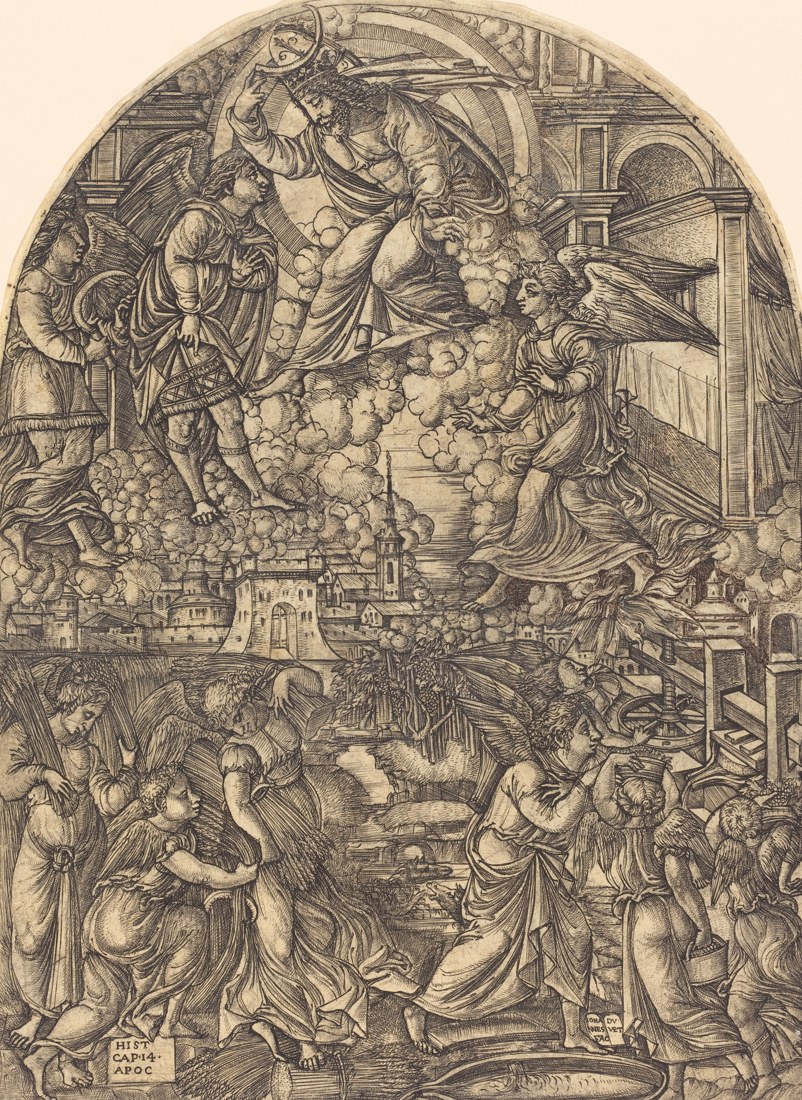
John lifts this verse almost intact into Revelation 14, where an angel cries to the One on the cloud, “Thrust in thy sickle, and reap: for the time is come for thee to reap; for the harvest of the earth is ripe” — and then a second angel gathers the vine of the earth into the winepress. Joel has both images in one verse: the sickle and the press, the grain and the grapes.
And Joel gives the reason Revelation leaves implicit. The harvest happens when the crop is ripe — and here, ripeness is defined: for their wickedness is great. Nothing is cut early. The gathering waits until what was growing has finished growing.
The Revelation 14 study is at The Everlasting Gospel To Every Nation.
The LORD Also Shall Roar
“The LORD also shall roar out of Zion, and utter his voice from Jerusalem; and the heavens and the earth shall shake: but the LORD will be the hope of his people, and the strength of the children of Israel.”
Joel 3:16
One verse, and it turns on the word but.
The same sound shakes heaven and earth and is a refuge to His people. Nothing changes about the roar; what differs is where you are standing when it comes. In chapter 1 the locusts had a lion’s teeth. Here the lion is God, and He is roaring on behalf of the people the nations sold for wine.
Amos opens his book with the identical sentence, and Revelation 10 has the mighty angel crying “as when a lion roareth.” It is the one noise in Scripture that means both terror and rescue at once.
The Mountains Shall Drop Down New Wine
“And it shall come to pass in that day, that the mountains shall drop down new wine, and the hills shall flow with milk, and all the rivers of Judah shall flow with waters, and a fountain shall come forth of the house of the LORD, and shall water the valley of Shittim.”
Joel 3:18
Now look back at chapter 1. The new wine is dried up (1:10). The rivers of waters are dried up (1:20). The vine is dried up (1:12).
The book closes by reversing its own opening, item by item. What was dried up runs; the mountains that had nothing on them drip with wine; and a fountain comes out of the house of the LORD — the same house where the offerings had stopped in chapter 1 because there was nothing to bring.
The valley it waters is named too, and the name is not decoration. Shittim was the last camp of Israel before they crossed into the land, and the place where they fell into the sin of Baal-peor. A fountain out of the house of the LORD, watering the valley where the nation disgraced itself, is the whole point of the book in one image.
Ezekiel was shown that fountain in more detail, running out from under the threshold and getting deeper the further it went; that study is at The LORD Is There. And it is the same river John sees in the last chapter of the Bible, proceeding out of the throne of God and of the Lamb.
What This Asks Of Us
Joel is three chapters long and it moves from a stripped field to a fountain out of the temple, and the whole distance is covered by one instruction: turn ye even to me with all your heart.
Chapter 3 adds something the first two did not say outright — that God keeps a record of what was done to people, and that He takes it personally. The nations in the valley are not there for their theology. They are there for a boy traded for an hour and a girl sold for a drink, and the God who is slow to anger in chapter 2 has not forgotten either of them.
The last verse of the book is a promise about cleansing — “For I will cleanse their blood that I have not cleansed: for the LORD dwelleth in Zion.” Blood that was never answered for gets answered for. And the reason given is the last four words: the LORD dwelleth in Zion. He lives there. It is His neighbourhood, and what happened in it is His business.
Anybody who has been treated as something to be sold, and has watched it go unanswered, is being told here that it did not go unnoticed.
This completes the study of Joel. The three chapters are gathered on the Joel page.
