Nine chapters of measurements, given to refugees who owned no land and had no building materials. And then the last three words of the book explain everything.
A Bible study on Ezekiel 40–48 · Arthur Baldwin · StandUp4Jesus.Org · 14 min read
Table of Contents
These are the chapters everyone skips. Gate measurements, chamber dimensions, wall thicknesses, land allotments — nine chapters of surveying, at the end of a book most readers have already found difficult.
But this is where the whole book has been going, and if you have followed this series from God And His Throne, you are about to watch it close a circle it opened in chapter one.
Twenty Years Later
“In the five and twentieth year of our captivity, in the beginning of the year, in the tenth day of the month, in the fourteenth year after that the city was smitten, in the selfsame day the hand of the LORD was upon me, and brought me thither.”
Ezekiel 40:1
He dates it, as he always does. And what a date it is.
Twenty-five years into the captivity. Fourteen years after the city was smitten — that is, fourteen years after Jerusalem fell and the temple burned, exactly as chapters eight through eleven said it would. Ezekiel is an old man now. Everyone in the camp knows he was right, which is a bitter sort of vindication.
And on that day, to that man, in that place, God shows a temple.
A Man With A Measuring Reed
“And he brought me thither, and, behold, there was a man, whose appearance was like the appearance of brass, with a line of flax in his hand, and a measuring reed; and he stood in the gate. And the man said unto me, Son of man, behold with thine eyes, and hear with thine ears, and set thine heart upon all that I shall shew thee… declare all that thou seest to the house of Israel.”
Ezekiel 40:3, 4
Three faculties are commanded: eyes, ears, heart. And then a fourth thing — declare it.
Consider how that must have sounded. A community of deportees, four hundred miles from a burned-out ruin they are forbidden to return to, being handed a full architectural specification. No land. No timber. No stone. No permission. And nine chapters of dimensions.
Measurements are a strange kind of comfort. But they are a very specific kind: you do not measure something you are imagining. You measure something that is really there. Every cubit in these chapters says the same thing to a man with nothing left — this is not a wish. It has dimensions.
The Glory Comes Back By The East Gate
Now, in chapter 43, comes the moment this series has been walking toward since the first article.
“Afterward he brought me to the gate, even the gate that looketh toward the east: And, behold, the glory of the God of Israel came from the way of the east: and his voice was like a noise of many waters: and the earth shined with his glory… And the glory of the LORD came into the house by the way of the gate whose prospect is toward the east. So the spirit took me up, and brought me into the inner court; and, behold, the glory of the LORD filled the house.”
Ezekiel 43:1, 2, 4, 5
Go back and read that against Begin At My Sanctuary. There we watched the glory leave in four slow stages — from the cherub, to the threshold, back over the cherubim, and then out: “every one stood at the door of the east gate of the LORD’s house” (10:19), and finally up from the midst of the city to the mountain on the east side (11:23).
It left by the east gate. It comes back by the east gate. Same door, opposite direction.
And Ezekiel himself tells us this is one continuous story. Look at the verse in between:
“And it was according to the appearance of the vision which I saw, even according to the vision that I saw when I came to destroy the city: and the visions were like the vision that I saw by the river Chebar; and I fell upon my face.”
Ezekiel 43:3
The same vision he saw by the river Chebar. That is chapter one — the chariot-throne on wheels, the creatures, the rings full of eyes. The book has three appearances of that throne: it arrives in Babylon to a captive priest, it carries judgment into Jerusalem and out again, and now it comes home. And each time, the prophet falls on his face.
Then the voice from the throne says the thing the whole book has been aching for:
“Son of man, the place of my throne, and the place of the soles of my feet, where I will dwell in the midst of the children of Israel for ever.”
Ezekiel 43:7
The Gate That Stays Shut
“Then said the LORD unto me; This gate shall be shut, it shall not be opened, and no man shall enter in by it; because the LORD, the God of Israel, hath entered in by it, therefore it shall be shut.”
Ezekiel 44:2
A sealed door, and the reason given is not security. The gate is shut because He came through it. It is a permanent memorial to an arrival — and, read against chapters ten and eleven, a quiet promise about the direction of travel. That door will not be used for leaving again.
The Word “If” In Chapter 43
Now to the question everyone eventually asks: this temple was never built. What happened?
The answer is not hidden in a commentary. It is sitting in the middle of the vision, in the instructions Ezekiel was given about what to do with the plans:
“Thou son of man, shew the house to the house of Israel, that they may be ashamed of their iniquities: and let them measure the pattern. And if they be ashamed of all that they have done, shew them the form of the house, and the fashion thereof… and write it in their sight, that they may keep the whole form thereof, and all the ordinances thereof, and do them.”
Ezekiel 43:10, 11
There it is, in the text itself. And if.
In Gog And Magog we looked at Jeremiah 18, where God explains that a promise to build and to plant a nation can be withdrawn if that nation walks away. Some readers find that principle convenient. Here it is not imported from anywhere — it is written into the temple vision, in the very instruction about handing over the plans. The blueprint comes with a condition attached, and the condition is repentance.
The exiles did return. And the house they built under Zerubbabel was not this house — so plain by comparison that the old men who remembered Solomon’s temple wept when they saw the foundation. The glorious thing on the mountain, with the river running east out of it, never rose.
Notice what God does not do, though. He does not withdraw the vision. The pattern stays in the book, dimension by dimension, for twenty-five centuries — because what He intended to do never changed, only the address at which He would do it.
The River That Nobody Dug
Chapter 47 is the most beautiful thing in the book, and it starts almost casually:
“Afterward he brought me again unto the door of the house; and, behold, waters issued out from under the threshold of the house eastward.”
Ezekiel 47:1
Water coming out from under the door of the sanctuary. Nobody dug a channel. Nobody pumped it. It simply comes out from where God lives.
And then the man with the measuring line does something with it that I find unbearably good. He measures the water:
- A thousand cubits — the waters were to the ankles.
- Another thousand — to the knees.
- Another thousand — to the loins.
- Another thousand — “a river that I could not pass over: for the waters were risen, waters to swim in, a river that could not be passed over” (47:5).
It deepens the further it gets from the source, which no natural river does. And there is a point at which measuring stops being possible and the only thing left to do is let go and swim.
Where does it go? East, down into the desert, into the sea — and the sea, the Dead Sea, “shall be healed”. “Every thing shall live whither the river cometh” (47:9). Trees on both banks whose leaf does not fade, new fruit every month, “and the leaf thereof for medicine” (47:12).
Ellen White takes this river and gives it a use that fits the whole series:
“Wonderful is the work which the Lord designs to accomplish through His church, that His name may be glorified. A picture of this work is given in Ezekiel’s vision of the river of healing.”
Ellen G. White · The Acts of the Apostles, p. 13
The church as the riverbed, not the spring. The water issues from the sanctuary; the people it passes through are where it goes. And note the reason she gives — that His name may be glorified — the same reason given for the restoration in chapter 36 and for the judgment in chapters 38 and 39. This book has one motive from end to end.
And The Stranger Gets An Inheritance
Then, in the middle of the land survey, a sentence that should stop us:
“And it shall come to pass, that ye shall divide it by lot for an inheritance unto you, and to the strangers that sojourn among you, which shall beget children among you: and they shall be unto you as born in the country among the children of Israel; they shall have inheritance with you among the tribes of Israel.”
Ezekiel 47:22
The foreigner does not get a courtyard at the edge and a permit. He gets an inheritance, and he is counted as born in the country. Written by a Jewish priest, in exile, about the tribal land of Israel.
Whatever else these chapters are, they were never small.
Where It All Lands
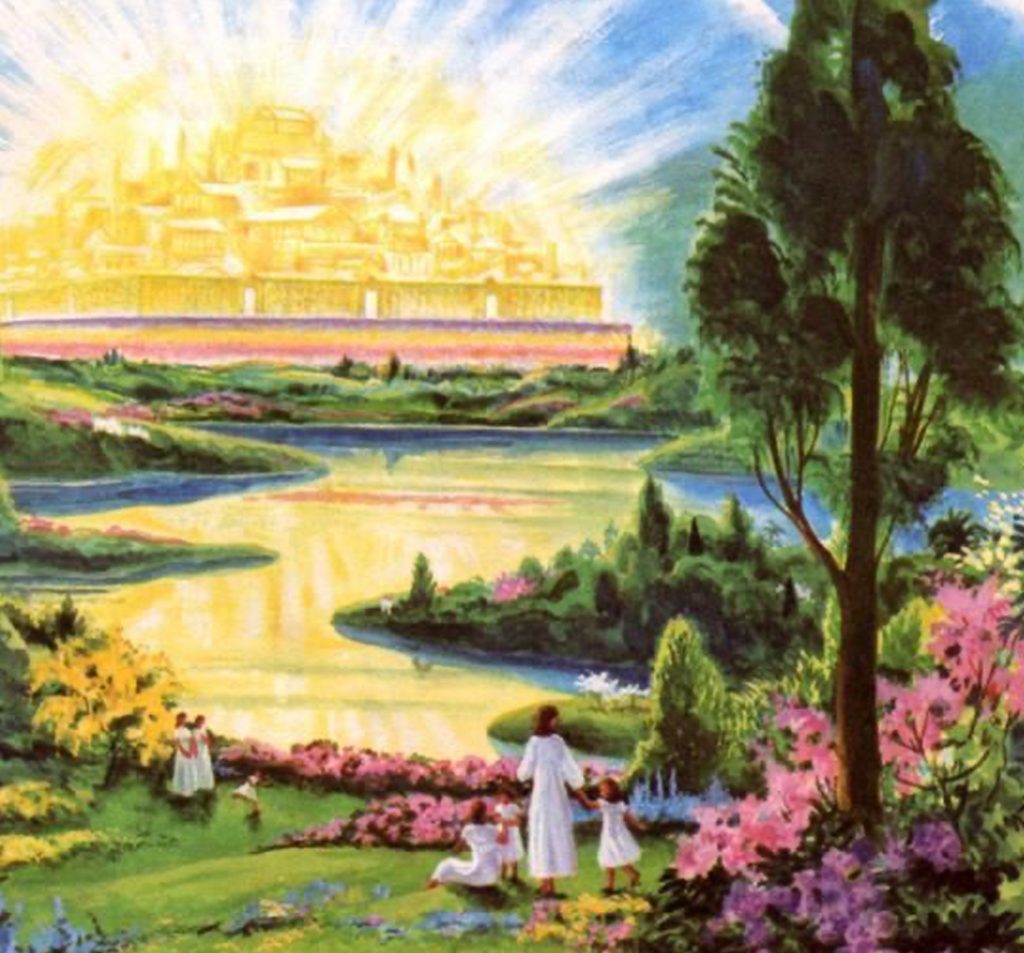
Turn to the last two chapters of the Bible and you will find Ezekiel’s vision, item by item, in a city instead of a temple:
- A man with a measuring reed — “he that talked with me had a golden reed to measure the city” (Revelation 21:15).
- The river — “a pure river of water of life, clear as crystal, proceeding out of the throne of God and of the Lamb” (22:1).
- The trees, the monthly fruit, the healing leaf — “the tree of life, which bare twelve manner of fruits, and yielded her fruit every month: and the leaves of the tree were for the healing of the nations” (22:2).
- God dwelling among them — “Behold, the tabernacle of God is with men, and he will dwell with them” (21:3).
And then the one difference, which is the whole point:
“And I saw no temple therein: for the Lord God Almighty and the Lamb are the temple of it.”
Revelation 21:22
Ezekiel was given nine chapters of temple. John is shown the same scene and reports that there is no temple in it, because God and the Lamb are the temple.
That is not a contradiction. It is the answer. The building was always a stand-in for a Person — a way of saying God is here in stone and cubits, to people who needed it said that way. When the Person is present without a veil, the stand-in is not needed. The blueprint was never the promise. The presence was the promise.
The Last Three Words
Forty-eight chapters. A throne on wheels over a prison camp. Abominations in the dark rooms of the temple. A man with an inkhorn marking foreheads. The glory going out by inches. A covering cherub who was perfect until he was not. A Sabbath polluted, shepherds who ate the flock, a valley of dry bones, an army of nations, and a river.
And the very last line of the book is the name of a city:
“…and the name of the city from that day shall be, The LORD is there.”
Ezekiel 48:35
The whole book is about a God who left. He left because He was driven out — by the image at the gate, the creeping things on the wall, the twenty-five men with their backs to Him. Ezekiel watched Him go, stage by stage, and then spent the rest of his life among people whose entire theology had been built on the assumption that He would never leave.
And the last thing the book says is that there is a city whose name is the fact that He is not going anywhere.
Jehovah Shammah. The LORD is there.
That is the end of Ezekiel, and the end of this series. If you have followed it through, you know by now that this book is not mainly about wheels, or about Gog, or about measurements. It is about whether God will dwell with people like us — and it answers yes, at enormous cost, and forever.
In one breath
- The vision comes fourteen years after the city fell — to an old prophet whose warnings had all come true.
- You do not measure what you are imagining. Nine chapters of dimensions say: this is real.
- The glory left by the east gate (10:19; 11:23) and returns by the east gate (43:1–4) — and Ezekiel says it is the same vision he saw by the river Chebar in chapter 1.
- That gate is then sealed because He entered by it (44:2).
- The condition is in the text: “and if they be ashamed of all that they have done, shew them the form of the house” (43:11). The temple was never built because the if was never met.
- The river deepens as it leaves the source — ankles, knees, loins, waters to swim in — and heals the Dead Sea. Ellen White makes it a picture of the work of the church.
- Revelation 21–22 carries it all forward — reed, river, tree, monthly fruit, healing leaves — with one temple missing, “for the Lord God Almighty and the Lamb are the temple of it.”
- The book ends with a city named “The LORD is there.”
