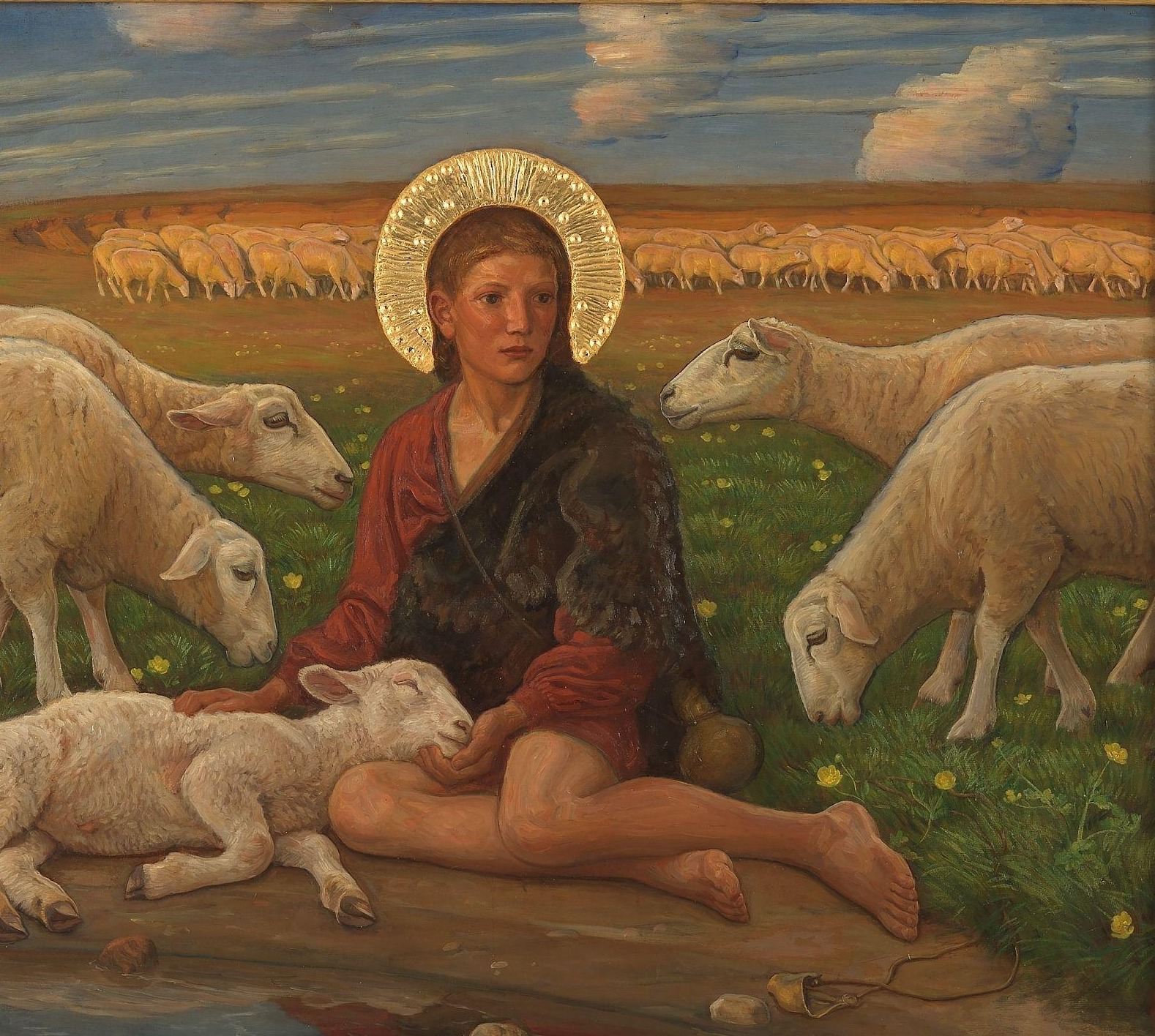
God spends nine verses on what the shepherds failed to do — and then does every one of those things Himself, in the same order.
A Bible study on Ezekiel 34 · Arthur Baldwin · StandUp4Jesus.Org · 12 min read
Table of Contents
In Begin At My Sanctuary we watched judgment fall on the men who were supposed to be guarding the spiritual interests of God’s people. Ezekiel 34 is the chapter where God says out loud what those men were and were not.
And then it does something that turns the whole book over. Having spent nine verses on what the shepherds failed to do, God announces that He will do every one of those things Himself.
Woe To The Shepherds
“Son of man, prophesy against the shepherds of Israel, prophesy, and say unto them, Thus saith the Lord GOD unto the shepherds; Woe be to the shepherds of Israel that do feed themselves! should not the shepherds feed the flocks? Ye eat the fat, and ye clothe you with the wool, ye kill them that are fed: but ye feed not the flock.”
Ezekiel 34:2, 3
Read verse 3 carefully, because it is not a charge of laziness. These men were busy. They ate the fat, they wore the wool, they killed the well-fed ones for the table. Every activity listed is an activity of harvesting. The flock was producing for them beautifully.
The charge is that the flow only ever went one direction. But ye feed not the flock. A shepherd who takes wool, milk and meat is not doing anything wrong — that is the arrangement. A shepherd who takes all three and puts nothing back has stopped being a shepherd and become a consumer of sheep.
Five Things They Did Not Do
Then comes the indictment proper, and I want you to notice its grammar:
“The diseased have ye not strengthened, neither have ye healed that which was sick, neither have ye bound up that which was broken, neither have ye brought again that which was driven away, neither have ye sought that which was lost; but with force and with cruelty have ye ruled them.”
Ezekiel 34:4
Five charges, and every one of them is something not done:
- the diseased — not strengthened
- the sick — not healed
- the broken — not bound up
- the driven away — not brought again
- the lost — not sought
No heresy is named here. No embezzlement, no immorality, no idol in the sanctuary. The case against these men is built almost entirely out of the sheep they did not go after. It is possible to be condemned by heaven for a list of things you simply never got around to.
And note which sheep are on the list. Not the strong ones. Every single category is a sheep that costs something — the sick one that needs nursing, the broken one that needs carrying, the strayed one that needs a long walk in the dark to find. Those are precisely the sheep that produce nothing, and precisely the ones nobody notices are missing.
Only the last clause is an act rather than an omission: “but with force and with cruelty have ye ruled them.” Where these men did exert themselves, it was to drive.
Whose Sheep They Were
“And they were scattered, because there is no shepherd: and they became meat to all the beasts of the field, when they were scattered. My sheep wandered through all the mountains, and upon every high hill: yea, my flock was scattered upon all the face of the earth, and none did search or seek after them.”
Ezekiel 34:5, 6
Because there is no shepherd. Not because there were no men in the office — the office was fully staffed, and the men in it were eating well. There was no shepherd because nobody in the role was doing the work.
And now count the possessives running through this chapter: my sheep, my flock, my pasture. Over and over. These shepherds were handling property that was never theirs, and that is exactly the ground of the sentence:
“Behold, I am against the shepherds; and I will require my flock at their hand, and cause them to cease from feeding the flock; neither shall the shepherds feed themselves any more; for I will deliver my flock from their mouth, that they may not be meat for them.”
Ezekiel 34:10
I will require my flock at their hand. An owner asking a hired man to account for livestock. Every sheep will be counted, and the missing ones will be asked about by name.
Behold, I, Even I
Here the chapter turns, and it is one of the great turns in Scripture:
“For thus saith the Lord GOD; Behold, I, even I, will both search my sheep, and seek them out… I will feed my flock, and I will cause them to lie down, saith the Lord GOD. I will seek that which was lost, and bring again that which was driven away, and will bind up that which was broken, and will strengthen that which was sick.”
Ezekiel 34:11, 15, 16
Now put verse 16 beside verse 4 and read them together. It is the same list. The identical five categories, in reverse order, every one of them turned from an accusation into a promise:
- “neither have ye sought that which was lost” → “I will seek that which was lost”
- “neither have ye brought again that which was driven away” → “and bring again that which was driven away”
- “neither have ye bound up that which was broken” → “and will bind up that which was broken”
- “the diseased have ye not strengthened” → “and will strengthen that which was sick”
That is not a coincidence of wording. It is the point of the chapter. God takes the charge sheet of the failed shepherds and turns it, item by item, into His own job description.
And notice one more thing He adds that they never managed: “I will cause them to lie down.” A sheep only lies down when it is not afraid. Under those men the flock was scattered over every high hill, jumpy and hunted. The first thing the true Shepherd does is make it safe enough to rest.
And As For You, O My Flock
If the chapter stopped at verse 16 we could all go home feeling sorry for ourselves and hard done by. It does not stop there. God turns from the shepherds and addresses the sheep:
“And as for you, O my flock, thus saith the Lord GOD; Behold, I judge between cattle and cattle, between the rams and the he goats. Seemeth it a small thing unto you to have eaten up the good pasture, but ye must tread down with your feet the residue of your pastures? and to have drunk of the deep waters, but ye must foul the residue with your feet?”
Ezekiel 34:17, 18
This is one of the most searching pictures in the Old Testament, and it is about sheep, not shepherds. The strong ones eat their fill — fair enough — and then walk through what is left and trample it. They drink from the clear water and then stand in it until it is muddy.
Nobody set out to ruin anything. That is what makes it so recognizable. It is simply careless strength, moving through a shared pasture without once looking behind to see what condition it leaves things in for the animals coming after. And then:
“Because ye have thrust with side and with shoulder, and pushed all the diseased with your horns, till ye have scattered them abroad.”
Ezekiel 34:21
Pushed all the diseased with your horns. The same sick and broken sheep the shepherds failed to bind up are now being shouldered out of the way by the healthy ones. The weak get it from both directions — neglected from above and jostled from beside.
So this chapter gives nobody a clean seat. If we read it and think only of leaders who have failed us, we have read half of it and stopped at the flattering half.
One Shepherd
“And I will set up one shepherd over them, and he shall feed them, even my servant David; he shall feed them, and he shall be their shepherd.”
Ezekiel 34:23
David had been dead some four hundred years when Ezekiel wrote this. So the promise is not about a resurrected king of Israel; it is about someone who would come in David’s line and do what David at his best had done — the shepherd boy who went after the lion and the bear for one lamb.
One shepherd, not a committee. And when He came, He claimed this chapter in as many words:
“I am the good shepherd: the good shepherd giveth his life for the sheep. But he that is an hireling, and not the shepherd, whose own the sheep are not, seeth the wolf coming, and leaveth the sheep, and fleeth… I am the good shepherd, and know my sheep, and am known of mine.”
John 10:11, 12, 14
The hireling in John 10 is the shepherd of Ezekiel 34 — the man whose own the sheep are not, who leaves when it costs. And the contrast Christ draws is not that He works harder. It is that He owns them, and lays down His life for them.
It is also worth seeing what moved Him when He looked at a crowd: “he was moved with compassion on them, because they fainted, and were scattered abroad, as sheep having no shepherd” (Matthew 9:36). The exact diagnosis of Ezekiel 34:5 — scattered, because there is no shepherd — made by the Shepherd Himself, standing in front of the flock.
Where Ellen White Puts This Chapter
Ezekiel 34 is quoted often, and usually as a weapon. So I went looking for where Ellen White uses it — and the setting surprised me.
She quotes verses 4 to 6 in Testimonies volume 5. But the paragraph she puts it in opens like this:
“Now, while probation lingers, it does not become one to pronounce sentence upon others and look to himself as a model man… We are not to condemn others; this is not our work; but we should love one another and pray for one another.”
Ellen G. White · Testimonies for the Church, vol. 5, p. 345
And a few sentences later, still in the same paragraph, immediately before she quotes Ezekiel 34:
“What a great missionary work is this! how much more Christlike than for poor, fallible mortals to be ever accusing and condemning those who do not exactly meet their minds… Jesus is the Good Shepherd. He cares for His feeble, sickly, wandering sheep. He knows them all by name. The distress of every sheep and every lamb of His flock touches His heart of sympathizing love, and the cry for aid reaches His ear. One of the greatest sins of the shepherds of Israel is thus pointed out by the prophet…”
Ellen G. White · Testimonies for the Church, vol. 5, p. 346
So she reaches for Ezekiel 34 in the middle of a warning against accusing people — and she uses the failed shepherds as the dark background against which the Good Shepherd is seen, not as ammunition for the critics of anybody.
I find that quietly corrective. The chapter is severe, and it is meant to be. But the moment I start reading it as a list of other people’s failures, I have used it in a way she did not.
What This Asks Of Us
Most of us are shepherds of something. Not many readers of this page are conference officials. But a father is a shepherd, and so is a Sabbath School teacher, a deacon, an elder, a big brother, anyone with somebody weaker in his care. The five verbs are the test, and none of them is doctrinal: strengthen, heal, bind up, bring again, seek.
The charge sheet is made of omissions. That is the part I cannot get past. These men were not accused of preaching heresy. They were accused of not going after the ones who had gone. Ask who has stopped coming, and how long it has been since anybody went and asked why.
Watch the water you leave behind you. Strong sheep foul the pool without meaning to. A church can be perfectly orthodox and still be a hard place to be weak in.
And if you are one of the scattered ones — driven off, pushed aside with somebody’s shoulder, or simply never missed — read verse 11 again and let it be about you. Behold, I, even I, will both search my sheep, and seek them out. He does not send. He comes.
Next in this series: Ezekiel 36 and 37 — the new heart, and the valley of dry bones.
In one breath
- The shepherds were not lazy — they were harvesting. “Ye eat the fat, and ye clothe you with the wool… but ye feed not the flock.”
- The indictment of verse 4 is five things not done, all of them about sheep that cost something: the diseased, sick, broken, driven away, lost.
- “Because there is no shepherd” — the office was staffed; the work was not being done.
- Verse 16 answers verse 4 item for item: what they would not do, God says He will do Himself. And He adds one thing more — “I will cause them to lie down.”
- Then He judges the sheep: fat ones treading the pasture, fouling the water, and pushing the diseased with their horns.
- One shepherd, “my servant David” — claimed by Christ in John 10, where the hireling is Ezekiel’s shepherd exactly.
- Ellen White quotes this chapter inside a warning against condemning others, as the backdrop to the Good Shepherd who “knows them all by name.”
