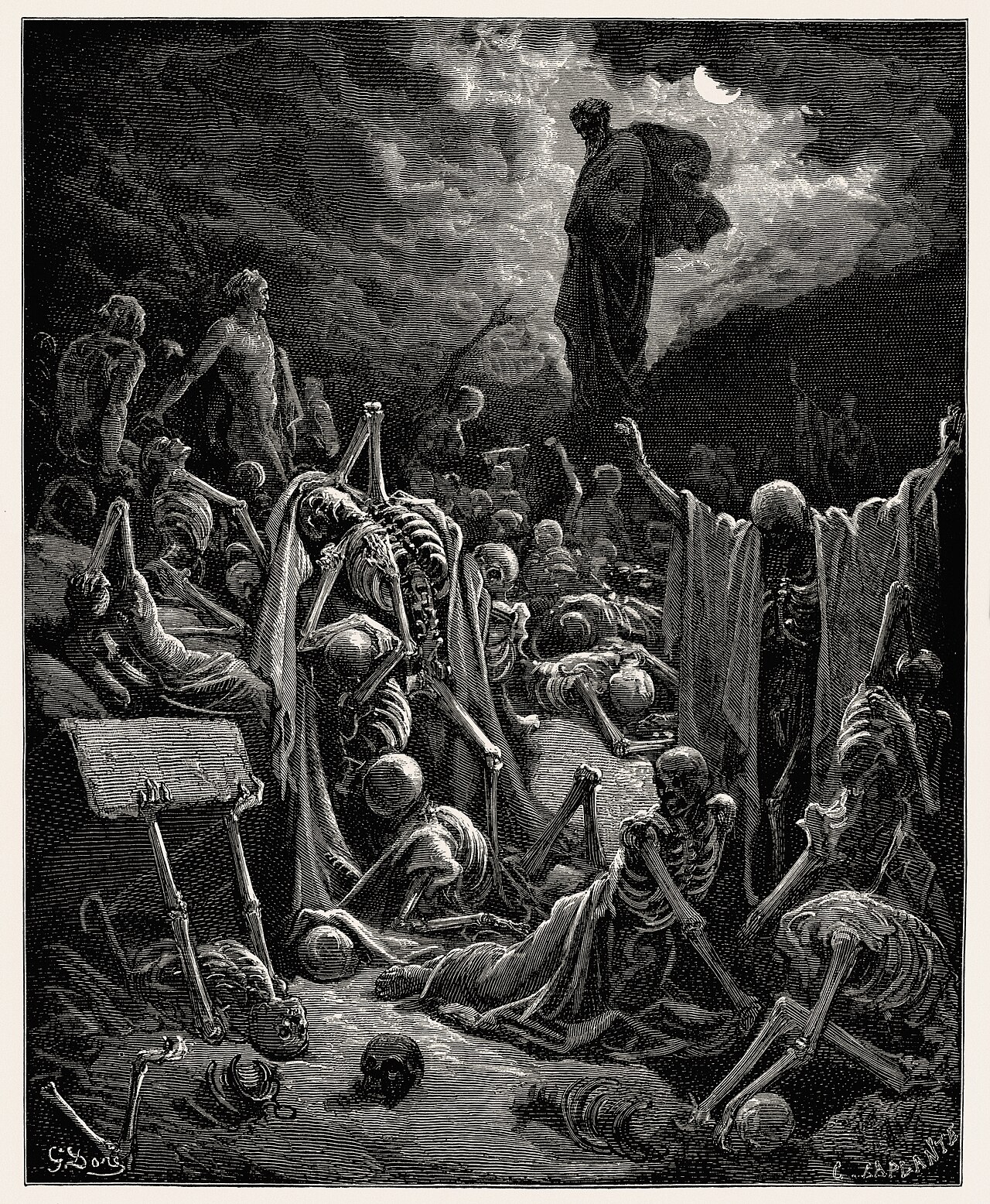
The bones come together, the sinews and flesh come up, the skin covers them over — and they are still dead. That verse is the most important one in the vision.
A Bible study on Ezekiel 36 and 37 · Arthur Baldwin · StandUp4Jesus.Org · 13 min read
Table of Contents
We have come a long way with this book. A throne arrived on wheels. A court convened in the temple and the glory went out the east gate. We have seen where sin began, what the sign of the Sabbath was for, and what God thinks of shepherds who feed themselves.
Now, in two chapters, Ezekiel is shown what God intends to do about all of it. And He does not propose to reform anybody. He proposes to replace the heart and raise the dead, which are two ways of describing the same act.
Not For Your Sakes
Before a word of promise, God says plainly why He is doing it — and it is not flattering:
“Therefore say unto the house of Israel, Thus saith the Lord GOD; I do not this for your sakes, O house of Israel, but for mine holy name’s sake, which ye have profaned among the heathen, whither ye went.”
Ezekiel 36:22
And in case anyone missed it, He says it a second time ten verses later: “Not for your sakes do I this, saith the Lord GOD, be it known unto you: be ashamed and confounded for your own ways, O house of Israel” (36:32).
This is the refrain we met in The Sign Between Us — I wrought for my name’s sake — and it is worth pausing on, because it settles something. The restoration is not a reward for improvement. There is no suggestion anywhere that Israel had turned a corner, learned its lesson, or earned a second look. God acts because His name is attached to these people, and He will not have that name dragged through the nations.
Which means the promise that follows is not fragile. It does not depend on the recipients being the sort of people who deserve it. It rests on God’s regard for His own character, and that is the safest foundation there is.
Every Verb Is His
“Then will I sprinkle clean water upon you, and ye shall be clean: from all your filthiness, and from all your idols, will I cleanse you. A new heart also will I give you, and a new spirit will I put within you: and I will take away the stony heart out of your flesh, and I will give you an heart of flesh. And I will put my spirit within you, and cause you to walk in my statutes, and ye shall keep my judgments, and do them.”
Ezekiel 36:25–27
Count the actors. I will sprinkle. I will cleanse. I will give. I will put. I will take away. I will give. I will put. I will cause. Eight times, and the pronoun never changes.
Then watch the one clause that describes the people doing something: “and cause you to walk in my statutes, and ye shall keep my judgments, and do them.” Their obedience is real — they walk, they keep, they do — but it stands on the far side of a cause. Obedience here is the result of the new heart, not the price of it.
That is the same order I set out in Even Your Sanctification, and it is worth saying plainly for anyone who fears this teaching is legalism: the law is not the ladder. It is what a new heart naturally does. Ellen White glosses the promise in one line:
“The words, ‘A new heart also will I give you,’ mean, ‘A new mind will I give you.’”
Ellen G. White · My Life Today, p. 24
Not new feelings. A new way of thinking — which is exactly what a stony heart lacks. And note that this promise was already made once in this book, back in chapter 11, in the very passage where the glory was leaving the temple. God announced the cure before He carried out the sentence.
The Startling Order Of Verse 31
“Then shall ye remember your own evil ways, and your doings that were not good, and shall lothe yourselves in your own sight for your iniquities and for your abominations.”
Ezekiel 36:31
Then. After the clean water. After the new heart. After the Spirit is put within them.
We usually assume the sequence runs the other way — that a man must first see how bad he is, be properly sorry, and then God will do something for him. This verse puts the deep sight of sin after the cleansing, not before it. And that matches experience. Nobody sees the real ugliness of what he has been while he is still in the middle of it, defending it. It is the man who has been brought into the light who looks back and is appalled.
Which is a mercy, not a threat. If God waited for us to feel sorry enough first, none of us would ever begin.
Set Down In The Valley
“The hand of the LORD was upon me, and carried me out in the spirit of the LORD, and set me down in the midst of the valley which was full of bones, And caused me to pass by them round about: and, behold, there were very many in the open valley; and, lo, they were very dry.”
Ezekiel 37:1, 2
Notice that he is made to walk through them first. Round about, past them, at close range — the way you are made to look at something before you are asked about it. And two facts are established before any question is put: there are very many, and they are very dry. Not recently fallen. Long dead, bleached, past the point where anyone would wonder about a pulse.
“And he said unto me, Son of man, can these bones live? And I answered, O Lord GOD, thou knowest.”
Ezekiel 37:3
That is one of the most honest answers in the Bible. He does not say yes, because he can see what he is looking at. He does not say no, because he knows who is asking. Thou knowest is the reply of a man who has run out of opinion and has not run out of faith.
Prophesy Upon These Bones
Now God gives an instruction that on its face is absurd: “Prophesy upon these bones, and say unto them, O ye dry bones, hear the word of the LORD” (37:4). Preach to a bone yard. Address skeletons as though they have ears.
Ellen White draws the obvious application, and it is bracing:
“Yet nevertheless the word of the prophecy must be spoken even to those who are like the dry bones in the valley… We are to preach the word of life to those whom we may judge to be as hopeless subjects as though they were in their graves.”
Ellen G. White · The SDA Bible Commentary, vol. 4, p. 1165
Whom we may judge to be as hopeless. Our estimate of a person’s prospects is not part of the commission. Ezekiel was not asked for an assessment; he was told to speak. And when he did:
“So I prophesied as I was commanded: and as I prophesied, there was a noise, and behold a shaking, and the bones came together, bone to his bone.”
Ezekiel 37:7
But There Was No Breath In Them
And now the verse this whole article exists for:
“And when I beheld, lo, the sinews and the flesh came up upon them, and the skin covered them above: but there was no breath in them.”
Ezekiel 37:8
Everything is there. Skeleton assembled, joint to joint. Sinews binding it. Flesh on the frame. Skin over the whole, so that from any distance at all you would see a valley full of people.
And not one of them is alive.
This is the stage most likely to be mistaken for success. A pile of scattered bones is obviously dead and nobody argues. A complete, well-formed, correctly assembled body is a different matter — it has structure, order, organization, everything in its proper place. And it is a corpse.
Ellen White applies it exactly where it hurts:
“But not only does this simile of the dry bones apply to the world, but also to those who have been blessed with great light; for they also are like the skeletons of the valley. They have the form of men, the framework of the body; but they have not spiritual life… These bones represent the house of Israel, the church of God, and the hope of the church is the vivifying influence of the Holy Spirit. The Lord must breathe upon the dry bones, that they may live.”
Ellen G. White · The SDA Bible Commentary, vol. 4, pp. 1165, 1166
Those who have been blessed with great light. We have met that phrase before in this series — it is what she calls the ancient men in Ezekiel 9, and it is who the shepherds of chapter 34 were. The book keeps returning to the same address.
A denomination can have doctrine assembled correctly, bone to his bone. It can have structure, institutions, a publishing work, a health work, a school system — sinews and flesh and skin — and have no breath in it. Verse 8 is not describing failure. It is describing something that looks like the finished article.
Prophesy Unto The Wind
“Then said he unto me, Prophesy unto the wind, prophesy, son of man, and say to the wind, Thus saith the Lord GOD; Come from the four winds, O breath, and breathe upon these slain, that they may live. So I prophesied as he commanded me, and the breath came into them, and they lived, and stood up upon their feet, an exceeding great army.”
Ezekiel 37:9, 10
There are two prophesyings in this vision, and both were commanded. The first put the bodies together; the second brought them to life. The first was addressed to the bones; the second was addressed to the wind.
That is the whole doctrine of revival in two verses. The word of God rightly preached does real work — it assembles, it orders, it puts truth in its place. But no amount of correct preaching manufactures life. For that, somebody has to ask the Spirit to come, and keep asking.
And when He came, they did not merely twitch. They stood up upon their feet, an exceeding great army — which is a military formation, not a crowd. Life arrived, and with it order, direction and purpose.
What The Bones Had Been Saying
Then God explains the vision, and He does it by quoting the people back to themselves:
“Son of man, these bones are the whole house of Israel: behold, they say, Our bones are dried, and our hope is lost: we are cut off for our parts.”
Ezekiel 37:11
That is not God’s verdict on them. It is their own sentence on themselves, and He repeats it word for word before He overturns it. Our bones are dried. Our hope is lost. We are cut off.
He does not argue with the diagnosis. The bones really were dry; that is why He walked the prophet through them first. What He denies is the conclusion. Being past hope and being past His hope are two different things, and only one of them is a fact.
One Stick, One Shepherd, One Sanctuary
The chapter closes with a sign nobody expected. Ezekiel is told to take two sticks, write Judah on one and Joseph on the other, and hold them together in his hand until they become one stick (37:19). Two kingdoms that had been divided since Solomon’s son — made one.
And then three promises land in a row, each of them picking up a thread from earlier in this series:
- One shepherd. “And David my servant shall be king over them; and they all shall have one shepherd” (37:24) — the promise of Ezekiel 34, repeated.
- An everlasting covenant of peace (37:26).
- “…and will set my sanctuary in the midst of them for evermore. My tabernacle also shall be with them: yea, I will be their God, and they shall be my people” (37:26, 27).
Read that last one against where this book started. In chapters eight through eleven the glory went up from the cherub, to the threshold, to the east gate, and out to the mountain — God leaving His sanctuary. Here He promises to set His sanctuary in the midst of them for evermore, and never leave.
That promise is what the last nine chapters of Ezekiel are about, and we will come to them.
What This Asks Of Us
Stop grading the bones. Ezekiel was never asked whether the valley looked promising. He was told to speak. Our assessment of who is too far gone is not information God requested.
Do not mistake assembly for life. Verse 8 is the most searching verse in the chapter precisely because it looks like arrival. Structure, doctrine, order, correct form — all of it good, none of it breath.
The second prayer is the one we forget. We labor at the first prophesying, and rightly. But the wind has to be asked for. If your church is orthodox and lifeless, the answer is not another program; it is the prayer of chapter 37 verse 9.
And if you are the one saying “our hope is lost” — He has heard it, He has written it down, and He is not disputing how dry the bones are. He is disputing the conclusion.
Next in this series: Ezekiel 38 and 39 — Gog, Magog, and what the battle is really about.
In one breath
- God says twice that He acts “not for your sakes” but for His name’s sake — so the promise does not rest on the recipients deserving it.
- In Ezekiel 36:25–27 every verb is God’s — sprinkle, cleanse, give, put, take away, cause. Obedience is the result of the new heart, not its price.
- Verse 31 puts self-loathing after the cleansing, not before it. Nobody sees the real ugliness of sin until he has been brought into the light.
- Ezekiel is walked through the valley first: very many, and very dry. His answer — “O Lord GOD, thou knowest” — is out of opinion but not out of faith.
- Verse 8 is the hinge: bones, sinews, flesh and skin all in place, “but there was no breath in them.” Ellen White applies this to “those who have been blessed with great light.”
- Two prophesyings — one to the bones, one to the wind. Preaching assembles; only the Spirit makes alive.
- “Our hope is lost” is their own verdict, quoted back before it is overturned. God does not dispute the dryness, only the conclusion.
