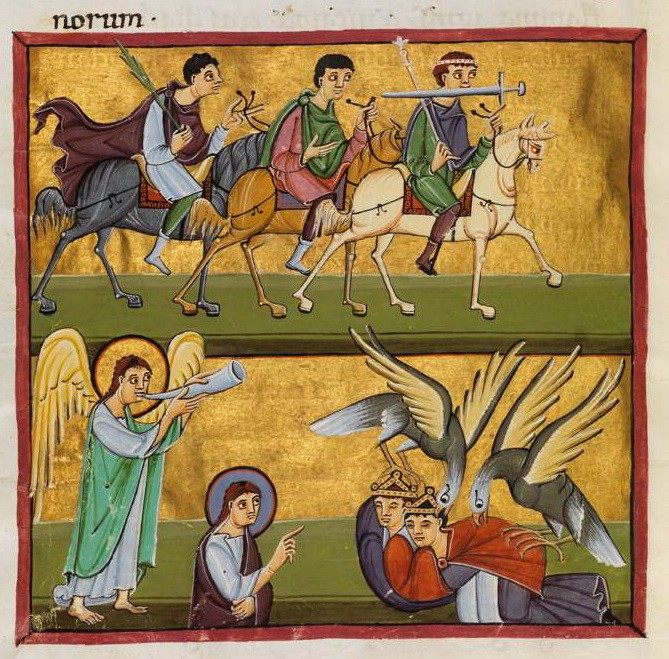
Heaven says Alleluia four times, a bride finishes getting ready, and then the sky opens and a rider comes out of it with a name on His thigh. This is the chapter the whole book has been walking toward.
A Bible study on Revelation 19 · Arthur Baldwin · StandUp4Jesus.Org · 14 min read
Table of Contents
Two chapters have just been spent on a city — her trade, her luxuries, her fall, and a call to God’s people to come out of her. Chapter 19 begins with the reaction in heaven, and the reaction is not sober satisfaction. It is a shout.
Four Times Alleluia
“And after these things I heard a great voice of much people in heaven, saying, Alleluia; Salvation, and glory, and honour, and power, unto the Lord our God:”
Revelation 19:1
The word Alleluia appears four times in this chapter and nowhere else in the New Testament. The whole Christian Bible saves it for one moment.
The word itself is two Hebrew words carried untranslated through Greek into English — praise Yah. It is how the Psalms end, one after another, and it is what a Jewish congregation had been saying for a thousand years before John heard it here. The oldest word of praise the people of God have arrives at the last possible moment, in the original language, and nobody bothers to translate it.
And what is being celebrated is stated carefully: “for true and righteous are his judgments” (Revelation 19:2). Not the suffering of anybody. The rightness of the verdict. Heaven is not cheering a punishment; it is relieved that the case has finally been heard, and heard properly, after all the centuries in which the blood of God’s servants had no answer.
That is the cry from under the altar in chapter 6 — How long, O Lord, holy and true, dost thou not judge? — receiving its reply thirteen chapters later. The martyrs were told to rest a little season. The little season ends here.
And the singing widens as it goes, the way it did in chapter 5. First much people in heaven; then the four and twenty elders and the four living creatures falling down with a single word, Amen; then a voice out of the throne itself telling every servant of God, small and great, to join in; and finally something John can only describe by piling up comparisons — “the voice of a great multitude, and as the voice of many waters, and as the voice of mighty thunderings” (Revelation 19:6). The whole room, and then the whole universe.
What that last voice says is the sentence the book has been holding back: “Alleluia: for the Lord God omnipotent reigneth.” Not will reign. The kingdoms of this world became the kingdoms of our Lord at the seventh trumpet; here creation finally says so out loud.
The Marriage Of The Lamb
“Let us be glad and rejoice, and give honour to him: for the marriage of the Lamb is come, and his wife hath made herself ready.”
Revelation 19:7
Two women have been walking through this book since chapter 12, and the contrast closes here. One was clothed with the sun; the other was decked with gold and precious stones and scarlet, and had just been stripped. Now the first one is dressed for a wedding.
“And to her was granted that she should be arrayed in fine linen, clean and white: for the fine linen is the righteousness of saints.”
Revelation 19:8
Hold verse 7 and verse 8 together, because they look like they disagree and do not. His wife hath made herself ready — she did something. To her was granted that she should be arrayed — the dress was given to her.
Both are true and the order settles it. Getting ready, for a bride, does not mean weaving the gown. It means being willing to wear it. The one thing Laodicea would not do was accept white raiment it had not made; this woman has.
The material is named too: fine linen, clean and white — the fabric priests wore in the sanctuary, and the same clothing the armies of heaven are wearing when they ride out a few verses later. Bride and army in the same cloth. Whatever is being described, it is one company.
Then a blessing dictated, the way one was dictated in chapter 14: “Write, Blessed are they which are called unto the marriage supper of the Lamb” (Revelation 19:9). Notice who is blessed. Not the bride — the guests. A wedding needs both, and the invitation list is where a reader is asked to find himself.
It is worth stopping on how ordinary the picture is. Of all the images available to describe the end of the great controversy — a coronation, a courtroom, a homecoming — the one chosen is a wedding, which is a party thrown by a family for two people who have waited a long time. That is the figure Jesus used repeatedly and the one Paul used of Christ and the church, and it is not decoration. It says what the relationship is.
See Thou Do It Not
“And I fell at his feet to worship him. And he said unto me, See thou do it not: I am thy fellowservant, and of thy brethren that have the testimony of Jesus: worship God: for the testimony of Jesus is the spirit of prophecy.”
Revelation 19:10
John — who has been in heaven since chapter 4, who watched the Lamb take the book and the seals come off — forgets himself and kneels to an angel. And he does it again in chapter 22, and is corrected the same way. The apostle who wrote the book is not immune to the mistake the book is about.
The correction is three words long and it is the whole issue of Revelation: worship God. Chapter 13 was a world persuaded to worship something else. Chapter 14 was an angel calling the planet back to the Creator. Here even a good angel, in a right cause, refuses the gesture.
It is a small scene and it does more work than it looks. Revelation has just spent six chapters on the danger of worshipping the wrong thing, and the example it finally gives of a good man getting it wrong is not an idolater at an altar. It is the apostle John, overwhelmed, kneeling to a messenger who had been kind to him. The mistake is that easy to make.
And then the definition that has mattered so much to this movement: the testimony of Jesus is the spirit of prophecy. It is the second of the two marks of the remnant in chapter 12, defined here by the book itself rather than by anybody’s argument.
And notice the angel’s own description of himself: “I am thy fellowservant, and of thy brethren that have the testimony of Jesus.” The being who has been showing John the future puts himself on the same footing as the people reading about it. There is no hierarchy in that room worth kneeling to.
Heaven Opened, And A White Horse
“And I saw heaven opened, and behold a white horse; and he that sat upon him was called Faithful and True, and in righteousness he doth judge and make war.”
Revelation 19:11
A door was opened in heaven in chapter 4 and a man was invited through it. Here heaven itself is opened, and what comes out is not an invitation.
The first seal in chapter 6 also opened on a white horse with a rider going out conquering. This study read that one as the gospel in its first purity, not as Christ — and the reason is visible here, in what this Rider carries that the other did not. That one had a bow and a single crown. This One has many crowns, a robe already dipped in blood, an army behind Him, and four names.
There is a further difference in what the two riders are given to do. The rider of the first seal went out conquering, and to conquer, and was handed a crown. This One comes to judge and make war, in righteousness, and the crowns He wears are already His. One is a message going out into the world; the other is the world’s owner coming back to it.
The armies are worth a sentence too. They follow Him on white horses clothed in fine linen, white and clean — dressed for a wedding rather than a war, carrying nothing. They are present at the battle and they take no part in it. Whatever happens on that field, it is not a fight anybody needs help with.
The names are worth listing, because together they are a portrait.
Faithful and True — the title the letter to Laodicea used, the faithful and true witness who told a comfortable church exactly what it was.
A name written, that no man knew, but he himself (verse 12). After all of this, something about Him is still unshared. The book that explains its own symbols leaves one name unread.
The Word of God (verse 13) — the name John used in the first sentence of his Gospel, arriving here on horseback.
“And he hath on his vesture and on his thigh a name written, KING OF KINGS, AND LORD OF LORDS.”
Revelation 19:16
The King James translators put that one in capitals, and they were right to. It is written where a rider’s sword-belt would be and where a banner would hang — the one place on a horseman that everybody on the field can read.
A Vesture Dipped In Blood
One detail decides how the whole scene reads. The robe is dipped in blood before the battle begins. Nothing has happened yet on this field; the armies of heaven behind Him are in fine linen, white and clean, and not one of them is armed.
So the blood is not from this war. He was wearing it when He arrived, and the only blood on Him that the rest of the book knows about is His own — the Lamb as it had been slain, standing in the middle of the throne since chapter 5.
And His weapon matches. “Out of his mouth goeth a sharp sword, that with it he should smite the nations” (Revelation 19:15). Not in His hand. Out of His mouth — which is where the two witnesses’ fire came from in chapter 11, and how the letter to Pergamos said He would fight. The battle at the end of the world is won by something said.
That is consistent with everything the book has shown about how God works. The seals were opened by a Lamb. The witnesses fought with fire out of their mouths. The saints overcame by the blood of the Lamb and the word of their testimony. At no point in Revelation does God’s side win by being better armed — and at the last battle, the only weapon in the picture is a word.
Two Suppers
The chapter puts two meals side by side, and the arrangement is deliberate.
In verse 9 there is the marriage supper of the Lamb, and a blessing on everybody invited. In verse 17 an angel standing in the sun calls the birds of heaven to “the supper of the great God” — and the menu is kings, captains, mighty men, and all men both free and bond.
Same word, two tables, and every human being ends up at one of them. That is as blunt as Revelation ever gets, and it is put in the plainest possible terms on purpose. The invitation in verse 9 is open right up until the moment the second table is laid.
And the birds are called by an angel standing in the sun — a detail that sounds decorative and is not. There is nowhere left to hide in a scene lit like that, which is the same point the sixth seal made when kings asked the rocks to fall on them. In this book, the end is not primarily destruction. It is visibility.
Notice also how the war ends. The beast and the false prophet are taken — no fight is described. The armies gathered against Him in verse 19 do not manage a single action in the narrative. Between the gathering in verse 19 and the taking in verse 20 there is no battle at all.
Joel had described the same gathering and the same anticlimax. The nations are summoned, told to beat their plowshares into swords, and brought down into the valley of decision — and what happens there is not a fight either: “The LORD also shall roar out of Zion, and utter his voice from Jerusalem” (Joel 3:16). One voice, and it is finished.
The false prophet is named here for the first time, and the description identifies him: the one “that wrought miracles before him, with which he deceived them that had received the mark of the beast” (Revelation 19:20). Those are the wonders of chapter 13 — the fire called down from heaven in the sight of men. The lamb-horned beast and the false prophet are the same power, described by what it did.
What This Asks Of Us
Revelation 19 is the chapter where the questions asked earlier get answered out loud.
The martyrs asked how long and were told to rest a little season; heaven now says the judgments are true and righteous. The churches were promised white raiment; the bride is wearing it. The world was told to worship a beast; the rider arrives with the answer written where everyone can read it.
And the two details that keep it from being merely triumphant are the ones easiest to miss. His robe was already bloody when He set out, and it was His own blood. And the invitation to the supper is still open on the page before the other supper is announced.
Next in this series: Satan Bound For One Thousand Years — a chain, a bottomless pit, and a thousand years with an empty earth.
