For most of the book, Babylon has been God’s instrument, “my servant” Nebuchadnezzar, the rod that punished Judah. Chapters 50 and 51, the longest prophecy in Jeremiah, turn the rod around. Babylon itself will fall: suddenly, at night, while its rulers feast, through the drying of its waters, at the hands of “the kings of the Medes.” The chapters end with a strange errand: a scroll tied to a stone and thrown into the Euphrates. Six hundred years later, the book of Revelation lifts whole sentences from these chapters to describe the fall of a greater Babylon at the end of time, and repeats their most urgent call: “Come out of her, my people.”
A study in Jeremiah 50-51 · Arthur Baldwin · StandUp4Jesus.Org · 14 min read
Babylon Is Taken, Bel Is Confounded
“Declare ye among the nations, and publish, and set up a standard; publish, and conceal not: say, Babylon is taken, Bel is confounded, Merodach is broken in pieces; her idols are confounded, her images are broken in pieces. For out of the north there cometh up a nation against her, which shall make her land desolate, and none shall dwell therein: they shall remove, they shall depart, both man and beast.”
Jeremiah 50:2, 3
When Jeremiah spoke these words, Babylon was at the height of its power. It had just crushed Egypt and was about to destroy Jerusalem. Its walls were among the wonders of the world. And Jeremiah announced its fall as if it had already happened: “Babylon is taken.” Bel and Merodach (Marduk), the chief gods of Babylon, would be “confounded,” put to shame. The gods who seemed to have defeated the God of Israel would themselves be broken.
Babylon had been used by God, but it had not served God. It was proud, cruel, and devoted to its idols, “for it is the land of graven images, and they are mad upon their idols” (50:38). The instrument of judgment would become the object of judgment.
They Shall Ask The Way To Zion
“In those days, and in that time, saith the LORD, the children of Israel shall come, they and the children of Judah together, going and weeping: they shall go, and seek the LORD their God. They shall ask the way to Zion with their faces thitherward, saying, Come, and let us join ourselves to the LORD in a perpetual covenant that shall not be forgotten.”
Jeremiah 50:4, 5
Babylon’s fall would mean freedom for God’s people. And look at how they would come home: “going and weeping,” seeking God, asking for directions to Zion “with their faces thitherward.” The two kingdoms, Israel and Judah, would come “together,” and they would join themselves to the LORD “in a perpetual covenant.” This is the new covenant of chapter 31, studied in I Will Write It In Their Hearts.
Then God describes His people as lost sheep, led astray by their shepherds, who “have forgotten their restingplace” (50:6). Their resting place was not a land. It was God Himself.
“In those days, and in that time, saith the LORD, the iniquity of Israel shall be sought for, and there shall be none; and the sins of Judah, and they shall not be found: for I will pardon them whom I reserve.”
Jeremiah 50:20
This is one of the most beautiful promises in the book. A search would be made for Israel’s sins, and none would be found. Not because there had not been any, but because God had pardoned them. The record would be clean. Ellen White joins this verse with the new covenant promise, “I will remember their sin no more” (31:34), as a picture of the final blotting out of the sins of God’s people (The Great Controversy, p. 485).
Their Redeemer Is Strong
“Thus saith the LORD of hosts; The children of Israel and the children of Judah were oppressed together: and all that took them captives held them fast; they refused to let them go. Their Redeemer is strong; the LORD of hosts is his name: he shall throughly plead their cause, that he may give rest to the land, and disquiet the inhabitants of Babylon.”
Jeremiah 50:33, 34
Babylon “refused to let them go,” just as Pharaoh once had. But “Their Redeemer is strong.” The Hebrew word is go’el, the kinsman-redeemer, the same idea we met in chapter 32: the near relative who buys back what was lost. Here, God Himself is the Redeemer, and He is stronger than any captor. He would “plead their cause” like a lawyer in court, and win.
How Babylon Fell
Jeremiah’s prophecy includes details of how Babylon would fall that history confirmed. The attackers would be “the kings of the Medes” (51:11, 28). Babylon’s great defence was its waters, the Euphrates flowing through the city and its moats. Yet God says, “A drought is upon her waters; and they shall be dried up” (50:38). Isaiah had foretold the same, naming the conqueror in advance: “That saith to the deep, Be dry, and I will dry up thy rivers: That saith of Cyrus, He is my shepherd” (Isaiah 44:27, 28).
“One post shall run to meet another, and one messenger to meet another, to shew the king of Babylon that his city is taken at one end, And that the passages are stopped, and the reeds they have burned with fire, and the men of war are affrighted.”
Jeremiah 51:31, 32
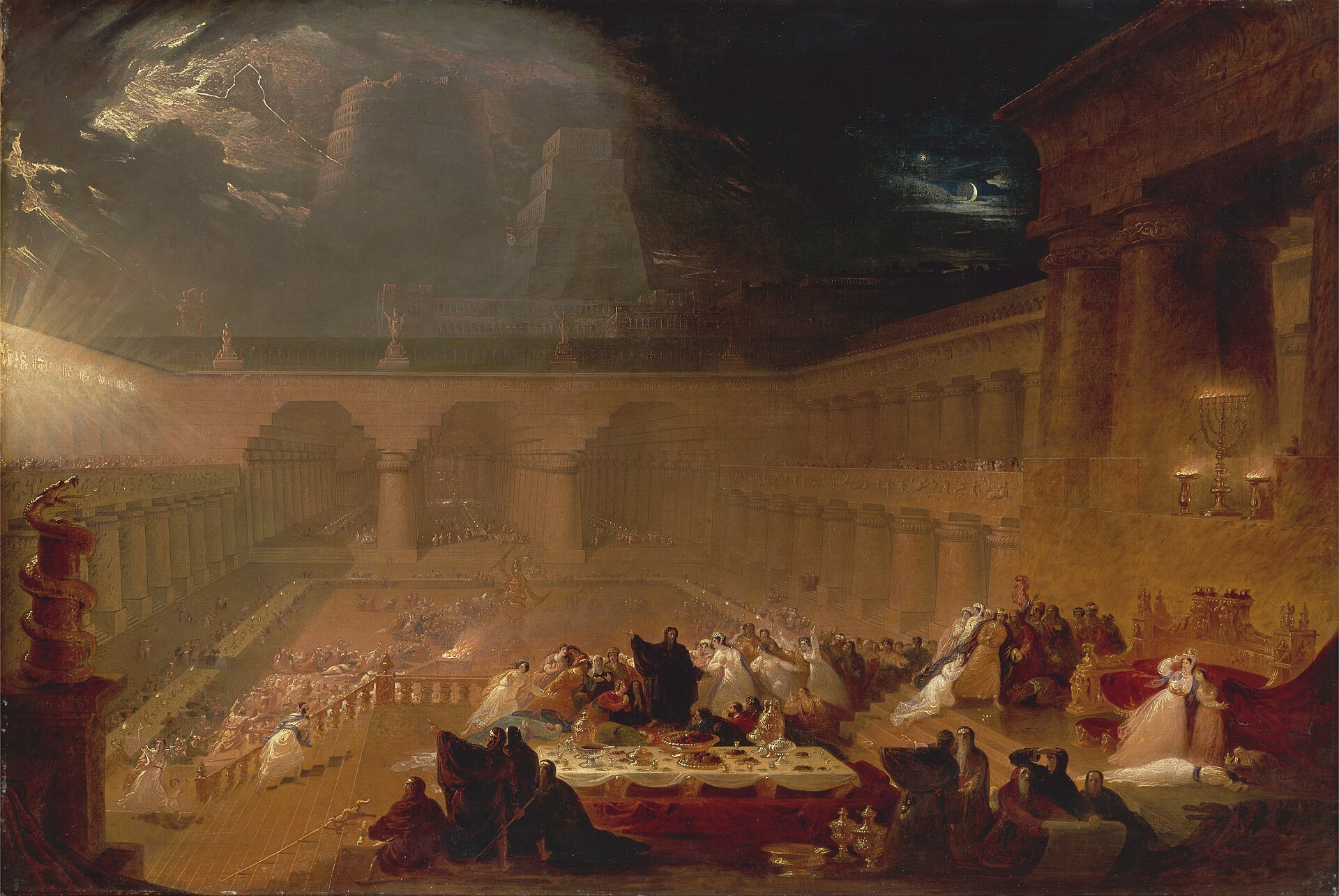
Ancient historians recorded that the army of Cyrus diverted the Euphrates and entered the city along the riverbed, and that much of Babylon did not realize the city had fallen until it was too late. Jeremiah pictures messengers running from one end of the huge city to the other to tell the king. And he adds another detail: “In their heat I will make their feasts, and I will make them drunken, that they may rejoice, and sleep a perpetual sleep, and not wake” (51:39). On the night Babylon fell, King Belshazzar was holding a great feast, drinking from the vessels taken from God’s temple in Jerusalem. “In that night was Belshazzar the king of the Chaldeans slain” (Daniel 5:30).
“Even while he and his nobles were drinking from the sacred vessels of Jehovah, and praising their gods of silver and of gold, the Medes and the Persians, having turned the Euphrates out of its channel, were marching into the heart of the unguarded city.”
Ellen G. White · Prophets and Kings, p. 531
A Golden Cup In The LORD’s Hand
“Flee out of the midst of Babylon, and deliver every man his soul: be not cut off in her iniquity; for this is the time of the LORD’s vengeance; he will render unto her a recompence. Babylon hath been a golden cup in the LORD’s hand, that made all the earth drunken: the nations have drunken of her wine; therefore the nations are mad. Babylon is suddenly fallen and destroyed: howl for her; take balm for her pain, if so be she may be healed.”
Jeremiah 51:6-8
Babylon was “a golden cup.” Beautiful, rich and attractive on the outside, and full of a wine that made the nations drunk. Its wealth, its religion and its power intoxicated the world. And “Babylon is suddenly fallen.”
Now read Revelation. “Babylon is fallen, is fallen, that great city, because she made all nations drink of the wine of the wrath of her fornication” (Revelation 14:8). The woman called Babylon has “a golden cup in her hand full of abominations” (Revelation 17:4). She “sitteth upon many waters” (Revelation 17:1), just as Jeremiah said to ancient Babylon, “O thou that dwellest upon many waters” (51:13). And the sixth plague falls on “the great river Euphrates; and the water thereof was dried up” (Revelation 16:12), as Babylon’s waters were dried up for Cyrus.
Revelation is telling us to read the end of the world through the lens of Jeremiah 50 and 51. Ancient Babylon was a real city that oppressed God’s people and fell. End-time “Babylon” is the great system of false religion that unites with worldly power against God’s truth and God’s people. It will fall just as suddenly. The study of Revelation on the Bible Prophecies page explores this in more depth.
My People, Go Ye Out
“My people, go ye out of the midst of her, and deliver ye every man his soul from the fierce anger of the LORD.”
Jeremiah 51:45
Three times in these chapters, God calls His people to leave Babylon (50:8; 51:6, 45). In chapter 29, the exiles were told to settle there and seek its peace for seventy years. That was for a season. When the time came, they were not to stay out of comfort or habit. They were to go home.
Revelation repeats the call almost word for word: “And I heard another voice from heaven, saying, Come out of her, my people, that ye be not partakers of her sins, and that ye receive not of her plagues” (Revelation 18:4). Notice that God calls them “my people.” He has faithful children inside Babylon, people who love Him and simply have not yet heard the call.
“As the captive exiles heeded the message, ‘Flee out of the midst of Babylon’ (Jeremiah 51:6), and were restored to the Land of Promise, so those who fear God today are heeding the message to withdraw from spiritual Babylon, and soon they are to stand as trophies of divine grace in the earth made new, the heavenly Canaan.”
Ellen G. White · Prophets and Kings, p. 715
This call is not a call to condemn people. It is a call to rescue them. Ellen White is careful to say that most of Christ’s true followers are still to be found in the churches that make up Babylon today.
“Notwithstanding the spiritual darkness and alienation from God that exist in the churches which constitute Babylon, the great body of Christ’s true followers are still to be found in their communion. There are many of these who have never seen the special truths for this time.”
Ellen G. White · The Great Controversy, p. 390
Thus Shall Babylon Sink
“And it shall be, when thou hast made an end of reading this book, that thou shalt bind a stone to it, and cast it into the midst of Euphrates: And thou shalt say, Thus shall Babylon sink, and shall not rise from the evil that I will bring upon her: and they shall be weary. Thus far are the words of Jeremiah.”
Jeremiah 51:63, 64
The chapters end with an acted parable. In the fourth year of Zedekiah, the king travelled to Babylon, and with him went Seraiah, the brother of Baruch (51:59). Jeremiah gave Seraiah a scroll with these prophecies against Babylon. When he reached the city, he was to read it aloud, tie a stone to it, and throw it into the Euphrates. “Thus shall Babylon sink, and shall not rise.”
Revelation closes its lament over Babylon with the same picture, made larger: “And a mighty angel took up a stone like a great millstone, and cast it into the sea, saying, Thus with violence shall that great city Babylon be thrown down, and shall be found no more at all” (Revelation 18:21). A scroll and a stone in a river; a millstone in the sea. The message is the same. Every power that sets itself against God and His people will go down and not rise again.
“Thus far are the words of Jeremiah.” The prophet’s own message ends here, with Babylon’s fall and God’s people going home. It is fitting that the last words of the weeping prophet are not about Jerusalem’s ruin but about the fall of its oppressor. Judgment was real, but it was not the end. “Their Redeemer is strong.”